Entity · Concept
Baal Cycle
A reference page linking a name, group, or concept to the materials that discuss it.
- Timeline
- From 1400 BCE to 1200 BCE
A group of Late Bronze Age Ugaritic religious texts recounting Baal’s conflicts, relationships with the gods and the building of his palace.
Reading path
Links recorded in this entry.
Periods
When does it appear?
- From 1400 BCE to 1200 BCE
Dates
Dates have distinct roles. The timeline uses creation, composition or historical coverage, rather than publication or discovery dates.
- Historical coverage
- Approximately From 1400 BCE to 1200 BCE
Text
Corpus and witness
The BaalBaalStorm god and protagonist of Ugarit’s Baal Cycle; exercises active kingship while El retains importance and authorizes the palace.Glossary · Click to read the explanation Cycle is a group of religious texts written in UgariticUgaritic languageAncient Semitic language preserved in Ugarit’s tablets on the Syrian coast, from the fourteenth–twelfth centuries BCE, written in a cuneiform alphabet.Glossary · Click to read the explanation on tablets from UgaritUgaritAncient city and kingdom at Ras Shamra on the Syrian coast, flourishing between the fourteenth and early twelfth centuries BCE and preserving multilingual archives.Glossary · Click to read the explanation, the ancient city at Ras Shamra on the Syrian coast. Its witnesses belong to the Late Bronze AgeLate Bronze AgeAn archaeological period conventionally around 1600–1200 BCE in much of the Near East, with regional variation.Glossary · Click to read the explanation, within archives extending from the late fourteenth to the early twelfth century BCE. The texts recount BaalBaalStorm god and protagonist of Ugarit’s Baal Cycle; exercises active kingship while El retains importance and authorizes the palace.Glossary · Click to read the explanation’s conflicts, relationships with the gods and kingship. [1]
An important episode is Baal’s request to ElEl at UgaritA deity prominent in West Semitic traditions, especially as head of the divine family in Ugaritic texts.Glossary · Click to read the explanation, head of the divine family, for permission to build his palace. The request and construction are read in the tablets identified as KTUKTU: Ugaritic Text ReferencesAbbreviation for a modern scholarly corpus of alphabetic cuneiform texts; its numbers are references, not dates.Glossary · Click to read the explanation 1.3–1.4. Codes such as KTU identify texts in a scholarly catalogue, helping locate a passage when translations differ or a tablet has gaps. [2][3]
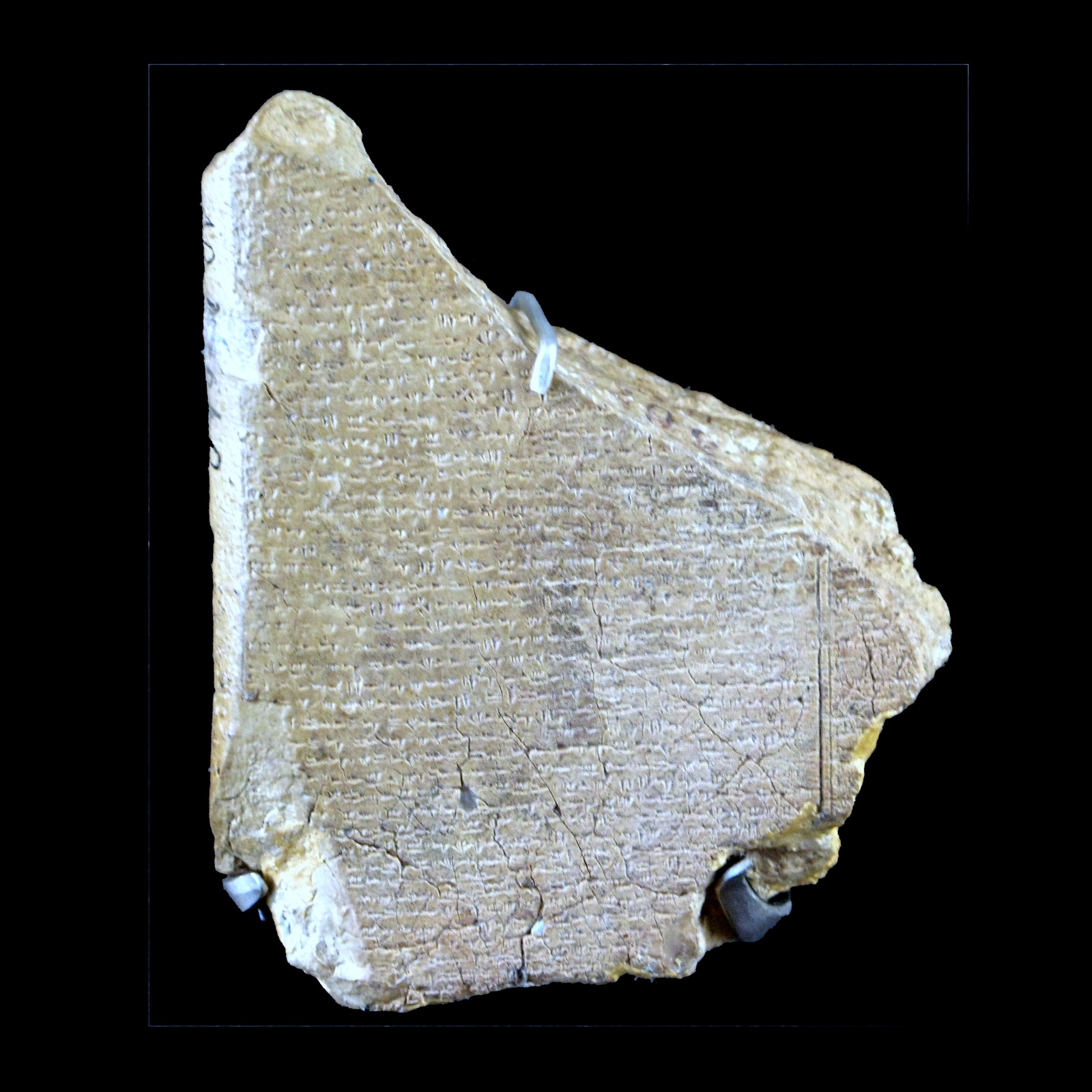
The photograph shows another tablet from the group, held in the Louvre as AO 16640 and associated with KTU 1.2. It presents a written witness from about 1400–1200 BCE; the palace passages are followed in their specified tablets. These accounts are studied as religious literature about gods, authority and relationships, alongside their historical setting. [4]
References and notes
- Nicolas Wyatt (2007). Religion in ancient Ugarit. In A Handbook of Ancient Religions, ed. John R. Hinnells, pp. 105–160. doi:10.1017/CBO9780511488429.004. Publisher summary: Ras Shamra, excavation from 1929, archive from late fourteenth century to first decade of twelfth century BCE. Print 2007; online 2012. Summary and metadata read, not the full chapter. Return to the text ↑
- Jeffery B. Lloyd (1994). The Goddess Anat: An Examination of the Textual and Iconographic Evidence from the Second Millennium B.C. PhD thesis, University of Edinburgh. Pp. 182–185: KTU 1.3 V, gray-hair threat, wisdom and El’s fatherhood, textual gaps and debate over El’s decline. P. 192: Athirat’s intercession and successful palace request. P. 184 visually checked. Thesis not read in full; restorations retained as restorations. Return to the text ↑
- Mark S. Smith & Wayne T. Pitard (2009). The Ugaritic Baal Cycle, Volume II: Introduction with Text, Translation and Commentary of KTU/CAT 1.3–1.4. Brill. doi:10.1163/ej.9789004153486.i-864. University abstract: Baal obtains El’s permission to build the palace and constructs it in KTU 1.3–1.4. Volume metadata and abstract only; full 864-page commentary not read. Return to the text ↑
- Musée du Louvre. Tablette AO 16640 / RS 3.367: cycle mythologique de Baal, KTU 1.2. Object record: clay, Ugarit, 1400–1200 BCE. KTU 1.2 identification retained; palace authorization in KTU 1.4 not assigned to it. Rama photograph under CC BY-SA 2.0 FR; no claim to have read the tablet from the photograph. Return to the text ↑
Research history
Substantive changes are retained here. Minor copy edits remain in the internal operational log.
-
Substantive record update
-
Substantive record update
-
Substantive record update
Suggest a correction · Suggest a source for this record
Cite this record
IL Archive, «Baal Cycle», Edition 4, https://ilarchive.com/en/entities/baal-cycle