Artifact · Inscription
The Metternich Stela
An object record bringing together its image, metadata, rights, and context.
- Names
- Cippus of Horus (Met 50.85) · Magical Stela with Horus the Child · Metternich Stele
- Timeline
- From 360 BCE to 343 BCE
- Region
- Egypt
An Egyptian stone of about 360–343 BCE, now in New York. The child Horus stands on crocodiles, and about 250 lines of spells protect against snakes and scorpions, including the story of Isis and the seven scorpions.
Estimated reading time: 6 min Published Last reviewed:
Share article
Photograph
Photo: The Metropolitan Museum of Art, Fletcher Fund, 1950 (50.85), CC0 1.0, via Wikimedia Commons.
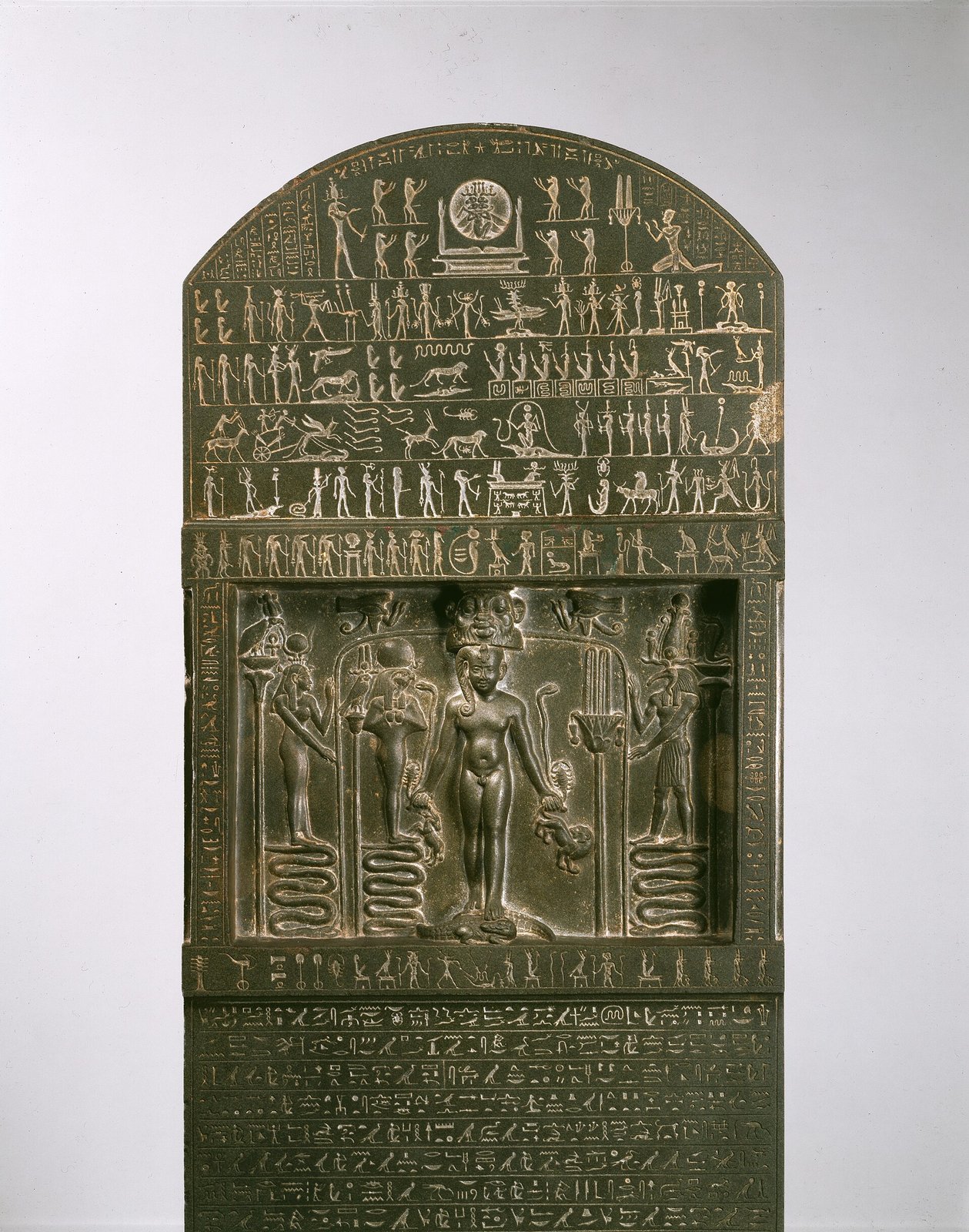
The upper part of the front of the Metternich Stela: the child Horus stands on two crocodiles and holds snakes, scorpions, a lion and an oryx, with the face of Bes above him. Egypt, reign of Nectanebo II, 360–343 BCE. Metropolitan Museum of Art, 50.85
License · Image sourceObject details
- Title
- The Metternich Stela
- Timeline
- From 360 BCE to 343 BCE
- Region
- Egypt
- Rights
- CC0
Text
Introduction
The Metternich Stela is a dark stone slab, a little over 80 centimetres tall, carved on every side with pictures and hieroglyphs. Egyptologists call this kind of object a cippus of Horus: a small stela showing the god HorusHorusEgyptian god associated with kingship and the sky, also appearing as the child protected by his mother Isis in marsh and nursing traditions.Glossary · Click to read the explanation as a child, standing on crocodiles and gripping dangerous animals. Its texts are spells against snakes, scorpions and other creatures that bite or sting. The cartouches, the oval rings that hold a king's name, give the reign of Nectanebo II of the Thirtieth Dynasty, and the Metropolitan Museum of Art in New YorkNew York CityNew York City is in the United States and houses the Metropolitan Museum of ArtGlossary · Click to read the explanation (accession number 50.85) dates it to 360–343 BCE. [1][2]
Budge called it the largest and most important of all the cippi. One of its spells tells how the goddess Isis, travelling with seven scorpions, healed a child stung by one of them. This entry describes the object and its texts, and marks where scholars still disagree. [2][3][4]
The object and its pictures
The stela is cut from one piece of metagreywacke, a hard dark stone, and stands on a low base. Together they are 83.5 cm high and 33.5 cm wide, and weigh about 52 kg. [1][2]
In a deep panel on the front, the child Horus stands naked, with the side-lock of hair that Egyptian art gives to children. He stands on two crocodiles and holds snakes, scorpions, a lion and an oryx, a desert antelope with long horns. Above his head is the face of Bes, a protective household god, and figures of ThothThothThoth is an Egyptian god of knowledge and writing, also associated with recording funerary judgment.Glossary · Click to read the explanation and Isis stand at the sides. Above the panel, the sun disk holds a god with four rams' heads, with rows of small gods below. Budge counted nearly three hundred divine figures on the whole stela. [2][4][5]
About 250 lines of spells
Vladimir Golenischeff, who first published the stela in 1877, numbered its lines and divided the text into spells; later editors kept his numbering. C. E. Sander-Hansen, in his 1956 edition, counted fourteen spells. He argued that they were meant to be read front, base, left side, right side and back, so that the text ends with the dedication in lines 87–88. [2][3]
One spell drives off Apophis, the great serpent who in Egyptian belief is the enemy of the sun god ReRe, Egyptian sun godRe is the Egyptian sun god, associated with creation, life and renewal of cosmic orderGlossary · Click to read the explanation. Another heals a bitten cat: each part of its body is identified with a god, so that the poison finds no place to stay. Others guard against creatures in the water, or ask Horus to keep away lions, snakes and crocodiles. A long spell on the base tells how Horus himself was stung in the marshes while his mother was away. When Isis cried out, the boat of the sun stopped in the sky, and Thoth came down from it to heal the child. [2][3][4]
Isis and the seven scorpions
This spell is on the back, in lines 48–71, and Isis tells it in her own voice. She has escaped from the house where Seth, the murderer of OsirisOsirisOsiris was an ancient Egyptian deity associated with the dead, life after death, renewal, and kingship. His roles appear in changing funerary texts, rituals, and judgment scenes, notably the weighing of the heart.Glossary · Click to read the explanation, had shut her in, and Thoth has advised her to hide with her young son. Seven scorpions guard her on the road: Tefen and Befen behind her, Mestet and Mestetef under her carrying chair, and Petet, Tjetet and Matet clearing the way. [2][3]
On the edge of the Delta, a rich lady sees her coming and shuts her door, afraid of the scorpions. A poor girl of the marshes opens her door instead. The scorpions put all their poison on Tefen's sting, and Tefen creeps under the lady's door and stings her son. The lady runs through the town crying, but no one answers. Isis pities the innocent child, lays her hands on him and orders the poison of each scorpion, by name, to leave his body: [2][3]
Line 58, after the German translation of Sander-Hansen. [3]
The child lives, and the lady brings her goods to Isis and to the girl. The spell then names simple remedies, among them bread of emmer wheat and onion or garlic, and ends with the wish that the child may live and the poison die. The story works as a precedent: the healer recited what Isis once did, so that the same cure would work on the person in front of him. Sander-Hansen saw here a joining of magic and medicine, as in Egyptian medical handbooks. He also thought the lines promising the recovery of Horus were added later, because the stung child in the story is not Horus. [2][3]
The seven scorpions can be compared with other Egyptian groups of seven, such as the Seven Hathors.
The dedication and the open questions
In the newest translation, by Peter Dils for the Leipzig project Science in Ancient Egypt, lines 87–88 name a priest, Nesatum, son of Ankh-Psamtik and the lady Tanethutnebu. He found the writing removed from the temple of Osiris-Mnevis and renewed it, to give breath to anyone who cannot breathe, and Osiris-Mnevis rewarded him with a long life and a good burial. [2]
Editors read these lines differently. Budge took Ankh-Psamtik to be the man for whom the stela was made, and Sander-Hansen read Nesatum as a woman, a priestess. Dils notes that the story of finding an old book may be a way of giving the text authority. [2][3][4]
Older books, including Budge's, dated the stela to Nectanebo I; the museum and the Leipzig edition read the cartouches as those of Nectanebo II. Its first home is also uncertain. Because of Osiris-Mnevis, the sacred bull of HeliopolisHeliopolis, ancient IunuHeliopolis is the Greek name of Egyptian Iunu, at Matariya in northern present-day CairoGlossary · Click to read the explanation, the museum places it probably in the temple of the Mnevis bulls there, but this is not proven. [1][2][4]
For cippi in general, scholars describe water being poured over the carved spells so that it took on their power, and then drunk by the person who had been stung. Small cippi were kept at home or carried; large, fine ones like this belonged to temples and the elite. The Metternich Stela itself gives no instructions for using water. [2][5]
From Alexandria to New York
The stela was dug up at AlexandriaAlexandria (Egypt)Alexandria is a city on Egypt’s Mediterranean coast, founded by Alexander the Great in 331 BCE and an important center of trade and culture.Glossary · Click to read the explanation. Budge reports that it came to light in 1828, while a cistern was being built in a Franciscan monastery. Muhammad Ali, the ruler of Egypt, gave it to the Austrian chancellor Prince Metternich, whose family kept it at their castle of Königswart, now Lázně Kynžvart in the Czech Republic. They sold it after the First World War, and the Metropolitan Museum bought it in 1950. [1][2][4]
Quick answers
Where is the story of Isis and the seven scorpions?
On the back of the stela, in lines 48–71, in a spell for someone stung by a scorpion. [2][3]
References and notes (5)
- The Metropolitan Museum of Art, “Magical Stela with Horus the Child (Cippus of Horus; Metternich),” accession number 50.85, collection record Object record, read through the Met Open Access collection data (object 546037): Late Period, Dynasty 30, reign of Nectanebo II, 360–343 BCE; metagraywacke; H. 83.5 × W. 33.5 × D. 14.4 cm, 52.6 kg; probably originally from Heliopolis, temple of the Mnevis bulls; Fletcher Fund, 1950; public domain. Findspot Alexandria as given in the Met data copied to Wikimedia Commons. Return to the text ↑
- Peter Dils, “Metternichstele,” digital edition with translation and commentary, Science in Ancient Egypt (Sächsische Akademie der Wissenschaften zu Leipzig) Introduction (object, date by cartouches, find in Alexandria, Heliopolis as probable origin, chain of ownership 1828–1950, editions, spell order) and translation with notes of spell 6 (back, lines 48–71), the base spell (lines 168–251) and the colophon (lines 87–88). Return to the text ↑
- C. E. Sander-Hansen, Die Texte der Metternichstele (Analecta Aegyptiaca 7), Copenhagen: Munksgaard, 1956 Preface and introduction (literature, line numbering and reading order, contents of spells I–X), and the translation of lines 48–66 and 86–88. Return to the text ↑
- E. A. Wallis Budge, Legends of the Gods: The Egyptian Texts, Edited with Translations, London: Kegan Paul, 1912 Introduction, section on the Metternich Stele (with plates XVII–XVIII): the cippi of Horus, the find of 1828, the colophon footnote, the figures on the stela and the summary of its spells. Return to the text ↑
- Giulia Tonon, “Horus Cippi,” blog of the Department of Archaeology, Classics and Egyptology, University of Liverpool, 6 July 2022 Whole post: iconography of Horus the Child, small and large cippi, the use of water poured over the stelae, practical treatments, links to Shed stelae. Return to the text ↑
Archive records may be reviewed and refined as better evidence or sources become available. Suggest a correction
Suggest a correction · Suggest a source for this record
Cite this record
IL Archive, «The Metternich Stela», https://ilarchive.com/en/artifacts/metternich-stela
Continue reading
Related readings