Entity
Isis
A reference page linking a name, group, or concept to the materials that discuss it.
- Names
- Aset · Iset · Isis
- Timeline
- From 2353 BCE to 457 CE
- Region
- Egypt
An Egyptian goddess, sister and wife of Osiris and mother of Horus. Texts from the pyramids to Roman times show her as mourner, healer, protector of children and model of royal motherhood.
Estimated reading time: 6 min Published Last reviewed:
Share article
Text
Introduction
Isis is one of the best documented goddesses of ancient Egypt. In Egyptian texts she is the sister and wife of OsirisOsirisOsiris was an ancient Egyptian deity associated with the dead, life after death, renewal, and kingship. His roles appear in changing funerary texts, rituals, and judgment scenes, notably the weighing of the heart.Glossary · Click to read the explanation, the god who was killed and lives on as ruler of the dead, and the mother of HorusHorusEgyptian god associated with kingship and the sky, also appearing as the child protected by his mother Isis in marsh and nursing traditions.Glossary · Click to read the explanation, the god who stands for the living king. She appears in the oldest religious texts of Egypt, carved inside royal pyramids in the 24th century BCE, and her temples were still in use more than 2,500 years later, under Roman rule. [1][6]
Her roles change from one kind of source to another: mourner of the dead, healer of a poisoned child, and, for Greek and Latin writers, a goddess of the whole world. This entry sets out what each source says, and where scholars still disagree. [1][2][5][8]
Name and image
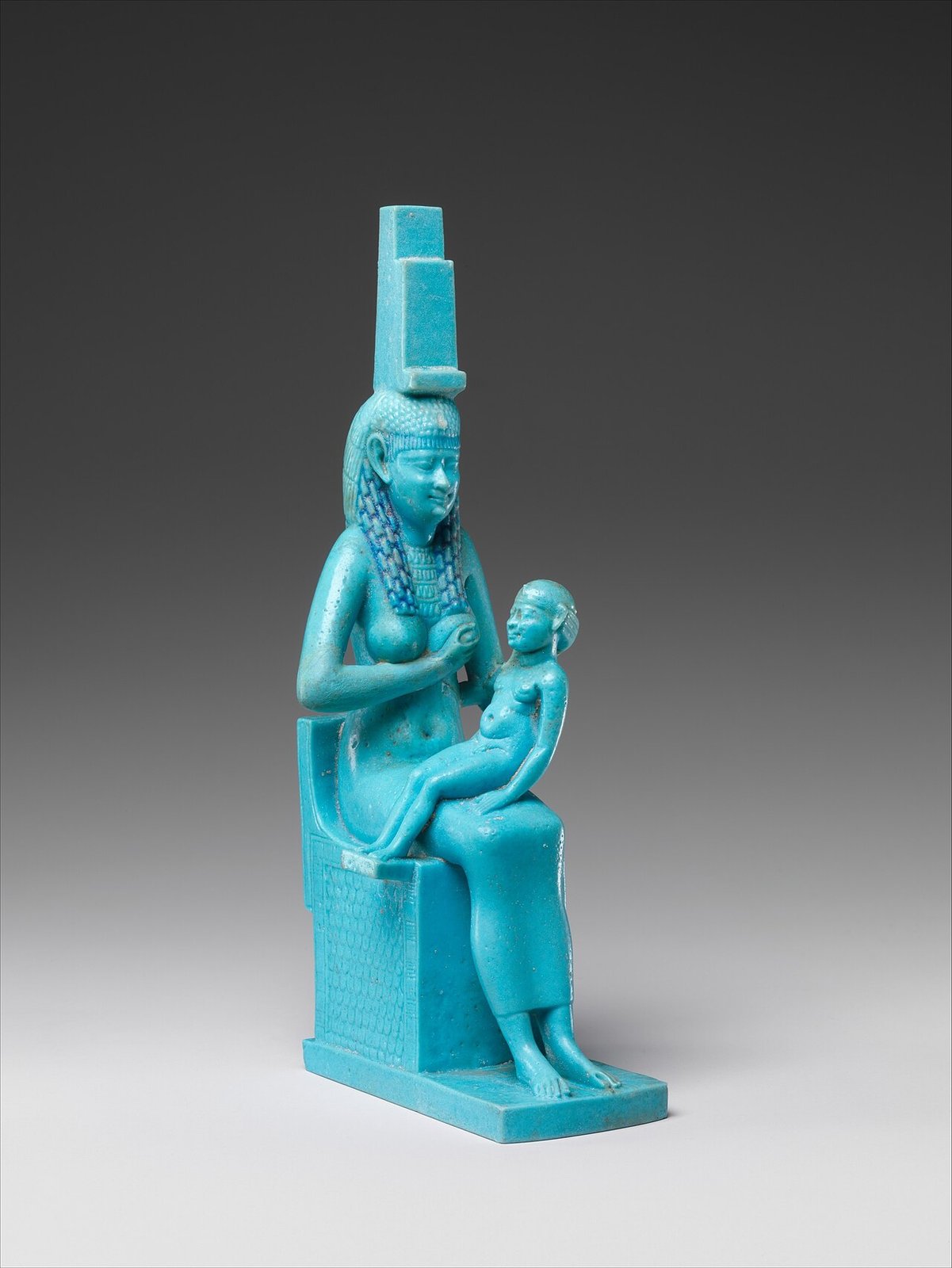
Her Egyptian name is usually written Aset or Iset by modern scholars; "Isis" is the Greek form. The name is spelled with the sign of a seat or throne, and in many images she wears that sign on her head, as on the faience figure in the picture. The Egyptologist James P. AllenJames P. AllenEgyptologist and Brown professor emeritus, studying ancient Egyptian language, literature and religion, including the Pyramid Texts.Glossary · Click to read the explanation describes her as the female principle of life and motherhood, daughter of the earth god Geb and the sky goddess Nut, and "also identified with the king's throne". Put simply: as a child sits on its mother's lap, the king sat on his throne, so the throne could be pictured as his mother. What the name meant at first is still debated. [1][9]
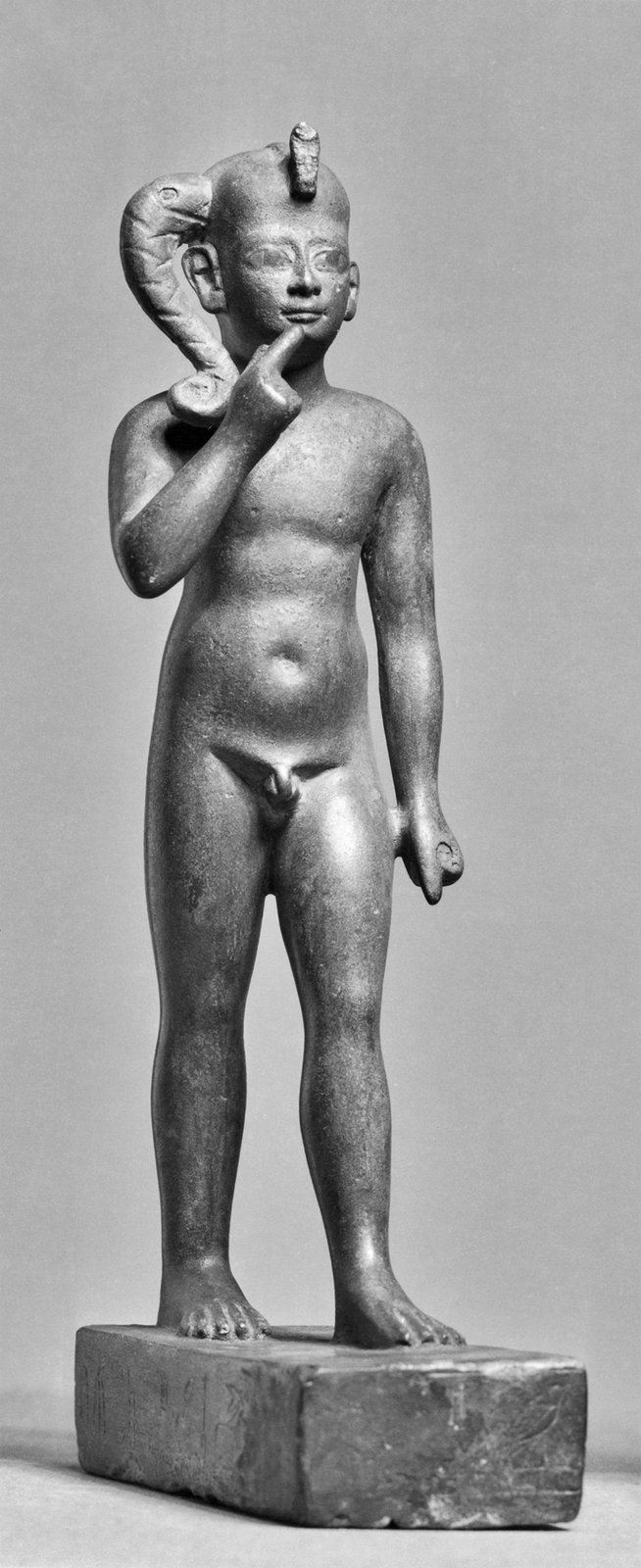
Small figures of Isis seated with the child Horus on her lap, often nursing him, were made in great numbers in the Late and Ptolemaic periods (7th to 1st centuries BCE), in faience and in bronze. They show her as the mother who feeds and shields the young king. [9]
Mourner and protector in the Pyramid Texts
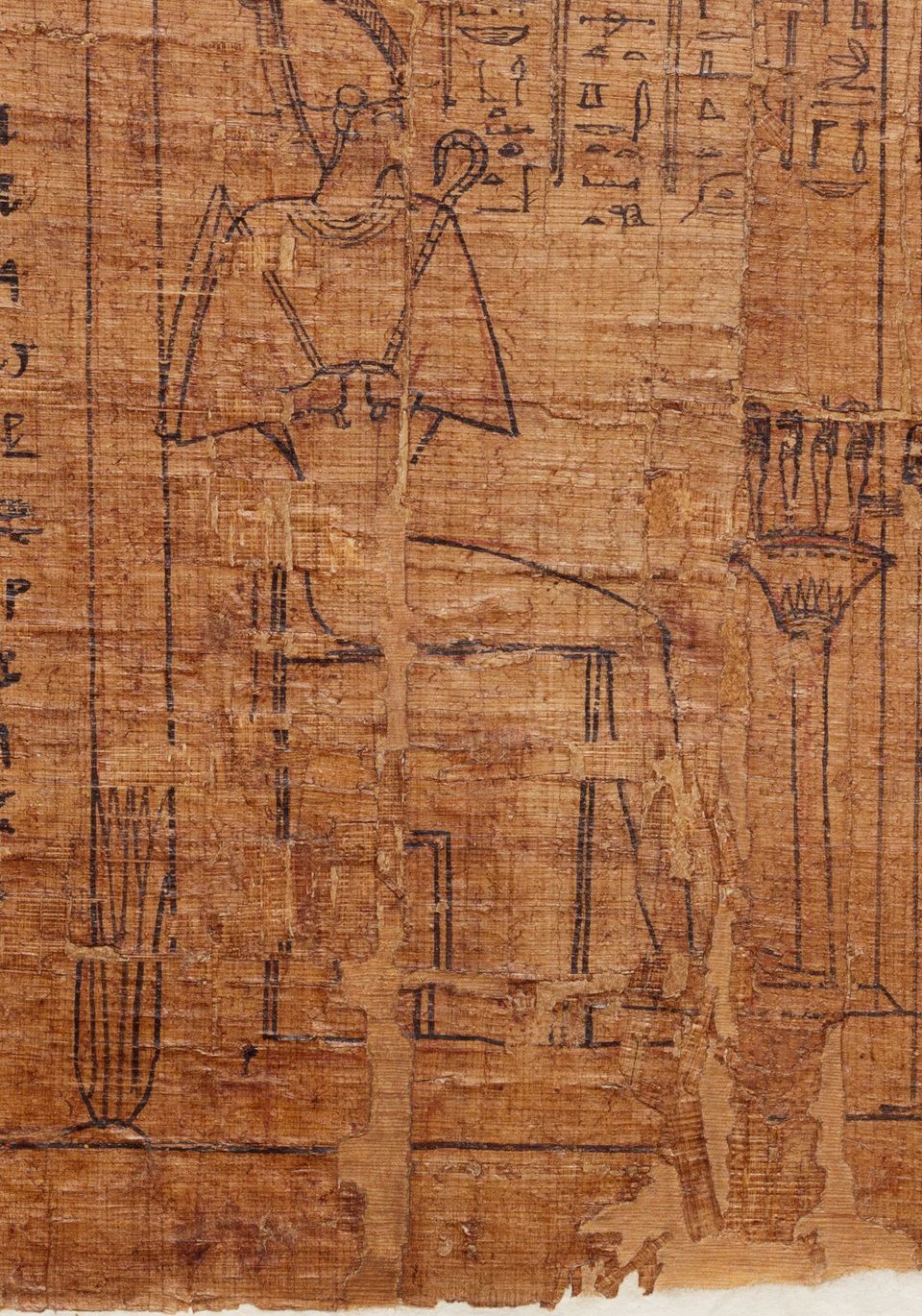
The Pyramid Texts are spells carved in the burial chambers of kings and queens, beginning with the pyramid of UnisUnasUnas was the last king of Egypt’s Fifth Dynasty, in the late third millennium BCEGlossary · Click to read the explanation (about 2353–2323 BCE). In them the dead king is joined with Osiris, and Isis and her sister Nephthys come to care for him. [1]
Pyramid Text 532 says that the two sisters came "one of them from the west, one of them from the east", as two birds of prey, and "found Osiris after his brother Seth threw him down". They keep the body from decay, so that the dead can rise again. In Pyramid Text 535 the goddesses are told to weep for their brother, and Pyramid Text 366 says that Isis came to the dead Osiris and conceived Horus from him. [1]
These are short ritualRitualAn organised or distinguished practice meaningful to a community; it may leave traces, but its form alone does not reveal an associated doctrine.Glossary · Click to read the explanation texts recited for the dead, not one continuous story; they refer to a story the hearers already knew. [1]
Healer of children
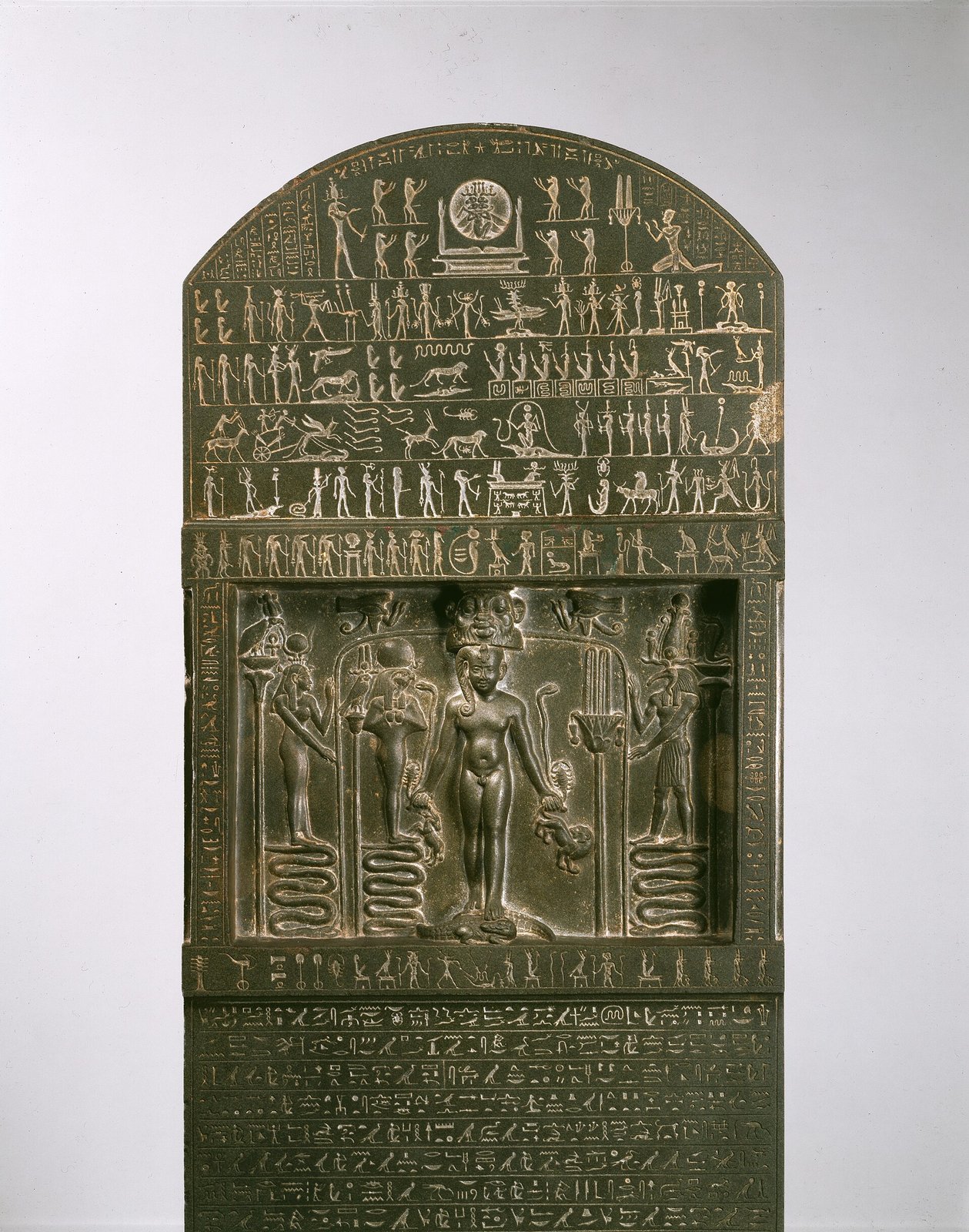
Other sources show Isis using heka, the Egyptian word for the power of effective words, to heal. The best known is the Metternich Stela in the Metropolitan Museum of Art (50.85), a stone slab of the reign of Nectanebo II (360–343 BCE) covered with fourteen spells against snakes, scorpions and other dangerous animals. [2][3]
In spell 6, Isis speaks in her own voice. On the advice of ThothThothThoth is an Egyptian god of knowledge and writing, also associated with recording funerary judgment.Glossary · Click to read the explanation, the god of writing, she flees with the infant Horus, guarded by seven scorpions. A rich woman shuts her door on her; a poor woman takes her in. One scorpion slips under the rich woman's door and stings her son, and Isis, moved by pity, drives out the poison with her words. In spell 14 Isis finds Horus himself stung in the marshes of Chemmis, in the Nile Delta. Her cries stop the sun until RaRe, Egyptian sun godRe is the Egyptian sun god, associated with creation, life and renewal of cosmic orderGlossary · Click to read the explanation sends Thoth down to heal the child. The spells end by promising that whoever is stung will be healed as Horus was: the story is told so that its healing can be repeated for a real patient. [2]
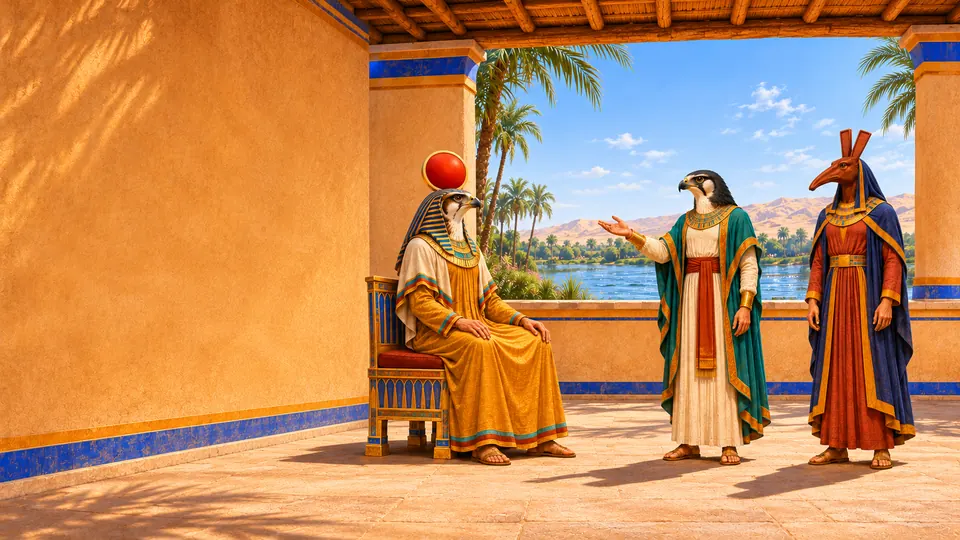
A papyrus in the Museo Egizio in Turin (Cat. 1993), copied about 1190–1077 BCE, tells how Isis shaped a snake from the spittle of the sun god Ra. The snake bit him, and only she could cure him, in exchange for his secret name. Ra agreed on condition that she share it only with Horus. This story, too, belongs to a spell against poison. [4]
Plutarch's connected story
The best known version of the whole story is Greek. In On Isis and Osiris, written around 100 CE, Plutarch tells how Seth (whom he calls TyphonTyphon / TyphoeusTyphon (Typhoeus), a serpentine adversary of Zeus in Greek myth; his defeat and punishment vary across Hesiod, Pindar, and the later Library.Glossary · Click to read the explanation) shut Osiris in a chest and threw it into the Nile. Isis searched everywhere and found the chest at ByblosByblos / JbeilByblos, or Jbeil, is a coastal city in Lebanon north of Beirut.Glossary · Click to read the explanation, on the coast of today's Lebanon, enclosed in a tree trunk that served as a pillar in the king's palace, and brought it home. Seth found it again and cut the body into fourteen pieces, and Isis searched for them in a papyrus boat; this, Plutarch says, is why Egypt had many "tombs of Osiris". [5]
Plutarch joins episodes that Egyptian sources only mention in passing, but he also adds Greek explanations of his own, giving the gods Greek names and explaining Egyptian words through Greek ones. He is read as a witness to how a Greek author of his time understood Egypt, not as a copy of one Egyptian original. [5]
Philae and the end of the temple cult
Isis had temples across Egypt. The most famous stands on the island of Philae near Aswan, at Egypt's southern border. Egypt's Ministry of Tourism and Antiquities says that the main temple was begun by Ptolemy IIPtolemy II PhiladelphusPtolemaic ruler of Egypt (sole reign c. 282–246 BCE), linked to Alexandrian cultural patronage and, in the later Letter of Aristeas, the Greek Torah translation; the particulars of royal commissioning remain independently unverified.Glossary · Click to read the explanation (285–246 BCE) and enlarged under Roman emperors, and that a priest of Isis carved there the last dated inscription in Egyptian hieroglyphs, in 394 CE. In the 20th century, when the waters of the Aswan dams threatened the island, the monuments were rebuilt on the nearby island of Agilkia. [6][7]
How the cult ended is debated. The Greek historian Procopius says that the emperor Justinian had the temples of Philae destroyed in the 530s CE, and the Ministry follows this traditional account. Jitse Dijkstra, after studying the island's inscriptions, argues that the cult was already fading on its own: the last dated inscription of the old cult is from 456 or 457 CE, Christians and worshippers of the old gods lived side by side for a long time, and the temples themselves survived. [6][7]
Isis beyond Egypt
Under the Ptolemaic dynastyPtolemaic dynasty in EgyptDynasty of Macedonian origin ruling Egypt as kings from 305 to 30 BCE, amid Greek and Egyptian traditions.Glossary · Click to read the explanation and then under Rome, the worship of Isis spread across the Mediterranean, with temples in Greece and in Rome itself. Its local forms differed, and a direct line from a particular Egyptian rite to a particular rite abroad has to be shown with local evidence, not assumed. [8]
The Latin novel The Golden Ass, written by Apuleius in the 2nd century CE, ends with a vision of Isis. She says that Phrygians, Athenians, Cypriots, Cretans and others honour her under many names, but the Egyptians call her by her true name, Isis. The hero is then initiated into her rites but will not describe them. It is fiction, yet it shows how one Roman author saw her: as one goddess behind many local names. [8]
References and notes (9)
- James P. Allen, The Ancient Egyptian Pyramid Texts, 2nd ed., Writings from the Ancient World 38 (Atlanta: SBL Press, 2015) Introduction, list of pyramids and dates (Unis ca. 2353–2323 B.C.); Teti, PT 366 (p. 85, with note 22, p. 99); Pepi I, PT 535 (p. 107) and PT 532 (p. 169); Glossary, entries Isis, Iseum, Nephthys and Osiris (pp. 359–363). Return to the text ↑
- Peter Dils, “Metternichstele” (translation and commentary), Science in Ancient Egypt / Wissenschaft im Alten Ägypten, Saxon Academy of Sciences in Leipzig, digital edition Introduction (date under Nectanebo II, lines 163–166; colophon of Nesatum, lines 87–88; 14 spells on lines 1–249); spell 6 (back, lines 48–71: Isis and the seven scorpions); spell 13 (the cat Bastet); spell 14 (Horus stung at Chemmis; Thoth sent by Re). Return to the text ↑
- The Metropolitan Museum of Art, “Magical Stela with Horus the Child” (the Metternich Stela), accession number 50.85, collection record Object record read through the Met Open Access collection data: date 360–343 BCE, Dynasty 30, reign of Nectanebo II; metagraywacke, H. 83.5 cm; probably from Heliopolis, temple of the Mnevis bulls; Fletcher Fund, 1950. Return to the text ↑
- Museo Egizio, Turin, Papyrus Collection, “Cat. 1993” (magical papyrus with the tale of Isis and the name of Re), catalogue record Whole record: date (New Kingdom, Dynasty 20, 1190–1077 BC), provenance (Thebes/Deir el-Medina, uncertain; Drovetti 1824), contents (recto 2.11–5.5, the tale of Isis and the name of Re; spells against snakes and scorpions), the condition about Horus, and the bibliography (Borghouts, Ancient Egyptian Magical Texts, pp. 51–55). Return to the text ↑
- Plutarch, On Isis and Osiris (De Iside et Osiride), in Plutarch, Moralia, vol. V, trans. Frank Cole Babbitt, Loeb Classical Library (Cambridge, MA: Harvard University Press, 1936), as presented on Bill Thayer's LacusCurtius Chapters 12–19: the birth of the gods on the five added days (12), the plot and the chest (13), the search of Isis (14), Byblos and the pillar (15–16), the return (17), the fourteen pieces and the tombs of Osiris (18), Horus and Typhon (19); with the Greek equivalents and etymologies Plutarch adds. Return to the text ↑
- Egyptian Ministry of Tourism and Antiquities, “Philae”, archaeological site page Whole page: Ptolemaic date of most buildings, Ptolemy II as founder of the temple of Isis, later work under Ptolemy VI, Augustus and Trajan, the birth house, the last dated hieroglyphic inscription (394 AD), the closure under Justinian I, the church in the temple, and the move to Agilkia in the UNESCO Nubia Campaign. Return to the text ↑
- University of Groningen, “J.H.F. Dijkstra: Religious Encounters on the Southern Egyptian Frontier in Late Antiquity (AD 298–642)”, PhD thesis summary, 10 March 2005 Whole summary page: Procopius' date of 535–537 questioned; 36 Demotic and Greek inscriptions; last inscription 456/457 AD; gradual, peaceful transition; bishopric on Philae by the fourth century; temples moved to Agilkia. Only the summary was read, not the thesis itself. Return to the text ↑
- Apuleius, The Golden Ass (Metamorphoses), Book XI, trans. A. S. Kline (Poetry in Translation, 2013) Book XI, sections 1–5 (the vision of the goddess, her dress and sistrum, and the list of peoples and names ending with the Egyptians and “royal Isis”), and sections 20–23 (the initiation and Lucius' refusal to reveal the rites); also the references to her temples in Greece and Rome. Return to the text ↑
- The Metropolitan Museum of Art, collection records of statuettes of Isis with the child Horus: 55.121.5, 45.4.3a–b, 45.4.4, 23.6.9 and 04.2.441 Object records read through the Met Open Access collection data (titles, dates from 664 to 30 BCE, materials faience, bronze and cupreous metal, credit lines); the throne sign on the head of 55.121.5 checked on the museum photograph. Return to the text ↑
Suggest a correction · Suggest a source for this record
Cite this record
IL Archive, «Isis», https://ilarchive.com/en/entities/isis
Continue reading
Related readings