Entity
Harpocrates
A reference page linking a name, group, or concept to the materials that discuss it.
- Names
- Harpocrates · Harpokrates · Hor-pa-khered · Horus the Child
- Timeline
- From 1070 BCE to 395 CE
- Region
- Egypt
Horus as a child: in Egyptian "Hor-pa-khered", in Greek "Harpocrates". A naked boy with a sidelock and a finger at his mouth, he guarded against snakes and scorpions and became a much-loved house god in Greek and Roman Egypt.
Estimated reading time: 6 min Published Last reviewed:
Share article
Text
Introduction
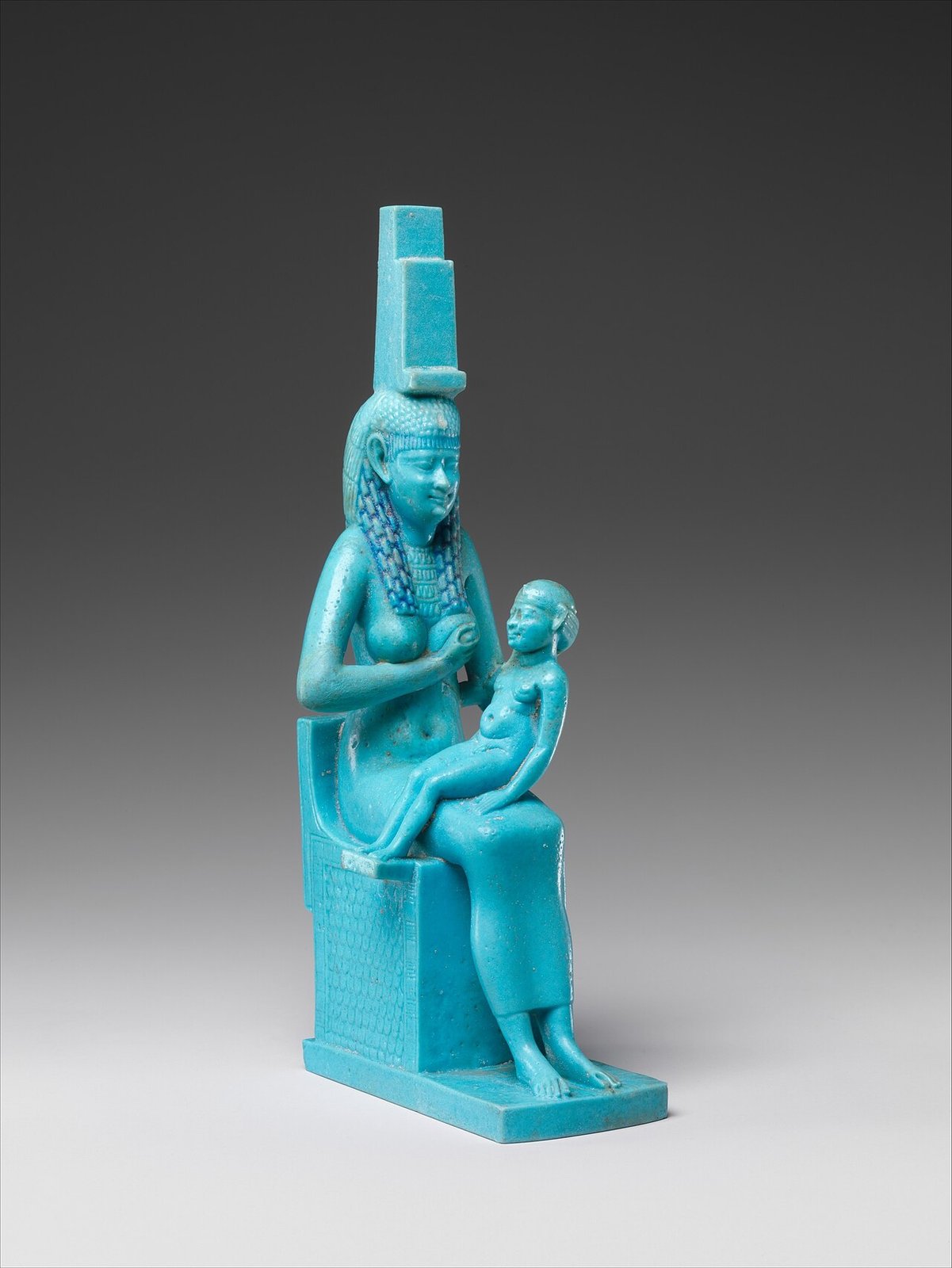
Harpocrates is the Greek form of an Egyptian name, Hor-pa-khered, "Horus the Child". He is the god HorusHorusEgyptian god associated with kingship and the sky, also appearing as the child protected by his mother Isis in marsh and nursing traditions.Glossary · Click to read the explanation seen as a small boy: the son of Isis and OsirisOsirisOsiris was an ancient Egyptian deity associated with the dead, life after death, renewal, and kingship. His roles appear in changing funerary texts, rituals, and judgment scenes, notably the weighing of the heart.Glossary · Click to read the explanation, hidden and protected by his mother in the marshes until he is old enough to claim his father's throne. Egyptian artists showed him as a naked child with a lock of hair on one side of his head and a finger raised to his mouth. [1][2][4]
The child Horus is very old in Egyptian texts, but Horus the Child as a god with his own name and worship appears only around 1070 BCE. He was most popular in Greek and Roman times, when Greek and Roman writers read his finger at the mouth as a call for silence, a reading that most Egyptologists do not share. [1][2][3]
The name
Hor-pa-khered means "Horus the Child": khered is the Egyptian word for a child, and pa is "the". Pa belongs to Late Egyptian, the language of the later New Kingdom, so the name was formed fairly late, and the Egyptologist Dagmar Budde concludes that Horus the Child did not become a separate god before the end of the New Kingdom. [1]
Greek speakers heard the name as Harpokrates, and Phoenician and Aramaic inscriptions write it with the same consonants, Ḥrpkrṭ. Budde adds a warning: modern scholars, and probably ancient writers too, often use "Harpocrates" loosely for any Egyptian child god, although Egypt had several, such as Ihy at Dendera and Khonsu as a child at Thebes. [1][2]
How to recognise him
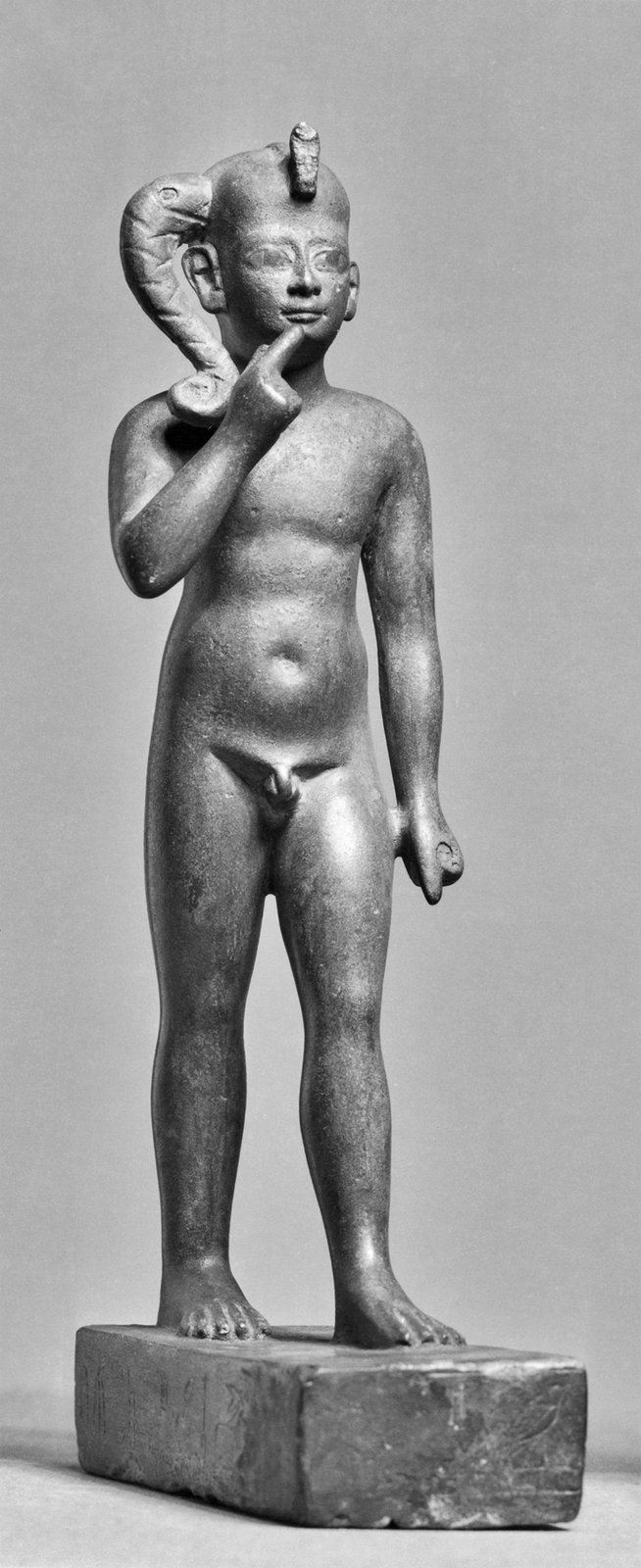
The boy in the picture is naked, wears a long lock of hair on the side of his head, and raises a finger to his lips; a cobra (uraeus) on his forehead marks him as a future king. In Egyptian art these are signs of childhood. The hieroglyph that means "child" is a seated naked figure with its hand at its mouth, much as a small child today might suck a thumb, and the sidelock written alone could also stand for "child" or "to be young again". [1][2][6]
Many other details changed with time and place: crowns of Egypt, a sun disc, a lotus flower to sit on, and, in the Greek period, a horn of plenty, a pot of food, a goose or other animals. Budde stresses that no child god had a look all his own. A figure can be named with confidence only when an inscription or its setting says who it is. [1][2]
From the Pyramid Texts to a cult of his own
The image of the child is far older than the name. The Pyramid Texts, the spells carved in royal tombs from about 2350 BCE, already speak of Horus as "the young boy with his finger in his mouth" who overcomes snakes; the dead king hoped to share that protection. [1]
Worship of child gods became important only from the Third Intermediate Period (about 1070–664 BCE). Budde places the first steps at ThebesThebes, EgyptThebes, Egyptian Waset, was an ancient Egyptian city in the area of modern Luxor, with monuments on both banks of the Nile.Glossary · Click to read the explanation, where Horus the Child and Khonsu were honoured as sons of AmunAmunAmun is an Egyptian deity centered on Thebes and Karnak, the “hidden one,” also worshipped as Amun-Re. His names and images were targeted under Akhenaten before royal support resumed.Glossary · Click to read the explanation; Youssri Abdelwahed notes a cult of Horus the Child in the Theban area under the 21st Dynasty. In later temples a small building called a mammisi, a "birth house", celebrated each year the birth of the local divine child, and with him the hope that the reigning king was the rightful heir. [1][2]
Protector against snakes and scorpions
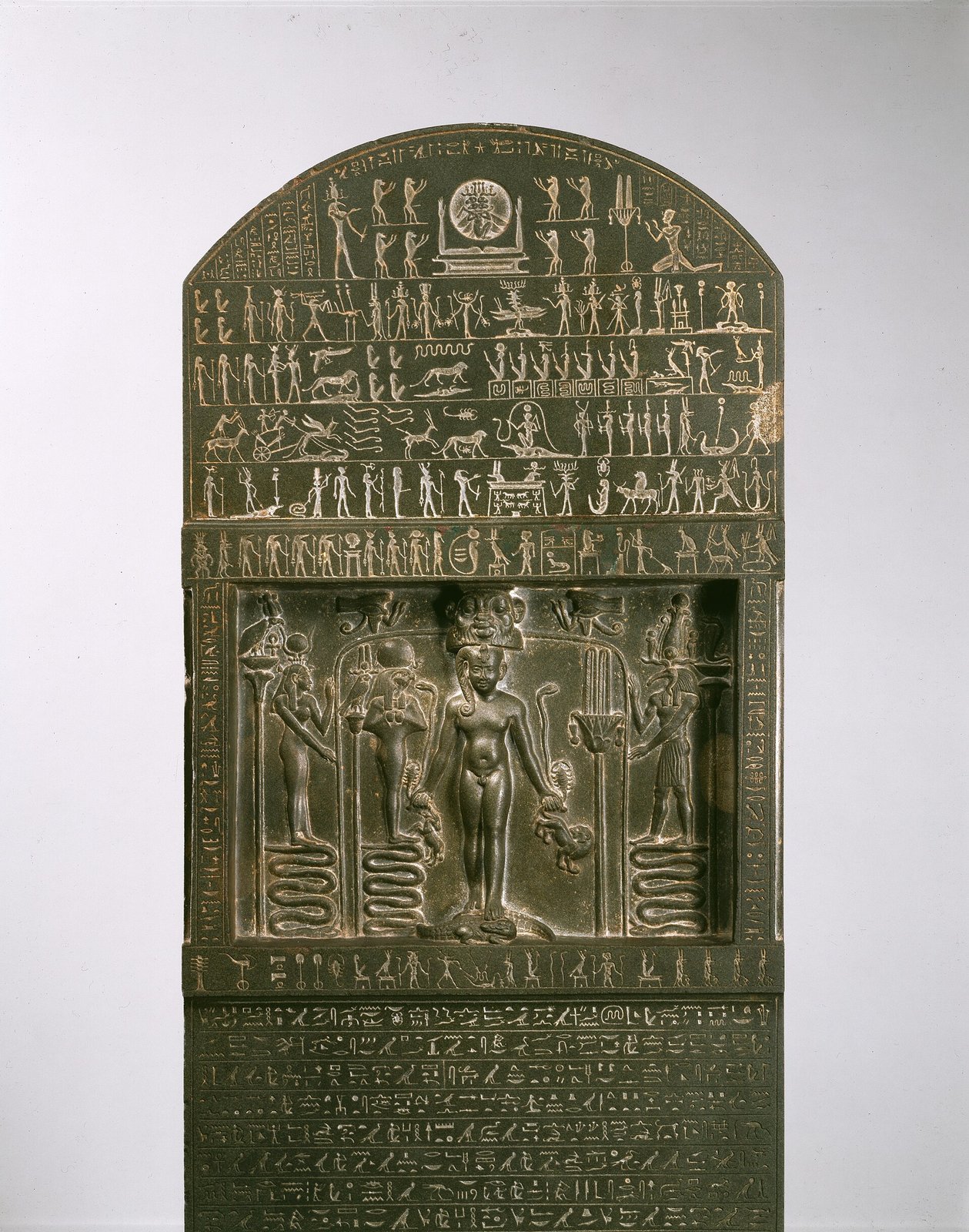
Horus the Child was also a healer's god. On many small stone slabs called cippi, he stands naked on crocodiles and masters snakes, lions and other dangerous animals: the dangers of the Nile valley, held fast by a child. The largest and best known is the Metternich Stela in New YorkNew York CityNew York City is in the United States and houses the Metropolitan Museum of ArtGlossary · Click to read the explanation, carved under Nectanebo II (360–343 BCE). [2][4]
Its spells tell how Isis fled with her baby into the marshes of Chemmis in the Delta, and how she found him there one day stung and lifeless. Her cries reached the sun god ReRe, Egyptian sun godRe is the Egyptian sun god, associated with creation, life and renewal of cosmic orderGlossary · Click to read the explanation, who sent ThothThothThoth is an Egyptian god of knowledge and writing, also associated with recording funerary judgment.Glossary · Click to read the explanation to heal the child. The spell repeats that Horus is to be healed for his mother Isis, and the person who was bitten healed in the same way, setting the divine child and the human patient side by side. Another spell on the same stone tells of Isis's flight with the child, guarded by seven scorpions. [4]
In Greek and Roman Egypt
Under the PtolemiesPtolemaic dynasty in EgyptDynasty of Macedonian origin ruling Egypt as kings from 305 to 30 BCE, amid Greek and Egyptian traditions.Glossary · Click to read the explanation and the Romans, Harpocrates became one of the most visible gods of Egypt. In AlexandriaAlexandria (Egypt)Alexandria is a city on Egypt’s Mediterranean coast, founded by Alexander the Great in 331 BCE and an important center of trade and culture.Glossary · Click to read the explanation he was honoured as the son of Isis and Serapis. Clay figures of him, often holding a pot or a horn of plenty, are found at Greek and Roman sites all over Egypt, mostly in houses. Abdelwahed calls him a favourite god of the household and of ordinary people, though he was rarely the main god of a temple. With Isis and Serapis he also travelled to Greece, Italy and beyond. [2]
His festival, the Harpokratia, is known only from a few Greek papyri, and it is confirmed in just two villages of the Fayum, Soknopaiou Nesos and Euhemeria. An account of the priests of Soknopaiou Nesos from 138 CE records "one jar of wine for the Harpokratia on 16 Tybi", a winter month of the Egyptian calendar. Abdelwahed suggests that the festival had a banquet with wine, a meal of bread and lentils, and a public procession, but he stresses that the papyri are few and that the festival seems to have been local rather than kept across Egypt. [2]
A god of silence?
Greek and Roman writers explained the finger at his mouth in their own way. Around 100 CE the Greek writer Plutarch, in On Isis and Osiris, says that Isis bore Harpocrates after Osiris's death, "untimely born and weak in his lower limbs", and that the Egyptians offered him the first lentils and celebrated his birth after the spring equinox. Yet Plutarch insists that he is not to be taken as a mere infant god: the finger at his lips is a sign of "restrained speech or silence", a lesson in speaking carefully about the gods. A little earlier, OvidOvidOvid was a Roman poet writing in Latin, who lived from 43 BCE to about 17 CE. His best-known works include the Metamorphoses.Glossary · Click to read the explanation, in the Metamorphoses, places among the companions of Isis a god who presses his finger to his lips to urge silence, usually taken to be Harpocrates. [3][5]
Most Egyptologists read the gesture differently: in Egyptian art it is simply a mark of a small child, alongside nakedness and the sidelock. The Greek reading lived on all the same: Renaissance artists and scholars made Harpocrates the god of silence and secrets, and art historians still call the finger on the lips the "Harpocratic sign". Both readings are part of his story. [1][2]
References and notes (6)
- Dagmar Budde, “Child Deities”, in Jacco Dieleman and Willeke Wendrich (eds.), UCLA Encyclopedia of Egyptology 1(1), Los Angeles, 2010 (peer reviewed; translated from the German by Jacco Dieleman) Whole article, pp. 1–8: definition and dating of child-deity cults (p. 1); iconography: finger to the mouth (with Plutarch's reading), sidelock as the sign for “child”, nudity, crowns, Greek-period attributes (pp. 2–4); epithets and the name Horus-pa-khered/Harpokrates, the Late Egyptian article pA and the end of the New Kingdom, the generic use of “Harpokrates” (p. 5); Pyramid Texts spell 378 (§663) “young boy with his finger in his mouth” (p. 5); Third Intermediate Period, Thebes, no unique iconography (pp. 6–7); mammisi and cult (pp. 7–8). Return to the text ↑
- Youssri Abdelwahed, “The Harpokratia in Graeco-Roman Egypt”, Rosetta 23 (2019), pp. 1–27 (University of Birmingham) Abstract; pp. 2–8 (literature, the name Hor-pa-khered and the Phoenician/Aramaic form Ḥrpkrṭ, the child hieroglyph and the finger gesture, the classical and Renaissance reading as silence, attributes, cippi, Pyramid and Coffin Texts, the cult under the 21st Dynasty at Thebes, Ptolemaic and Roman cult, terracottas, household god); pp. 11–12 and 14–15 (the Harpokratia in the papyri: Soknopaiou Nesos, 16 Tybi, AD 138; bread and lentil-meal); p. 18 (processions and conclusion). Return to the text ↑
- Plutarch, On Isis and Osiris (De Iside et Osiride), in Plutarch, Moralia, vol. V, trans. Frank Cole Babbitt, Loeb Classical Library (Cambridge, MA: Harvard University Press, 1936), as presented on Bill Thayer's LacusCurtius Chapter 19 (Harpocrates born to Isis after Osiris' death, “untimely born and weak in his lower limbs”); chapter 65 (birth “amid the early flowers and shoots”, first-fruits of lentils, birth days kept after the spring equinox); chapter 68 (not an infant god; finger on his lips “in token of restrained speech or silence”; offering of legumes in Mesore). Return to the text ↑
- Peter Dils, “Metternichstele” (translation and commentary), Science in Ancient Egypt / Wissenschaft im Alten Ägypten, Saxon Academy of Sciences in Leipzig, digital edition Introduction (date under Nectanebo II, lines 163–166; colophon of Nesatum, lines 87–88; picture programme of the front, with Horus on the crocodiles and Isis's words “Do not be afraid, my son Horus”); spell 6 (back, lines 48–71: Isis's flight with the child and the seven scorpions); spell 14 (Horus stung at Chemmis, Isis's cry, Thoth sent by Re, the refrain that Horus be healed for his mother Isis and the bitten one likewise). First half of the page read. Return to the text ↑
- Ovid, Metamorphoses, Book IX, trans. A. S. Kline (Poetry in Translation, 2000) Book IX, lines 666–713, “The birth of Iphis”: Isis appears to Telethusa with her companions, among them the god who urges silence with his finger (Kline names him Harpocrates; the Latin does not give the name). Return to the text ↑
- Walters Art Museum, Baltimore, “Horus the Child”, bronze with silver inlay, Late Period (664–342 BC), accession number 54.1983, museum record Museum record data and description as reproduced on the Wikimedia Commons file page (date, medium, size 19.4 × 5.5 × 10.2 cm, accession number, description: nude boy with finger to the mouth and sidelock as signs of childhood, uraeus as sign of the right to kingship). The museum's own page refused automated access (HTTP 403). Return to the text ↑
Suggest a correction · Suggest a source for this record
Cite this record
IL Archive, «Harpocrates», https://ilarchive.com/en/entities/harpocrates
Continue reading
Related readings