Artifact
Shabaka Stone
An object record bringing together its image, metadata, rights, and context.
The Shabaka Stone (British Museum EA498), inscribed c. 710 BCE, links Ptah, heart, speech, creation, and kingship; its damage, textual readings, and alleged older papyrus remain central questions.
Estimated reading time: 9 min Published Last reviewed:
Share article

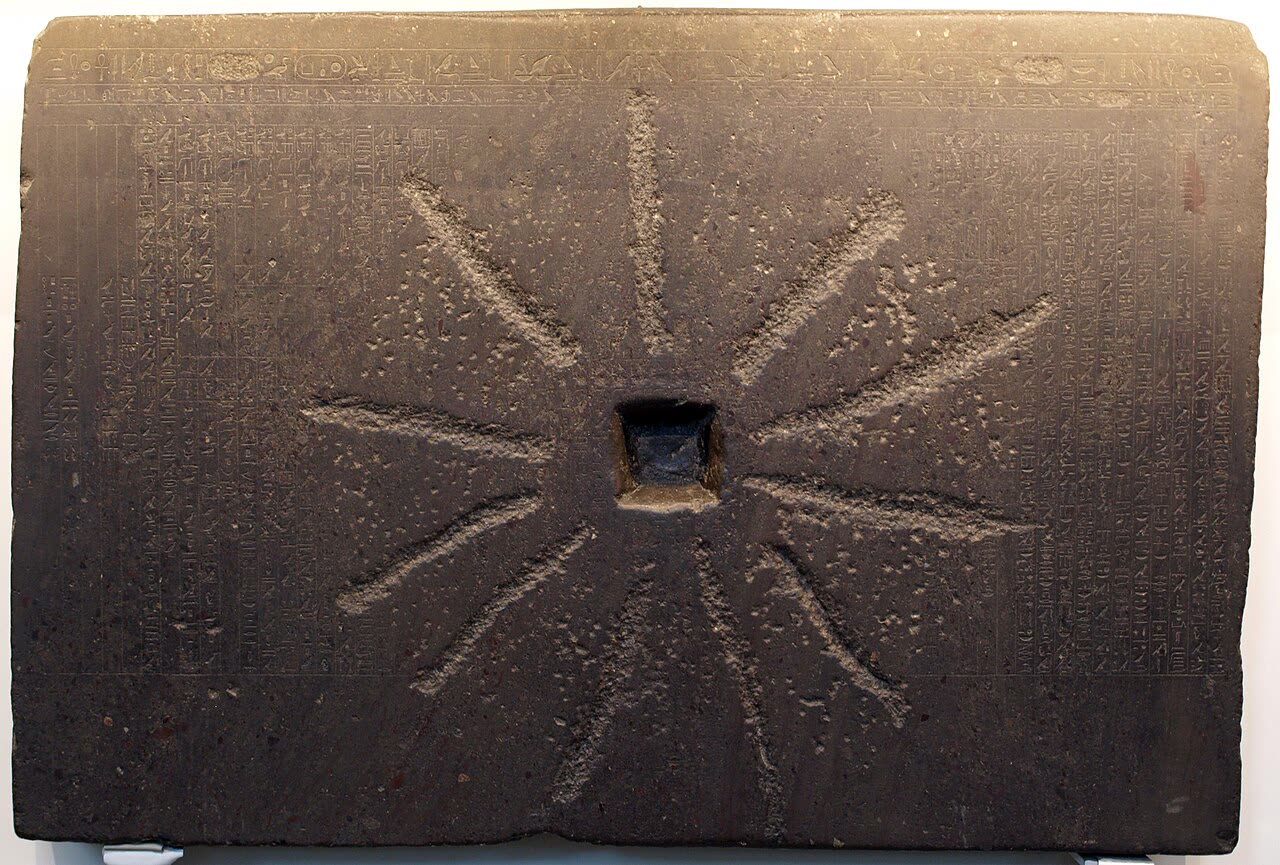
Illustration — not a photograph of the original object
Original IL Archive schematic made with Python/Pillow; CC0
Modern schematic of the slab and abrasion around its centre. Not a photograph of EA498, a transcription of its signs, or a restoration of missing columns; proportions and marks are indicative
Object details
- Title
- Shabaka Stone
- Rights
- CC0
Text
Introduction
The Shabaka Stone is a surviving Egyptian object bearing a religious inscription, not merely an abstract example of “creation by the word.” Its text makes PtahPtahPtah is an Egyptian god associated with Memphis, craftsmanship and creationGlossary · Click to read the explanation and Memphis central to creation, kingship, and divine order. But it also raises a historical question: does the inscription reproduce a genuinely earlier composition, or was its archaic appearance cultivated under a Kushite king? The stone, its damage, its surviving wording, and the disagreements over its reading must be examined before dating the ideas it contains. [5][2]
The object and its documented history
The Shabaka Stone is held by the British Museum, London, as EA498. It is an incised, rectangular stela made of conglomerate, later reused as a lower millstone. The museum gives maximum dimensions of 95 cm high, 137 cm wide, and 20.5 cm deep, with a weight of 585 kg. Its catalogue records MemphisMemphis in EgyptMemphis is an ancient Egyptian city near Mit Rahina south of present-day CairoGlossary · Click to read the explanation, Egypt, as its find/acquisition place and 1805 as the year it was donated by the second Earl Spencer. Older publications sometimes call it black basalt or offer other dimensions; the present museum record provides the preferable physical inventory. [5][1]
The extant inscription belongs to Dynasty 25, around 710 BCE, under the Kushite ruler ShabakaShabakaShabaka was a Kushite king of Egypt’s Twenty-fifth Dynasty in the late eighth century BCEGlossary · Click to read the explanation, whose throne name was Neferkare. The time of events narrated about the gods, the date when traditions used by the writer arose, and the date of the surviving stone are three different matters. No alleged source papyrus survives for independent physical or textual comparison. [5][6]
Layout, numbering, and loss
The museum describes two upper horizontal registers with the royal names and a statement about copying an older work, followed by sixty vertical registers of religious writing. Earlier epigraphic editions differ in how they count and subdivide the columns. Breasted's editorial numbering reaches 64, which must not be mistaken for sixty-four intact physical columns. [5][1]
Reuse as a millstone created a central hole and radiating abraded grooves, obliterating substantial portions of the central writing. Published translations mark long gaps and proposed restorations in brackets. Loss of writing on the present stone must be distinguished from omissions sometimes attributed to its alleged earlier exemplar: neither the date of every gap nor its original wording can be recovered from the current object. James Henry Breasted's early twentieth-century publication opened the modern analysis, followed by important re-editions and reinterpretations. [1][6][2]
The king's claim to have rescued a text
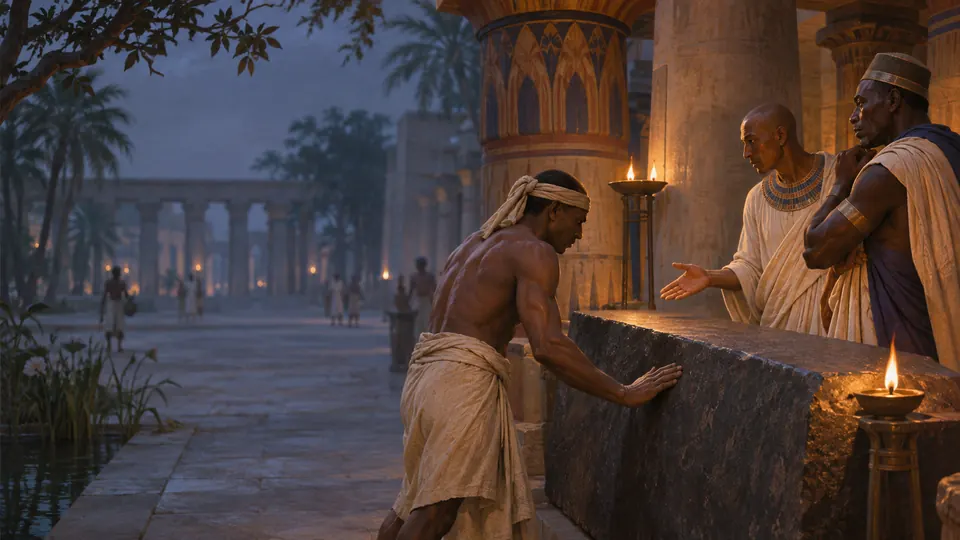
According to Miriam Lichtheim's translation as displayed online, the second upper horizontal register says that the king found an ancestral writing eaten by worms and no longer understandable from beginning to end, then ordered it copied anew in his father Ptah's temple. This is the inscription's own claim, not an independently verified record of finding a papyrus. The royal preface also connects the undertaking with the durability of the king's name and monument: antiquity functions as a source of religious and royal authority. [6][5]
There is no consensus on whether the story must be fictional. Friedrich Junge, as discussed by Boyo Ockinga and in the museum catalogue, argued that the archaizing composition could have been created under Dynasty 25. Ockinga objects that the copying motif need not always be invented, and points to apparent inherited lacunae and concepts paralleled in New Kingdom texts as evidence favoring an earlier composition. Neither interpretation dates a vanished papyrus merely on the basis of the inscription's assertion. [2][5]
Memphis and the unification of the Two Lands
The surviving composition does not begin with a simple creation narrative. Early passages describe the dispute between HorusHorusEgyptian god associated with kingship and the sky, also appearing as the child protected by his mother Isis in marsh and nursing traditions.Glossary · Click to read the explanation and Seth over the inheritance of OsirisOsirisOsiris was an ancient Egyptian deity associated with the dead, life after death, renewal, and kingship. His roles appear in changing funerary texts, rituals, and judgment scenes, notably the weighing of the heart.Glossary · Click to read the explanation. Geb first apportions Upper and Lower Egypt and subsequently assigns the inheritance to Horus. Other passages locate their reconciliation in Ptah's house at Memphis, presented as the point where the Two Lands meet. The damaged narrative also associates Osiris with Sokar's sanctuary, invoking a Memphite funerary deity. Many words in these sections are broken or restored; the divine plot cannot be used as a literal chronicle of a historical war or a securely dated city foundation. [6][2]
Ockinga emphasizes the incorporation, rather than simple rejection, of influential Egyptian traditions: kingship and succession, Osiris and Sokar, and the creation associated with AtumAtumAtum is an Egyptian creator god associated with HeliopolisGlossary · Click to read the explanation at HeliopolisHeliopolis, ancient IunuHeliopolis is the Greek name of Egyptian Iunu, at Matariya in northern present-day CairoGlossary · Click to read the explanation. These traditions are reinterpreted within a scheme privileging Ptah and Memphis. The combination of kingship, myth, and creation on one monument thus forms part of its argument, not a collection of unrelated quotations. [2]
Ptah, the heart, and the tongue
The best-known portion comes after the damaged areas, at column 52a and especially columns 53–58 in the usual editorial notation. Column 52a identifies Ptah the Great with the heart and tongue of the Ennead, the group of gods associated with Atum's creative tradition. The ensuing lines connect what the heart devises with what the tongue pronounces. Teeth and lips, sense perception, bodily motion, and the crafts are also drawn into the argument. This is not an isolated magical word but a relationship between perception, planning, command, and accomplishment. [6][1][2][13]
An Egyptian phrase in column 56 is reproduced below in scholarly transliteration from a secondary online transcription based on published plates; IL Archive has not independently deciphered the hieroglyphs. [4]
Its approximate sense is “As for the tongue, it repeats what the heart has devised.” Breasted's 1903 translation likewise describes the tongue repeating the heart's thought. The surrounding passage in Lichtheim's translation runs from sight, hearing, and breathing to the heart and from there to divine naming and skilled work. Here “heart” denotes a seat of understanding and intention, not only an anatomical pump, while “tongue” expresses or commands what is conceived. These terms should not be silently recast as categories of later Greek philosophy. [1][6][4]
Column 55 equates Atum's organs of generation with the mouth's organs in Ptah's mode of creation. This is a reinterpretation of Heliopolitan cosmogony within Memphite theology, not an erasure of Atum. Ockinga also relates Ptah's priority of conception to his established role as patron of craftsmen and their skill. [6][2]
Readings that do not simply coincide
Column 53 poses an actual grammatical and textual problem. The translation attributed to Lichtheim can mean that the form of Atum took shape in the heart and on the tongue; an alternative has the heart and tongue themselves taking shape in Atum's form. Some pronouns may refer either to Ptah or to the heart and tongue, and the value of prepositions is disputed. Column 56 provides a comparatively clearer formulation of thought and speech; a fully developed metaphysical system should not be constructed from the uncertain opening of column 53 alone. [6][1][2]
The same caution matters in the largely erased political and Osirian sections. Bracketed words in an edition are supplied readings, not invariably marks still visible on the object. Moreover, an English version reproduced from Lichtheim on an intermediary website is not a new translation made directly from the hieroglyphs. [6]
The disputed date of composition
- Old Kingdom, approximately 2686–2181 BCE: older traditions concerning Atum and kingship existed; their possible reuse does not date the present composition to that era.
- New Kingdom, approximately 1550–1069 BCE, particularly the Ramesside period in the thirteenth to eleventh centuries BCE: texts linking Ptah with creative deliberation and the integration of cult traditions provide significant parallels, not identical copies.
- About 710 BCE: the surviving monument was inscribed under Shabaka; this is the secure material date.
- 1805 and 1901–1903 CE: the museum acquired the object, and Breasted's publication made sustained modern reading possible. [5][1][2]
Early scholars commonly assigned the composition to the Old Kingdom on the strength of its apparently archaic language and perceived antiquity of its ideas. In 1973, Junge challenged that reasoning: deliberate archaism can mimic early language, and he proposed composition under Shabaka. Hans Albert Schlögl instead argued for a Nineteenth Dynasty setting. In 2010, Ockinga favored a principal formulation by Memphite theologians after the AmarnaAmarna / AkhetatenAmarna is the archaeological site of Akhetaten, Akhenaten’s fourteenth-century BCE capital in Middle Egypt, preserving royal boundary stelae, temples, houses and cemeteries.Glossary · Click to read the explanation period. His evidence includes Ramesside parallels for creation initiated by the heart, the association of Ptah with Tatenen and Atum, and a project unifying major traditions. Yet those parallels do not by themselves exclude redaction under Dynasty 25, and some scholars have entertained the survival of still older elements. The sound conclusion is to date the extant stone firmly while keeping the composition's history open to argument, rather than assigning it categorically to the First or Twenty-fifth Dynasty. [2][5]
Comparison and assessment
The coupling of conception and utterance can remind modern readers of later discussions of the “Word” or LogosLogosGreek term for speech, explanation or reason, also used for cosmic rationality. Philo uses it in accounts of creation, while John’s prologue speaks of the Word becoming flesh; its function varies with context.Glossary · Click to read the explanation. Breasted himself drew such a parallel. But resemblance does not demonstrate textual borrowing, transmission, or identity between Ptah's relationships to Egyptian gods and later philosophical or theological concepts. An argument for historical influence would require chronological, linguistic, and documentary pathways beyond the phrase “heart and tongue.” [1][2]
EA498 therefore establishes the existence, in Shabaka's reign, of a Memphite inscription that puts Ptah at the centre of creation, divine tradition, and kingship. Damage, restoration, and alternate readings make it more complex than the short quotations often circulated about it. The age of the alleged source papyrus and the missing wording remain unproved. The most responsible comparison begins with the object, its textual layers, and the history of its interpretation. [5][6][2]
Quick answers
What is the Shabaka Stone and where is it now?
It is an incised rectangular stela of conglomerate, later reused as a lower millstone. It is held by the British Museum in London as EA498, donated in 1805 by the second Earl Spencer. [5][1]
How old is the stone, and does that date the ideas on it?
The surviving inscription dates to about 710 BCE, under the Kushite king Shabaka. That is not the same as the age of the ideas or of any earlier source text. [5][6]
What does the famous passage say about the heart and tongue?
It links Ptah with the heart and tongue of the Ennead, the group of gods tied to Atum's creative tradition. Column 56 says roughly that the tongue repeats what the heart has devised. [6][1][2][13]
Why is so much of the text missing or uncertain?
Reuse as a millstone left a central hole and grooves that wore away much of the writing. Translations mark gaps and restorations in brackets, and some readings, such as column 53, are disputed. [1][6][2]
Did the text really come from an older, worm-eaten manuscript?
That is the inscription's own claim, and no source papyrus survives. Scholars disagree: some think the composition was archaizing work under Dynasty 25, others favor an earlier origin. [2][5]
References and notes (6)
- James Henry Breasted, “The Philosophy of a Memphite Priest,” The Open Court (1903). Selected article pages and scanned images were examined; some early physical descriptions differ from today’s museum catalogue. The Open Court 1903, printed pp. 458, 464–471, 478–479; screenshots of PDF pp. 1, 7 and 21 Return to the text ↑
- Boyo G. Ockinga, “The Memphite Theology—Its Purpose and Date,” in Egyptian Culture and Society, 2010. Article body, parallels, discussion of dating and conclusion read in web extraction; not a separately inspected printed volume. CASAE 38 (2010), II, pp. 99–113, particularly argument pp. 99–112 and references at 113 Return to the text ↑
- Editable Wiktionary user transcription citing El Hawary plates (2008), with minor modifications; used only as secondary aid for transliteration of columns 53–56, not a vetted critical edition or independent autopsy. User:Tomispev/Memphite Theology, col. 53, 55–56, especially col. 56 verse 16 Return to the text ↑
- The indexed British Museum EA498 catalogue furnished material, dimensions, dating, acquisition, layout and curator commentary; opening the museum page itself was blocked (HTTP 403). British Museum, EA498 object catalogue: material, dimensions, date, acquisition, description and curator notes Return to the text ↑
- Read the full inscription translation displayed by Attalus from André Dollinger, credited to Miriam Lichtheim, including lacunae and variant readings; not collated against the Egyptian original or a scan of Lichtheim’s book. Surrounding site comments are not all Lichtheim’s. Miriam Lichtheim, Ancient Egyptian Literature I (1973), pp. 51–55 as reproduced on Attalus; entire displayed translation Return to the text ↑
- The museum exhibition excerpt on heart, tongue and crafts was visible in search-indexed text; the one-page PDF was not directly accessible (HTTP 403). This is an exhibition extract, not a full inscription reading. British Museum, exhibition transcript: indexed excerpt from one-page PDF Return to the text ↑
Archive records may be reviewed and refined as better evidence or sources become available. Suggest a correction
Suggest a correction · Suggest a source for this record
Cite this record
IL Archive, «Shabaka Stone», https://ilarchive.com/en/artifacts/shabaka-stone
Continue reading