Artifact · Inscription
The Tel Dan Stele: Preserved Text, Restorations, and Limits of Inference
An object record bringing together its image, metadata, rights, and context.
- Names
- Tel Dan Inscription · Tel Dan Stele
- Timeline
- From 900 BCE to 801 BCE
- Region
- Tel Dan, northern Levant/Jordan basin; Aram-Damascus, Israel and Judah in the ninth century BCE
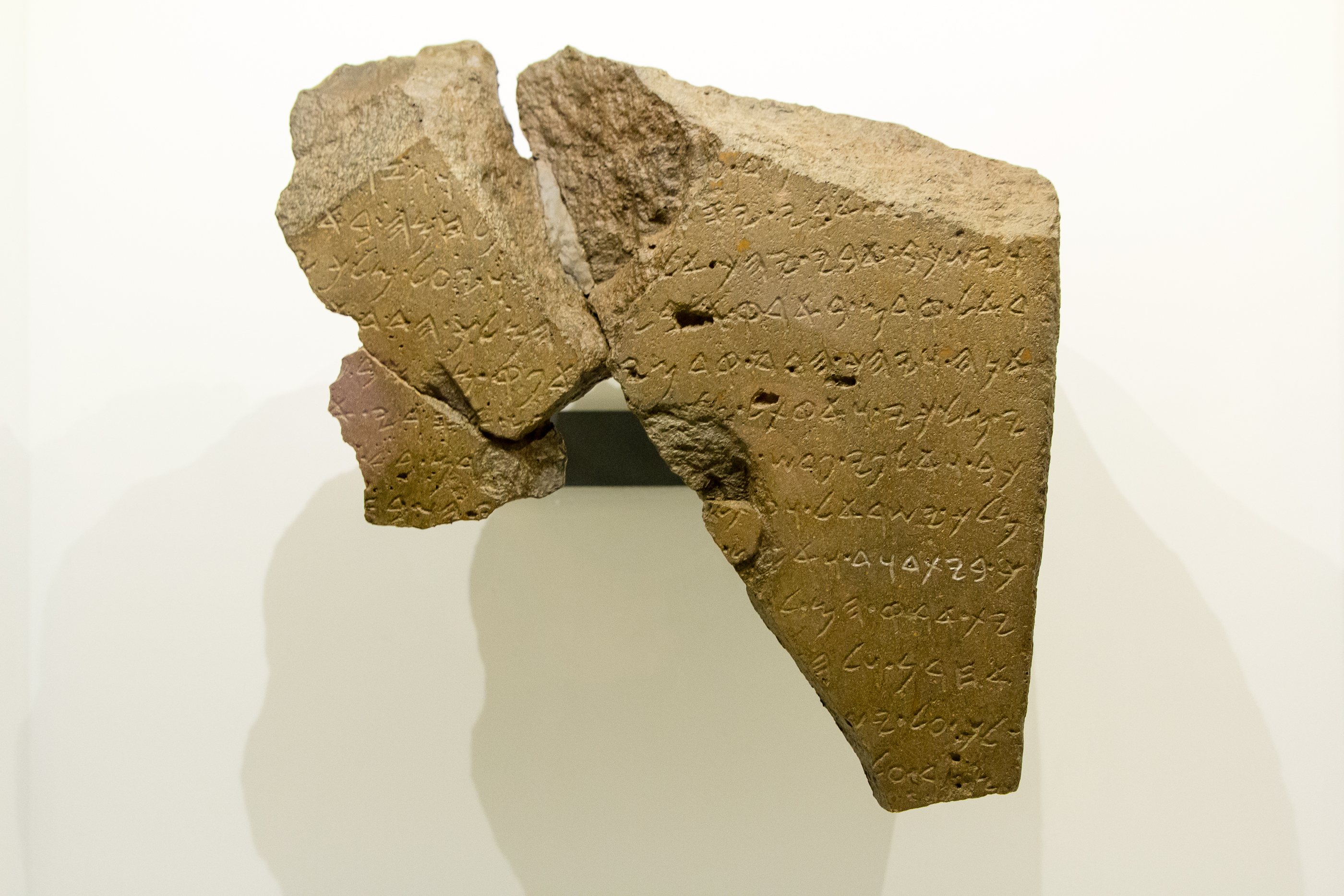
Three basalt fragments of a ninth-century BCE Aramaic royal inscription, found at Tel Dan in 1993 and 1994. The entry separates their surviving letters, including bytdwd, often read as “House of David,” from restorations.
Estimated reading time: 8 min Published Last reviewed:
Share article
Photograph
Photograph by Oren Rozen, via Wikimedia Commons, CC BY-SA 4.0.
The original fragments of the Tel Dan Stele on temporary display in 2017. The photograph shows the breaks and Aramaic inscription lines, but the displayed arrangement should not be treated as decisive proof for the disputed join
License · Image sourceObject details
- Title
- The Tel Dan Stele: Preserved Text, Restorations, and Limits of Inference
- Timeline
- From 900 BCE to 801 BCE
- Region
- Tel Dan, northern Levant/Jordan basin; Aram-Damascus, Israel and Judah in the ninth century BCE
- Rights
- CC BY-SA
Text
Introduction
The Tel Dan Stele survives not as a complete monument but as three broken basalt fragments bearing an Aramaic royal inscription. It preserves political language from the northern LevantThe LevantThe Levant is a regional name for lands along the eastern MediterraneanGlossary · Click to read the explanation in the ninth century BCE, including a sequence widely read as “House of David.” Yet there is a crucial difference between letters surviving on stone, an editor's reconstruction, a royal speaker's claims, and a historian's inference. This entry examines the physical fragments and the levels at which they can be read; it is neither a biography of DavidDavid, the biblical kingRoyal figure in Samuel and Kings, cited here in an instance of “adversary” applied to a human.Glossary · Click to read the explanation nor a verdict on the overall historicity of biblical narratives.
Three fragments, not an intact monument
The excavation team found the largest fragment, now called A, at Tel Dan, near the ancient entrance to the site in present-day northern Israel, on 21 July 1993. Gila Cook noticed it reused as building stone by a paved plaza outside the gate. The material is dark basalt, with a worked, inscribed face and broken edges. Its first editors gave the fragment's measurements as approximately 32 cm high and 22 cm at its greatest width. Those figures describe A as found, not the original height of the complete stele. [1]
On 20 June 1994, B1 was uncovered in debris some 0.80 m above the pavement and roughly 13 m northeast of A's findspot. B2 was found on 30 June near the base of a wall, about 8 m north of B1's findspot. About six inscribed lines remain on B1 and four on B2, with varying losses. B1 and B2 have a genuine physical join; their placement against A does not rest on an adjoining fracture surface. Proximity during excavation cannot establish their relative positions at the moment of inscription. [2]
An institutional exhibition catalogue describes the displayed composite as 34 cm high and 32 cm wide and lists the inventory references IAA 1996-125 and 1993-3162. Without a separate accession concordance, these numbers should not be assigned individually to A, B1, or B2 by guesswork. The fragments belong to the Israel Antiquities Authority collection and were lent from the Israel Museum, JerusalemJerusalemJerusalem is a city of religious importance in Judaism, Christianity and IslamGlossary · Click to read the explanation, for an exhibition at New YorkNew York CityNew York City is in the United States and houses the Metropolitan Museum of ArtGlossary · Click to read the explanation's Jewish Museum from 5 December 2024 to 5 January 2025. That past exhibition should not be treated as a current location. [3]
Three different chronologies
The date of the inscription is generally placed within the ninth century BCE from its script and historical setting, with disagreement over a narrower date. The events narrated by its speaker have no wholly preserved explicit year-date. The breaking and secondary use of the stone in pavement or a wall belongs to a later archaeological phase, not automatically the year when the words were carved. A was recovered from reused masonry and B1 from debris; excavators discussed the pavements and destruction levels in relation to the eighth-century BCE history of the gate area. Neither a reused block nor a destruction horizon is a self-dating royal inscription. Finally, 1993 and 1994 mark only the modern discoveries. [1][2]
Aramaic and the rhetoric of victory
The language is early AramaicAramaicNorthwest Semitic language varieties documented since the early first millennium BCE, including Old and Imperial Aramaic, Syriac, Jewish dialects, and living Neo-Aramaic forms.Glossary · Click to read the explanation, written in an alphabetic script running from right to left, with word-dividing dots visible in some places. Its subject matter touches ancient IsraelAncient IsraelName attested for a population on the Merneptah Stele around 1208 BCE, later for the northern Iron Age kingdom and for broader textual and religious identities; the senses are not identical.Glossary · Click to read the explanation, but that does not make the inscription HebrewHebrewA Northwest Semitic language of the Canaanite group, encompassing Iron Age epigraphy, Biblical, Rabbinic, medieval and Modern Hebrew; its scripts and pronunciations changed over time.Glossary · Click to read the explanation. Nor is it an impartial chronicle or treaty. The speaker uses the royal first person, credits Hadad with establishing him as king and going before him, and claims success against rival kings. This is the rhetoric of a victory monument: assertions about killed rulers and defeated enemies are political claims to be compared with other evidence, not neutral eyewitness findings. [4][5]
The author is frequently identified as Hazael, king of Aram-Damascus, because the period and possible events fit his reign and scholarly restorations point in that direction. Hazael's own name is not legibly preserved on these fragments. Scholars differ over details of his role and over the political alignments suggested by the composite. Attribution to him is therefore a substantial historical hypothesis, not a surviving signature. [5][11]
What is preserved, restored, or joined?
Epigraphic work begins with each break separately: visible signs, damaged signs assigned tentative values, lost letters supplied in square brackets, and still larger inferred words and sentences. These stages are not interchangeable. In 1993 only A was published; it already held the expressions “king of Israel” and the sequence later rendered “House of David” amid incomplete lines. With the discovery of B1 and B2 in 1994, the editors' 1995 publication proposed a longer arrangement and a connected story of victories involving royal names known from elsewhere. A readable reconstruction must not be mistaken for a single continuous preserved text. [1][5]
The physical distinction is decisive: B1 and B2 fit together; the position of A relative to their joined piece remains an editorial arrangement open to testing. Using reflectance transformation imaging (RTI) and comparisons of letter forms and line directions, Michael Langlois argued in 2024 that A and B exhibit distinguishable hands, perhaps two engravers or one engraver whose technique changed. He also argued that the traditional alignment of the three pieces fails geometric tests. This is a substantive challenge to the established layout, not proof of forgery and not a demonstration that the fragments necessarily came from two separate monuments. [6][9]
What does “House of David” establish?
In line 9 of fragment A, the Latin-letter transliteration bytdwd represents a sequence actually preserved on the stone. It is not a word supplied to fill the physical space between A and B. Conventionally analysed as byt dwd, it is widely translated “House of David,” in the context of a king associated with that house. The likeliest referent is a dynasty or political house rather than a person's literal dwelling. Still, word analysis and the referent of dwd are linguistic and historical interpretations of the letters, not additional letters themselves. [7]
Alternatives have been proposed, including linking dwd with a divine name or another designation. Scholars have weighed them against the script, word division, context, and the parallel title “king of Israel.” The dynastic reading is widely preferred; it is not reasonable to present every alternative as equally well supported. But accepting the dynastic name does not establish David's precise dates, actions, the size of any kingdom, or every episode in the Books of Kings and Samuel. The published English abstract of Bob Becking's study explicitly cautions against making a whole narrative follow from a dynastic designation. [8]
A short demonstration of textual layers
The following is not a complete translation or a fresh independent reading of Aramaic from the photograph. The preserved witness, as published for A line 9, contains bytdwd. Editorial analysis separates it as byt dwd; the favoured scholarly translation is “House of David.” A specific royal name such as [Ahaziah], where supplied in a composite account of the nearby lines, belongs to the editors' restoration informed by context and other sources, not to the six letters of bytdwd itself. Lastly, “evidence that a ruling house bore that designation in this period” is a historical inference, much narrower than “the whole biography of David has been verified.” The distinction follows the editions of Biran and Naveh and later critiques of the assembly; it is not a claimed new autopsy of the stele. [7][5][9]
Two slain kings and 2 Kings 9
In the composite reconstruction published after B1 and B2, the royal speaker claims responsibility for defeating or killing two rulers whom editors tentatively identify as Joram/Jehoram of Israel and Ahaziah of Judah. Portions of the personal names, patronymics, and adjoining syntax are restored, however, and their identification relies more heavily on the arrangement of the fragments than a fluent modern translation may suggest. “King of Israel” and “House of David” have firmer footholds in A. The two reconstructed proper names should not be cited as if carved in full. [5]
The Books of Kings, specifically 2 Kings 9:21–28, attribute the shooting of Joram to Jehu, who then orders Ahaziah pursued; the latter is wounded and dies after fleeing. This allocation of agency differs from the royal boast commonly reconstructed for the Tel Dan text. A monarch might claim the achievements of allies or subordinates, or two political traditions may preserve differing accounts. The broken inscription neither compels harmonisation nor proves that two entirely separate killing episodes occurred. The extent of the restored names must first be acknowledged before comparing the alleged killers. [10][11]
Comparison, imaging, and limits
Tel Dan supplies a physical, non-biblical Aramaic witness to political and dynastic language within regional conflicts. It should not be conflated with the Moabite Mesha Stele: their material witnesses, excavation histories, broken lines, and scholarly editions differ. In particular, proposals to read “House of David” in a damaged passage of the Mesha SteleMesha SteleA ninth-century BCE Moabite royal basalt stele at the Louvre (AO 5066; KAI 181). Its inscription names Chemosh, Omri, Israel and YHWH (line 18). A proposed “House of David” reading in damaged line 31 is disputed.Glossary · Click to read the explanation pose a different evidentiary question from the surviving sequence on Tel Dan A. The existing study of Mesha and Chemosh helps compare royal victory rhetoric without treating two inscriptions as a single witness. [7][9]
RTI can reveal incisions obscured under one lighting angle and permit closer comparisons of strokes. It cannot itself join broken fragments or recover a king's missing name. A heritage imaging platform documents the stele digitally, although one sentence of its brief description confusingly calls part of this Aramaic inscription Hebrew. Images are valuable to epigraphyEpigraphyThe study of writing preserved on physical objects and monuments: its documentation, reading, dating, translation, material context and historical interpretation.Glossary · Click to read the explanation when interpreted alongside critical editions; a 3D model alone is not a substitute for explicit readings and their uncertainties. [12][9]
What the fragments do—and do not—show
Materially preserved are three basalt fragments, a broken royal Aramaic inscription, and expressions including “king of Israel” and bytdwd. The prevailing interpretation understands the latter as the political “House of David” and situates the monument amid ninth-century BCE conflicts involving Aram, Israel, and Judah. Less certain are A's position against B1+B2, substantial stretches of the reconstructed victories and names, and the precise identities of the writer and victims. The stele's historical value increases when those levels are kept distinct; its fragmentary royal rhetoric need not be inflated into wholesale confirmation or refutation of a later literary narrative.
References and notes
- Avraham Biran and Joseph Naveh, “An Aramaic Stele Fragment from Tel Dan,” Israel Exploration Journal 43 (1993), 81–98; first edition of fragment A, find context and dimensions. Printed pp. 81–84, 88–95 and 98; selected pages of the 17-page scanned PDF visually inspected, not the entire article read continuously. Return to the text ↑
- Avraham Biran and Joseph Naveh, “The Tel Dan Inscription: A New Fragment,” Israel Exploration Journal 45/1 (1995), 1–18; JSTOR full text not accessible, selected visible OCR preview passages from Scribd consulted; corrupted Aramaic was not independently collated. Selected passages on printed pp. 1–2, 5, 8–15 as exposed in an OCR text preview, not a complete reading of the publisher PDF. Preview: https://www.scribd.com/document/1060302425/Biran-TelDanInscription-1995 Return to the text ↑
- The Jewish Museum (New York), “Tel Dan Stele” exhibition page; artifact measurements, accession references, ownership/loan and dates, not a critical edition. Object caption, loan information and exhibition dates 5 December 2024–5 January 2025 read on the page. Return to the text ↑
- Biran and Naveh, “An Aramaic Stele Fragment from Tel Dan” (1993); Aramaic edition of A, palaeography and royal discourse. Printed pp. 89–95, particularly published readings and epigraphic discussion, inspected visually in selected pages. Return to the text ↑
- Biran and Naveh, “The Tel Dan Inscription: A New Fragment” (1995); editorial arrangement, royal-name restorations and historical attribution; reconstructions are not preserved lettering. Selected visible OCR-preview passages on printed pp. 8–15; bibliographic JSTOR record available but publisher full text not read. Return to the text ↑
- Michael Langlois, “The Tel Dan Inscription after 30 Years: A Fresh Look,” Israel Exploration Journal 74/2 (2024), 59–79; join and imaging reassessment. Published argument pp. 59–77, especially pp. 60–64 and 71–77, with selected illustrations examined; no conclusion of demonstrated forgery. Return to the text ↑
- Biran and Naveh, “An Aramaic Stele Fragment from Tel Dan” (1993); bytdwd in A line 9 and the “House of David” interpretation. Printed pp. 89–94, especially line 9 in the edition and discussion; reliance on editors, not an independent Aramaic autopsy. Return to the text ↑
- Bob Becking, “Het ‘Huis van David’ in een pre-exilische inscriptie uit Tel Dan,” NTT 49/2 (1995), 108–123; publisher’s English abstract only was consulted, not the Dutch article. English abstract on publisher page only; no claims to having read internal article pages. Return to the text ↑
- Langlois, “The Tel Dan Inscription after 30 Years: A Fresh Look” (2024); differing ductus, line slopes, position of A, explicit caution against asserting forgery from script differences alone. Published pp. 64–77, especially pp. 71–77, read with selected figures. Return to the text ↑
- 2 Kings chapter 9, United States Conference of Catholic Bishops (USCCB) Bible translation; literary comparison, not a contemporary archaeological witness. Chapter 9, verses 21–28, read directly on the Bible page; Jehu, Joram and Ahaziah. Return to the text ↑
- William Schniedewind, “Tel Dan Stela: New Light on Aramaic and Jehu’s Revolt,” BASOR 302 (1996), 75–90; publisher abstract only, not the full study; Hazael/Jehu possibilities treated as hypotheses. Publisher abstract alone; 75–90 gives the publication range, not pages actually read. Return to the text ↑
- Jerusalem Institute for Research and Digital Documentation of Cultural Heritage, “Imaging the Tel Dan Stele”; RTI/3D resource page. Its brief text inconsistently also mentions ancient Hebrew; that error was not repeated. Project description and RTI/3D links read; no independent inspection of the RTI viewer’s grooves claimed. Return to the text ↑
Archive records may be reviewed and refined as better evidence or sources become available. Suggest a correction
Suggest a correction · Suggest a source for this record
Cite this record
IL Archive, «The Tel Dan Stele: Preserved Text, Restorations, and Limits of Inference», https://ilarchive.com/en/artifacts/tel-dan-stele
Continue reading