Entity · Deity
Anshar in the Babylonian Poem of Creation
A reference page linking a name, group, or concept to the materials that discuss it.
- Names
- Anshar · Anšar
- Region
- Mesopotamia
Anshar belongs to an early generation of gods in Enuma Elish. When Tiamat raises an army, he sends his vizier to summon the assembly that will recognize Marduk’s authority.
Estimated reading time: 5 min Published Last reviewed:
Share article
Text
Introduction
Anshar, also written Anšar, belongs to an early generation of gods in the Babylonian creation poem Enuma ElishEnuma ElishA seven-tablet Babylonian creation poem in Akkadian, recounting Marduk’s rise, victory over Tiamat, cosmic ordering and human creation, and culminating in praise through fifty names. Its composition date is debated; later manuscripts and recitation traditions preserve it.Glossary · Click to read the explanation. He and Kishar appear in its genealogy before Anu, EaEnkiMesopotamian deity also known as Ea, linked with Eridu and the Abzu (deep fresh waters), wisdom, incantations, and narratives of creation and cosmic order. Later written attestations do not identify the deity of Eridu’s earliest layers.Glossary · Click to read the explanation and MardukMardukBabylon’s leading god, worshipped at Esagil and elevated in the Akkadian Enūma eliš. His symbols include a spade and mušḫuššu dragon. His earliest origins remain obscure; Nibiru is no evidence of a planetary homeland.Glossary · Click to read the explanation. The poem returns to Anshar when TiamatTiamatTiamat is a primeval divine mother and watery figure in Enūma eliš who later opposes Marduk; he divides her body in making the cosmos. No Babylonian portrait of her is securely identified.Glossary · Click to read the explanation is preparing for war. He learns what she has done, seeks help among the gods and sends his vizier to arrange an assembly. The meeting will give Marduk the authority he demands before facing Tiamat. [1][2]
Anshar speaks and acts in the first half of a poem that ends with praise of Marduk. His role gives the other gods a way to act together. The episode is preserved on several witnesses, including a tablet from NinevehNineveh and KuyunjikNineveh is an ancient Assyrian city near Mosul in northern Iraq; Kuyunjik is one of its archaeological moundsGlossary · Click to read the explanation now in the British Museum. On that tablet, his instructions and the later report of the assembly belong to a longer sequence of speeches about the same crisis. [1][3][4]
Generations before Marduk
The poem begins before the sky and earth have taken their familiar form. Apsu and Tiamat mingle their waters, and the genealogy names Lahmu and Lahamu, then Anshar and Kishar. Anu is their son and is described as equal to Anshar. Anu in turn fathers Nudimmud, another name for Ea, who surpasses the earlier gods. Later in the tablet, Ea and Damkina become the parents of Marduk. The sequence identifies Anshar as Marduk’s great-grandfather and makes the gods’ increasing powers a feature of the genealogy. [1][2]
The generations matter to the conflict that follows. Apsu wants to end the disturbances caused by the younger gods, and Ea intervenes against him. Tiamat later raises her own force, gives QinguQinguQingu (Kingu): a god whom Tiamat appoints commander and gives the Tablet of Destinies; captured after Marduk’s victory, his blood is used to make humans in Tablet VI.Glossary · Click to read the explanation authority and prepares to confront the other gods. When Ea brings the news to Anshar, the younger gods already face the consequences of decisions taken within their own family. Several figures belonging to the earliest generations remain able to convene, advise or oppose them. [1][2][3]
Choosing a champion
In Tablet II, Anshar hears Ea’s report of Tiamat’s preparations. The task of confronting her passes through a series of gods. Ea cannot face her, and Anu is also unable to confront her. Marduk comes forward, but his acceptance has a condition. He asks that the gods convene, give him the highest authority and recognize the force of his decrees. The request requires more than Anshar’s private assent. The assembly will have to grant what Marduk asks. [1][3]
The demand is repeated in Tablet III as part of Anshar’s instructions to his vizier Kaka. Anshar tells him to go to Lahmu and Lahamu, invite the gods to meet and have the gathering make its decision. His instructions include the preparations for a banquet. The speech sets out both the danger from Tiamat and the authority that Marduk wants. Its message lets the older generation hear the terms before the assembly acts. [1][3]
Kaka then goes to Lahmu and Lahamu. He speaks on Anshar’s behalf and repeats the account in much the same sequence. The gods are alarmed by what they hear about Tiamat. They come before Anshar, share a banquet and determine Marduk’s destiny. Tablet IV opens with the preparations for Marduk’s elevation. The arrangement of the two tablets gives time to the exchange of messages and the decision that precede the fight. [1][3]
The narrow tablet from Nineveh
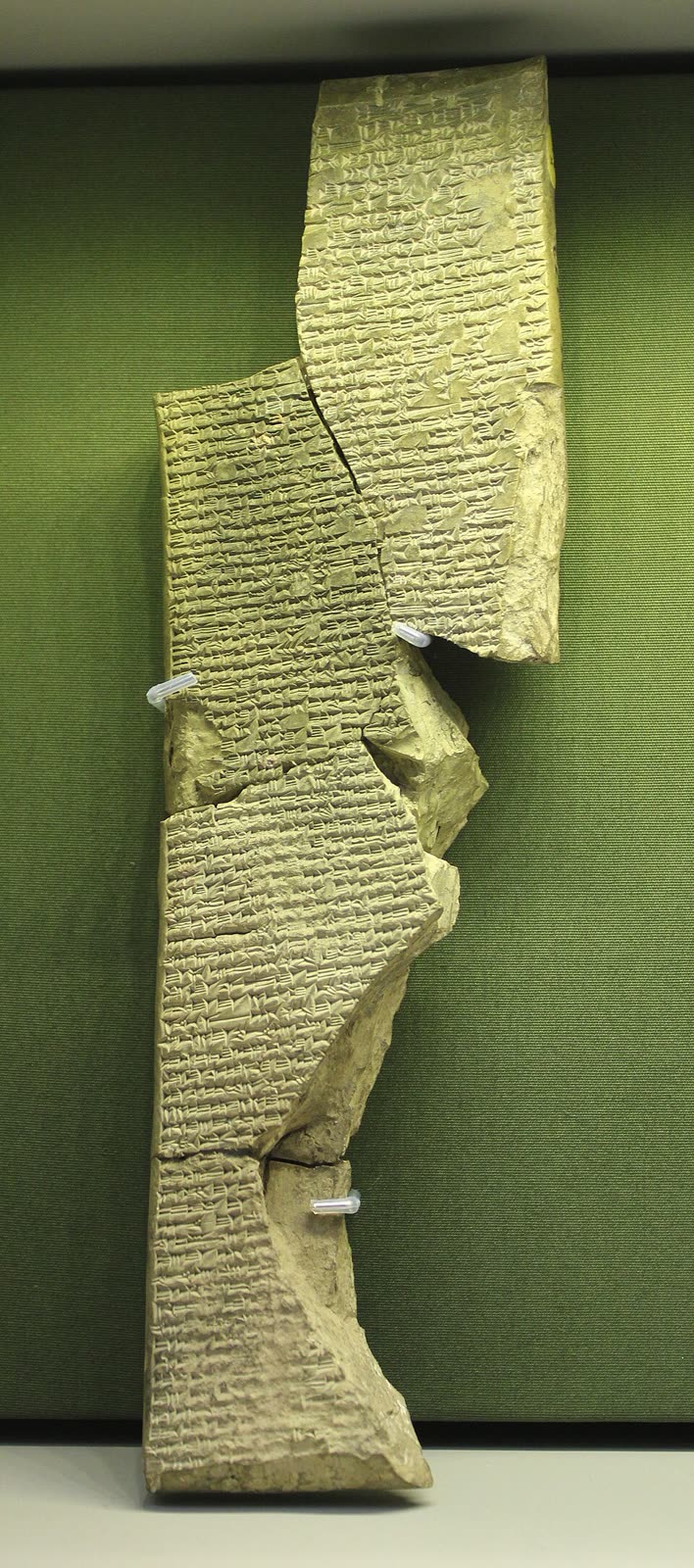
The photographed tablet, K.3473, is a British Museum witness to this part of the poem. Wilfred Lambert lists it with its joined fragments under the Nineveh manuscripts of Tablet III. The lines deal with the summons and the assembly that recognizes Marduk’s place as champion. The visible fractures belong to the physical tablet, while the edited text also draws on other witnesses from Assyria and Babylonia. In Lambert’s list, another Nineveh fragment preserves a short stretch of the speech that Kaka delivers. A tablet from Ashur preserves lines near both the beginning and the end of the episode. [1][4]
Babette Schnitzlein and Jon Taylor include K.3473 in a study of the shapes and layouts of scholarly tablets in AshurbanipalAshurbanipalAshurbanipal was an Assyrian king of the seventh century BCE, reigning about 668–631 BCEGlossary · Click to read the explanation’s library. It appears alongside similarly elongated examples of several compositions in their comparison. The authors also note a two-column example of Enuma Elish from Ashur. Copies from different settings could preserve the same composition in different layouts. The particular format photographed here is one way ancient scribes gave the series a physical form. [1][5]
The name in an Assyrian adaptation
Lambert identifies a small group of manuscripts from Nineveh and Ashur that show an attempt to make the Assyrian god Ashur take Marduk’s place. Scribes could write Ashur’s name with the signs used for Anshar. The substitutions also extend to the names of Marduk’s parents in parts of the surviving evidence. The adaptation survives incompletely, and the familiar genealogy remains necessary for understanding the places where the old and revised readings come together. [1]
In the main Babylonian narrative, Anshar already has his own role before the combat begins. His place in the genealogy links him to both the oldest gods and the proposed champion. The assembly’s decision depends on the delivery of his instructions and the presence of the assembled gods. The poem puts that decision between the preparations for war and the emergence of Marduk as king. [1][2][3]
References and notes (5)
- Wilfred G. Lambert, Babylonian Creation Myths Read the discussion of the Assyrian recensional readings and the genealogy, the translations of Tablets I–IV, and the manuscript list for Tablet III. Return to the text ↑
- Ira Spar, Mesopotamian Creation Myths, Metropolitan Museum of Art Read the account of the poem’s structure, the opening genealogy, the search for a champion and Marduk’s resulting authority. Return to the text ↑
- Alexander Heidel, The Babylonian Genesis Read the close of Tablet II and the translation and notes for Tablet III on Kaka’s instructions, the repeated report and the banquet. Return to the text ↑
- British Museum, Cuneiform Tablet Telling the Epic of Creation Read the museum’s identification of the object as K.3473 and the description of its dimensions, findspot and the scene with Anshar. Return to the text ↑
- Babette Schnitzlein and Jon Taylor, Typological Aspects of Scholarly Tablets in the Library of Ashurbanipal Read the section on literary tablet formats and Figure 13, including the account of the two-column example from Ashur. Return to the text ↑
Suggest a correction · Suggest a source for this record
Cite this record
IL Archive, «Anshar in the Babylonian Poem of Creation», https://ilarchive.com/en/entities/anshar