Entity · Concept
ʿEved: Service and Subordination in Ancient Hebrew
A reference page linking a name, group, or concept to the materials that discuss it.
- Names
- ʿeved · ʿeḇeḏ · עֶבֶד
A contextual history of עֶבֶד (ʿeved) as service, subordination or enslavement, comparing Exodus, Deuteronomy, Leviticus and a documented Babylonian sale tablet.
Estimated reading time: 8 min Published Last reviewed:
Share article
Text
Introduction
The Biblical HebrewHebrewA Northwest Semitic language of the Canaanite group, encompassing Iron Age epigraphy, Biblical, Rabbinic, medieval and Modern Hebrew; its scripts and pronunciations changed over time.Glossary · Click to read the explanation noun עֶבֶד (ʿeved) may describe an enslaved person, but it can also denote a servant, subordinate or official exercising duties under someone else's authority. This entry asks how a particular context establishes the meaning, especially in the laws of the Book of ExodusBook of ExodusTorah book recounting Israel’s departure from Egypt and containing different formulations of seventh-day rest.Glossary · Click to read the explanation, DeuteronomyBook of DeuteronomyTorah book presenting commandments in Moses’ discourse and grounding Sabbath rest in slavery and liberation from Egypt.Glossary · Click to read the explanation and LeviticusLeviticusA Torah book concerning offerings, priesthood, and purity; chapter 16 describes sanctuary purification and a living goat carrying iniquities away.Glossary · Click to read the explanation. [4][5][6]
The aim is neither to soften nor to intensify the translation in advance. Instead, we ask what each text allows someone to do to another person: who may purchase or employ them, when can they leave, and what becomes of spouses and children? A separately identified Babylonian document provides a comparison, not evidence that both societies followed the same law.
Guide to the sections
- The word and the different relations it can describe.
- A purchased worker and his family in Exodus 21.
- Female dependants and bodily injury in that chapter.
- The release of men and women in Deuteronomy 15.
- Kin, outsiders and the Jubilee in Leviticus 25.
- A prophetic narrative and a fugitive from a master.
- The Babylonian tablet and the limits of comparison.
One word, distinct social relations
The Hebrew spelling is עֶבֶד, conventionally transliterated ʿeved or ʿeḇeḏ, and it belongs to the עבד root associated with working and serving. The Semantic Dictionary of Biblical Hebrew includes the senses slave, servant, officer, official and political subject, as well as a speaker presenting himself as a servant in a deferential address or a prayer. Not every occurrence is therefore a hired employee, nor is every occurrence someone who can be sold. The same Hebrew spelling can also be a personal name, a separate use not at issue here. [7]
A royal “servant” may hold office under the king rather than be a person traded on the market; religious language can similarly designate someone as God's servant. Those usages do not cancel passages which explicitly describe human purchase, sale or inheritance. Terms including אָמָה (ʾamah) and שִׁפְחָה (šifḥah) occur for female servants or enslaved women, with particular regulations that should not be mechanically deduced from those for a male ʿeved. [7][9]
Six years, but not necessarily family release: Exodus 21
Exodus 21:2–6 begins with the purchase of a “Hebrew slave/servant”. He serves six years and leaves without payment in the seventh. The text distinguishes his family circumstances: a wife whom he had on entering leaves with him, but a wife provided by his master, together with her children, remains with that master while the man departs alone. If he declares that he wishes to remain with his master, wife and children, the law describes the piercing of his ear and continued service. This is not automatic emancipation for his whole family, and the stated affection alone cannot settle how free the choice would be under such unequal conditions. [4]
The verbs of purchase and the master's claim to the family denote powers quite unlike those of a modern employment contract. Equally, the six-year rule governs the case specified here, not everyone ever designated ʿeved in biblical literature. [4]
The sold daughter and limits on physical abuse
Exodus 21:7–11 addresses another case: a father selling his daughter as an אָמָה. She expressly does not leave under the same conditions as male servants. The passage regulates designation for the master or his son, redemption, a restriction on resale to outsiders in the stated circumstances, and entitlements to food, clothing and what the consulted translation calls conjugal rights; the interpretation of the last Hebrew term is debated. If the specified obligations are unmet, she may depart without payment. This combines family authority, property and marriage; it is not a blanket promise that every enslaved girl becomes free after seven years. Scholars differ over aspects of the arrangement and its social interpretation. [4][9]
Other verses offer circumscribed bodily protection. Exodus 21:20–21 prescribes an unspecified penalty when an enslaved man or woman dies under a master's beating but treats differently a person who survives a day or two, giving a rationale in terms of the master's money. Verses 26–27 require release after the destruction of an eye or loss of a tooth. The rules thus recognize injury and paths to release while also making property status relevant to liability. They neither establish equality with free persons nor depict completely unlimited power over enslaved people. [4]
Deuteronomy 15: men, women and a start after release
Deuteronomy 15:12–18 explicitly mentions a Hebrew brother or a Hebrew woman who has been sold. After six years of service, release is prescribed in the seventh, together with gifts from the flock, threshing floor and winepress. The command is linked to Israel's memory of bondage in Egypt. The passage also discusses a servant who chooses continued service and the ear-piercing procedure, expressly mentioning a bondwoman. [5]
This is not word for word the arrangement for a designated daughter in Exodus 21:7–11. Some scholars examine the differences as legislative revision; others consider whether distinct legal situations are involved. The presence of these collections within the same Pentateuch does not itself prove that a single undifferentiated code operated everywhere at one time. Earlier in Deuteronomy 15, the release of claims against a fellow community member in the seventh year is a related, but not identical, rule on debt. [5][10]
Leviticus 25: kinship, foreign origin and Jubilee
Leviticus 25:39–43 describes an impoverished kinsman who sells himself. He must not be treated as a slave under harsh labour, but as a hired worker or resident, and he and his children return to their family holding in the Jubilee year. The rationale given is that Israelites already belong as servants to the deity who brought them out of Egypt. The rule, as written, does not use the six-year timetable of Exodus and Deuteronomy; the Jubilee is another temporal structure linked to land and kinship. [6]
By contrast, verses 44–46 permit purchasing enslaved men and women from neighbouring nations or from non-Israelite resident families, describing them as possessions inheritable by children. These particular provisions distinguish Israelite kin from others: protection for one group is not abolition of the ownership of people in general. Verses 47–55 further regulate redemption when an impoverished Israelite is sold to a resident non-Israelite; the range of possible statuses cannot be collapsed into two simple labels. [6]
A prophetic account and an escaped slave
JeremiahBook of JeremiahProphetic book addressing Judah and the Babylonian crisis; chapter 34 recounts liberation followed by renewed subjection.Glossary · Click to read the explanation 34:8–17 narrates events in JerusalemJerusalemJerusalem is a city of religious importance in Judaism, Christianity and IslamGlossary · Click to read the explanation under King Zedekiah: Hebrew men and women were released through a covenant but later re-enslaved, and the prophetic voice condemns the reversal. This is a prophetic account of violated obligations within its narrated setting; it is not an independent administrative census showing how often liberation laws were implemented across the country. [8]
Deuteronomy 23:16–17 forbids surrendering a slave who has escaped to the addressee, and says the fugitive may live where desired without mistreatment. Some scholars argue that the envisaged individual is a foreign fugitive seeking refuge in Israel; others discuss the provision in a broader tradition of emancipation. Its intended scope and date are debated, and it does not, on its own, erase Leviticus' inheritance and sale provisions. [11][12]
A Babylonian tablet, not a Torah manuscript
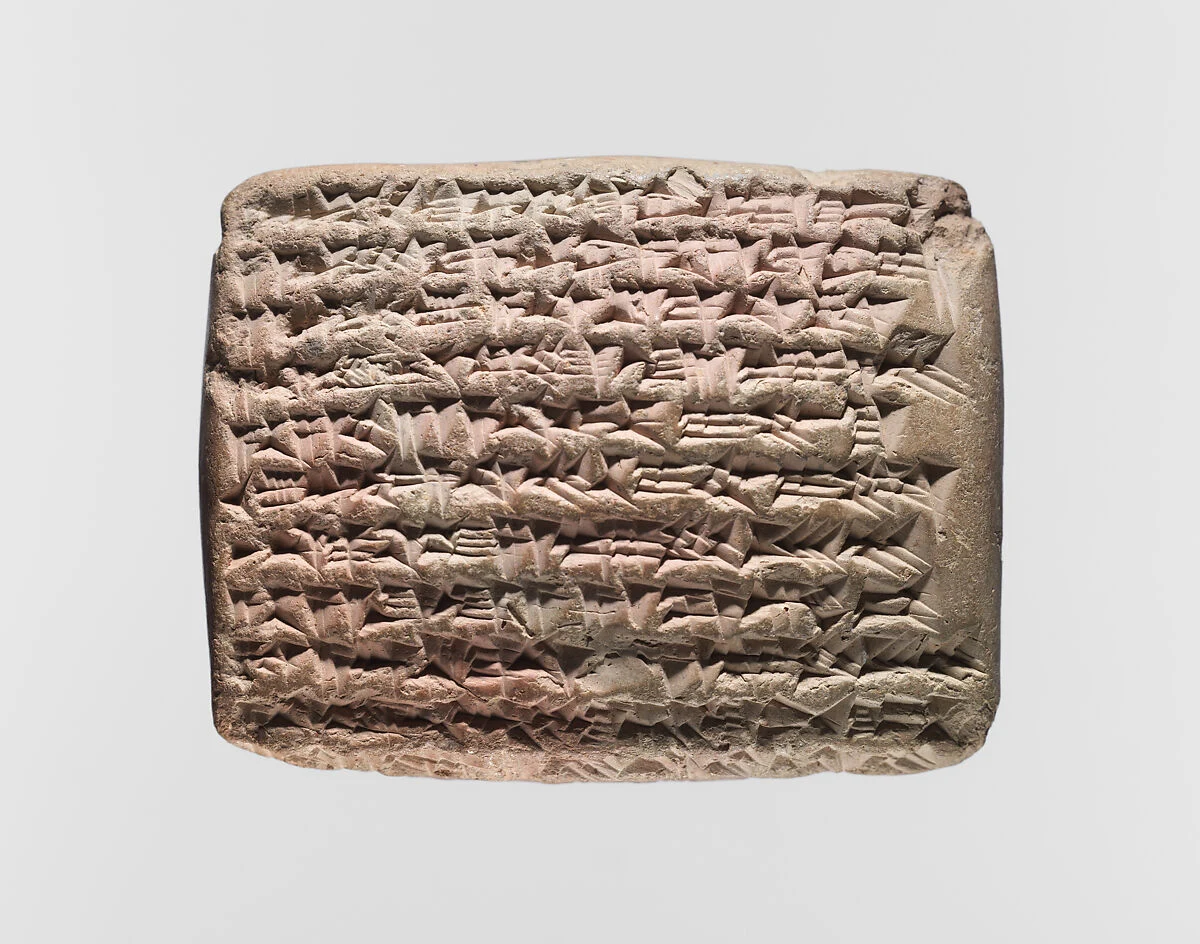
The cover photograph depicts a cuneiformCuneiformWriting with wedge-shaped signs, developed from Mesopotamian recording traditions and used for several languages from the third millennium BCE.Glossary · Click to read the explanation tablet from the family Egibi archiveEgibi archiveBabylonian family archive including a proxy purchase contract for a slave around 554 BCE.Glossary · Click to read the explanation in BabylonBabylonBabylon is an ancient city in central present-day Iraq, south of BaghdadGlossary · Click to read the explanation, from the Neo-Babylonian period, about 554 BCE. It is held by the Metropolitan Museum of Art under accession 79.7.11. The museum catalogues it as a proxy purchase contract involving an enslaved person; the scholarly NaBuCCo database paraphrases it more specifically as the sale of an enslaved woman and her son through an intermediary. These identifications come from catalogues; we did not independently read the AkkadianAkkadianAn ancient East Semitic language written in cuneiform from the third millennium BCE; its varieties include Babylonian and Assyrian, and it served in international diplomacy.Glossary · Click to read the explanation cuneiform inscription. [13][14]
The object is material evidence of a particular transaction within a later Babylonian economy. It does not contain the Hebrew word ʿeved, does not transmit Exodus 21 and does not show enforcement of the Laws of HammurabiLaws of HammurabiAn eighteenth-century BCE Babylonian legal text in Akkadian, presenting property, family, labor and injury provisions within Hammurabi’s account of justice.Glossary · Click to read the explanation, composed centuries earlier. Comparisons must distinguish the language, date and genre of each witness before claiming close institutional correspondence or transmission of law. [13][14]
What is disputed among scholars?
Gregory Chirichigno's thesis on debt service proposes that Exodus 21 and Deuteronomy 15 concern a dependant sold in a household debt situation, whereas Leviticus describes a household head forced to sell himself by deeper poverty. Only the university repository abstract was accessible and read for this review, not the complete thesis. Adrian Schenker's publicly visible article information records disagreements over the sequence and coherence of the manumission laws, including a contrasting proposal by Sara Japhet. His paywalled article was not read in full. [10][15]
These debates call for two distinctions. Each legal sentence covers a particular person and situation, while the final Pentateuch combines collections that need not have originated at the same time. The prescriptions tell us what the texts authorize, prohibit and demand; their actual enforcement requires other evidence of the relevant society and period. The useful question for each use of ʿeved is therefore: whose authority, what status, which family relations and what duration are involved?
Conclusion
ʿEved has a broad semantic range and alone does not fix a person's legal status. Some contexts explicitly allow ownership and inherited human property; others prescribe release, protection of kin or the relationship of an official or worshipper to an authority. Recognizing that variety neither excuses slavery where the text describes it nor obscures the meaningful differences between the individual regulations.
References and notes (12)
- Exodus 21:2–11, 16, 20–21, 26–27: Hebrew with the facing 1917 JPS translation, on service, family, daughters and bodily injury. Exodus 21:2–11, 16, 20–21, 26–27; Hebrew and JPS (1917) Return to the text ↑
- Deuteronomy 15:1–3 and 7–18: Hebrew and the 1917 JPS translation, distinguishing debt remission from the release of Hebrew women and men. Deuteronomy 15:1–3 and 7–18; Hebrew and JPS (1917) Return to the text ↑
- Leviticus 25:35–55, especially 39–46 and 47–55, Hebrew with the 1917 JPS translation; rules on kinship, Jubilee, human property and redemption. Leviticus 25:35–55, especially 39–46 and 47–55; Hebrew and JPS (1917) Return to the text ↑
- Semantic Dictionary of Biblical Hebrew (SDBH), entry עֶבֶד, H5650, senses of slave, servant, officer, subject and respectful address; published via HiperBiblia from United Bible Societies lexicographic data (2023). Entry H5650, visible semantic senses Return to the text ↑
- Jeremiah 34:8–17, narrative of release followed by re-enslavement; Hebrew text with the older JPS English translation at Mechon-Mamre. Jeremiah 34:8–17, especially 8–11 Return to the text ↑
- Ilona Rashkow, “Chattel or…? Laws Relating to Female Slaves in Ancient Israel,” Jewish Bible Quarterly 51/1 (2023), pp. 33–45; selected HTML article sections examined; this interpretation is secondary to the biblical passage. HTML sections on Exodus 21:7–11, women’s status, comparisons, selected endnotes; not a page-by-page reading of the PDF Return to the text ↑
- Gregory Conrad Chirichigno, Debt Slavery in the Ancient Near East and Israel (PhD thesis, 1989), University of Gloucestershire research repository; ABSTRACT ONLY, full thesis not available there. Repository abstract: interpretation of Exod 21, Deut 15 and Lev 25 Return to the text ↑
- Deuteronomy 23:16–17, law on a fugitive slave, Hebrew text with the older JPS translation. Deuteronomy 23:16–17 Return to the text ↑
- Myrto Theocharous, “Refugee Asylum: Deuteronomy’s ‘Disobedient’ Law,” Studies in Christian Ethics 30/4 (2017), pp. 464–474; PUBLISHED ABSTRACT ONLY (foreign fugitive/asylum interpretation). Publisher abstract only; full text restricted Return to the text ↑
- The Metropolitan Museum of Art, “Cuneiform tablet: proxy contract for the purchase of a slave, Egibi archive,” accession 79.7.11, Babylon, ca. 554 BCE; object record, illustration and Public Domain designation. Museum catalogue: title, accession, origin, date, image rights; NOT the cuneiform text Return to the text ↑
- NaBuCCo research database, MMA 79.7.11 / NaBuCCo ID 498, primary publication CTMMA 3 48; catalogue metadata and prose paraphrase of proxy sale; neither the cuneiform nor CTMMA edition was read. Entry metadata and Paraphrase section only; NOT the Akkadian original Return to the text ↑
- Adrian Schenker, “The Biblical Legislation on the Release of Slaves: the Road From Exodus to Leviticus,” Journal for the Study of the Old Testament 23/78 (1998); only publicly visible bibliographic material and note 1 discussing competing models were examined, NOT the restricted article. Public note 1 and publication details only; not full article Return to the text ↑
Suggest a correction · Suggest a source for this record
Cite this record
IL Archive, «ʿEved: Service and Subordination in Ancient Hebrew», https://ilarchive.com/en/entities/eved-servant-ancient-israel