Entity
River Ordeal: Divine Adjudication by Water
A reference page linking a name, group, or concept to the materials that discuss it.
A form of divine arbitration attested in cuneiform law and Mari letters. Hammurabi’s rules and reported cases differ; punitive immersion and the drinking-water rite in Numbers must be distinguished.
Estimated reading time: 8 min Published Last reviewed:
Share article
Text
Introduction
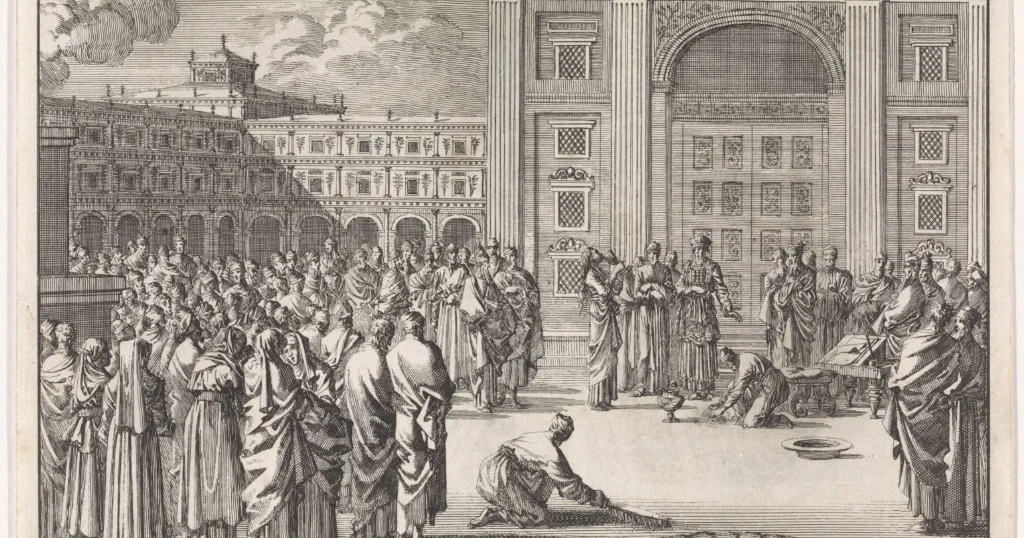
The river ordeal was a form of divine adjudication invoked when a claim could not readily be established by ordinary evidence. In some ancient Mesopotamian texts, a person—or someone acting on that person's behalf—was referred to the River, treated as an agent of judgment, and the outcome was given legal force. A law collection, a letter reporting a particular incident, and a procedural instruction need not describe one uniform rite. The practice must also be distinguished from throwing people into water as punishment and from the drinking-water ritualRitualAn organised or distinguished practice meaningful to a community; it may leave traces, but its form alone does not reveal an associated doctrine.Glossary · Click to read the explanation in the Book of Numbers. [1][4][6]
What was being judged, and by whom?
Here a river ordeal means submission of a disputed case to a divinized River, not simply contact with water. CuneiformCuneiformWriting with wedge-shaped signs, developed from Mesopotamian recording traditions and used for several languages from the third millennium BCE.Glossary · Click to read the explanation texts use the name Id for the River, sometimes with a divine determinativeThe divine determinative in cuneiformA cuneiform sign used mostly before a divine name to classify it without being spoken independently; shown as raised d or {d} in transliteration. Usage depends on language and context.Glossary · Click to read the explanation. References to the deity, a natural river, and a locality identified with Id or Ḫīt on the Middle Euphrates intersect. A writing convention does not by itself settle the physical location or method of any individual test. A recognized ordeal centre in that region is likely, but making every case take place at one precisely identified body of water would exceed the evidence. [4][6]
Three bodies of evidence need separate treatment: the collection associated with HammurabiHammurabiKing of Babylon in Mesopotamia, reigning around 1792–1750 BCE. A celebrated legal text preserved on a stele and cuneiform copies bears his name.Glossary · Click to read the explanation, which sets out conditional legal rules; palace correspondence found at MariMariMari at Tell Hariri on the Syrian Euphrates was founded around 2900 BCE and rebuilt through three major urban phases. Its palace and cuneiform archives illuminate trade, royal government and religious practice, especially in the eighteenth century BCE.Glossary · Click to read the explanation on the Syrian Euphrates, which reports particular disputes; and procedural documents whose intended use may be more specific. A prescriptive clause does not tell us how often its rule was applied. Nor can the surviving correspondence be treated as a representative sample of everyone who underwent an ordeal. [1][3][4][6]
Evidence and chronological bearings
- Earlier Sumerian contexts: Töyräänvuori discusses Sumerian-language legal formulas and evidence assigned to early periods. The proposed antiquity of a legal tradition must nonetheless be distinguished from the dates of individual surviving texts or copies; parts of the reconstruction remain debated. [6]
- Late nineteenth century BCE: A 2025 study by Ilya Arkhipov describes a Mari tablet excavated in 2002 and published by Antoine Cavigneaux in 2019. It concerns a land dispute and includes ordeal instructions. This statement draws on the publisher's abstract, not on direct examination of the inaccessible full chapter or its difficult readings. [3]
- Eighteenth century BCE: The Babylonian Hammurabi collection and the royal correspondence of Zimri-LimZimri-Lim, king of MariEighteenth-century BCE king of Mari, recipient of letters reporting river ordeals.Glossary · Click to read the explanation at Mari belong broadly to this horizon. The former is a normative composition; the latter consists of administrative reports about disputes. Contemporary evidence does not imply that BabylonBabylonBabylon is an ancient city in central present-day Iraq, south of BaghdadGlossary · Click to read the explanation and Mari followed identical procedures. [1][4][6]
- Other and later comparisons: Further Mesopotamian legal evidence survives, while the water rite in Numbers belongs to a separate literary and editorial history. Similarities across intervals do not in themselves demonstrate continuous transmission. [2][6]
Hammurabi's collection: the rules and their limits
Under §2, when a man accuses another of sorcery but cannot substantiate the allegation, the accused must go to and enter the River. If the River overcomes him, his accuser may take his estate; if the River clears him and he comes out unharmed, the accuser is to be killed and the acquitted man takes the accuser's estate. This is a conditional rule, not a report that a particular trial took place. [1]
The phrase reads approximately “he shall go to the River / and jump into the River” in the CDLI composite edition (§2, numbered lines 317–319). It is a short excerpt from the published normalized transliteration; this English rendering is editorial, informed by that edition's gloss. It should not be presented as an independent reading of a single excavated tablet. [1]
The distinctions among the provisions concerning women are instructive. §131 concerns a husband who accuses his wife without catching her in the act: the text calls for a divine oath, after which she returns home. §132 concerns an accusation directed at a wife about another man without her having been caught; the woman is directed to the River on her husband's behalf. The identity of the accuser and the legal response therefore matter. By contrast, §129 envisages tying together a man and woman caught in the act and throwing them into water. In that context the act is a prescribed punishment, not sufficient evidence in itself for a river ordeal. [1]
Mari letters: participants, allegations, consequences
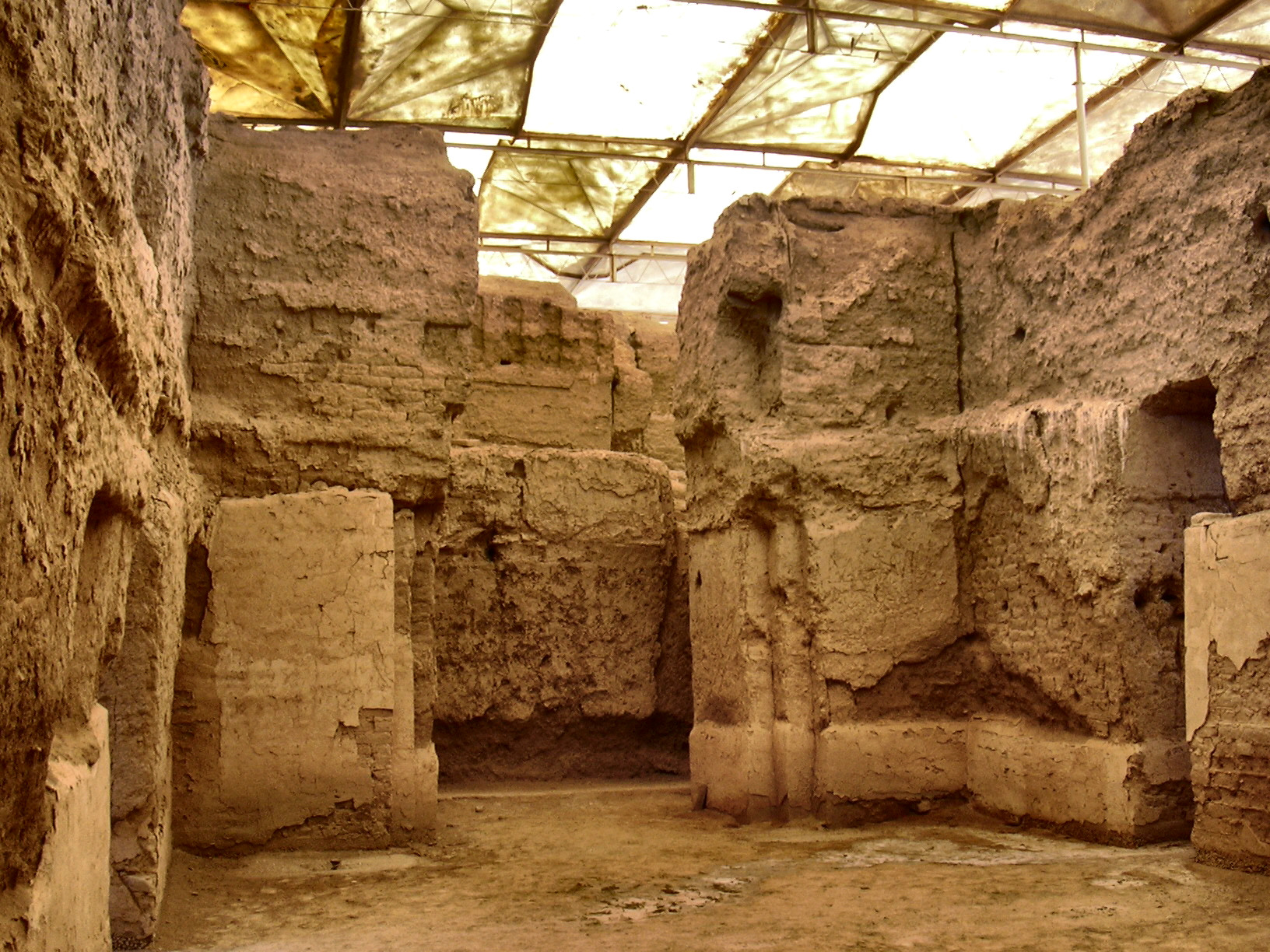
More detailed incidents survive in the correspondence sent by officials to Zimri-Lim and preserved in the palace archives at Mari, Tell Hariri. Senders, inspectors, and delegations attest to the involvement of different political authorities. These are selective administrative communications rather than full transcripts of everything that occurred at the water. The persons undergoing an ordeal could also be substitutes for the disputants rather than the disputants themselves. [4][6]
In ARM 26:249, the official Meptum reports a quarrel over a town and its land between Šubram and Ḫaya-sumu. One woman came out; an elder completed a stated distance and emerged safely; then another woman survived. The third woman is described as having been “overcome” by the River. When further women were not sent, a document was prepared renouncing future claims against Šubram's possession of the town and land. Jack SassonJack M. SassonHebrew Bible and ancient Near Eastern cultures scholar, Vanderbilt professor emeritus, also specializing in Mari’s archives.Glossary · Click to read the explanation interprets the phrase about the third woman as a euphemism for drowning. That is a reasoned interpretation, but the wording of the report and the inference of her death must not be conflated: not every reference to the River overcoming someone explicitly states a death. [4][6]
ARM 26:253, reported by Meptum, concerns an allegation of sorcery. A mother swore before the River that her daughter Marat-Ištar had not harmed a boy named Ḫammi-epuḫ. The mother died; the daughter's subsequent fate is not established by the report. The details used here come from Sasson's published explanation and translation of the AkkadianAkkadianAn ancient East Semitic language written in cuneiform from the third millennium BCE; its varieties include Babylonian and Assyrian, and it served in international diplomacy.Glossary · Click to read the explanation letter, not from a fresh collation of its tablet. Other Mari cases involve allegations of theft, disclosure of secrets, loyalty, or marital conduct. Sorcery was thus one application, not a demonstrably exclusive purpose of the ordeal. [4][6]
Procedure, outcomes, and disputed readings
The sources permit us to identify officials, observers, representatives of litigants and, in some accounts, oaths, read texts, or water-related gestures. These scattered elements cannot be combined into a compulsory script for every occasion. Verbs for approaching the River, emerging safely, being absolved, or being overcome may carry legal and religious implications; they do not alone specify water depth, exposure time, or a location that was always in the flowing Euphrates. [4][6]
One interpretation emphasizes a real river crossing or entry, supported by language of entering and emerging and by some descriptions of movement. Another associates certain ordeals with natural springs and bitumen-related features near Ḫīt. Each has textual support and assumptions; the letters do not resolve all physical details. In particular, reducing every outcome to “drowned or survived” oversimplifies the evidence. Töyräänvuori notes that one letter in the corpus she examines explicitly mentions a death, whereas Sasson infers a death from more indirect wording in another report. Neither the incompleteness of the records nor the small, unrepresentative group warrants statistical claims about the general survival rate, still less a practical reconstruction of a dangerous test. [4][6]
Numbers 5: drinking water rather than entering a river
In Numbers 5:11–31, a husband suspects marital infidelity without the usual proof. A priest presides over a rite involving consecrated water held in an earthen vessel, dust, written curses, and the woman's drinking of the water. Within the narrative, the effect of the curse distinguishes the outcomes. There is no crossing of a river or emergence from its waters. Both traditions refer an unresolved judgment to divine power, but they diverge in material actions, institutions, and participants. [5]
This short HebrewHebrewA Northwest Semitic language of the Canaanite group, encompassing Iron Age epigraphy, Biblical, Rabbinic, medieval and Modern Hebrew; its scripts and pronunciations changed over time.Glossary · Click to read the explanation quotation from Numbers 5:17 means “holy water in an earthen vessel.” The English rendering here is newly formulated for this entry, rather than a lengthy reproduction of a modern Bible translation. [5]
The story in Numbers is set during Israel's wilderness journey, which is narrative time, not the date when the extant literary formulation was composed. Its composition, editorial development, manuscript transmission, and subsequent translations belong to distinct chronological discussions; there is no simple agreed date for every paragraph. Zev Farber has proposed that the tension between Numbers 5:13, which speaks as though intercourse occurred, and 5:14, which allows that the wife either did or did not transgress, reflects editing that reshaped a purification rite into an ordeal of suspicion. This is an argued source-critical hypothesis, not a proven reconstruction of an actual ritual history. Functional resemblance alone cannot establish direct borrowing from Hammurabi or Mari. [2][7]
What the evidence supports
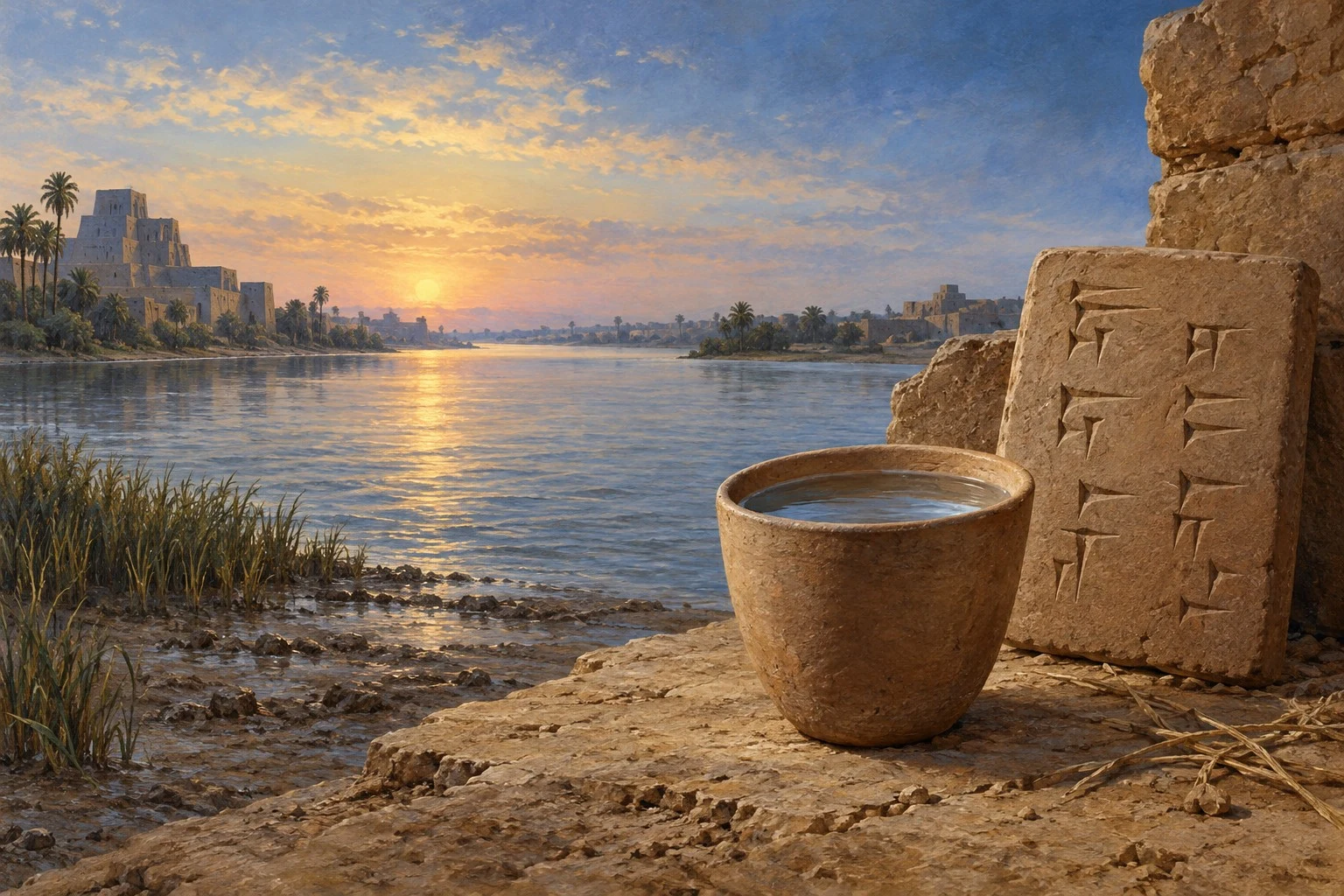
Taken together, normative provisions and case-reporting letters show that an ordeal involving the divine River was used, or envisaged, for disputes lacking satisfactory proof, across more than one kind of allegation and participant. Yet a law stipulates what ought to occur, a letter reports what its author chose to disclose, and a modern study interprets both. The existence and varied social functions of the practice can be supported; a fixed universal ritual, its prevalence, and all its physical consequences cannot. The accompanying river-and-vessel image is a modern explanatory illustration, not an archaeological witness to either rite. [1][3][4][6]
References and notes (7)
- Laws of Hammurabi in the CDLI composite edition; published transliteration and English gloss, not an independently collated tablet. CDLI P464358, Laws of Hammurapi (composite), §§2, 129, 131–132; §2 edition lines 311–336 (esp. 317–319). Return to the text ↑
- Society for Old Testament Study (SOTS), “Numbers,” entries on the name, narrative setting and contents. SOTS Wiki, “Numbers,” sections “Name” and “Contents”; especially Num 5:11–31. Return to the text ↑
- Ilya S. Arkhipov (2025), chapter on a Mari river-ordeal instruction; publisher abstract and bibliographic listing only, not the full chapter. Arkhipov, “On a Recently Published River Ordeal Instruction from Mari on the Euphrates (Late 19th Century BC),” in Greeks and Barbarians Networking… (Brill, 2025), pp. 242–256; publisher abstract only; DOI 10.1163/9789004310070_016. Return to the text ↑
- Jack M. Sasson (2022), discussion and translations of Mari dossiers; selected pages examined, without direct collation of the tablets. “From Babylon to Jerusalem: Water Ordeals in the Ancient World,” in A Community of Peoples (Brill, 2022), pp. 324–348; consulted printed pp. 325–334 and 337–339; DOI 10.1163/9789004511538_017. Return to the text ↑
- Numbers 5:11–31, especially the Hebrew wording of verse 17 in Sefaria; short primary-text quotation with editorial translations. Hebrew Bible, Numbers 5:11–31, esp. 5:14–17, 23–28; short Hebrew quotation from 5:17 (Sefaria). Return to the text ↑
- Joanna Töyräänvuori (2021), early evidence, Mari dossier, terminology, and disputed locations and outcomes; selected printed pages read. “Trial by Water through the Ages,” Studia Antiqua et Archaeologica 27/2 (2021), pp. 301–330; consulted printed pp. 303–305, 309–313, 317–321. Return to the text ↑
- Zev Farber (2025), a source-critical proposal on Numbers 5:13–14 and layers of the sotah rite; consulted argument, not treated as consensus. Farber, “Sotah: A Purification Ritual for an Adulteress Revised into an Ordeal,” TheTorah.com (2025), opening argument on Num 5:12–14 and editorial layers. Return to the text ↑
Suggest a correction · Suggest a source for this record
Cite this record
IL Archive, «River Ordeal: Divine Adjudication by Water», https://ilarchive.com/en/entities/river-ordeal
Continue reading