Entity · Deity
Sakkan, God of the Animals of the Steppe
A reference page linking a name, group, or concept to the materials that discuss it.
- Names
- Sakkan · Sumugan · Sumuqan · Šakkan
- Region
- Mesopotamia
Sakkan was a Mesopotamian god associated with ibexes, wild goats and other animals of the open country. Stories also place him among the rulers of Dunnu and among recipients of gifts in the netherworld.
Estimated reading time: 4 min Published Last reviewed:
Share article
Text
Introduction
Sakkan, also written Šakkan and known as Sumuqan in AkkadianAkkadianAn ancient East Semitic language written in cuneiform from the third millennium BCE; its varieties include Babylonian and Assyrian, and it served in international diplomacy.Glossary · Click to read the explanation, was a Mesopotamian god associated with the animals of the open country. In the Sumerian composition EnkiEnkiMesopotamian deity also known as Ea, linked with Eridu and the Abzu (deep fresh waters), wisdom, incantations, and narratives of creation and cosmic order. Later written attestations do not identify the deity of Eridu’s earliest layers.Glossary · Click to read the explanation and the World Order, Enki gives him charge of the creatures of the uplands after making their pastures green and their numbers grow. The poem names ibexes and wild goats and calls Sakkan the king of the hills. Other texts extend his associations to donkeys and to the netherworld. [1][2]
The TheogonyHesiod’s TheogonyGreek poem on divine generations and Zeus’s kingship; its surviving form does not identify all of Hesiod’s sources.Glossary · Click to read the explanation of Dunnu gives Sakkan a role as one of the earliest rulers of a city. The composition relates his birth, his seizure of power and his death at the hands of his son. Its account of succession can be read alongside texts that assign him special authority over animals. Each composition puts the god’s authority to work in a different setting. [1][3]
The land outside the folds
In Enki and the World Order, the upland plain receives a crown, a beard of lapis lazuli and a covering of vegetation. The language gives a large tract of land the appearance of a figure who can be dressed and adorned. Enki increases the numbers of its animals, including the ibexes and wild goats of its pastures. The titles given to Sakkan at his appointment draw on the land and its creatures. He is called a lion of the high plain and given strength associated with EnlilEnlilEnlil/Ellil: a major Mesopotamian god associated with destinies, kingship, and Ekur at Nippur, already prominent in third-millennium god lists. His name’s origin and cult beginnings remain debated.Glossary · Click to read the explanation. [1]
The next episode gives Dumuzid responsibility for sheepfolds and cow-pens. Milk, fat and their abundance belong to that part of the narrative. Putting the appointments next to one another makes the location of Sakkan’s domain clearer. Enki gives the open country and the managed enclosures their own divine overseers. Earlier passages similarly assign cultivation and irrigation to Enkimdu and account for the accumulation of crops under Ezina. [1]
The animals of Sakkan also appear in the hymn for InannaInanna / IshtarA prominent Mesopotamian goddess whose Sumerian name Inanna became associated with Akkadian Ishtar across diverse traditions. She was associated with desire, war, royal authority and Venus, while local forms and genealogies varied among texts.Glossary · Click to read the explanation and Iddin-Dagan. As the evening star rises, the poem places people, yoked oxen, sheep in pens and the creatures of the plain within the same scene. Sakkan’s animals belong to the part of the catalogue that reaches into the open country. A hymn to Ninurta calls Sakkan lord of donkeys and says he sets donkey foals at Ninurta’s feet. The two hymns invoke him through particular groups of animals without assigning a single species to all his appearances. [2][4][5]
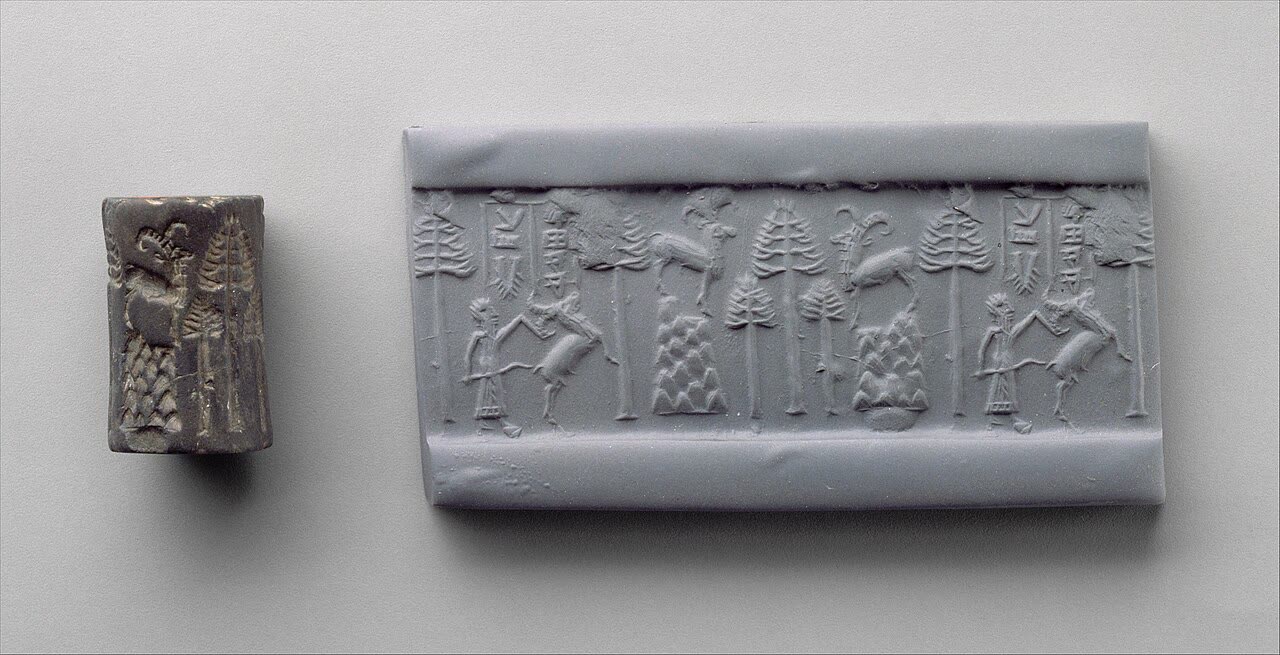
Ibexes on an Akkadian seal
A cylinder sealCylinder sealSmall engraved cylinder rolled over soft clay to leave an extended image. Used to secure, document and identify administrative actions; its pictures do not automatically constitute writing.Glossary · Click to read the explanation belonging to a cupbearer named Balu-ili shows how an ancient engraver placed ibexes in a landscape. The Metropolitan Museum of Art describes two groups in its design. A hunter grasps one animal between trees, while in the other group ibexes face each other on mountains. The scene pairs trees and uplands with a species named among Sakkan’s charges in the Sumerian poem. The museum identifies the picture as a hunt. [1][6]
Rulers of Dunnu
In the Theogony of Dunnu, the surviving opening describes the first pair bringing the Sea into existence with the stroke of a plough. Sakkan is then born, and the gods establish Dunnu. Ha’in takes lordship there. Wilfred G. Lambert’s edition presents Sakkan as his son and gives one possible account of the relationships implied by the damaged opening. Part of that opening is lost. [3]
Sakkan marries Earth, his mother, and kills his father. He lays his father to rest in Dunnu and takes over his position. The damaged text also records a marriage to Sea, described as his sister. Their son Lahar kills Sakkan and lays him to rest in the city. Further generations continue the succession. The composition gives dates for some transfers of rule, including the sixteenth day of Kislimu for the assumption of lordship and kingship after Sakkan’s death. [3]
Sakkan’s place in this story depends on descent and succession. Dunnu is named as the place of burial as well as the centre of overlordship. The repeated return to the city ties the changes in the ruling family to one place. Lambert notes that Sakkan’s two marriages make his generation unusual within the preserved sequence. [3]
Gifts and appearances below ground
The Sumerian Death of Gilgamesh includes Sumugan in a list of recipients of audience gifts. The list also names gods of the Holy Mound and deceased religious personnel. In the Babylonian Epic of Gilgamesh, Enkidu sees Sumuqan in the company of Etana and EreshkigalEreshkigalMesopotamian goddess ruling the netherworld; Inanna’s sister in descent texts, with varying accounts of her relationship with Nergal.Glossary · Click to read the explanation in his vision of the dead. The first text approaches the god through a gift, while the latter places him among figures encountered in a vision. [2][7][8]
The association was available to other writers as well. The speaker of Ludlul bēl nēmeqiLudlul bēl nēmeqiBabylonian Akkadian poem about Šubši-mešrê-Šakkan, his suffering, recovery, and praise of Marduk, examined through its five tablets, manuscript witnesses, dating, and qualified comparison with Job.Glossary · Click to read the explanation bears a name that appeals to Sakkan to create wealth. Anthony P. SooHoo reads the name in light of the speaker’s initial prosperity and suggests that Sakkan’s connection with the netherworld can give it further resonance as his fortunes change. The interpretation depends on the way the name works in that poem. In the Sumerian account of the uplands, the appointment still gives the fullest picture of Sakkan’s animals and the landscape under his care. [1][8]
References and notes (8)
- Electronic Text Corpus of Sumerian Literature, Enki and the World Order Read lines 318–367 on cultivation, the upland plain, Sakkan’s appointment over its animals and the assignment of folds and pens to Dumuzid. Return to the text ↑
- Jeremy Black and Anthony Green, Gods, Demons and Symbols of Ancient Mesopotamia, Šakkan Read the entry on the names, the god’s protection and fertility of wild animals and his appearance in the underworld of the Babylonian Gilgamesh epic. Return to the text ↑
- Wilfred G. Lambert, Babylonian Creation Myths, The Theogony of Dunnu Read the introductory genealogy, discussion of the damaged opening and translation of lines 3–24 on the family relationships, funerals and succession. Return to the text ↑
- Electronic Text Corpus of Sumerian Literature, Inana and Iddin-Dagan Read lines 89–105 on the rising evening star, Sakkan’s animals and the larger scene of devotion. Return to the text ↑
- Electronic Text Corpus of Sumerian Literature, A Shir-namshub to Ninurta Read lines 38–57 on the donkey foals and the title given to Sakkan. Return to the text ↑
- Metropolitan Museum of Art, Cylinder Seal and Modern Impression: Hunting Scene, 41.160.192 Read the museum’s description of the inscription naming Balu-ili, the two parts of the setting and the ibexes on mountains. Return to the text ↑
- Electronic Text Corpus of Sumerian Literature, The Death of Gilgamesh Read the Nibru version’s gift list naming Sumugan and the other recipients. Return to the text ↑
- Anthony P. SooHoo, Lament and Hope in Ludlul Bēl Nēmeqi Read the discussion of the speaker’s name, the associations with prosperity and the netherworld, and the references to the two Gilgamesh compositions. Return to the text ↑
Suggest a correction · Suggest a source for this record
Cite this record
IL Archive, «Sakkan, God of the Animals of the Steppe», https://ilarchive.com/en/entities/sakkan