Entity
Sotah Ritual: The Suspected Wife’s Ordeal
A reference page linking a name, group, or concept to the materials that discuss it.
A jealousy-and-oath procedure in Numbers 5:11–31 bringing a suspected wife before the priest and the water of the curse; readings of the bodily outcome differ, and its description does not prove its historical frequency.
Estimated reading time: 10 min Published Last reviewed:
Share article
Text
Introduction
The Book of NumbersBook of NumbersTorah book addressing daughters’ inheritance and tribal retention of land.Glossary · Click to read the explanation 5:11–31 describes a religious and legal procedure that, within the world of the text, addresses a husband's suspicion of his wife's fidelity when witnesses cannot resolve the allegation. The woman is required to take an oath before a priest and drink what the passage calls the “bitter water that brings the curse”; its outcome is assigned to a conditional divine judgment. “Sotah,” a HebrewHebrewA Northwest Semitic language of the Canaanite group, encompassing Iron Age epigraphy, Biblical, Rabbinic, medieval and Modern Hebrew; its scripts and pronunciations changed over time.Glossary · Click to read the explanation designation made familiar by later rabbinic literature, is associated with the verb for straying or turning aside. The name does not itself establish that the ceremony took place historically.
This entry examines the law's wording, conditions, and consequences, distinguishing the text from successive stages of its interpretation and from what can be established about practice. A written prescription cannot demonstrate that every part was performed as described, or that the water functioned as a medically identifiable drug or poison. [3]
Suspicion and the absence of witnesses
The case begins with a wife represented as having “strayed,” and a sexual encounter with another man that cannot be established through witnesses or detection in the act. Yet verse 5:14 explicitly offers two alternatives: the woman may actually have become defiled, or she may not have become defiled although a “spirit of jealousy” has come over her husband. Thus the absence of ordinary proof is central to the case, and jealousy itself does not count as proof of adultery. The phrase often rendered “she was not caught” in 5:13 has also been understood as “she was not forced”; translations of this difficult expression should not conceal the difference. [3][5]
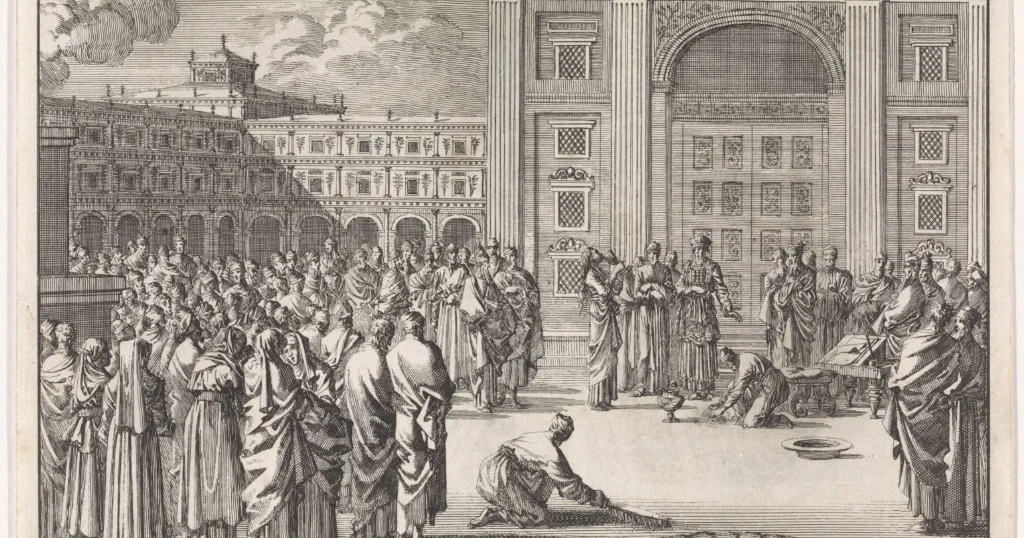
The husband brings the woman before the priest and presents a tenth of an ephah of barley flour on her behalf, without oil or frankincense. The offering is named both an “offering of jealousy” and an “offering of remembrance.” The priest then stations the woman before YHWHYahwehThe proper name of Israel’s deity, written יהוה (YHWH), the Tetragrammaton. Its exact ancient pronunciation is not directly preserved; texts and inscriptions witness its history.Glossary · Click to read the explanation, loosens or uncovers her hair—the Hebrew verb permits discussion about the precise gesture—and places the offering in her hands. No corresponding procedure is laid down for a husband suspected of unfaithfulness. This is a structural asymmetry in who may initiate an accusation and whose body undergoes examination, even though the passage also recognizes that the woman might be innocent. [3][7]
Oath, water, and erased writing
The setting is the tabernacleTabernacle in the biblical narrativeNarrative worship tent whose floor supplies dust in Numbers 5.Glossary · Click to read the explanation, the portable sanctuary in the wilderness narrative about the Israelites. The priest uses holy water in an earthenware vessel and dust taken from the tabernacle floor. He administers a conditional oath: if no other man has slept with the woman, the curse is to leave her unharmed; if she has been unfaithful, the words invoke a degrading bodily outcome. She replies “Amen, amen.” The curses are written on a scroll and their writing is erased into the water. Part of the barley offering is also presented on the altar. These are elements of a normative ritualRitualAn organised or distinguished practice meaningful to a community; it may leave traces, but its form alone does not reveal an associated doctrine.Glossary · Click to read the explanation text, not a usable chemical recipe or evidence for a uniquely identifiable substance. [3]
Verse 5:24 describes the woman drinking, while 5:26 places the drinking after the offering. In a reading of the passage as a unified ceremony, this can be understood as summary and subsequent execution, or as a distinction between introducing the water and the act itself. It has also been used to argue that the passage combines different editorial layers. Repetition alone cannot securely date a revision or warrant inventing separate stages of performance. [3][8]
What does the bodily outcome mean?
The curse names the “belly” (בטן) and “thigh” (ירך) alongside verbs of swelling and falling or collapsing. “Thigh” can be used in expressions related to procreation or the sexual organs, but can also denote a part of the body. The wording therefore does not impose a single medical interpretation. In a familiar reading, the guilty woman suffers a bodily sign and punishment, whereas the innocent woman is cleared and receives the prospect of offspring. But the initial case never says the woman is pregnant, and neither abortion nor a particular disease is explicitly named. [3][9]
Richard Elliott Friedman has proposed that aspects of the bodily outcome concern pregnancy and might expose adultery. That construction, however, requires assumptions about a pre-existing pregnancy and its relationship to the husband that the passage does not state. Aslan Cohen Mizrahi reads the consequence as an illness that marks an offense against divine sovereignty, calling it “dropsy” in his scholarly argument; the medical label is a modern interpretation, not a clinical diagnosis contained in the Hebrew wording. What the verses most securely establish is the contrast between innocence, curse, and fertility—not a demonstrated biological mechanism. [7][9][19]
Jealousy, guilt, and authority
Hanna Liss draws attention to the repeated Hebrew root קנא, denoting jealousy or zeal, in the law's description of the husband, offering, and procedure. She proposes that one purpose of the ritual is to allow the husband to remain married while his religious position is cleared, rather than simply to convict the wife. Her evidence includes the closing statement that the man is “free of guilt” and the idea that defilement may affect both spouses. This is an interpretation of the passage's function, not an independent report documenting a historical performance. [5]
Where that argument foregrounds the marital relationship, Cohen Mizrahi reads the conditional legal form as requiring the husband to bring the matter under YHWH's jurisdiction. The woman's appearance and the unusual offering, in his account, stage a confrontation with divine authority. The evidence for this approach lies chiefly in the case-law construction and the prominence of priest, curse, and deity. Yet turning an “if this occurs, do that” clause into a duty applying to every husband entails an interpretive judgment: the verses provide no account of how enforcement worked in society. These approaches illuminate real features of the text—the husband's jealousy and the priestly claim to divine judgment—but neither can be proven to express its only historical purpose. [3][7]
Socially, the husband initiates the referral, the priest conducts the proceedings, and the wife's body bears the ordeal of establishing innocence. This does not make suspicion true; neither should the explicit possibility of her acquittal be omitted. Later accounts of humiliation or coercion must be assigned to the sources in which they occur, not projected without evidence onto the narrative wilderness period or present-day religious communities. [3][11]
One text or successive revisions?
Zev Farber reconstructs an earlier priestly passage focused on an acknowledged sexual transgression and an offering or purification initiated by the woman. He then proposes that Holiness-oriented editors reworked it into an ordeal driven by the husband's suspicion. He points to 5:12–13, where the infidelity is narrated as an event, as against the possible innocence in 5:14; to the repeated drinking instruction; and to tensions in the offering narrative. These are textual problems worth addressing, but the Hebrew text consulted offers no explicit division that independently attests the hypothesized layers, and Farber's reconstructed earlier text is not attested as an independent manuscript. [8]
Alternatively, the final form can be read as a legal hypothetical that combines an envisaged offense, its concealment, and the possibility that the husband is mistaken. Reading the completed passage coherently does not rule out older stages of growth; conversely, proposing layers does not automatically date them. It is important to distinguish what the extant text says—a conditional ordeal without sufficient human proof—from contested hypotheses about how that text was assembled. [3][8]
Later witnesses: Josephus and the Mishnah
In the late first century CE, the Jewish historian Flavius Josephus retold the sotah law from NumbersBook of NumbersTorah book addressing daughters’ inheritance and tribal retention of land.Glossary · Click to read the explanation in his Jewish Antiquities. In his presentation the priest writes God's name, innocence is signaled by the birth of a son, and the guilty woman dies with a swollen belly described as dropsy. These details are not identical to Numbers' instruction to write the “curses”; nor are they an independent account of a particular ceremony Josephus witnessed. They show how the biblical passage could be elaborated in Jewish interpretation during the Roman period. [3][13]
The MishnahMishnahThe Mishnah is a rabbinic compilation assembled around 200 CE, organizing teachings and discussions by topic.Glossary · Click to read the explanation, a collection of rabbinic legal teachings compiled around 200 CE, offers more precise procedural rules. Mishnah Sotah 1:1 preserves a disagreement: Rabbi Eliezer requires two witnesses to the warning but accepts one witness to seclusion, or the husband's own testimony; Rabbi Joshua requires two witnesses for both. Mishnah Sotah 3:3–4 considers refusal to drink before or after the written words have been erased, including a depiction of coercion following erasure. These are later rabbinic treatments of authority and consent; their additional details are not set out in Numbers. [10][11][17]
Mishnah Sotah 9:9 attributes the cessation of the procedure to Rabban Yohanan ben Zakkai and associates it with widespread sexual misconduct, quoting Hosea 4:14 in a context also critical of men's behavior. This establishes that a rabbinic tradition remembered a practice as discontinued. It cannot alone establish how often the ordeal actually took place, precisely when it stopped, or whether the Mishnah's procedures describe those of an earlier period. [12][17]
Comparison with Babylonian river ordeal
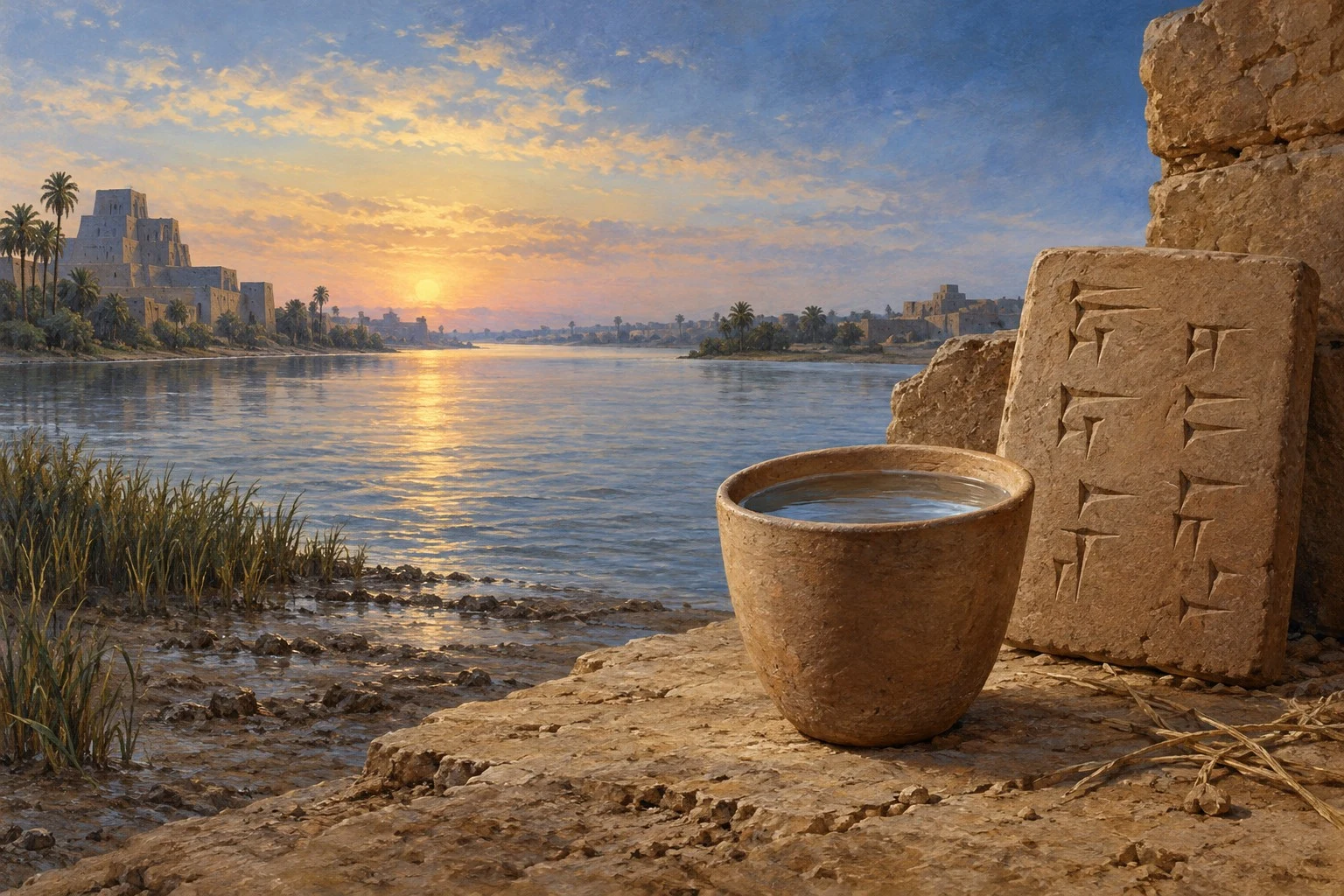
The Laws of HammurabiLaws of HammurabiAn eighteenth-century BCE Babylonian legal text in Akkadian, presenting property, family, labor and injury provisions within Hammurabi’s account of justice.Glossary · Click to read the explanation, associated with an eighteenth-century BCE ruler of BabylonBabylonBabylon is an ancient city in central present-day Iraq, south of BaghdadGlossary · Click to read the explanation, offer an earlier legal response to allegations that cannot be settled by ordinary witnesses. Under §131, a wife accused by her husband but not caught with another man takes an oath and returns home. Under §132, a woman against whom an accusation involving another man has circulated, though she was not caught, is directed to submit to the river ordeal “for her husband's sake,” in published translations. This cuneiformCuneiformWriting with wedge-shaped signs, developed from Mesopotamian recording traditions and used for several languages from the third millennium BCE.Glossary · Click to read the explanation legal tradition describes a different procedure from swallowing water into which written curses have been washed at an Israelite sanctuary. [14][15]
Both examples concern insufficient evidence, appeal to divine adjudication, and a test focused on a woman. They differ, however, in the circumstances triggering the case, the medium of the ordeal, its administration, and its expected outcome. Immersion in a river is not equivalent to drinking the water of Numbers. The greater antiquity of the Babylonian text does not prove direct borrowing or uninterrupted institutional continuity; independent evidence would be required to trace such transmission. The retained cover is an openly modern symbolic drawing rather than a photograph of a cuneiform document relating to Numbers. [3][14]
Chronology and limits of evidence
- Around the eighteenth century BCE: HammurabiHammurabiKing of Babylon in Mesopotamia, reigning around 1792–1750 BCE. A celebrated legal text preserved on a stele and cuneiform copies bears his name.Glossary · Click to read the explanation's reign in Babylon and the legal witness concerning a river ordeal; this is not a date for composing Numbers 5. [15]
- Narrative setting of the TorahTorah / PentateuchThe first five books of the Jewish and Christian Bible: Genesis, Exodus, Leviticus, Numbers and Deuteronomy. They combine narrative and law from creation to Moses’ death; in Jewish usage, “Torah” can also encompass a wider body of authoritative teaching.Glossary · Click to read the explanation: the Israelites' wilderness journey and the tabernacle; a literary setting, not a securely dated occasion of composition or performance. [3]
- Formation and editing of priestly Torah traditions: debated by scholars within the first millennium BCE, with influential proposals emphasizing exilic and post-exilic periods; the passage itself cannot assign one year or resolve all layered-text theories. [8]
- Mid- to late third century BCE: translation of the Pentateuch into Greek in Ptolemaic Egypt; evidence for a translation's date rather than the narrative's setting. [16]
- Late first century CE: Josephus' discussion of the rite in Jewish Antiquities 3.270–273. [13]
- Around 200 CE: principal compilation of the Mishnah, including Sotah and traditions attributed to earlier teachers. [17]
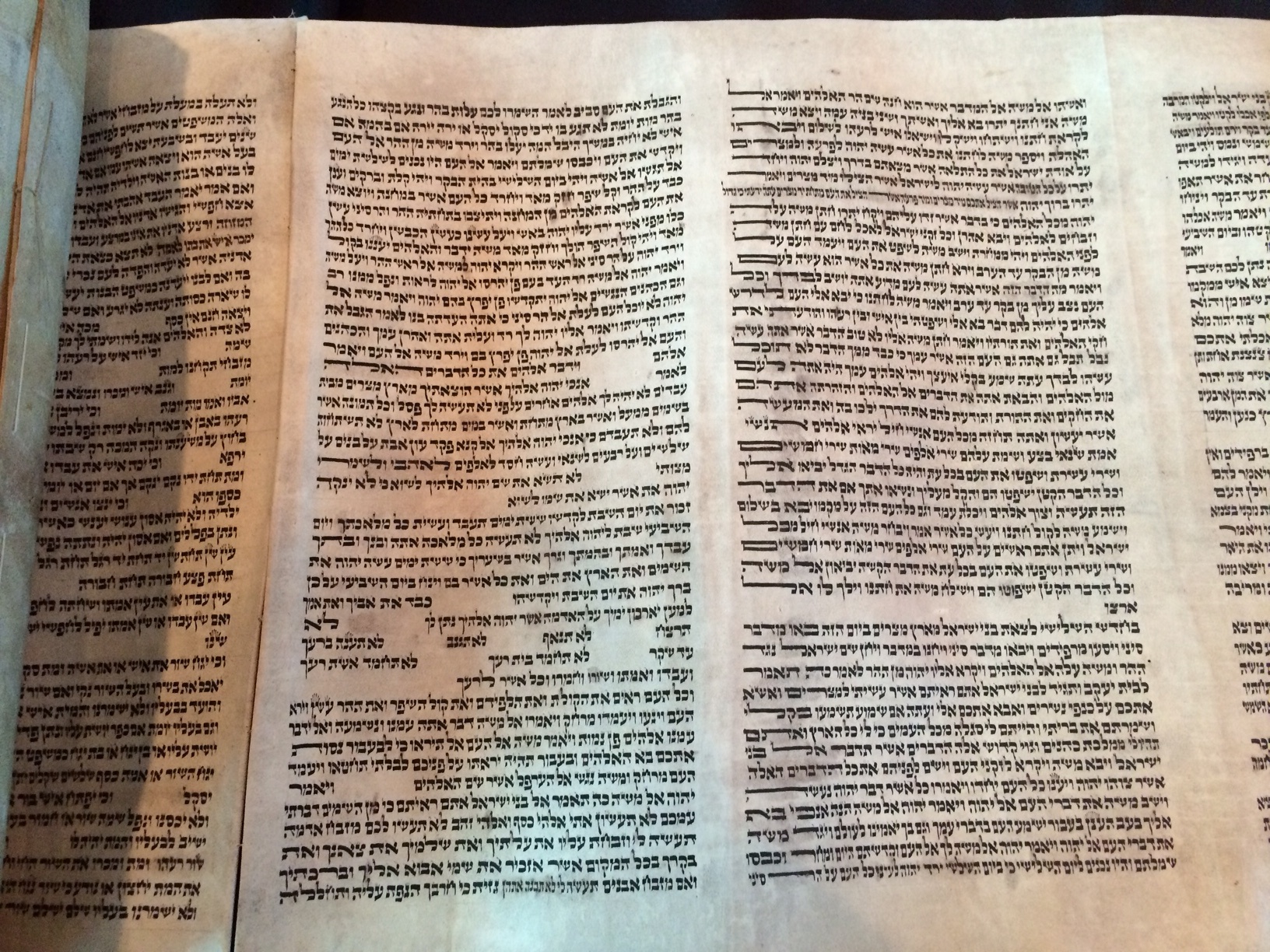
- 1008–1009 CE: date of the complete Hebrew Masoretic Leningrad Codex, a much later manuscript witness, not a date for the law. This review did not collate Numbers 5 against photographs of that codex or a critical apparatus. [18]
The secure conclusion is that we possess a biblical prescription for a conditional judgment through oath and curse, later interpretive and legal traditions, and an older but structurally distinct Babylonian comparison. None of these sources alone supplies statistics on actual sotah performances, a medically specific explanation of their supposed outcome, or proof of direct derivation from the river ordeal. A historical reading has to preserve those limits while analyzing jealousy, social power, and the vulnerable position of the woman's body within the text. [3][8][12]
References and notes (15)
- Numbers 5:11–31 in Hebrew and JPS 1917; not a manuscript-critical collation Numbers 5:11–31, Hebrew and JPS 1917 Return to the text ↑
- Hanna Liss on the sotah rite and marital jealousy; full accessible article, not all its sources Hanna Liss, The Sotah Ritual: Permitting a Jealous Husband to Remain with His Wife (2019, updated 2026) Return to the text ↑
- Aslan Cohen Mizrahi, recent reading of the suspected-wife ordeal; accessible article and selected notes Aslan Cohen Mizrahi, The Suspected Adulteress Ordeal: A Ritual that Provokes YHWH (2026), body and selected notes Return to the text ↑
- Zev Farber, “Sotah: A Purification Ritual for an Adulteress Revised into an Ordeal,” TheTorah.com, 13 June 2025 (updated 6 October 2026); proposal for textual layers and supporting arguments. Full accessible article and notes 1–6; Numbers 5:12–14 and 24–26 Return to the text ↑
- Richard Elliott Friedman, “The Sotah: Why Is This Case Different from All Other Cases?” in Ian Provan and Mark Boda (eds.), Let Us Go Up to Zion: Essays in Honour of H. G. M. Williamson (Brill, 2012); bodily-language and pregnancy hypothesis. Printed pp. 371–382; 12 pages in the consulted PDF Return to the text ↑
- Mishnah, Sotah 1:1, Hebrew and displayed English translation at Sefaria; Eliezer and Joshua on witnesses for warning and seclusion. Sotah 1:1, first mishnah only Return to the text ↑
- Mishnah Sotah 3:3–4, Posen Library, adapted translation by Joshua Kulp; refusal and coercion rules, accessed through English translation, without direct Hebrew collation. Accessible §§3–4 and editorial introduction Return to the text ↑
- Mishnah Sotah 9:9, Hebrew text at AllMishnah and discussion at Posen Library; reported cessation of bitter water under Yohanan ben Zakkai, not a quantitative record of performances. Sotah 9:9, bitter-water clause Return to the text ↑
- Flavius Josephus, Jewish Antiquities 3.270–273, William Whiston’s English translation at Lexundria; original Greek not independently collated. Book 3, §§270–273 Return to the text ↑
- Laws of Hammurabi §§131–132, Robert Francis Harper’s historical English translation reproduced by Wikisource; original Akkadian not directly collated. Only §§131 and 132; oath versus river ordeal Return to the text ↑
- Musée du Louvre, collection record for the Hammurabi law stele, inventory SB 8; object identity, script, origin and reign date, with no museum photograph reused. Object record SB 8; Babylon/Susa, Hammurabi reign c. 1792–1750 BCE Return to the text ↑
- Leonard J. Greenspoon, revised by William A. Ross, “Septuagint,” Oxford Bibliographies (2011; revised 2024); freely accessible introduction only, on dating the Greek Pentateuch. Public introduction extract only, not the entire paid article Return to the text ↑
- Martin Goodman, “Mishnah,” Oxford Classical Dictionary (2015); publicly available abstract only, dating the principal compilation to c. 200 CE. Publisher extract/abstract only Return to the text ↑
- National Library of Israel catalogue entry for the Leningrad Codex held by the National Library of Russia, Ms. EVR I B 19a; catalogue metadata and date 1008–1009 CE only, not a collation of Numbers 5 folios. Catalogue record Ms. EVR I B 19a, date and identity only Return to the text ↑
- Aslan Cohen Mizrahi, “The Suspected Adulteress (śôṭâ) as Sovereign Threat,” The Journal of Religion 106/2 (2026):154–183; publisher abstract only; detailed reasoning sourced separately from his accessible essay [7]. Publisher abstract only; pp. 154–183 is the article’s range, not pages read Return to the text ↑
Suggest a correction · Suggest a source for this record
Cite this record
IL Archive, «Sotah Ritual: The Suspected Wife’s Ordeal», https://ilarchive.com/en/entities/sotah-ritual
Continue reading