Entity
Testament of Solomon
A reference page linking a name, group, or concept to the materials that discuss it.
A critical introduction to the Testament of Solomon: ring, spirits, Temple-building, decans, narrative layers, Greek witnesses and papyrus, dating hypotheses, and limits of Jewish, Christian and Qur’anic parallels.
Estimated reading time: 7 min Published Last reviewed:
Share article
Text
Introduction
The Testament of Solomon is a pseudepigraphic religious narrative presented in the voice of King SolomonSolomonSolomon is the biblical king, David’s son, associated in Kings with Jerusalem and building the templeGlossary · Click to read the explanation. It combines the construction of the JerusalemJerusalemJerusalem is a city of religious importance in Judaism, Christianity and IslamGlossary · Click to read the explanation Temple with the interrogation and coercion of spirits. A ring, angelic names, and threats attributed to unseen beings dominate the story, which ends when the king forfeits his authority by disobeying his God. It is neither the biblical book of Proverbs nor the Song of Songs nor a Solomonic psalm, and it is not a document from the period when the Temple was built. Its surviving early witnesses are Greek, and the transmitted texts do not represent a single unchanging version: the narrated age of the king must be distinguished from the composition and copying of the work.[12]
The story: a ring, workmen, and spirits
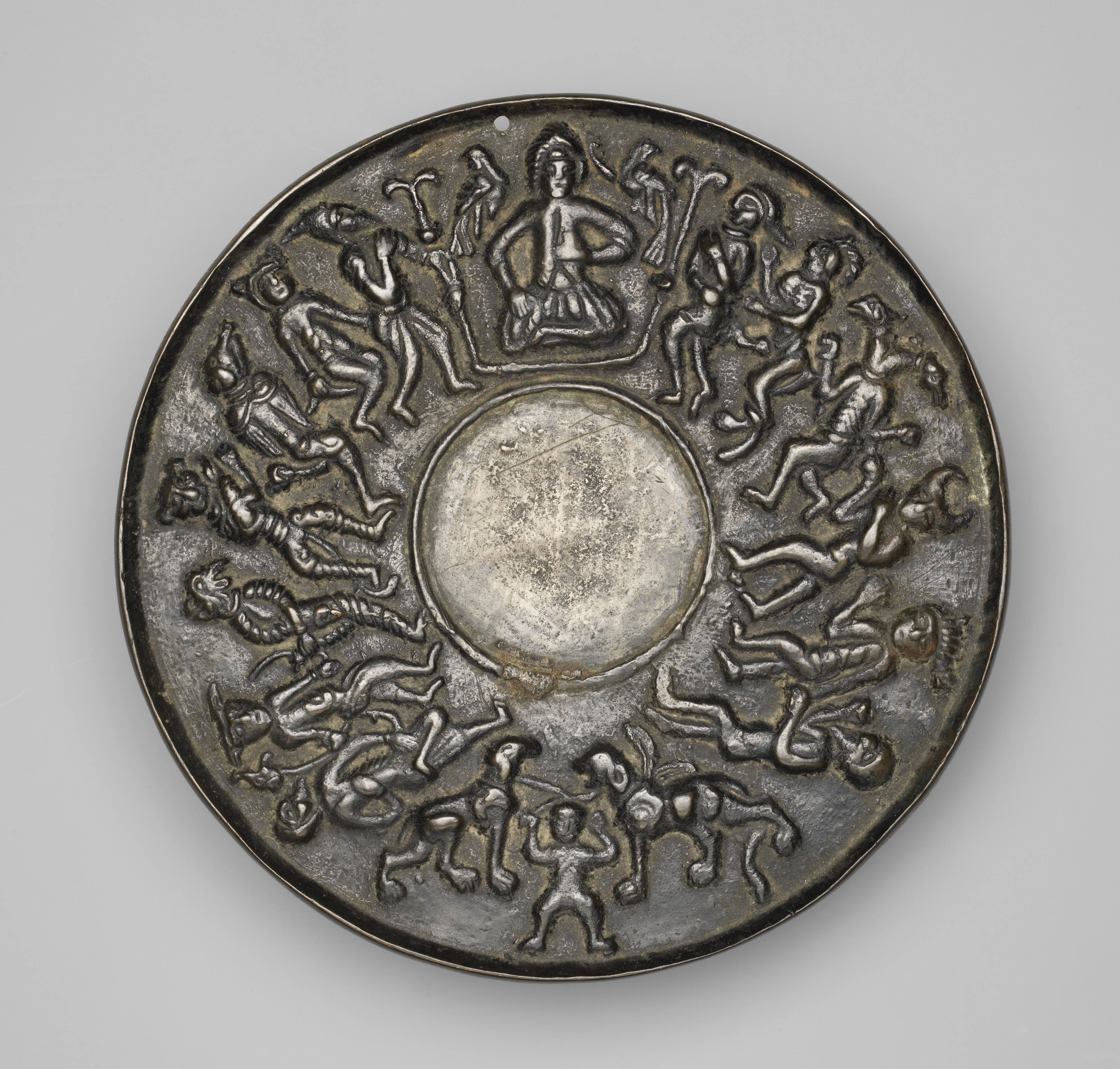
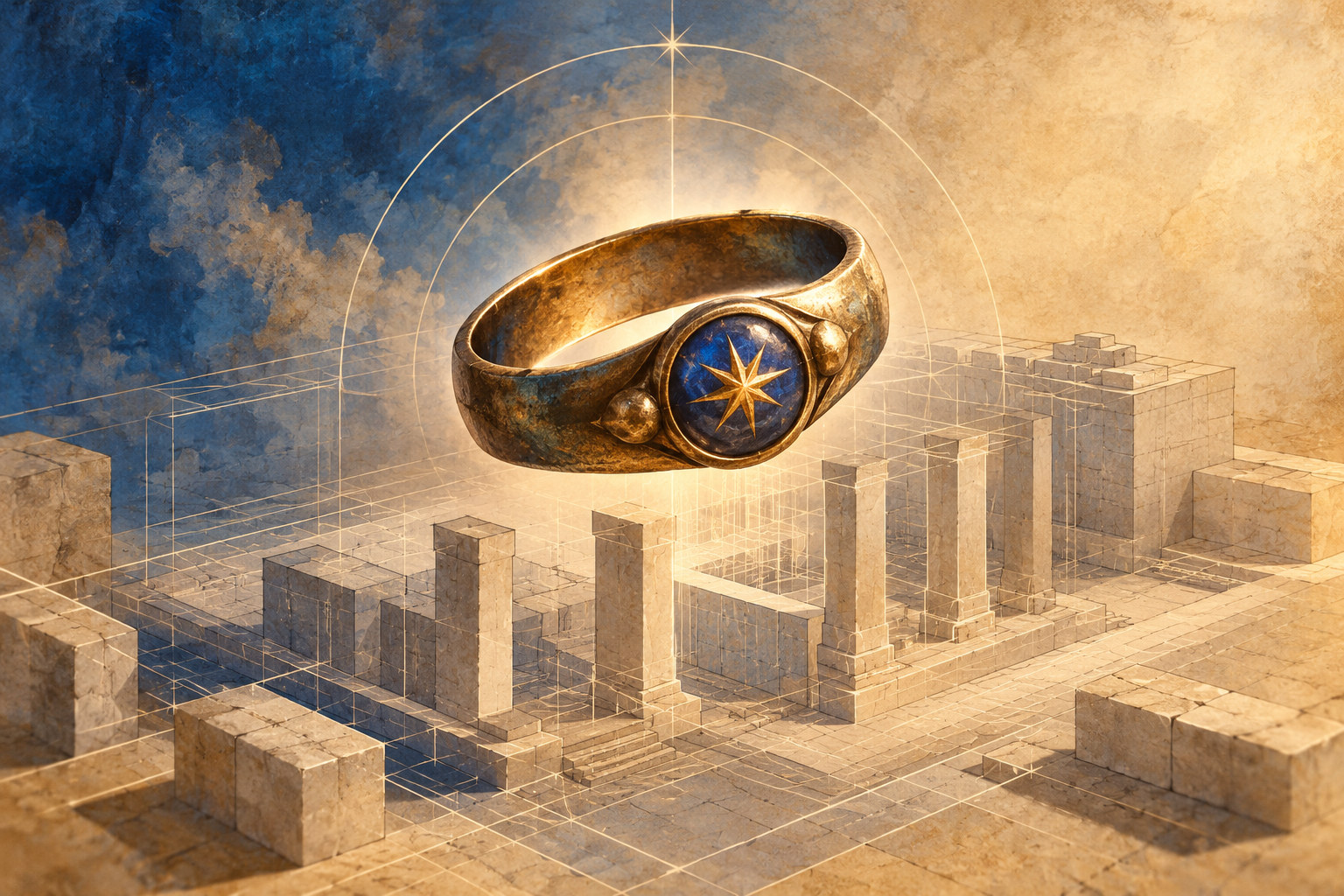
In the version translated by F. C. Conybeare, a boy working among the builders is tormented by OrniasOrniasA harmful spirit named in the Greek Testament of Solomon, whose capture begins the ring-and-Temple narrative.Glossary · Click to read the explanation, a harmful spirit that takes his food and wages. Solomon prays, and MichaelMichael / MīkālA name meaning “Who is like God?”, borne by humans and an angel. The angel protects Daniel’s people, is called archangel in Jude and fights the dragon in Revelation. The Qurʾan names Mīkāl without assigning a task; later traditions develop different roles.Glossary · Click to read the explanation brings him a ring, described in that version as bearing a five-pointed engraving. The boy uses it to bring Ornias to court. Beelzeboul, chief of the demons, is summoned in turn, and other figures are interrogated about their names, their actions, and the forces that frustrate them. This is not a documented event from the king's lifetime: the narrative makes knowledge of names and seals a means of setting antagonistic beings to work on the Temple.[1]
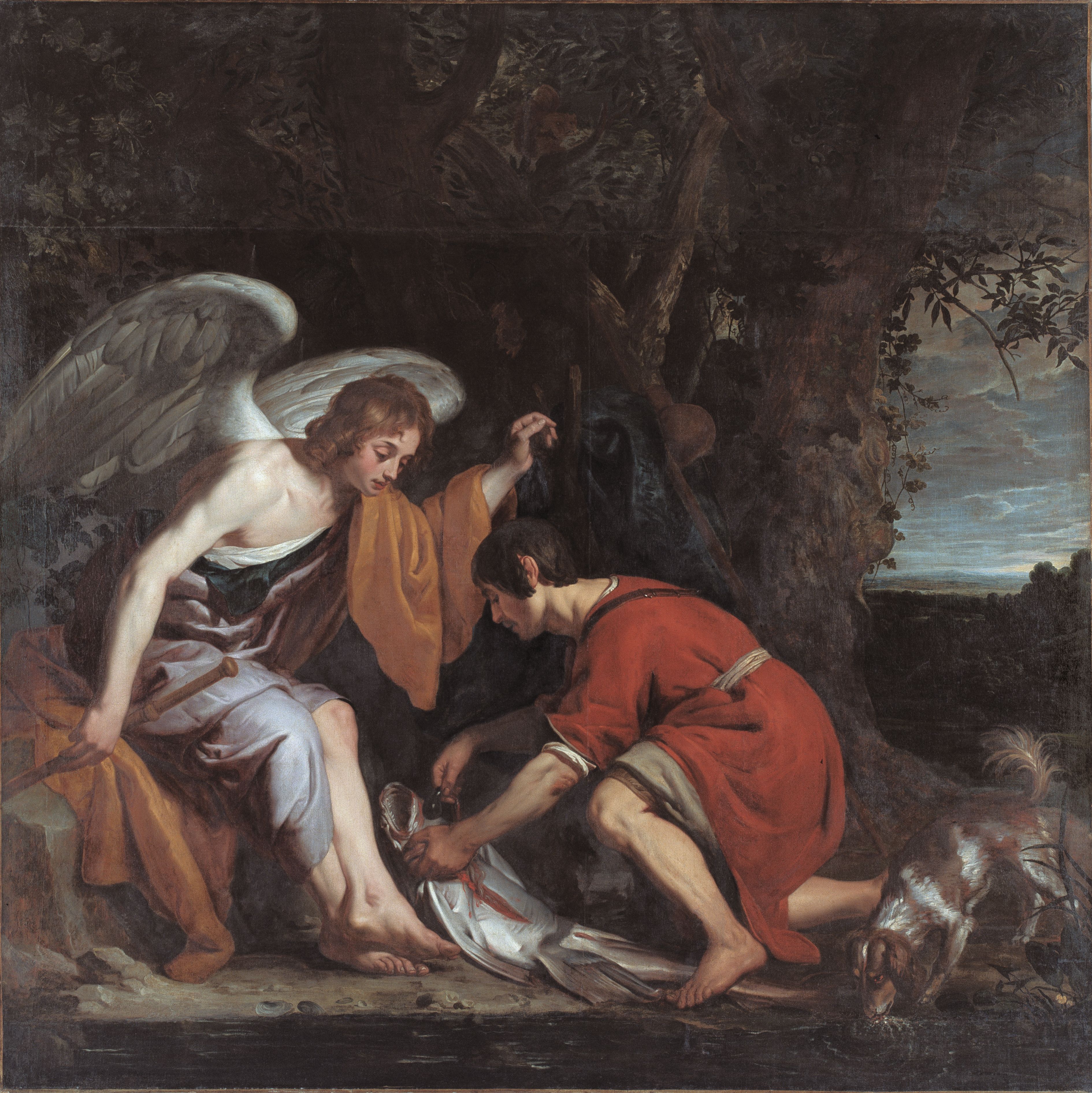
Among them is Asmodeus, whom the Testament associates with hostility to marriage and with Raphael and smoke from parts of a fish. The narrative motifs overlap clearly with the Book of TobitBook of TobitJewish story of a family in Assyria, combining adversity, prayer, journey and almsgiving, and naming Ahiqar.Glossary · Click to read the explanation, where RaphaelRaphael / RephaelRaphael means “God has healed,” a name borne by a human in Chronicles and an angel in Tobit and 1 Enoch. In Tobit he accompanies the travelling son, helps heal the father and presents prayer before God; in Enoch he executes judgment and explains the places of the dead. Similarity of names does not settle his relationship to Israfil.Glossary · Click to read the explanation pursues the spirit threatening Sarah and fish organs feature in the account. This is a specific parallel, not proof that the Testament's compiler copied any particular edition of Tobit. Neither text's descriptions of protection or healing should be offered to a modern reader as a medical or ritualRitualAn organised or distinguished practice meaningful to a community; it may leave traces, but its form alone does not reveal an associated doctrine.Glossary · Click to read the explanation procedure.[2]
The spirits do more than submit to confinement: some cut stone or carry wood. Later Ephippas, a wind spirit said to come from Arabia, helps lift a corner stone of the Temple; Abezithibod is brought from the Red Sea to help support a column that, according to the narrator, will remain suspended until the world's end. This miraculous architecture belongs to the literary claim of the tale, not to an archaeological description of the Temple.[4]
The demon catalogue and a readable witness
A distinctive unit, chapter 18 in Chester McCown's numbering, assembles thirty-six decans: divisions of the zodiac reimagined here as powers associated with human body parts and afflictions. In the narrative each spirit has a corresponding angelic name or power that can overcome it, and some versions feature written protective formulas. These passages illuminate the meeting of older astral systems with protective and healing literature; they do not demonstrate that the prescribed means work. The unit's numerical arrangement and marked literary form have led scholars to consider whether some of its material circulated independently.[3][6]
The first sentence is a short excerpt of Conybeare's English translation, not a new translation from a physical Greek manuscript. The Greek phrase is reproduced as printed in his introduction, not newly collated against the Vienna papyrus or any particular codex. The English line is at Conybeare's §72, at the start of the decan sequence in the modern chapter division.[3]
An ending that overturns the wise king
The work contains explicit Christian predictions concerning “Emmanuel” and the crucified saviour, alongside references to angels, fallen beings, and material drawn from Jewish and Greek religious imagery. These passages need not all have the same date, and they do not establish that Solomon uttered them. In the conclusion he falls in love with a woman, offers a small sacrifice to Moloch to please her, loses wisdom and power over the spirits, and writes a testament to warn others of his fate. The movement from the triumphant ruler to the ruler in error supplies the extant story with an ethical frame; it does not settle when the ending was joined to earlier narrative units.[4]
Witnesses and chronological scale
Three levels of time must be kept apart: the traditional reign of Solomon in which the story is set, the proposed dates of earlier themes and compositions, and the dates of actual surviving copies. The evidence can be ordered as follows:
- Late first century CE: JosephusFlavius JosephusFirst-century Jewish historian who retold older narratives, including Abraham’s test, in Jewish Antiquities.Glossary · Click to read the explanation describes EleazarEleazar in Josephus's exorcism reportA Jewish man whose exorcism Josephus says he witnessed before Vespasian; distinct from the biblical Eleazar son of Aaron.Glossary · Click to read the explanation using a ring with a plant root in an exorcism attributed to Solomon's wisdom. This is early evidence for a tradition of authority ascribed to Solomon, not a demonstrated quotation from the extant Testament.[5]
- Second to third centuries CE, as scholarly reconstructions: Todd Klutz posits early material concerned with astral healing. In 2025 Gradel and Pedersen linked rings attributed to the third century with a command spoken by Solomon in an episode of the Testament, and proposed a second-century narrative behind it. The dated rings are not manuscripts of the complete work; the inference requires evaluation.[9][10]
- Approximately sixth–seventh centuries: Vienna's Greek Rainer papyrus preserves parts of chapter 18, including passages from the decan sequence. It is a fragmentary witness, not a complete copy dating every chapter.[6]
- Roughly twelfth–seventeenth centuries: Vatican Greek MS 1871, dated to the twelfth century, transmits excerpts from chapters 8–13; Vatican Greek MS 1700, dated 1332–1333, preserves other selections. Recensions A, B, C, and shorter narrative forms appear in later manuscripts from Paris, London, Athos, and other collections. Their divergences rule out treating them as identical copies.[7][12]
- 1837, 1898, 1922, then 2005 and 2025: These date editions and modern scholarship, from Fleck's publication to Conybeare's translation, McCown's edition, and recent analyses. They are not successive dates of the Testament's composition.[8][10]
Reading strata and competing dates
In 1922 Chester McCown edited Greek texts from several witnesses and described their distinct recensions. Consequently, a scholarly edition selecting readings is not automatically one unambiguous manuscript testimony. In 2005 Todd Klutz argued for the critical importance of the Paris witness P in reconstructing the astral material, proposing that chapters 19–26 redirected the work against Solomon's reputation as a source of protective expertise. The contrast between the decan catalogue and the plot of the king's failure makes this model plausible; literary contrast alone, however, cannot date every compositional step or identify where it occurred.[8][9]
Gradel and Pedersen's 2025 study offers another line of evidence: rings with a brief Greek formula equivalent to “Solomon says: Watch out!”, which the authors relate to his command to the spirits holding up the column. A specific verbal link, if the readings, dating, and contexts withstand scrutiny, is stronger evidence than the mere recurrence of Solomon's name and a ring. But even such a link would not by itself show that the complete extant work was written in the second century or that its wording survived unchanged. The authors also acknowledge in their preface that eight of the ten rings lack documented pre-1970 provenance, limiting assessment of their archaeological context without by itself disproving their inscriptions. We have not independently inspected all ring photographs or the book's complete critical argument: the account here draws on its accessible introduction and the publisher's description, and treats the early-date proposal as reasoned but unconfirmed.[10]
Michael Beshay has argued that the suspended-column episode can be read against later Byzantine monumental building and apocalyptic lore. His proposal encourages analysis of separate textual units, without disproving the possibility of older material about rings and spirits. Likewise, Egypt is a plausible setting for some strands, not an established birthplace for every part of the Testament.[11]
Religious intersections without a simple borrowing chain
In sura Saba, the Qur'anThe QuranThe central scripture of Islam, consisting of 114 Arabic surahs; its study distinguishes Quranic discourse from manuscript history, reading traditions, and historical inference.Glossary · Click to read the explanation portrays jinn working for Solomon by God's permission and learning of his death only when a creature eats through his staff. The Greek Testament instead concentrates on questioning demons, the ring, and a final lapse into alien worship. Supernatural labour and construction invite a comparison of narrative functions, but do not establish a direct line of transmission between texts with different histories and purposes.[13]
Across the forms studied, the Testament brings together Jewish, Christian, and ancient astrological language: named angels, Solomon as commanding sage, cosmic powers questioned about harm, and explicit Christian references to salvation and crucifixion. The best methodological conclusion is to read it as a changing narrative collection, neither a royal dictation nor a tested treatment manual. Dates of material witnesses can be documented more securely than the beginnings and lines of transmission of every literary layer.[12]
References and notes (13)
- Conybeare’s 1898 English translation of a Paris Greek recension printed by Fleck; its five-pointed ring description does not identify an excavated object. F. C. Conybeare, “The Testament of Solomon,” JQR 11 (1898), §§1–9, esp. §§2–7. Return to the text ↑
- Comparison of Asmodeus with Tobit, based on the relevant Testament passages and Tobit 8:2–3; overlap does not settle direction of borrowing. Book of Tobit 8:2–3 (USCCB NABRE); compare Conybeare 1898, §§21–25 (Testament source in note 3). Return to the text ↑
- Conybeare’s historical 1898 translation of one recension, not a fresh Greek critical edition. The Greek words are printed in his introduction; the English excerpt is §72, not a quotation from the Vienna papyrus. F. C. Conybeare, “The Testament of Solomon,” Jewish Quarterly Review 11 (1898): 1–45, introduction and §§72–85. Return to the text ↑
- Ephippas, the pillar and Solomon’s fall occur near the end of Conybeare’s translation of the Paris recension; changes of narrative unit do not by themselves date composition. Conybeare, 1898, §§117–130, esp. §§123–130. Return to the text ↑
- Josephus describes Eleazar’s ring with a root in an exorcism, not an identifiable copy of today’s Testament; read in Whiston’s English translation on Perseus. Flavius Josephus, Jewish Antiquities 8.2.5 = Book 8 §42 (Perseus, Whiston translation). Return to the text ↑
- The specialist catalogue supplies Rainer papyrus inventories, approximate date and reported contents; the papyrus lettering was not independently transcribed from photographs. NASSCAL, “Vienna … P. Rainer Cent. 39,” inventory G 330 + 21390 + 29436 + 35939; T. Sol. 18:27–28, 33–40; 6th/7th c. Return to the text ↑
- Vatican witnesses are identified from the catalogue, not newly inspected images: O = Vat. gr. 1871, fols. 142v–147r, 12th century, chs. 8–13; G = Vat. gr. 1700, fols. 80r–86v, 1332–1333, portions of chs. 1–7 and 18–26. NASSCAL e-Clavis, §3.1.2.4 (O) and §3.1.26 (G; catalogue’s own numbering). Return to the text ↑
- McCown’s 1922 edition: only selected introductory passages in third-party OCR were read, without independent page-image collation or the full apparatus; NASSCAL corroborates the edition and recensions. C. C. McCown, The Testament of Solomon (Leipzig: Hinrichs, 1922), intro pp. 1–5 and contents, accessed in unverified third-party OCR. Return to the text ↑
- University-hosted abstract of Klutz’s book, not the full monograph; arguments about chapters 1–18, 19–26 and manuscript P come from that abstract. Davila’s review was not directly read. Todd E. Klutz, Rewriting the Testament of Solomon (T&T Clark, 2005), author abstract hosted by the University of Manchester only. Return to the text ↑
- New ten-ring hypothesis: publisher’s authorized preview consulted for preface, opening and early scholarship survey; specific ten-ring argument drawn from publisher synopsis, not the unavailable full artefact chapter. No independent transcription of all inscriptions. Ittai Gradel and Nils Arne Pedersen, The Lost Novel of King Solomon and the Demons (Mohr Siebeck, 2025): preview pref. ix–xi, ch. I pp. 1–4 and ch. II pp. 5–7; publisher synopsis of rings. Return to the text ↑
- Only the university abstract, not Beshay’s complete article, was read; it links the column scene to Byzantine monuments and Constantine’s column. Accordingly the interpretation is explicitly attributed as a proposal. Michael Beshay, “Solomon the Builder,” Journal of Late Antiquity 14.2 (2021): 471–497, Penn State abstract only. Return to the text ↑
- The specialist catalogue distinguishes Greek recensions A, B and C and identifies their witnesses, including Vatican copies; it supplies no single composition date for the complete work. NASSCAL e-Clavis, “Testament of Solomon,” §§3.1.2.1–3.1.2.7, witnesses O, G, P, L; copy dates, not composition dates. Return to the text ↑
- Comparison limited to Qur’an 34:12–14: the jinn work with divine permission and Solomon’s staff reveals his death; these verses do not name the Testament’s ring or individual demons. Qur’an, Saba 34:12–14; comparative translations in The Quranic Arabic Corpus, vv. 12–14. Return to the text ↑
Suggest a correction · Suggest a source for this record
Cite this record
IL Archive, «Testament of Solomon», https://ilarchive.com/en/entities/testament-of-solomon
Continue reading