Person · Figure
Naram-Sin of Akkad, in Royal Inscriptions and Later Stories
- Names
- Naram-Sin · Naram-Suen · Narām-Sîn
- Timeline
- From 2254 BCE to 2218 BCE
- Region
- Mesopotamia
Naram-Sin ruled Akkad in the twenty-third century BCE. His monuments celebrate victory and divine favour. Later stories remember a king whose decisions brought trouble.
Estimated reading time: 5 min Published Last reviewed:
Share article
Text
Introduction
Naram-Sin ruled Akkad in the twenty-third century BCE. The Sumerian King List, which calls him Naram-Suen, places him in the dynasty of SargonSargon of AkkadSargon of Akkad was a historical third-millennium BCE ruler and founder of the Akkadian dynasty; royal accounts of his campaigns must be distinguished from later stories of his birth and rise.Glossary · Click to read the explanation and names his father as Man-ištušu, the king usually called Manishtushu. Modern dates for the reign are approximate. The Louvre uses 2254–2218 BCE in its dating of his victory monument, while the Metropolitan Museum of Art gives about 2260–2223 BCE for the reign. [1][2][3]
A royal inscription on the Bassetki statue celebrates Naram-Sin for overcoming a revolt and says the people of his capital sought divine status for him. In The Cursing of Agade, a later Sumerian poem, he attacks a temple after seeing a vision of his city’s troubled future. The two accounts give very different reasons for remembering him. [4][5]
The victory monument
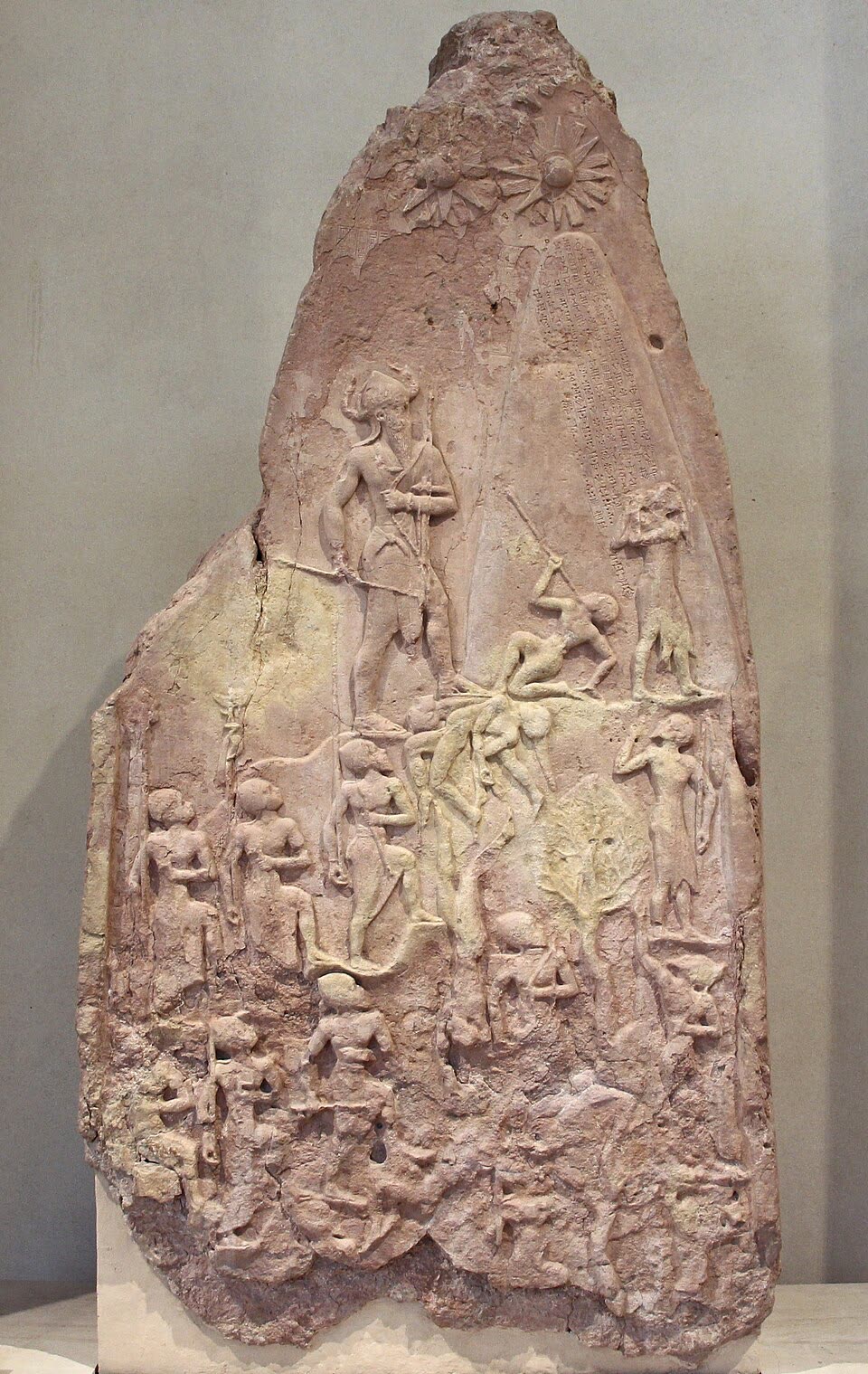
The Victory Stele of Naram-Sin is a carved slab of pink and beige limestone about two metres high. The king stands above his soldiers on a wooded mountainside. He wears a horned helmet and carries a bow and an axe. Several enemy figures appear around him. The Louvre records three sun disks among the carved details. Only a small part of the original inscription about his victory over the Lullubi survives above the king. The museum identifies a dedication there, probably to ShamashShamashMesopotamian god of the sun and justice, shown before Hammurabi on an eighteenth-century BCE stele preserved in the Louvre.Glossary · Click to read the explanation. [2]
The same stone bears a later inscription in Elamite. The ruler Shutruk-Nahhunte says he brought the monument from Sippar. The Louvre records that he took it to Susa as war booty in the twelfth century BCE, more than a millennium after its carving. It was found on the acropolis at Susa in 1898. The stone thus preserves a record of Naram-Sin’s victory and a later ruler’s record of taking the monument itself. [2]
The revolt and the king’s divine status
The inscription on the Bassetki statue calls Naram-Sin the mighty king of Agade. It says that when the regions rose against him, he won nine battles in a year and captured the kings who had risen. It credits the support of IshtarInanna / IshtarA prominent Mesopotamian goddess whose Sumerian name Inanna became associated with Akkadian Ishtar across diverse traditions. She was associated with desire, war, royal authority and Venus, while local forms and genealogies varied among texts.Glossary · Click to read the explanation for his victories. An account of the revolt preserved on a later clay tablet from Mari names cities in opposition to the king and says the people of Kish raised Ipḫur-Kiši to kingship. The tablet is fragmentary, and parts of the account survive as restored readings. [4][6]
After the victories, the Bassetki inscription says, the people of Agade sought support from deities in several cities. It names EnlilEnlilEnlil/Ellil: a major Mesopotamian god associated with destinies, kingship, and Ekur at Nippur, already prominent in third-millennium god lists. His name’s origin and cult beginnings remain debated.Glossary · Click to read the explanation in Nippur, Sin in Ur and Nergal in Kutha, among others. The people asked that Naram-Sin become the god of Agade and built a temple to him in the city. The inscription presents these honours as a response to his defence of the capital. [4]
How the stories remember his choices
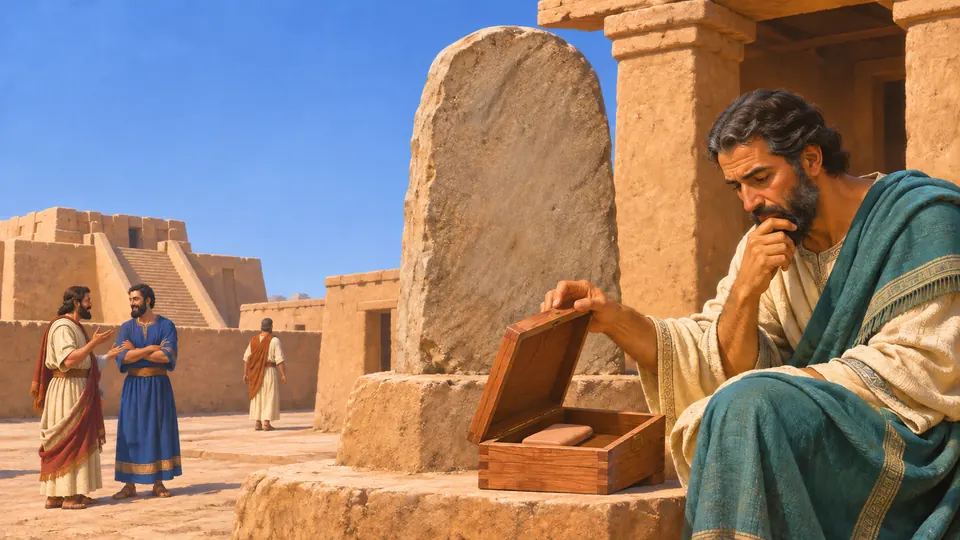
In The Cursing of Agade, Naram-Sin sees in a dream that the city’s future is in danger. He seeks an omen about the temple of Enlil and receives no answer about building it. He attacks the sanctuary and removes its valuables. In the poem the gods answer by cursing Agade. The roads and paths grow over, and the city’s fresh water turns brackish. These are the consequences the poet gives to the king’s actions. [5]
The Cuthean Legend has Naram-Sin speak in his own voice. He recounts the trouble that followed his disregard of the gods and addresses a future prince, governor or anyone called to rule. He says he has left a record in Nergal’s shrine at Cutha so that a later ruler can hear his account. The king who commemorates his victories on monuments becomes a speaker who asks others to learn from his mistakes. [7]
What survives of the royal record
The Bassetki text is carried on a copper statue recorded as IM 077823 in the IraqIraqIraq is a modern country encompassing much of ancient MesopotamiaGlossary · Click to read the explanation Museum. The CuneiformCuneiformWriting with wedge-shaped signs, developed from Mesopotamian recording traditions and used for several languages from the third millennium BCE.Glossary · Click to read the explanation Digital Library gives its dimensions as 670 by 670 by 430 millimetres and its findspot as Bassetki. The inscription names Agade as the city whose people built a temple for the king. The findspot identifies where the object was recovered, long after the text was composed. It does not establish the position of the city named on it. [4][8]
Another monument survives in part at Tulul al-Baqarat. Nashat Alkhafaji and Gianni Marchesi identify its fragment as coming from a monument that may have been a stele. They read part of an inscription about a campaign against Armanum and EblaEblaAncient city at Tell Mardikh, southwest of Aleppo, Syria. Its Palace G archives illuminate third-millennium BCE administration, language, and cult; the site has later occupation phases.Glossary · Click to read the explanation. In a passage spoken in the king’s voice, Naram-Sin claims to have captured Rida-Hadda, king of Armanum. The rest of the monument remains missing. The editors date the inscription to Naram-Sin’s own time. Their reading supports the association of the king with a campaign that included Ebla, a point the Metropolitan Museum’s overview phrases as a possibility. [3][9]
These objects give the reign a record beyond the story of the Great Revolt. The Louvre stone names a victory over the Lullubi. The Tulul al-Baqarat fragment names Armanum and Ebla. The statue at Bassetki describes a rebellion and a temple for the king in Agade. Taken together, the monuments show that a title or a claim of victory can be checked against a particular object, even when a complete account of a reign has not survived. [2][4][8][9]
References and notes (9)
- Electronic Text Corpus of Sumerian Literature, The Sumerian King List, 2.1.1, English translation Read lines 266–296 on Sargon’s dynasty and Naram-Suen’s stated parentage and place in the succession. Return to the text ↑
- Musée du Louvre, Stèle de Naram-Sin, SB 4 Read the dating, object numbers, scene and material descriptions, original and later inscription descriptions, Sippar and Susa entries, and the discovery date. Return to the text ↑
- Metropolitan Museum of Art, The Akkadian Period (ca. 2350–2150 B.C.) Read the discussion of Sargon’s dynasty and the alternative approximate regnal dates for Naram-Sin. Return to the text ↑
- Cuneiform Digital Library Initiative, Bassetki statue inscription, RIME 2.01.04.10 ex. 01, P216558 Read columns 1–3 of the English gloss and transliteration for the royal title, revolt, number of victories, named gods and foundation of a temple. Return to the text ↑
- Electronic Text Corpus of Sumerian Literature, The Cursing of Agade, 2.1.5, English translation Read the Old Babylonian version, lines 83–148, on the dream, omens and attack, and lines 210–281 on the curse and its result. Return to the text ↑
- Sources of Early Akkadian Literature, The Great Revolt against Narām-Sîn A, SEAL no. 1540 Read the catalogue record and restoration and translation of the obverse, lines 1–17, including the revolt and the installation of Ipḫur-Kiši. Return to the text ↑
- Sophus Helle, The First Authors: Narratives of Authorship in Ancient Iraq (2020) Read appendix section 1.5, printed pp. 283–284, including the introduction and translation of the Standard Babylonian Cuthean Legend, lines 1–3 and 149–155. Return to the text ↑
- Cuneiform Digital Library Initiative, Bassetki statue, P216558, Iraq Museum IM 077823 Read the record’s material, dimensions, provenance, inventory number and identification of the inscription witness. Return to the text ↑
- Nashat Alkhafaji and Gianni Marchesi, Naram-Sin’s War against Armanum and Ebla in a Newly-Discovered Inscription from Tulul al-Baqarat (2020) Read the introductory discussion and description of IM 221139 and the translated passage at columns iii 17–iv 19, including the named king of Armanum. Return to the text ↑
Suggest a correction · Suggest a source for this record
Cite this record
IL Archive, «Naram-Sin of Akkad, in Royal Inscriptions and Later Stories», https://ilarchive.com/en/people/naram-sin-of-akkad