Person · Figure
Pygmalion of Tyre
- Names
- Pumayyaton · Pumiyaton · Pygmalion · Pygmalion of Tyre
- Timeline
- From 831 BCE to 785 BCE
- Region
- The Levant
A king of Tyre in the late ninth century BCE, remembered as the brother whose crime drove Elissa to found Carthage. A king list keeps his reign; the story of the murder is legend.
Estimated reading time: 6 min Published Last reviewed:
Share article
Text
Introduction
Pygmalion was a king of TyreTyreTyre is a city on the coast of present-day southern Lebanon and an important ancient Phoenician centerGlossary · Click to read the explanation, the island city of the PhoeniciansPhoeniciansCommunities of Levantine coastal cities known for Mediterranean contact during the first millennium BCE.Glossary · Click to read the explanation off the coast of today's Lebanon. Two kinds of ancient writing remember him. A list of Tyre's kings, said to come from the city's own records, gives the length of his reign and his age at death. A famous foundation story makes him the brother of Elissa (Dido), whose flight from his greed led to the founding of Carthage. [1][2]
No inscription from his own lifetime securely names him, and every account of him was written centuries later. This entry separates what the king list says, what the story adds, how his dates are worked out, and what the few objects bearing a similar name can and cannot prove. [5][8][9]
The king in Menander's list
The Jewish historian Flavius JosephusFlavius JosephusFirst-century Jewish historian who retold older narratives, including Abraham’s test, in Jewish Antiquities.Glossary · Click to read the explanation (first century CE) quotes Menander of Ephesus, a Greek writer who said he had learned Tyre's history "out of their own records". Menander's list runs from Hiram, the king who traded with SolomonSolomonSolomon is the biblical king, David’s son, associated in Kings with Jerusalem and building the templeGlossary · Click to read the explanation, down to Pygmalion. Its last names are Ithobalus, "the priest of Astarte", who seized the throne; his son Badezorus; Badezorus's son Matgenus (Mattan); and then Pygmalion, who "lived fifty six years, and reigned forty seven years". [1]
A simple subtraction says a great deal: if he died at 56 after 47 years on the throne, he became king at about nine. Menander then adds one sentence that links Tyre to Africa: "in the seventh year of his reign, his sister fled away from him, and built the city Carthage in Libya." Menander does not name her. Josephus counts 143 years and 8 months from the building of the temple in JerusalemJerusalemJerusalem is a city of religious importance in Judaism, Christianity and IslamGlossary · Click to read the explanation to the founding of Carthage. [1]
The brother in the Elissa story
The Roman writer Justin, who summarised a lost history by Pompeius Trogus, tells the story from the Tyrian side. A king of Tyre died and left his throne to his son Pygmalion and his daughter Elissa together, but the people gave it to Pygmalion alone, "who was quite a boy". This agrees with Menander's figures, which also make him a child king. [2][1]
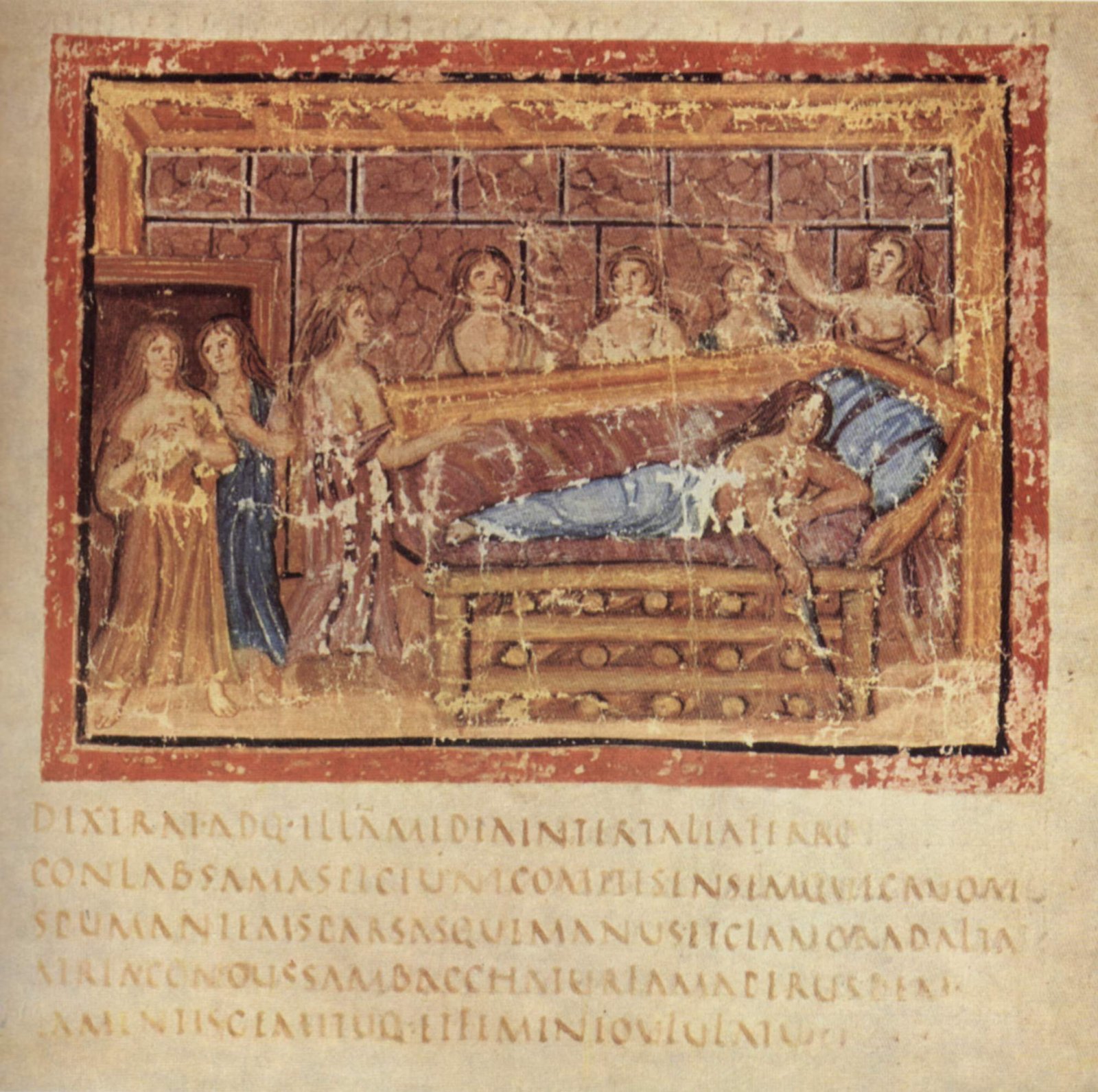
Elissa married their uncle Acerbas, priest of Hercules (the Roman name for Tyre's god Melqart), whose office came "next to that of the king". Acerbas was said to have buried his gold in the ground. Pygmalion, "excited by the account", had him murdered. Elissa pretended to move into her brother's house; Pygmalion agreed, "thinking that with her the gold of Acerbas would come to him", and she sailed away at night with leading citizens. When he heard of the flight he prepared to pursue her, but his mother's prayers and the warnings of the diviners held him back: he would not go unpunished if he stopped the founding of a city destined to prosper. [2]
The Roman poet Virgil (late first century BCE) gives the same crime a darker colour. In the first book of the Aeneid, the goddess Venus describes Pygmalion as "none deeper dyed in crime", "blinded by greed", who struck down his sister's husband, here called Sychaeus, "at the very altar" and hid the deed with lies, until the dead man's ghost revealed it to her in a dream. [3]
The greed, the hidden gold and the murder belong to the foundation legend. They may keep a memory of a quarrel inside the royal family, but no independent source confirms them.
Working out his dates
His dates depend on the date of Elissa's flight in his seventh year, and the ancient writers disagree about it. Justin's reckoning gives about 825 BCE. The Greek historian Timaeus placed the founding of Carthage in the thirty-eighth year before the first Olympic Games, which the editors of Dionysius of Halicarnassus convert to 813 BCE. [2][4]
An Assyrian royal text gives a fixed point. Shalmaneser III, king of Assyria, records that in his campaign of 841 BCE he "received the payment of Baʾal-manzēr of Tyre" together with that of Jehu of Israel. Many historians take this Ba'al-manzer to be Menander's Badezorus, Pygmalion's grandfather. [5][6] Counting forward with Menander's figures (Badezorus 6 years, Mattan 9 years, then seven years of Pygmalion), Elissa's flight falls roughly in the 820s BCE. That fits Justin's date better than Timaeus's, and it is why Pygmalion's reign is often placed at about 831–785 BCE. Every step, however, rests on numbers copied through Menander and Josephus, so these dates have a margin of several years. [1][5][10]
In these decades Tyre was a wealthy sea power. Assyrian bronze reliefs show the king and queen of Tyre on the shore of their island sending tribute by boat, and Tyre had already set up a colony at Kition on Cyprus to control the island's copper. [7]
His name
"Pygmalion" is a Greek form. Scholars usually explain it as a rendering of a Phoenician name built on the name of Pumay (also written Pummay), a little-known Phoenician god; a full form such as Pumayyaton, "Pumay has given", is often suggested. The explanation is likely, but no Tyrian document of his time spells out his name. [9][10][8]
Two objects are often brought into the discussion:
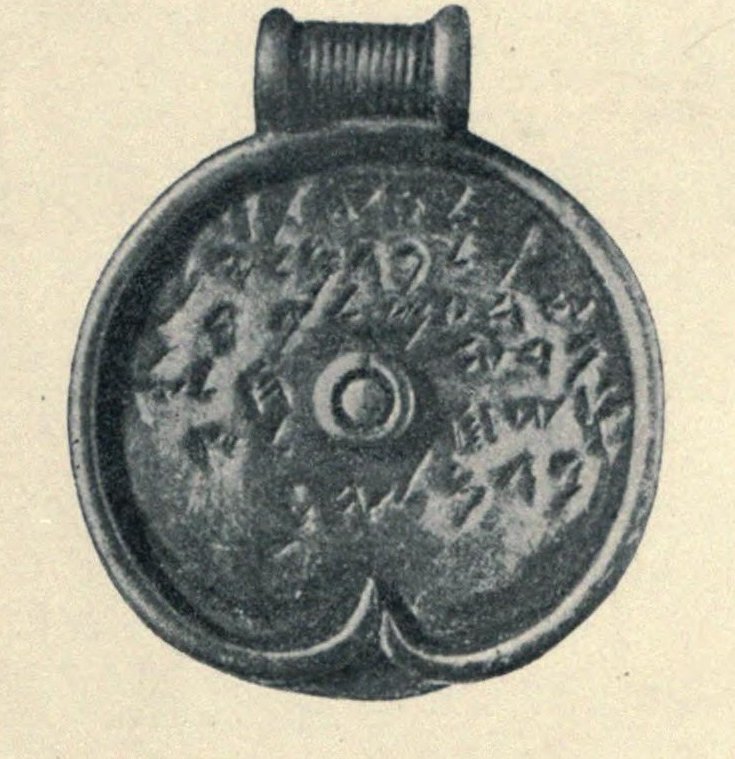
- The Douïmès medallion. A tiny gold pendant, about 1.4 cm across, was found in a tomb of the Douïmès cemetery at Carthage in the 1890s. Its six lines of Phoenician dedicate it to Astarte and to PGMLYN, Pygmalion, on behalf of a man named Yadamelek. Most scholars take this Pygmalion to be a god honoured beside the goddess, not a king. The tomb dates to the seventh century BCE; whether the pendant is older, perhaps a family heirloom, is debated. It shows that the name was honoured at Carthage, not that the king was. [8]
- The Nora Stone. This Phoenician inscription from Sardinia is dated by the shape of its letters to the late ninth or early eighth century BCE. Several scholars read the letters PMY in its last line as the god Pumay. The American scholar Frank Moore Cross took them as a short form of the king's name and dated the stone to about 825 BCE, in Pygmalion's reign. Other readings do not find the name there at all, so the link remains a hypothesis. [9][10]
A different Pygmalion
The Pygmalion most people know today is not this king. OvidOvidOvid was a Roman poet writing in Latin, who lived from 43 BCE to about 17 CE. His best-known works include the Metamorphoses.Glossary · Click to read the explanation, writing in the early first century CE, tells of a Pygmalion who carved a woman of ivory, fell in love with the statue and saw it come to life through the favour of Venus at her festival on Cyprus. [11] A late ancient dictionary writer, Hesychius, also says that Cypriots used the name Pygmalion for AdonisAdonis: death and return in differing narrativesA Greek mythic figure associated with Aphrodite, lament, and the Adonia; ancient sources diverge on his birth, death, divided residence, and ritual return.Glossary · Click to read the explanation. [8] These Cypriot stories share the name, not the person: nothing in them connects the sculptor with the king of Tyre.
The pages on Elissa (Dido) and on Carthage on this site tell the rest of the foundation story and describe the city's earliest remains.
References and notes (11)
- Flavius Josephus, Against Apion, book 1, translated by William Whiston (1737), online edition on penelope.uchicago.edu Book 1, sections 17–18 (1.116–126): Menander of Ephesus and the Tyrian records; the kings from Hiram to Pygmalion (Ithobalus priest of Astarte, Badezorus, Matgenus); Pygmalion lived 56 years and reigned 47; his sister's flight in his seventh year and the founding of Carthage; the counts of 155 years 8 months from Hiram and 143 years 8 months from the temple. Return to the text ↑
- Justin, Epitome of the Philippic History of Pompeius Trogus, translated by John Selby Watson (London, 1853), transcribed by Roger Pearse on tertullian.org Book 18, chapters 4–5: Pygmalion and Elissa as joint heirs, the throne given to Pygmalion “who was quite a boy”, Acerbas priest of Hercules and his buried gold, the murder, Elissa's pretended move and night flight, Pygmalion's planned pursuit stopped by his mother's prayers and the diviners' warning; translator's note 99 (Sichaeus, Sicharbas). Return to the text ↑
- Virgil, Aeneid, book 1, translated by Theodore C. Williams (Boston, 1910), Perseus Digital Library Book 1, lines 335–371 (Latin 1.340–364): Venus's account of Pygmalion's rule in Tyre, his greed, the murder of Sychaeus at the altar, the concealment and the ghost's revelation of the crime and the treasure. Return to the text ↑
- Dionysius of Halicarnassus, Roman Antiquities, book 1, translated by Earnest Cary (Loeb Classical Library, 1937), LacusCurtius edition Book 1, chapter 74.1 with the editor's note: Timaeus places the founding of Rome at the same time as Carthage, in the thirty-eighth year before the first Olympiad (813 BCE in the editor's conversion). Return to the text ↑
- Shalmaneser III 010, stone-tablet annals from Ashur, after A. Kirk Grayson, Assyrian Rulers of the Early First Millennium BC II (858–745 BC), RIMA 3 (Toronto, 1996); Royal Inscriptions of Assyria online (RIAo), Oracc English translation of the eighteenth regnal year (841 BCE), column iv line 10: the payment of Baʾal-manzēr of Tyre and of Jehu of Bīt-Ḫumrî. Return to the text ↑
- John Drummond, “The House of Tyre: Ancient Israel's powerful northern neighbor”, Bible History Daily, Biblical Archaeology Society (27 May 2025) The sections on Menander's king list, Ithobaal (Ethbaal), Baal-Eser II's tribute to Shalmaneser III alongside Jehu, Mattan as father of Pygmalion (Pumiyaton) and Elissa, and the founding date of Carthage. Return to the text ↑
- Karen Radner, “Tyre and the other Phoenician city-states”, Assyrian Empire Builders, University College London (Oracc) The whole page: Tyre as an island harbour city under its own king, the Balawat bronze band showing the king and queen of Tyre sending tribute by boat to Shalmaneser III, and the colony at Kition on Cyprus from the ninth century BCE. Return to the text ↑
- Claudia Kunze, “The Tomb of Yadamelek at Carthage: a new approach to its architecture, burial rite and grave goods”, Talanta 34–35 (2002–2003) Introduction (discovery of the tomb in the Douïmès necropolis, seventh-century date) and the section on the gold medallion (inv. 893-2.1) with notes 112–122: size, the six-line inscription, the readings of Berger, Ferron, Garbini, Peckham and Donner–Röllig, the agreement on the divine sense of Pygmalion, Hesychius on Pygmalion as Adonis in Cyprus, and the dating of the pendant against the tomb (heirloom). Return to the text ↑
- Abigail R. Zammit, “The Stele of Nora: A Phoenician gift that keeps on giving”, Revista d'Arqueologia de Ponent 33 (2023), pp. 9–25, DOI 10.21001/rap.2023.33.1 Pages 9–21: the stele (CIS I 144 = KAI 46), Casti's 2019 reading without PMY, the palaeographic date (late ninth to first half of the eighth century BCE), the alternative reading PMY in line 8 as the god Pumay or as Pumayyaton/Pygmalion of Tyre, and the readings of Mosca, Puech and Peckham. Return to the text ↑
- “The Nora Stone, c. 831–785 BCE”, Center for Online Judaic Studies, after Hershel Shanks (ed.), Frank Moore Cross: Conversations with a Bible Scholar (Biblical Archaeology Society, 1994) The whole entry: Cross's reading (“at Tarshish”, a Phoenician force in Sardinia), Pummay/Pu'myaton as the Greek Pygmalion, ruler of Tyre 831–785 BCE, and Cross's date of 825 BCE for the inscription. Return to the text ↑
- Ovid, Metamorphoses, book 10, translated by Brookes More (Boston, 1922), Perseus Digital Library Book 10, lines 243–297: Pygmalion's ivory statue, his prayer at the festival of Venus, the statue coming to life, and the birth of Paphos. Return to the text ↑
Suggest a correction · Suggest a source for this record
Cite this record
IL Archive, «Pygmalion of Tyre», https://ilarchive.com/en/people/pygmalion-of-tyre
Continue reading
Related readings