Entity
Adonis: death and return in differing narratives
A reference page linking a name, group, or concept to the materials that discuss it.
Adonis across lament, divided residence, the commemorative flower, and ritual return: a source-by-source comparison of Sappho, Pseudo-Apollodorus, Ovid, Theocritus, Bion, Lucian, and Attic pottery.
Estimated reading time: 10 min Published Last reviewed:
Share article
Text
Introduction
Adonis stands at the intersection of a love story, a violent death, women's lamentation, and celebrations of an absent figure's return. Yet the surviving evidence does not yield one consistent biography. One account divides his residence between goddesses before his death; a Roman poem transforms his blood into a commemorative flower; an Alexandrian festival song expects him back. We therefore need to establish what “return” means in each witness rather than assume an annual death-and-resurrection story in advance.
This entry compares Greek and Latin literature, celebrations reported in Alexandria and Byblos, and an Attic archaeological object. It distinguishes mythic narrative time from the date of composition and from the later copies transmitting a text. Resemblance between names or plant symbols is not by itself proof that a particular doctrine traveled unchanged between cultures.
The name and the chronology of the witnesses
Greek “Adonis” is related to the West Semitic word ʾadōn, “lord,” making connections with the eastern Mediterranean an appropriate historical inquiry. But linguistic derivation does not establish a complete identity between Greek Adonis and Mesopotamian Dumuzi or TammuzDumuzi / TammuzDumuzi is a deity of ancient Mesopotamian traditions associated with shepherding and Inanna; Tammuz appears as the name in later linguistic and textual traditions.Glossary · Click to read the explanation. Their roles, laments, absences, dates of attestation, and possible routes of transmission must be examined separately; there is no continuous documentary chain for every detail. [1]
The evidence considered here can be arranged approximately by the date of its composition, not by the imaginary time of its events:
- A lament fragment attributed to Sappho comes from around the late seventh or sixth century BCE, but its words survive as a quotation in a later work, not a manuscript written in Sappho's lifetime. [2]
- In the late fifth century BCE Aristophanes refers to lamentation at Athens; in the fourth century PlatoPlatoPlato (approximately 427–347 BCE) was a Greek philosopher who explored goodness, justice and cosmic order through philosophical dialogues.Glossary · Click to read the explanation makes philosophical use of “gardens of Adonis.” The Attic vessel discussed below also belongs approximately to the middle of the fourth century. [3][4][12]
- In the third century BCE Theocritus depicts an Alexandrian court festival; the lament attributed to Bion belongs to later Hellenistic poetry. These dates do not establish successive evolutionary stages of a single creed. [9][10]
- Ovid writes his Latin account near the beginning of the first century CE. The anonymous mythographic Bibliotheca is generally placed in the first or second century CE, while the description of Byblos belongs to a second-century CE text attributed to Lucian. These composition dates must not be confused with the dates of all surviving manuscripts. [5][7][8][11]
Death, lament, and the gardens of Adonis
In Sappho's fragment 140a as numbered by modern editors, a group addresses AphroditeAphroditeGreek goddess whose origin Hesiod relates to foam after the assault on Ouranos.Glossary · Click to read the explanation by the epithet “Cytherea,” and the goddess replies by calling for breast-beating and torn garments. The short Greek text, preserved through later quotation, begins: [2]
This is early evidence for the language of loss and women's participation in its expression, not an explanation of how Adonis died or came back. Its original performance context is uncertain because most of the poem and the occasion of its singing are lost.
Aristophanes' comedy Lysistrata, first performed in 411 BCE, evokes women mourning Adonis on rooftops amid political mockery surrounding the Sicilian expedition. It shows how familiar such lamentation was in Athenian discourse, but comic staging is not neutral ethnography. In the Phaedrus, PlatoPlatoPlato (approximately 427–347 BCE) was a Greek philosopher who explored goodness, justice and cosmic order through philosophical dialogues.Glossary · Click to read the explanation invokes the “gardens of Adonis,” quickly sprouting plants in small containers, to contrast their growth in eight days with crops cultivated over many months. This is a philosophical image of short-lived display, not proof of a universal agricultural doctrine of the god's bodily resurrection. [3][4]
Adonis' birth and a divided year before his death
The Bibliotheca, attributed to Pseudo-ApollodorusPseudo-ApollodorusName used for the author of the Bibliotheca, a Greek mythographic collection usually dated to the first or second century CE.Glossary · Click to read the explanation, records divergent parentages. After reporting alternative older genealogies, one version describes Smyrna, or Myrrha, transformed into a myrrh tree following an incestuous union with her father, from which Adonis is born. AphroditeAphroditeGreek goddess whose origin Hesiod relates to foam after the assault on Ouranos.Glossary · Click to read the explanation, the Greek goddess of love, places the infant in a chest and entrusts it to PersephonePersephonePersephone is a Greek goddess associated with the underworld and a participant in one account of Adonis’s childhood.Glossary · Click to read the explanation, goddess of the underworld. Having seen him, Persephone refuses to return him. [7]
ZeusZeusZeus is the sky god and leading deity in many Greek traditions. In the Iliad he presides over divine gatherings while others can still speak and object.Glossary · Click to read the explanation settles the quarrel by dividing the year into three portions: one for Adonis himself, one with Persephone, and one with Aphrodite. Adonis then grants his own portion to Aphrodite, giving her two thirds in practice. Only afterward does the Bibliotheca state that a wild boar killed him. The sequence matters: divided residence precedes death, and this passage does not explicitly tell of Adonis being raised after the attack. Transposing that arrangement to a period following the killing would turn it into a resolution the passage does not narrate, although Persephone's underworld domain and the divided time invite seasonal interpretation. [7]
The Bibliotheca was neither composed by Sappho nor reliably authored by the second-century-BCE scholar Apollodorus. Its anonymous compiler drew on earlier traditions, and its text survives through later manuscript transmission. Consequently, the likely composition date of the collection does not date the invention of each story it reports. [5]
Ovid: a flower and an annual memorial, not bodily restoration
The Roman poet OvidOvidOvid was a Roman poet writing in Latin, who lived from 43 BCE to about 17 CE. His best-known works include the Metamorphoses.Glossary · Click to read the explanation retells Myrrha's story and Adonis' birth, then his affair with Aphrodite, in Book 10 of the Metamorphoses, composed around 8 CE. She warns her lover against dangerous beasts, but a wild boar mortally wounds him while hunting. She returns to his lifeless body and vows to memorialize her sorrow each year; she then treats his blood, which produces a short-lived flower. [8]
Near the end, the Latin says: [8]
The transformation concerns blood, accompanied by the continuing remembrance and annual re-enactment of grief, not the revival of Adonis as a living person. Aphrodite speaks as a character in a crafted Latin poem: her words cannot automatically be treated as an eyewitness report of a rite performed in Ovid's presence.
Alexandria: celebrating arrival and expecting return
The Greek poet TheocritusTheocritusTheocritus was a Greek poet of the third century BCE. His fifteenth Idyll describes an Adonis festival in Alexandria.Glossary · Click to read the explanation, in Idyll 15, stages two Syracusan women visiting a festival for Adonis in third-century-BCE AlexandriaAlexandria (Egypt)Alexandria is a city on Egypt’s Mediterranean coast, founded by Alexander the Great in 331 BCE and an important center of trade and culture.Glossary · Click to read the explanation, in the environment of Ptolemaic court patronage and Queen Arsinoe. The poem describes a ceremonial couch, figures of Adonis and Aphrodite, food, perfume, fine weaving and offerings of plants. A singer then gives voice to a festival hymn: Adonis has arrived from Acheron, the river associated with the dead, and his figure will be carried toward the sea the next morning, amid unbound hair and songs of farewell. [9]
Near the hymn's end we read: [9]
This is comparatively early, positive evidence for an arrival and departure repeated in festival speech: it would be mistaken to deny all pre-Christian talk of Adonis' “return.” Yet the song does not prescribe a universal doctrine for every city or specify the physical mechanics of bringing a once-dead body permanently back to life. A literary representation of a royal celebration does not certify every detail of the practice everywhere and every year. [9]
A later Hellenistic Lament for Adonis, attributed to Bion, offers a different emphasis. The Fates are asked to recall the young man, but Persephone will not release him; the prospect is of mourning him again next year. Its imagery of flowers also differs from Ovid's. Annual lament, then, does not itself document a completed resurrection, and neither poem can simply supply missing episodes to the other. [10]
Byblos: reporting that “he is alive”
In the second-century-CE treatise On the Syrian Goddess, attributed to Lucian of SamosataLucian of SamosataLucian of Samosata was a second-century CE writer in Greek, associated with Samosata on the Euphrates.Glossary · Click to read the explanation, the narrator describes Adonis rites at ByblosByblos / JbeilByblos, or Jbeil, is a coastal city in Lebanon north of Beirut.Glossary · Click to read the explanation on the Phoenician coast. Sections 6–8 report mourning and offerings to Adonis as a dead figure, followed on the next day by a claim that he is alive and by lifting him into the air. The Greek phrase in section 6 is: [11]
That is stronger than a flower arising from blood: it explicitly attributes a statement about life after mourning to celebrants. But it is still reported ritualRitualAn organised or distinguished practice meaningful to a community; it may leave traces, but its form alone does not reveal an associated doctrine.Glossary · Click to read the explanation speech in a later author's account, not a proof of permanent corporeal resurrection. The passage alone cannot decide whether the meaning is physical revival, the raising of a cult image, or a declaration of life shaped by the festival cycle. Elsewhere the same text says some local people associated the story instead with OsirisOsirisOsiris was an ancient Egyptian deity associated with the dead, life after death, renewal, and kingship. His roles appear in changing funerary texts, rituals, and judgment scenes, notably the weighing of the heart.Glossary · Click to read the explanation; it also presents a local legend about a reddish river alongside a natural explanation involving colored earth. Belief, observed procedure, and explanation should not be conflated. [11]
This second-century description cannot simply be projected backward to second-millennium-BCE Byblos or outward onto every Greek version. Authorship of the treatise is also debated, and a traveler-like religious description operates differently from Sappho's fragment or Theocritus' literary mime.
What the archaeological image shows
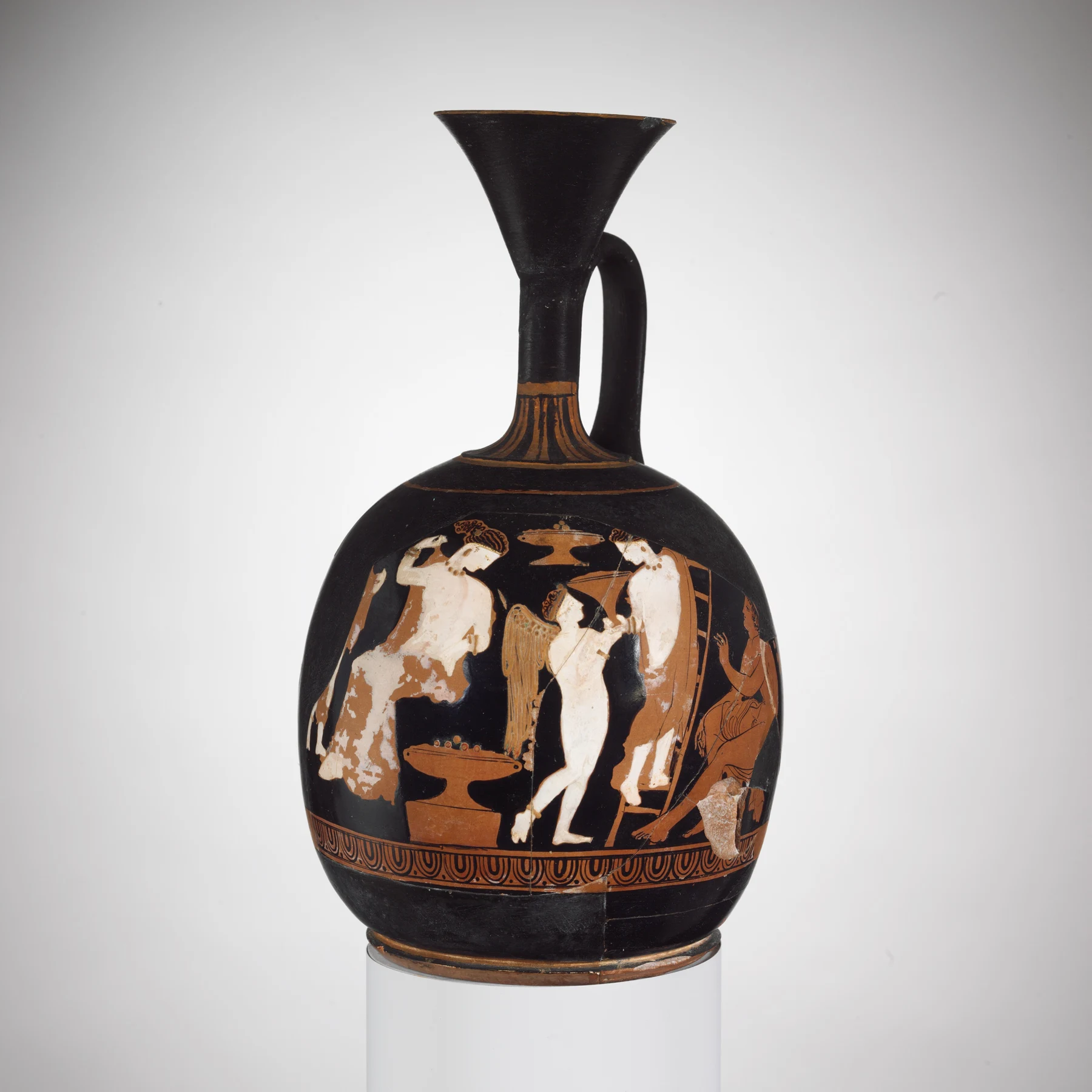
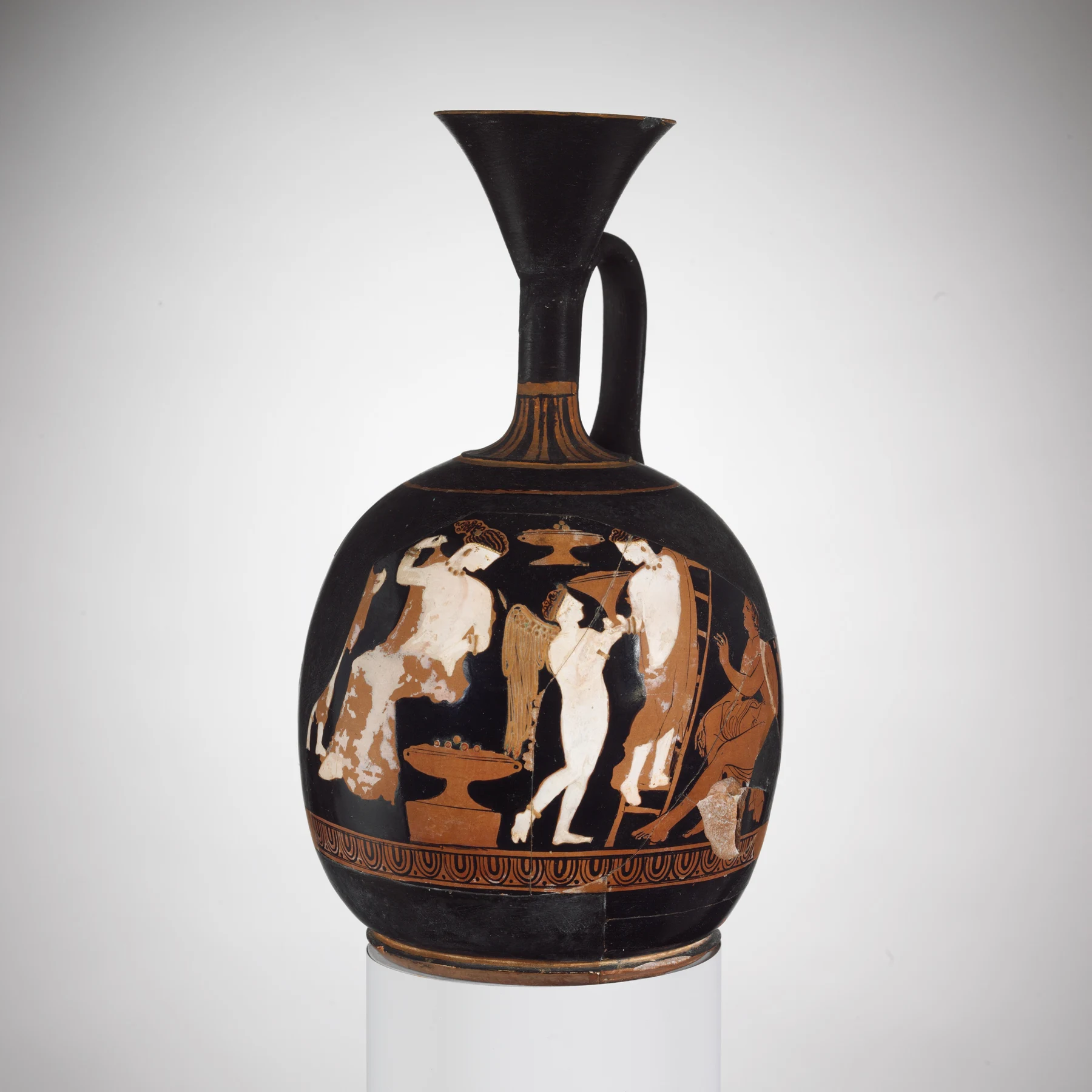
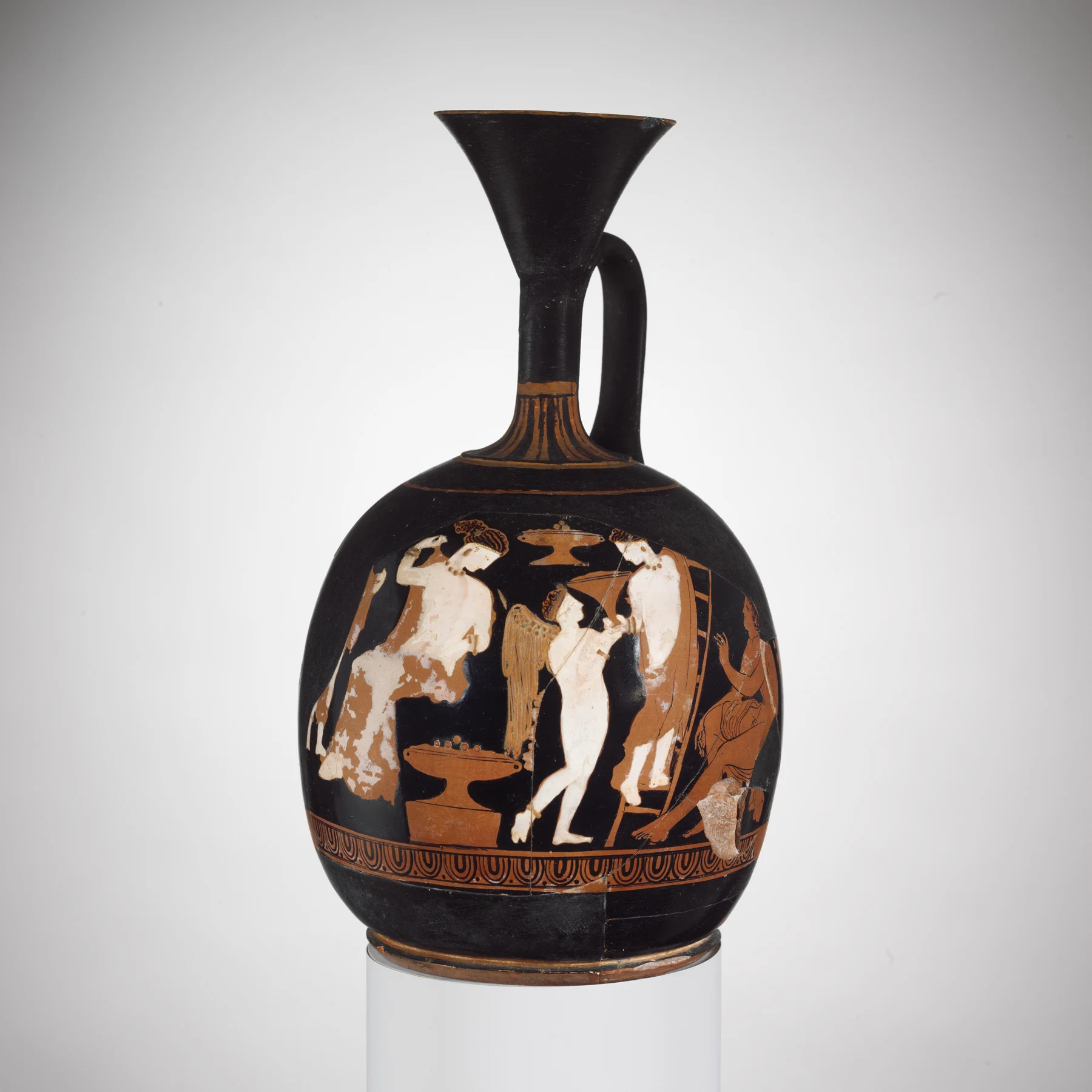
The cover depicts a small Attic red-figure oil flask, dated approximately to the middle of the fourth century BCE, in the Metropolitan Museum of Art, accession number 22.139.26. The museum associates the scene with the AdoniaAdonia: the celebration of AdonisAdonia: a festival associated with Adonis, attested through women’s laments and ephemeral plantings; its surviving descriptions vary among Athens, Alexandria, and Byblos.Glossary · Click to read the explanation: a woman receives a planter from winged ErosErosEros is the Greek god of love, represented with wings in ancient art.Glossary · Click to read the explanation among other figures. Identifications of some figures as Adonis or Aphrodite are expressly tentative. The retained museum image is catalogued as Public Domain. [12]
This object shows that containers of plants and festival imagery could be represented in Athenian art at that date. It does not itself portray Adonis returning from death, nor does it depict the rites of Byblos. The vessel's production date dates this object, not the composition of the much later accounts of Pseudo-Apollodorus or Ovid.
Eastern connections and the “dying-and-rising god” model
The eastern origin of Adonis' name and the long history of contact between the Greek and eastern Mediterranean worlds support an inquiry into shared or transmitted traditions, but not an equation of every Adonis lament with the Dumuzi myths. Mesopotamian sources have distinctive narrative contexts, functions, and dates; the hunting death, Aphrodite and Persephone play different roles in Greek material. A specialist encyclopedia abstract regards mediated transmission through West Semitic culture as plausible, but the accessible abstract does not provide a complete documentary itinerary or authorize importing every detail. [1]
The comparative scholar James George FrazerJames George FrazerJames George Frazer (1854–1941) studied classical literature, anthropology and comparative religion and was associated with Trinity College, Cambridge.Glossary · Click to read the explanation treated Adonis as an example of a vegetation god dying and returning with the natural cycle, interpreting the gardens through fertility and imitative magic. Marcel Detienne instead emphasized their quick, sterile growth and their contrast with productive, sustained cultivation. Plato's description gives good grounds for attending to the plants' brevity; it does not on its own establish one ritual meaning or make Detienne's entire interpretation incontestable. [4][13][14]
The broader dispute over “dying-and-rising gods,” including the reconstruction offered by Tryggve MettingerTryggve N. D. MettingerTryggve N. D. Mettinger (1940–2023) was a Swedish Old Testament scholar and professor of Old Testament exegesis at Lund from 1978 to 2003.Glossary · Click to read the explanation and its criticism, requires three distinctions: death as an episode in a myth, repeated ceremonies about absence and arrival, and a clear statement of reanimating a dead person. Scholarly reviews of this debate stress the uneven dates and explicitness of the evidence. Reconstructing ancient Near Eastern doctrines from Roman testimony remains contested. This account draws on the reviews actually consulted, not on a claimed reading of Mettinger's entire book. [15]
Comparative conclusion
Lament, waiting, and arrival clearly intersect in traditions of Adonis, but they do not occur in the same form in every witness. Sappho's fragment gives loss without a return; the Bibliotheca divides residence before the fatal attack; Ovid preserves the memory and makes a flower from blood; Theocritus presents renewed arrival from the realm of the dead; and the Byblos account says celebrants speak of him being alive on the following day. None cancels the others, and they should not be merged into one continuous biography.
“Adonis returns” is consequently a statement that always needs a particular source, date, and definition of return. Alone, it cannot establish a uniform cross-cultural history of resurrection or prove that a later faith borrowed its doctrine from an older myth without independent evidence of transmission.
References and notes (14)
- Specialist entry on Adonis, publisher abstract only; supports considering an eastern connection through linguistic and cultural mediation, not documenting every transmission step. J. D. Reed, “Adonis,” The Encyclopedia of Ancient History (2012); publisher abstract only Return to the text ↑
- Sappho fragment 140a (Lobel–Page): displayed Greek text and its later quotation through Hephaestion checked; a lament, not a narrated return. Sappho, fragment 140a (Lobel–Page); preserved by Hephaestion, Greek Language Centre anthology Return to the text ↑
- Aristophanes’ rooftop lament passage read in English translation; comic representation is not a neutral festival record. Aristophanes, Lysistrata, approximately lines 387–398; Ian Johnston English translation, selected passage Return to the text ↑
- Plato, Phaedrus 276b–c, gardens of Adonis and swift sprouting versus sustained farming; relevant English passage read, not entire dialogue. Plato, Phaedrus 276b–c; B. Jowett English translation, selected passage Return to the text ↑
- Modern dating and attribution of Bibliotheca remain discussed; publisher/index information and abstract checked, not a full manuscript study. M. van der Valk, on Pseudo-Apollodorus’ Bibliotheca, Revue des Études Grecques 71 (1958); abstract/index only Return to the text ↑
- Both passages read; divided year precedes the killing, not its explicit resolution here. Pseudo-Apollodorus, Bibliotheca 3.14.3–4; J. G. Frazer’s historical English translation Return to the text ↑
- Specified passages only; flower and remembrance separated from restoration of the person. Ovid, Metamorphoses 10.519–559 and 10.705–739; Latin 10.725–729 checked; Brookes More’s historical English translation Return to the text ↑
- Displayed song and context read; pre-Christian annual return, not precise dating of every action. Theocritus, Idyll 15, especially lines 100–144; displayed Greek, Andrew Lang’s 1889 English translation and Fordham excerpt Return to the text ↑
- Bion’s Lament for Adonis read in historical English translation, including the Fates, Persephone’s refusal, and renewed mourning; attribution/date are approximate. Bion, Lament for Adonis, approximately lines 85–100; J. M. Edmonds’s 1912 English translation Return to the text ↑
- On the Syrian Goddess §§6–8 read in a historical English translation; short Greek phrase checked in an available Greek edition. Reports a ritual declaration of life plus alternative Osiris/river explanations. On the Syrian Goddess, §§6–8; H. A. Strong’s English translation (1913), Greek phrase checked against A. M. Harmon’s edition (1925) Return to the text ↑
- Catalogue, original and rights checked; Adonis/Aphrodite tentative, scene not Dumuzi. Metropolitan Museum of Art, 22.139.26; Attic red-figure oil flask, mid-4th century BCE, associated with Adonia Return to the text ↑
- Frazer’s historical chapters on Adonis and his gardens consulted; influential vegetation and imitative-magic interpretation, not a uniform primary description. J. G. Frazer, The Golden Bough, “The Gardens of Adonis,” read alongside the ritual chapter; historical text Return to the text ↑
- Marcel Detienne, The Gardens of Adonis: publisher overview only, not full book; interpretation of short, unproductive growth reported with that limitation. Marcel Detienne, The Gardens of Adonis: Spices in Greek Mythology, Princeton edition; publisher overview only Return to the text ↑
- David Frankfurter’s full review of Mettinger read, with Richard Hess’s review consulted; Mettinger’s monograph itself was not accessed, and views are reported secondhand. David Frankfurter, review of Tryggve Mettinger’s The Riddle of Resurrection, BMCR 2002.09.07; full review, not the book Return to the text ↑
Suggest a correction · Suggest a source for this record
Cite this record
IL Archive, «Adonis: death and return in differing narratives», https://ilarchive.com/en/entities/adonis
Continue reading