Entity
Adonia: the celebration of Adonis
A reference page linking a name, group, or concept to the materials that discuss it.
- Names
- Adonia
The Adonia, a festival of Adonis in the Greek world: women’s laments, “gardens of Adonis” and Ptolemaic court celebrations. The entry separates documented rites from interpretations of return, fertility and eastern influence.
Estimated reading time: 12 min Published Last reviewed:
Share article
Text
Introduction
The Adonia was a celebration associated with AdonisAdonis: death and return in differing narrativesA Greek mythic figure associated with Aphrodite, lament, and the Adonia; ancient sources diverge on his birth, death, divided residence, and ritual return.Glossary · Click to read the explanation, the young figure whose Greek stories bring together love, death, and return, and with AphroditeAphroditeGreek goddess whose origin Hesiod relates to foam after the assault on Ouranos.Glossary · Click to read the explanation, who mourns him. Some practices are known from quickly grown plants, women's laments, carried images, and songs, but our sources do not describe one identical ceremony in AthensAthensAthens is a Greek city renowned in antiquity for philosophy, arts and political institutions, preserving the Acropolis and monuments from several periods.Glossary · Click to read the explanation, AlexandriaAlexandria (Egypt)Alexandria is a city on Egypt’s Mediterranean coast, founded by Alexander the Great in 331 BCE and an important center of trade and culture.Glossary · Click to read the explanation, and ByblosByblos / JbeilByblos, or Jbeil, is a coastal city in Lebanon north of Beirut.Glossary · Click to read the explanation.
This article asks what participants can actually be shown to have done, and what poems, philosophical polemic, and pictures tell us about its meaning. It compares evidence from different centuries without treating myth as archaeological fact or automatically equating Adonis's return in ancient song with resurrection in a different religious setting.
Contents
- The name and the evidence
- An early voice of lament
- Women on Athenian rooftops
- PlatoPlatoPlato (approximately 427–347 BCE) was a Greek philosopher who explored goodness, justice and cosmic order through philosophical dialogues.Glossary · Click to read the explanation's quickly growing gardens
- The Attic vase painting
- Politics and decline in the story of Nicias
- Going to the Alexandrian celebration
- The royal hymn and annual return
- Byblos and competing local accounts
- Meanings of death and return
- From fertility to social readings of ritualRitualAn organised or distinguished practice meaningful to a community; it may leave traces, but its form alone does not reveal an associated doctrine.Glossary · Click to read the explanation
- Eastern Mediterranean connections and their limits
- What is established and what remains open
The name and the evidence
“Adonia” names a celebration connected with Adonis, not an independent sacred book or simply another name for the god. Stories commonly portray the young man as Aphrodite's beloved and as dying in a boar hunt, yet his ancestry and fate vary from one account to another. Rather than assembling different myths into a single biography, we investigate how motifs of love and loss entered visible and audible ritual practice. Our evidence consists of lyric poetry, comedy, philosophy, much later biography, and figured pottery; each kind of evidence answers a different question. [17]
Early Greek literary testimony begins with lyrical fragments, followed by references to lament and gardens in fifth- and fourth-century BCE Athens. A palace celebration in AlexandriaAlexandria (Egypt)Alexandria is a city on Egypt’s Mediterranean coast, founded by Alexander the Great in 331 BCE and an important center of trade and culture.Glossary · Click to read the explanation is known chiefly through a poem of the third century BCE, whereas the account of ByblosByblos / JbeilByblos, or Jbeil, is a coastal city in Lebanon north of Beirut.Glossary · Click to read the explanation belongs to a later imperial world. This sequence cannot establish an unchanged annual festival in every city. Nor should the date of a decorated object be conflated with the date of the myth evoked by its imagery. [18][21]
An early voice of lament
A short fragment attributed to Sappho, a poet of the late seventh and early sixth centuries BCE, asks what is to be done as Adonis dies; the response tells young women to beat their breasts and tear their clothing. The lines survive through quotations by later writers, not in a complete extant collection of Sappho's poetry. They attest the language of mourning associated with an early lyric tradition, not a detailed festival calendar or proof that women everywhere performed exactly the same actions. [14]
The lines connect lament with collective voices and bodily gestures. They say nothing, however, about the starting point of a procession, the organiser of a ceremony, or the placement of an image of Adonis. The next question must therefore be what Athenian texts actually show, not which missing details can be reconstructed imaginatively from these two lines.
Women on Athenian rooftops
In Lysistrata, performed in 411 BCE, Aristophanes makes a magistrate complain about women lamenting Adonis from the roofs while male politicians debated sending a fleet to Sicily. The women's cries are placed in comic opposition to the shouting of military politics. The play confirms that its audience could recognise the reference to rooftop mourning, but the hostile magistrate is a comic speaker, not an impartial witness to the social position or behaviour of every participant. [15]
It is therefore too simple to call the celebration an exclusively marginal or secluded “private” ritual. Voices from elevated rooftops could be heard across the urban setting, and comedy made them part of a discussion about gender and authority. Laurialan Reitzammer's study argues that connections with weddings, civic funeral speeches, and Athenian politics make the festival more significant than a trivial diversion or an elementary fertility rite. That is a modern, debatable interpretation, not a direct ancient statement about what all women intended. [17]
Plato's quickly growing gardens
In Phaedrus 276b–c, PlatoPlatoPlato (approximately 427–347 BCE) was a Greek philosopher who explored goodness, justice and cosmic order through philosophical dialogues.Glossary · Click to read the explanation has Socrates ask whether a serious farmer would plant precious seed in summer “gardens of Adonis” to admire its beauty after eight days, rather than cultivate a genuine crop over many months. He contrasts hurried festive gardening with agriculture aimed at a real harvest, as part of a wider analogy between writing and living instruction. The passage is early evidence for the name and rapid growth of the gardens, not a complete schedule defining the duration of every Adonia festival. [13]
The “gardens” are associated with small containers in which seeds sprout quickly and then dry out or wither. They have been interpreted as images of an interrupted life or unfulfilled fertility. But the philosophical text makes these plantings a comparison for education; it does not identify every plant species, prove that every city used identical installations, or prescribe a rigid sequence beginning on the eighth day and ending on the ninth. The difference between explicit text and scholarly symbolic interpretation matters here. [23]
The Attic vase painting
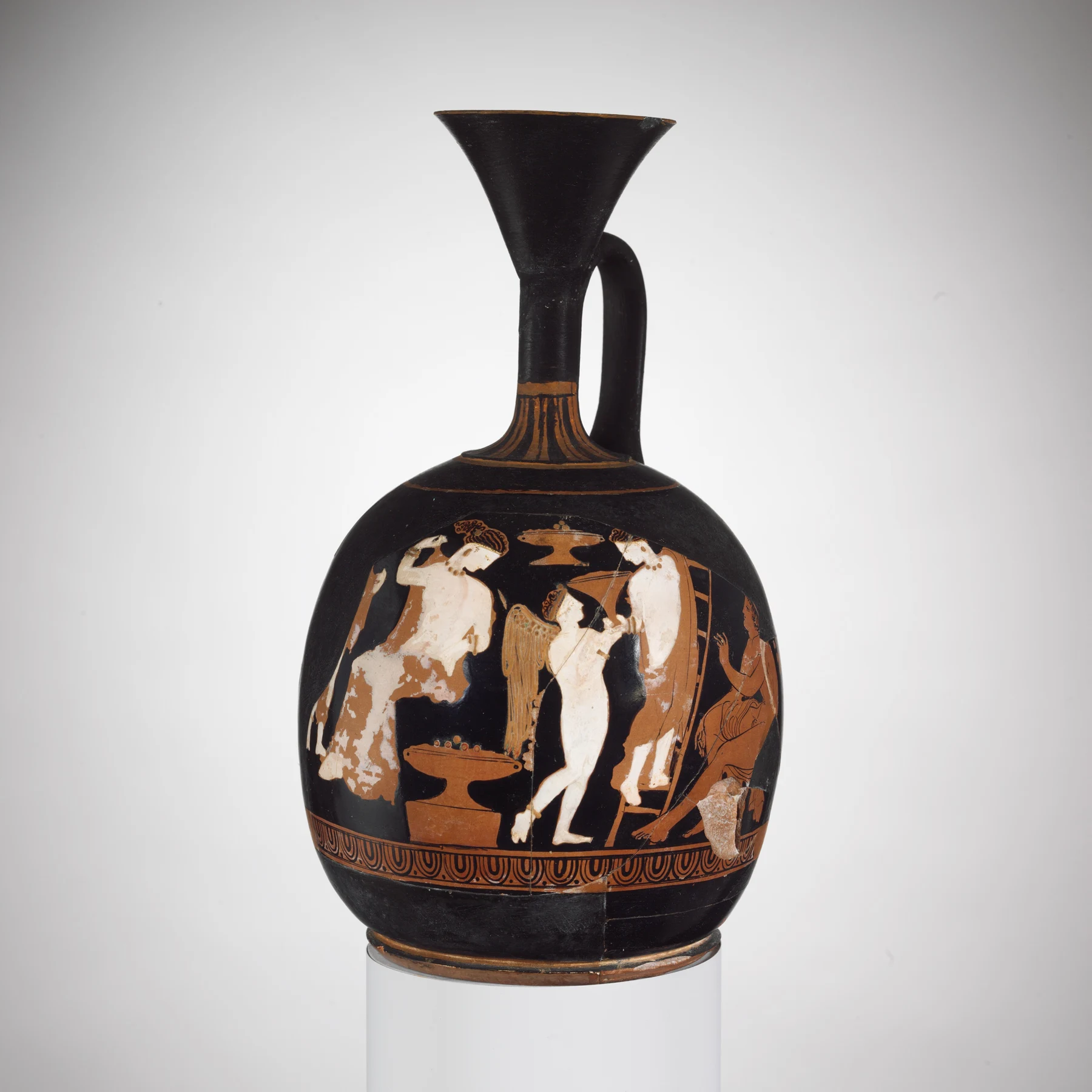
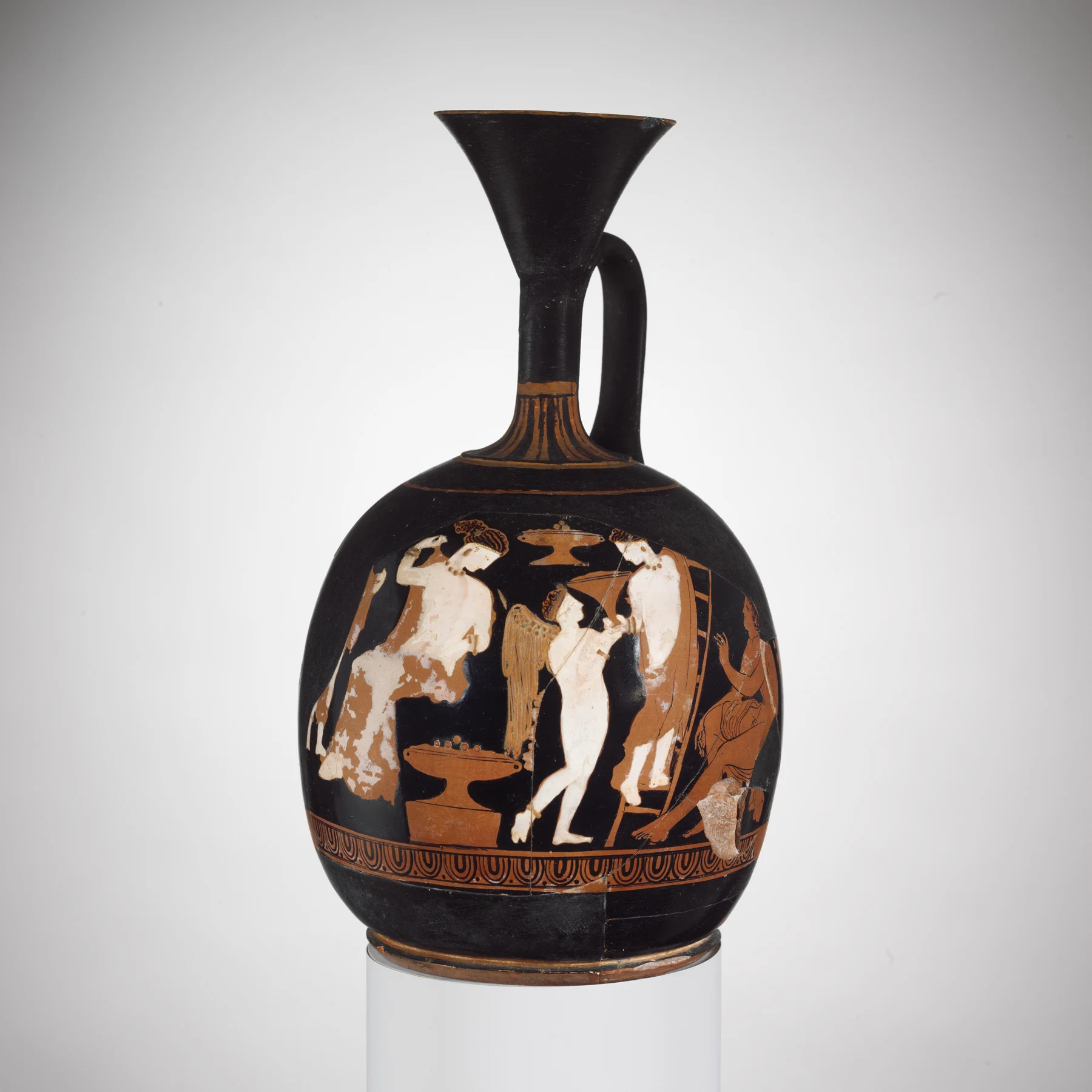
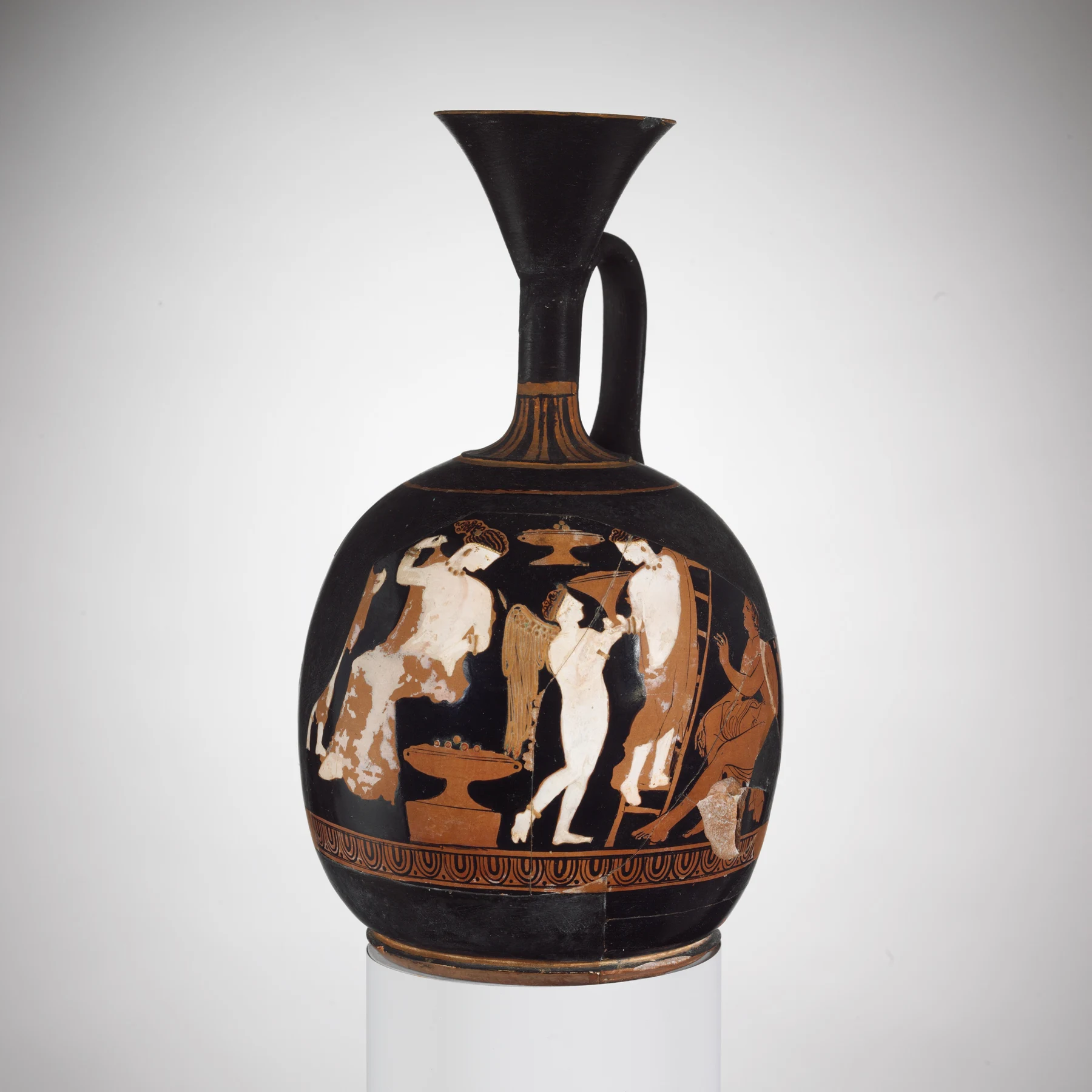
The cover is a photograph of an actual small Attic red-figure oil jar, or squat lekythos, dated to the mid-fourth century BCE. It is held by the Metropolitan Museum of Art under inventory number 22.139.26. Its decoration shows a woman on a ladder receiving a planter from Eros, with a seated man below and another woman behind Eros. The museum relates the scene to the Adonia, but calls the seated man “perhaps Adonis” and the other woman “perhaps Aphrodite.” These identifications remain conjectural. [12]
The vessel strengthens the association between ladders, planters, and celebrations in Attic imagery without depicting every stage of a procession or necessarily identifying historical people present at one particular festival. It is not a Byblian object, a depiction of Mesopotamian Dumuzi, or archaeological proof of a body emerging from a grave. Comparative studies also caution that ladder imagery can overlap with the epaulia, a ceremony following a wedding; an isolated ladder scene cannot definitively establish one ritual context. [24]
This review retains both the original image and its display derivative, with the museum's documented identity and credit, rather than obscuring the object behind its interpretation. [12]
Politics and decline in the story of Nicias
Another Athenian connection appears in Plutarch's Life of Nicias, chapter 13. According to his account, as the Sicilian expedition sailed in 415 BCE, women were mourning Adonis and small effigies were laid out as if for burial. Some observers, he says, treated the scene as an omen that the splendid force would soon perish. The expedition did end disastrously; however, Plutarch wrote centuries after the events and presented the lament within an account of signs and forebodings. [16]
This does not mean the festival caused the military defeat or that its date had been fixed identically every summer from 415 BCE to Plutarch's lifetime. Rather, it records how a familiar religious image could be read politically from a later standpoint. Comparing Aristophanes' satire with Plutarch's biography yields a related motif of mourning, but the literary genres and dates of composition remain very different. [15][16]
Going to the Alexandrian celebration
The richest continuous literary portrayal of an Adonis celebration comes from the third-century BCE poet TheocritusTheocritusTheocritus was a Greek poet of the third century BCE. His fifteenth Idyll describes an Adonis festival in Alexandria.Glossary · Click to read the explanation, in Idyll 15. Gorgo and Praxinoa discuss their homes and husbands before crossing crowded streets to the palace of Ptolemy IIPtolemy II PhiladelphusPtolemaic ruler of Egypt (sole reign c. 282–246 BCE), linked to Alexandrian cultural patronage and, in the later Letter of Aristeas, the Greek Torah translation; the particulars of royal commissioning remain independently unverified.Glossary · Click to read the explanation, where Queen Arsinoe II has arranged an Adonis festival. They admire textiles and gifts, inspect the prepared display, and hear a female singer. This sequence reminds us that the poem is a crafted literary representation with characters and a narrator, not an official inventory of every rite historically performed. [9][18]
The setting differs markedly from an Athenian rooftop: a queen sponsors a display at court which women from the city come to see. Art, religion, and dynastic patronage overlap. Joan B. Burton interprets the scene in relation to urban mobility, identity, and the public roles of female singers, spectators, and patrons. Its representation of women nevertheless remains a topic of literary debate. We should neither treat Athenian and Alexandrian celebrants as one undifferentiated group nor assume that every Mediterranean city possessed an equally elaborate royal festival. [19][20]
The royal hymn and annual return
The hymn within Theocritus' poem describes a decorated couch with images of Adonis and Aphrodite, little gardens in silver baskets, Syrian perfumes, cakes, and other offerings. The singer credits Arsinoe with preparing the spectacle, praising the queen while setting divine love within a dynastic environment. The women announce that on the following day they will take Adonis towards the seashore and sing their farewell. These are particulars of the poem's portrayal of an Alexandrian festival, not a direct record of every action conducted outside the text. [9][18]
Significantly, the hymn says that Adonis returns from Acheron every twelve months and that he travels to the realm of the dead and back in a way denied to heroes such as Hector and Agamemnon. Annual return is therefore not a motif invented by much later religions and projected upon every Greek source: it is explicit in a pre-Christian poem. But in this witness it is a literary and ceremonial return; it alone does not describe the resurrection of a historical body or a uniform doctrine shared by every form of the festival. [9][18]
Byblos and competing local accounts
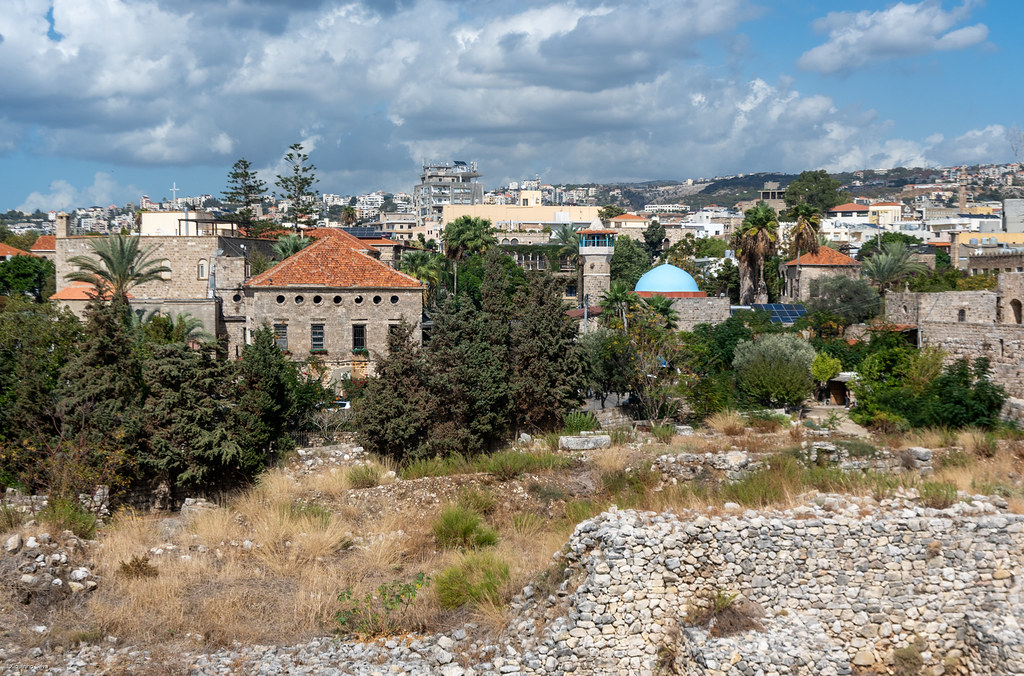
The Greek work On the Syrian Goddess, attributed to Lucian of SamosataLucian of SamosataLucian of Samosata was a second-century CE writer in Greek, associated with Samosata on the Euphrates.Glossary · Click to read the explanation and belonging to the Roman imperial period, mentions a sanctuary of the Byblian Aphrodite at ByblosByblos / JbeilByblos, or Jbeil, is a coastal city in Lebanon north of Beirut.Glossary · Click to read the explanation. Its author describes lamentation, breast-beating, mourning, offerings for the departed, and then an announcement that Adonis lives again and the raising of his image towards the sky. This explicit report of a return should not be erased to make another interpretation easier; nor should this later account from another city be mistaken for first-hand evidence of fifth-century BCE Athenian practice. Its descriptions of hair shaving and the sexual penalty for women declining to shave belong to the ancient author's rhetoric and require critical handling, not automatic generalisation. [21]
The author adds that some people of Byblos understood the rites as mourning OsirisOsirisOsiris was an ancient Egyptian deity associated with the dead, life after death, renewal, and kingship. His roles appear in changing funerary texts, rituals, and judgment scenes, notably the weighing of the heart.Glossary · Click to read the explanation rather than Adonis, alongside an extraordinary story of a head travelling from Egypt. The annual reddening of the River Adonis is then explained twice: through the god's blood in the legend and through red earth carried into the water from the mountains in another local explanation. The presence of rival explanations within the source matters. Red water cannot stand as archaeological evidence for the death of a god, nor were Osiris and Adonis necessarily identical for all worshippers. [22]
Meanings of death and return
An Attic picture shows short-lived planting, an Alexandrian hymn promises another return, and a report from Byblos declares the lost figure alive once more. These elements concern separation, bereavement, and recurrence, but their wording cannot simply be transferred to “resurrection” in Jewish and Christian texts without further argument. Nor does one vase image disclose whether those who used it envisaged an immortal Adonis, the return of an effigy, or the repetition of a communal rite. [12][18][21]
The historical question is not whether every participant experienced sincere sorrow or joy: the evidence rarely gives access to individuals' feelings. More fruitful is identifying what a singer or narrator says, what the pot, planter, and image actually display, and where modern inference begins. This allows both death and return to remain visible, without merging divergent witnesses into one seamless narrative of dying and rising.
From fertility to social readings of ritual
Gardens of Adonis have often been read as rapidly perishing plants emblematic of death and growth. James George Frazer famously placed such ceremonies within a model of seasonal fertility. Marcel Detienne resisted reducing the Adonia to a successful agricultural fertility rite and interpreted plants, scents, sexuality, and marriage within a pattern of incomplete or fruitless growth. Reitzammer, in turn, re-examines Athenian gender, weddings, civic mourning, and political speech. These are different interpretive models. The publishers' descriptions and summaries consulted here are not equivalent to reading either monograph from beginning to end. [23][17]
In the Alexandrian case, Burton explores Arsinoe's patronage and the poem's several audiences, while Joseph D. Reed describes the festival of Idyll 15 as a hybrid drawing on multiple customs in the Ptolemaic court. Relevant passages of Burton's openly available monograph were examined; Reed is represented here by the published abstract, not by a claim to have read the complete article. Both perspectives remind us that treating poetry as a transparent ritual transcript, or severing the ceremony entirely from royal politics, misses important layers of evidence. [19][20]
Eastern Mediterranean connections and their limits
Scholarship frequently relates Adonis to the religious cultures of the eastern Mediterranean, especially the traditions of Dumuzi/TammuzDumuzi / TammuzDumuzi is a deity of ancient Mesopotamian traditions associated with shepherding and Inanna; Tammuz appears as the name in later linguistic and textual traditions.Glossary · Click to read the explanation and his lamentation. Ezekiel 8:14 describes women weeping for Tammuz at the temple's entrance, a detail comparable to Greek expressions of mourning. It does not, however, describe Athenian gardens of Adonis or the hymn of Theocritus or the Ptolemaic palace festival. Comparison can raise useful questions about contact and transformation, but cannot itself demonstrate an uninterrupted sequence of identical rites from MesopotamiaMesopotamiaHistorical region associated with the Tigris and Euphrates: Uruk, Ur, Eridu, cuneiform, Sumer, Akkad, Babylon and Assyria, their languages and cults, and the limits of archaeological evidence.Glossary · Click to read the explanation to Greece. [25]
The Byblian account also illustrates how divine names and local stories might be translated or reinterpreted among Byblian Aphrodite, Adonis, and Osiris. Historical connections and cultural exchange across the eastern Mediterranean are both plausible and important. Proving the derivation of a particular practice, though, requires dated intervening witnesses rather than merely similar plots about a beloved figure who disappears. The archive already contains a separate comparative study, “Dumuzi and Adonis: Death and Return in Narrative and Ritual”; this record need not duplicate it. [22]
What is established and what remains open
The strongest evidence comprises early lyrical lament, swift ritual gardening mentioned in Plato and suggested by an Attic vase, publicly audible mourning in comedy and biography, an Alexandrian poem depicting court patronage and annual return, and an imperial-period description of Byblian rites combining grief with a claim of renewed life. These distinct witnesses are not a single document proving one universal practice or festival date. [9][12][13]
The number of festival days in each city, the precise species grown everywhere, the social composition of all gatherings, the uninterrupted duration of each practice, and the origin of each symbol cannot all be assigned the same degree of certainty. The Adonia is particularly instructive because it shows how mythic imagery changes between poetry, civic space, and an illustrated object, while the evidence and its limits can remain visible to readers. [17][23]
References and notes (15)
- Theocritus, Idyll 15, “Women at the Adonia.” The Fordham historical sourcebook excerpt of the court scene and hymn was read; it is not a complete edition of the poem. Compare [18]. Idyll 15, court scene and Adonis song; Fordham excerpt (from M. Carroll, Greek Women, 1908, pp. 369–375) Return to the text ↑
- The Metropolitan Museum of Art, Attic red-figure squat lekythos, accession 22.139.26 (collection record 251204), mid-fourth century BCE. Catalogue, original image, derivative and public-domain statement checked. The museum describes the figures as “perhaps Adonis” and “perhaps Aphrodite.” The Met, accession 22.139.26; catalogue description, object image, credit and rights Return to the text ↑
- Plato, Phaedrus 276b–c, Benjamin Jowett’s English translation, “gardens of Adonis” and the eight-day growth metaphor within a discussion of writing and teaching. Passage and immediate context read; not evidence for a fixed eight-day festival. Plato, Phaedrus 276b–c (Jowett translation; selected passage and its context) Return to the text ↑
- Sappho, fr. 140a (Voigt), a two-line lament for Adonis transmitted through the later metrical writer Hephaestion. The brief translation at Harvard’s Center for Hellenic Studies was read; it is a fragment, not a surviving complete festival hymn. Sappho fr. 140a (Voigt); Harvard CHS, Selections from Sappho, item 5 Return to the text ↑
- Aristophanes, Lysistrata, approx. lines 387–398, comic recollection of women lamenting Adonis on rooftops during discussion of the Sicilian expedition. The passage in English was checked, not the entire Greek play. Aristophanes, Lysistrata 387–398, English passage (Perseus record and search extract) Return to the text ↑
- Plutarch, Life of Nicias 13.7, a retrospective narrative about Adonis laments and small funerary effigies at the departure of the Sicilian expedition in 415 BCE. Section and immediate context read; it is not contemporary evidence that the omen caused defeat. Plutarch, Nicias 13.7 and adjacent paragraphs (English translation at LacusCurtius) Return to the text ↑
- Laurialan Reitzammer, The Athenian Adonia in Context (University of Wisconsin Press, 2016). Only the publisher’s description and chapter outline were consulted, not the complete book. Claims about wedding, funerary and civic resonances are modern interpretations. Reitzammer, The Athenian Adonia in Context (2016); publisher description and table of contents only Return to the text ↑
- Theocritus, Idyll 15, full poem (approx. 149 lines) in Andrew Lang’s English translation (1889): Gorgo and Praxinoa, palace tapestries, song and farewell. The English translation was read in full; the displayed Greek was not independently collated. Theocritus, Idyll 15.1–149 (Andrew Lang, English translation of 1889; complete poem) Return to the text ↑
- Joan B. Burton, Theocritus’s Urban Mimes: Mobility, Gender, and Patronage (University of California Press, 1995), selected available discussion around pp. 134–147 on Idyll 15, female voices and royal patronage. Only the relevant online passages, not the entire book, were inspected. Burton (1995), selected online passages on Theocritus 15, around pp. 134–147 Return to the text ↑
- Joseph D. Reed, “Arsinoe’s Adonis and the Poetics of Ptolemaic Imperialism” (2000). Only the accessible abstract was consulted for the scholarly debate over Alexandrian royal ritual; the full article was not read. Reed (2000), “Arsinoe’s Adonis and the Poetics of Ptolemaic Imperialism”; abstract only Return to the text ↑
- On the Syrian Goddess, attributed to Lucian of Samosata, §6: Byblian Aphrodite, lamentation, offerings, and the report that Adonis is alive again. Read the translated section; the imperial-period narrative does not attest an identical Classical Athenian ritual. On the Syrian Goddess (De Dea Syria) §6 (English translation and footnotes) Return to the text ↑
- On the Syrian Goddess §§7–8: alternative Byblian identification with Osiris, the floating head, and two accounts of the red Adonis River (blood versus mountain soil). The translated sections were read; no miracle is treated as archaeological proof. On the Syrian Goddess §§7–8 (English translation and footnotes) Return to the text ↑
- Marcel Detienne, The Gardens of Adonis: Spices in Greek Mythology (Princeton University Press, English edition). Only the publisher/library synopsis was consulted, not the complete monograph; symbolic interpretations are reported as scholarly hypotheses. Detienne, The Gardens of Adonis (Princeton edition), publisher/book description only Return to the text ↑
- Jeremy McInerney, full BMCR review of Reitzammer, The Athenian Adonia in Context (2017), especially its discussion of ladder scenes and ambiguity between the Adonia and post-wedding epaulia. The review was read; it is not the complete monograph. McInerney, Bryn Mawr Classical Review 2017.05.50; full review, chapter 2 assessment Return to the text ↑
- Ezekiel 8:14, mention of women weeping for Tammuz at a temple gateway, checked in accessible English translations. This is comparative eastern textual evidence, not a description of the Athenian Adonia or proof of continuous transmission. Ezekiel 8:14, verse in modern English translations Return to the text ↑
Suggest a correction · Suggest a source for this record
Cite this record
IL Archive, «Adonia: the celebration of Adonis», https://ilarchive.com/en/entities/adonia
Continue reading