Site
Esharra in Babylonian and Assyrian Texts
- Names
- Eshara · Esharra · Ešarra
- Region
- Mesopotamia
Esharra is a structure Marduk builds in the Babylonian creation poem Enūma eliš. Assyrian texts use the same name for the temple complex of the god Ashur at Assur.
Estimated reading time: 5 min Published Last reviewed:
Share article
Text
Introduction
Esharra is a named structure in the Babylonian creation poem Enūma elišEnuma ElishA seven-tablet Babylonian creation poem in Akkadian, recounting Marduk’s rise, victory over Tiamat, cosmic ordering and human creation, and culminating in praise through fifty names. Its composition date is debated; later manuscripts and recitation traditions preserve it.Glossary · Click to read the explanation. MardukMardukBabylon’s leading god, worshipped at Esagil and elevated in the Akkadian Enūma eliš. His symbols include a spade and mušḫuššu dragon. His earliest origins remain obscure; Nibiru is no evidence of a planetary homeland.Glossary · Click to read the explanation sets it up near the end of Tablet IV, while arranging places for Anu, EnlilEnlilEnlil/Ellil: a major Mesopotamian god associated with destinies, kingship, and Ekur at Nippur, already prominent in third-millennium god lists. His name’s origin and cult beginnings remain debated.Glossary · Click to read the explanation and EaEnkiMesopotamian deity also known as Ea, linked with Eridu and the Abzu (deep fresh waters), wisdom, incantations, and narratives of creation and cosmic order. Later written attestations do not identify the deity of Eridu’s earliest layers.Glossary · Click to read the explanation. The name is also attested in Assur as a designation for the temple complex of the city’s patron god Ashur. In the poem it helps establish relationships between parts of the cosmos. In Assyrian records it belongs to a place with gates, offices and a history of building. [1][2]
The two uses can be followed through different types of evidence. The literary passages give Esharra a position relative to the heavens and the Apsû, the dwelling of Ea. In Assur, a scholarly tablet lists gates from an extension of the temple, and an excavated basalt basin gives a view of equipment made for its courtyard. [1][2][3]
Building a place for Enlil
Tablet IV tells of Marduk defeating Tiāmat and dividing her body. He sets one part up as the heavens, appoints a watch to restrain the waters and surveys the new space. The building of Esharra follows this measuring. In Wilfred Lambert’s translation, Marduk measures the Apsû and establishes Esharra as a replica of Eshgalla. He then settles the gods in their shrines. Building is part of the work that follows the battle, as places take shape and their occupants are assigned. [1]
The names in the last couplet are arranged in a way that makes their associations easy to miss. Lambert reads the order of places and occupants as reversed across the two lines. The heavens belong to Anu, Esharra to Enlil, and Eshgalla refers here to the Apsû, the dwelling of Ea. In that interpretation Esharra is a lower heaven below the abode of Anu. Lambert also discusses a fragmentary ancient commentary which interprets the building in relation to the Apsû but leaves part of the wording about its position damaged. [1]
The position of Babylon
In Tablet V, Marduk announces his intention to establish his own dwelling. He describes its position as above the Apsû, beneath the heavens and opposite Esharra in Lambert’s rendering. There he will set up a sanctuary and a place for his kingship. The new dwelling will also serve as a resting place for the gods when they come up for an assembly. Esharra is already in place, so the reference helps the audience locate the building Marduk proposes. [1]
Tablet VI returns to that relationship when the gods complete Esagil, Marduk’s sanctuary in BabylonBabylonBabylon is an ancient city in central present-day Iraq, south of BaghdadGlossary · Click to read the explanation. The description puts the upper features of Esagil in relation to the base of Esharra. Lambert uses the passage to support his reading of Esharra as above the Babylonian temple. In one later royal inscription that Lambert cites, Nabopolassar describes Babylon’s zigguratZigguratZiggurat: a monumental stepped or terraced cult structure of ancient Mesopotamia. Not every raised temple platform was a ziggurat, and the form and specific use of lost upper stages often remain uncertain.Glossary · Click to read the explanation EtemenankiEtemenankiStepped ziggurat in Babylon’s Esagil sacred precinct, associated with Marduk. Excavations establish its base, royal texts attest rebuilding, and a later Esagil Tablet supplies idealized dimensions.Glossary · Click to read the explanation as a counterpart of Esharra. Lambert pairs this with other royal inscriptions that describe Esagil as a replica of the Apsû. The two Babylonian buildings could thus be associated with different parts of the cosmos, each through a relation set out in its own inscription. [1]
A temple name in Assur
Assur stood on the Tigris in northern MesopotamiaMesopotamiaHistorical region associated with the Tigris and Euphrates: Uruk, Ur, Eridu, cuneiform, Sumer, Akkad, Babylon and Assyria, their languages and cults, and the limits of archaeological evidence.Glossary · Click to read the explanation. The site faces the river on its eastern side and lies near the boundary between zones of rain-fed and irrigated agriculture. It was an early political capital and remained a religious center associated with the god Ashur. In texts from the city, Esharra is one of the names used for the large temple complex of that god. Troels Pank Arbøll notes that names used for the complex and its parts differ across documents. Esharra itself occurs in a title borne by Bāba-šuma-ibni, a priest identified in the written records of a family of specialists at Assur. [2][4]
A tablet linked to the scholar Kiṣir-Aššur presents the name in a different setting. Known as KAV 42, it lists deities grouped by temples, includes a section on the city gates and records the gates of Sennacherib’s extension to the Esharra complex. Its colophon says the old gates are omitted. The statement makes the list a document about a particular part of the complex and a particular phase of work. Arbøll suggests that the scholar may have prepared an updated version of a topographical text. [2]
The basin from the temple courtyard
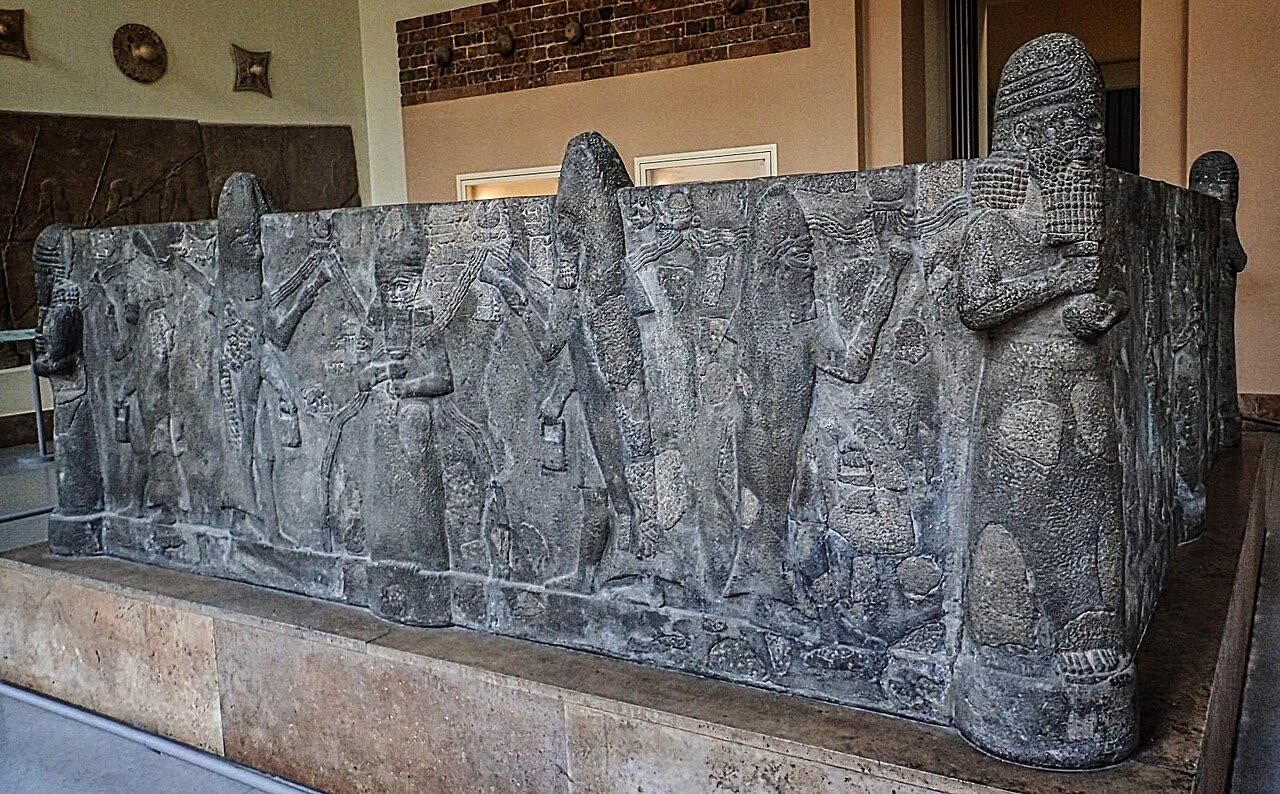
The object pictured is a large water basin that the Vorderasiatisches Museum identifies as a commission of Sennacherib for the courtyard of the Ashur temple. It was made from a block of basalt. Its outer walls show gods dispensing water alongside figures in fish-scale robes, which the museum identifies as priests. The CuneiformCuneiformWriting with wedge-shaped signs, developed from Mesopotamian recording traditions and used for several languages from the third millennium BCE.Glossary · Click to read the explanation Digital Library Initiative registers it under the Berlin collection number VA Ass 01835 and links the object to an inscription in the edition of Sennacherib’s royal texts. [3][5]
The basin gives the temple name a connection to physical evidence. Its stone, carved walls and intended location belong to a courtyard at Assur, while the written list of gates traces the complex’s expansion. The Esharra of Enūma eliš is described through its relationships to other divine dwellings. Reading the name in each setting allows those particular details to remain visible, from the position of Enlil’s shrine to the placement of a basin in a temple courtyard. [1][2][3][5]
References and notes (5)
- Wilfred G. Lambert, Babylonian Creation Myths, Enūma Eliš Read Tablet IV lines 135–146, Tablet V lines 119–125, Tablet VI lines 62–68 and the commentary on Ešarra, Ešgalla, the Apsû and later royal comparisons. Return to the text ↑
- Troels Pank Arbøll, Medicine in Ancient Assur Read the discussion of Ešarra in titles, designations for the temple complex, and the topographical tablet KAV 42, especially pages 187 and 210 and its reverse lines 36–40. Return to the text ↑
- Vorderasiatisches Museum, Water Basin, VA Ass 1835 Read the collections entry for provenance, courtyard use, basalt, reliefs, commission and museum number. Return to the text ↑
- UNESCO World Heritage Centre, Ashur (Qal’at Sherqat) Read the site statement on Tigris geography, early political history and religious association with the city’s patron deity. Return to the text ↑
- Cuneiform Digital Library Initiative, Sennacherib 192, witness P466938 Read the basin’s archaeological findspot, period, Berlin number and catalogue links to the royal inscription edition. Return to the text ↑
Suggest a correction · Suggest a source for this record
Cite this record
IL Archive, «Esharra in Babylonian and Assyrian Texts», https://ilarchive.com/en/sites/esharra