Ancient text
Śatapatha Brāhmaṇa
A text for line-by-line reading, with transliteration, translation, and resources.
A Vedic prose work tied to the White Yajurveda, explaining rituals and the link of sacrifice to cosmos and knowledge. At 1.8.1 it tells of Manu’s rescue by a fish and Idā’s emergence; later epic expansions differ.
Estimated reading time: 9 min Published Last reviewed:
Share article
Text
Introduction
The Śatapatha Brāhmaṇa is a vast work of late Vedic prose explaining sacrifices, the formulas spoken during them, and connections between ritualRitualAn organised or distinguished practice meaningful to a community; it may leave traces, but its form alone does not reveal an associated doctrine.Glossary · Click to read the explanation details, creation, the cosmos and knowledge. This entry examines it as a layered, school-transmitted ritual text rather than a book devoted chiefly to the flood. It does contain the earliest surviving detailed Indian account of ManuManu, Survivor in Indian Flood TraditionsA central human figure in several Sanskrit accounts of the flood and human renewal; his position and role differ across the Śatapatha Brāhmaṇa, Mahābhārata and Purāṇas.Glossary · Click to read the explanation's rescue by a fish, but that account belongs within an explanation of sacrifice and must be distinguished from later epic forms of the story.
We examine the work's identity, recensions, transmission and chronology, then test three passages in the Mādhyandina recension: the building of the fire altar, a dialogue about the milk offering, and the account of Manu and Idā. These are identified passages actually consulted, not a claim to have collated all surviving manuscripts or read the complete Sanskrit work.
A ritual text, not merely a storehouse of myths
The title Śatapatha Brāhmaṇa may be rendered approximately “Brāhmaṇa of a Hundred Paths.” The work belongs to the Brāhmaṇa prose literature associated with the White Yajurveda (Śukla Yajurveda). Here, brāhmaṇa denotes a category of Vedic ritual exposition, not a person called Brahmā. Such literature explains how offerings are performed and why a particular formula, substance or gesture matters. This work discusses the establishment of sacred fires and altars, seasonal offerings, soma rites, royal consecration, and correspondences linking the body, breath and universe. A narrative can therefore lead directly into instructions for officiants. [4]
Its interpretive method connects physical actions with wider meaning. Sacrifices are not presented only as mechanical performances: they may be understood as reordering the world and connecting the sacrificer with divinities and cosmic time. These are claims and interpretations within the textual tradition, not empirical accounts of the universe's origins.
Two schools, different arrangements
Two major surviving textual recensions are Mādhyandina and Kāṇva, both linked to the White Yajurveda. The Mādhyandina arrangement has fourteen large books (kāṇḍas) and one hundred chapters (adhyāyas); Kāṇva distributes its material across seventeen books, with differences in order and subdivisions. The divergence is not just a change of numbering: wording, distribution and school-specific materials also differ. A Mādhyandina passage reference cannot automatically be converted into Kāṇva numbers. [3][4]
Every numerical reference to the Śatapatha Brāhmaṇa in this entry follows Mādhyandina, in the order book.chapter.section.paragraph, for instance 1.8.1.2. Whenever Kāṇva's arrangement is discussed, the recension is named. The final Mādhyandina book and the final Kāṇva book are associated with the Bṛhadāraṇyaka Upaniṣad, where discussions of the self and knowledge expand. Lauren Bausch links much of Mādhyandina's cultural setting with Videha and the Kāṇva redaction with Kosala, while stressing the problems of reconstructing the history of these schools. [3] The Indira Gandhi National Centre for the Arts lists volumes of a Kāṇva edition with English translation published between 1994 and 2015; modern editions do not amount to one original autograph of the text. [11]
Composition, transmission and dates
There is no securely identified single author who dictated this book in one year. Its traditions belong to the later Vedic milieu of northern India, within the broad first millennium BCE, and different passages may have quite different histories. One Sanskrit teaching resource places the Manu narrative roughly in the seventh century BCE; this is a general approximation, not independent proof of the date of the individual paragraph. Schools maintained and transmitted their material orally, while larger units were compiled and edited over time. Scholars examine sections associated with the Yājñavalkya and Śāṇḍilya traditions and the possibility that some parts once circulated independently. Suggestions that certain redactional layers persisted into the final centuries BCE must not become fixed dates for the whole composition. [3][10]
Three timeframes must be kept apart: the flood's time within the story, an undated mythic setting; the composition and revision of textual layers, for which scholarly estimates differ; and the dates of extant manuscripts, editions and translations, often far later. A relatively late manuscript is not the date of the first recitation, and a nineteenth-century printed edition does not make its contents a nineteenth-century invention.
How ritual explains the cosmos and knowledge
Instructions for agnicayana, constructing the fire altar in layers, provide one example. At 6.1.1.5 the text identifies the cosmic Person with Prajāpati, “Lord of Creatures,” and then with the fire whose altar is to be built. A short Sanskrit extract follows, in normalized Roman transliteration from a specified passage, not attributed to one particular manuscript. [6]
The following clause identifies this figure with Agni, the fire embodied in the altar under construction. At 10.1.5.1–3, the stages of constructing that altar are correlated with other sacrifices, and its five layers with different rites: the act of building becomes a comprehensive representation of sacrificial activity. The bricks are not merely a literary metaphor. Their physical arrangement is integral to the text's production of meaning. [7]
The knowledge required of practitioners is knowledge of the meanings of performance as well as its procedures. At 11.5.3.1–7, Saukeya Prākīnayogya questions Uddālaka Āruṇi about agnihotra, the morning and evening offering to the sacred fire. The exchange tests the significance of the cow, milk, utensils, movements and invocations, and then gives them cosmic and divine counterparts. When Idā, “Manu's daughter,” reappears in the explanation of the offering cow, it becomes clear that the symbolism of Manu's story also operates elsewhere in the work. [8]
The fish and Manu's survival
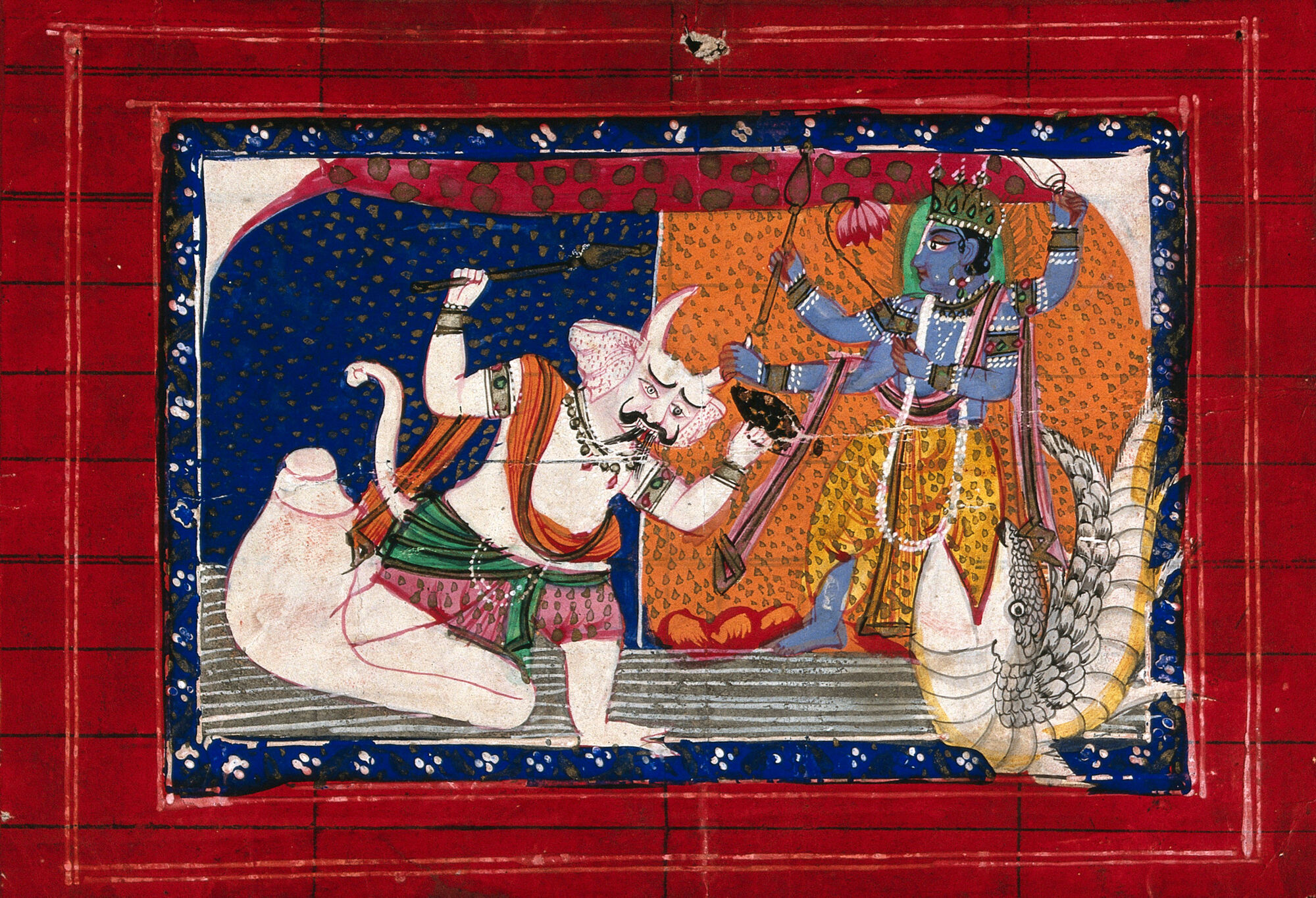
At 1.8.1.1–6 a fish lands in the washing water brought to ManuManu, Survivor in Indian Flood TraditionsA central human figure in several Sanskrit accounts of the flood and human renewal; his position and role differ across the Śatapatha Brāhmaṇa, Mahābhārata and Purāṇas.Glossary · Click to read the explanation. It asks to be reared, since larger fish devour smaller ones, and promises to save him from a flood that will carry off living beings. Manu moves it from a vessel to a pit and then to the sea, and builds a boat on its instructions. When the flood comes, he ties the boat's rope to the fish's horn, and it draws him to a mountain in the north. He descends as the waters recede. The text states that Manu alone survived the destruction, without presenting a geographical report or an archaeologically dated event. [1]
The fish's reply at 1.8.1.2 is central to the episode. This brief extract comes from the Mādhyandina Sanskrit, with ordinary word separation in Roman transliteration, checked against a published Sanskrit text and a separate grammatical discussion. The English rendering here is a short fresh translation, not a verbatim quotation from Eggeling's translation. [5][10]
The two verbs establish the story's reciprocity: first the fish is protected, and then it protects Manu. The passage says “a northern mountain,” without explicitly naming the HimalayasHimalaya mountain rangeMountain range separating the Tibetan Plateau from parts of the Indian subcontinent, named in Manu’s epic story.Glossary · Click to read the explanation, and does not identify the fish as ViṣṇuViṣṇuHindu deity with whom the saving fish is identified in later Vaiṣṇava versions.Glossary · Click to read the explanation or BrahmāBrahmāCreator deity in Indian traditions, named as the fish’s identity in Mahābhārata 3.185.Glossary · Click to read the explanation here. These are limits of this particular witness, not a denial of identities assigned in other traditions. [1]
Idā and the passage into sacrificial practice
The unit numbered 1.8.1 does not end when Manu leaves the mountain. In 1.8.1.7–11, wishing for descendants, he offers clarified butter and milk products into water, and a woman emerges who identifies herself as his daughter. The passage associates her with IdāIdā, sacrifice and human renewalFemale figure arising from Manu’s post-flood offering in the Śatapatha Brāhmaṇa.Glossary · Click to read the explanation, a blessing, the generation of offspring, and the sacrificial portion bearing her name. It says that through her Manu generated his human descendants. Mitra and Varuṇa also appear in the account of her parentage. [1][2]
The same unit continues through paragraph 44, explaining the cutting and distribution of Idā's portion, its invocation and the subsequent purification, with the roles of different priests. Paragraphs 1–11 thus provide the opening narrative and its immediate ritual rationale, not “the complete section.” The connection between survival, human renewal and detailed practice is precisely why removing the flood story from its ritual setting distorts its function. [1]
Scholars have considered whether the flood narrative in 1.8.1.1–6 and the sacrifice-and-descent sequence in 1.8.1.7–11 preserve different layers brought together by a redactor. Reviewing earlier arguments about distinct Sanskrit words for water, Guillaume Ducœur discusses this possibility without treating vocabulary alone as decisive proof of an insertion. What the transmitted text certainly presents is a connection between rescue and sacrifice; its prehistory is not settled by that connection alone. [2]
What the epic and later traditions add
Another telling appears in the MahābhārataMahābhārataSanskrit epic formed over centuries, preserving a version of Manu, the fish and the seeds.Glossary · Click to read the explanation, Forest Book 3.185.1–54 in the edition reproduced with Sanskrit and French translation by Ducœur. At 3.185.29–30, seven sagesSeven sages in Manu’s flood storySages accompanying Manu aboard the boat in the Mahābhārata version, Sanskrit saptarṣi.Glossary · Click to read the explanation and seeds to be preserved are brought aboard; at 3.185.44–47, a peak of the HimalayasHimalaya mountain rangeMountain range separating the Tibetan Plateau from parts of the Indian subcontinent, named in Manu’s epic story.Glossary · Click to read the explanation is named; and at 3.185.48 the fish declares itself to be BrahmāBrahmāCreator deity in Indian traditions, named as the fish’s identity in Mahābhārata 3.185.Glossary · Click to read the explanation. These belong to the epic witness, not to Mādhyandina Śatapatha Brāhmaṇa 1.8.1.1–11. A modern illustration that includes those motifs cannot serve as ancient documentary evidence for the earlier telling. Later traditions vary in their divine identification of the fish, including its connection to Viṣṇu in Matsya PurāṇaMatsya PurāṇaSanskrit Purāṇic text framing religious instruction through the divine fish’s dialogue with Manu.Glossary · Click to read the explanation traditions. When reporting this particular epic passage, Brahmā must not silently be replaced by Viṣṇu. [9][2]
Comparisons with Mesopotamian or other flood stories can illuminate shared motifs—survivors, boats and destructive waters. Establishing a historical borrowing, however, requires scrutiny of witness dates, narrative arrangements, differences and plausible channels of contact. Ducœur surveys the history of comparisons between Indian and Semitic flood traditions and evaluates far-reaching transmission hypotheses. Similarities make a question worth asking; by themselves they prove neither a particular route of diffusion nor that every detail of a later epic existed behind an earlier Vedic witness. [2]
Chronology and conclusion
- Within the narrative: a catastrophic flood and Manu's rescue take place in mythic time, not a datable calendar year.
- Broadly during the first millennium BCE: Vedic Brāhmaṇa traditions take shape across several schools and phases; some approximate dating places the Manu account around the seventh century BCE without fixing the date of every section. [10][3]
- Through successive school and redactional phases: Mādhyandina and Kāṇva texts circulate with different arrangements; exact stages and dates remain debated. [3]
- Nineteenth and twentieth centuries CE: printed editions and studies, including Julius Eggeling's English translation issued in volumes beginning in 1882, make older textual traditions available to modern readers; they are not the initial moment of composition. [1][4]
- 2018–2019 CE: Bausch's study of the recensions appeared in 2018, and Ducœur's study of Indian flood comparisons in 2019, with a Sanskrit text and French translation of 1.8.1.1–11 in its appendix. [3][2]
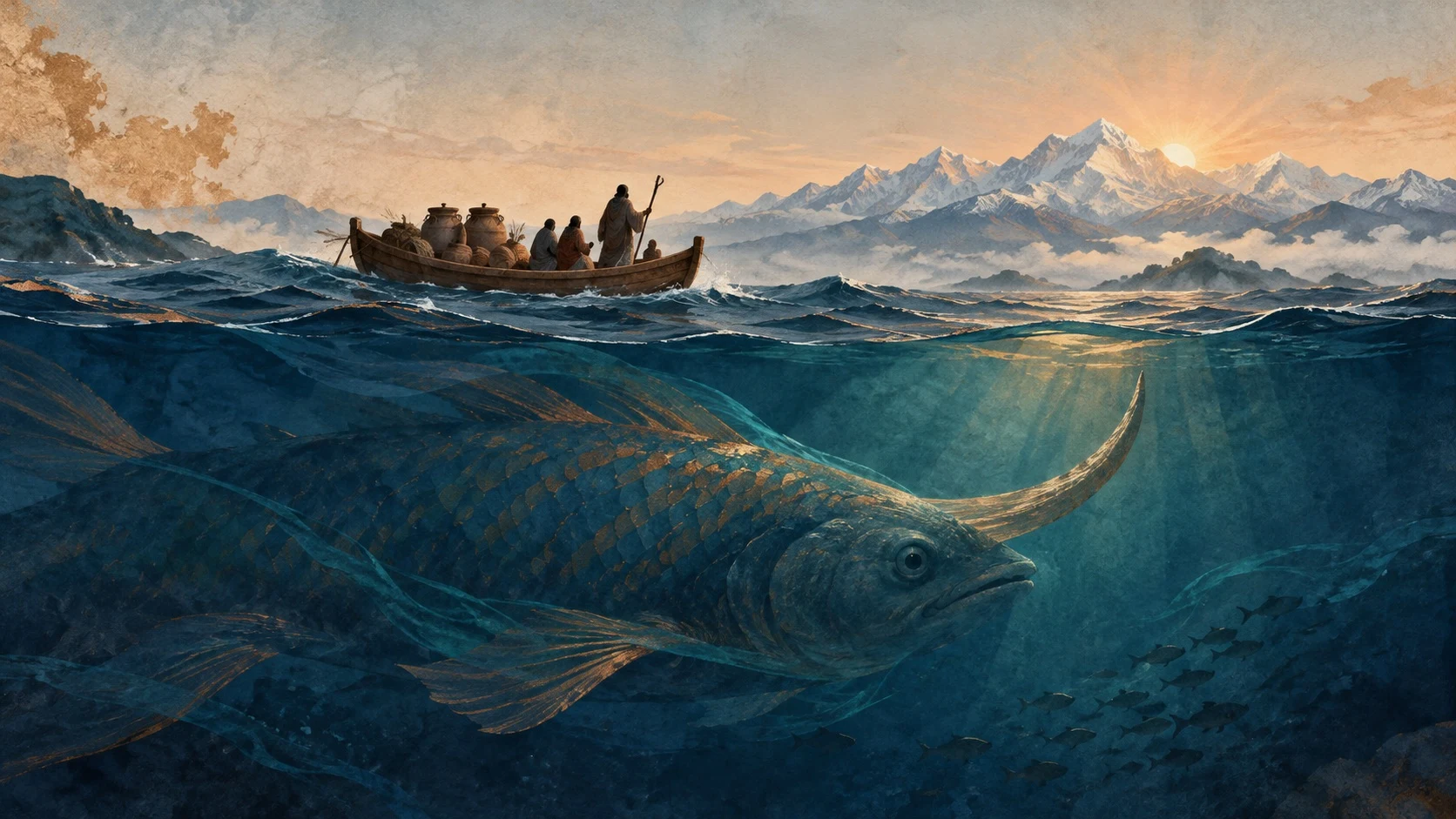
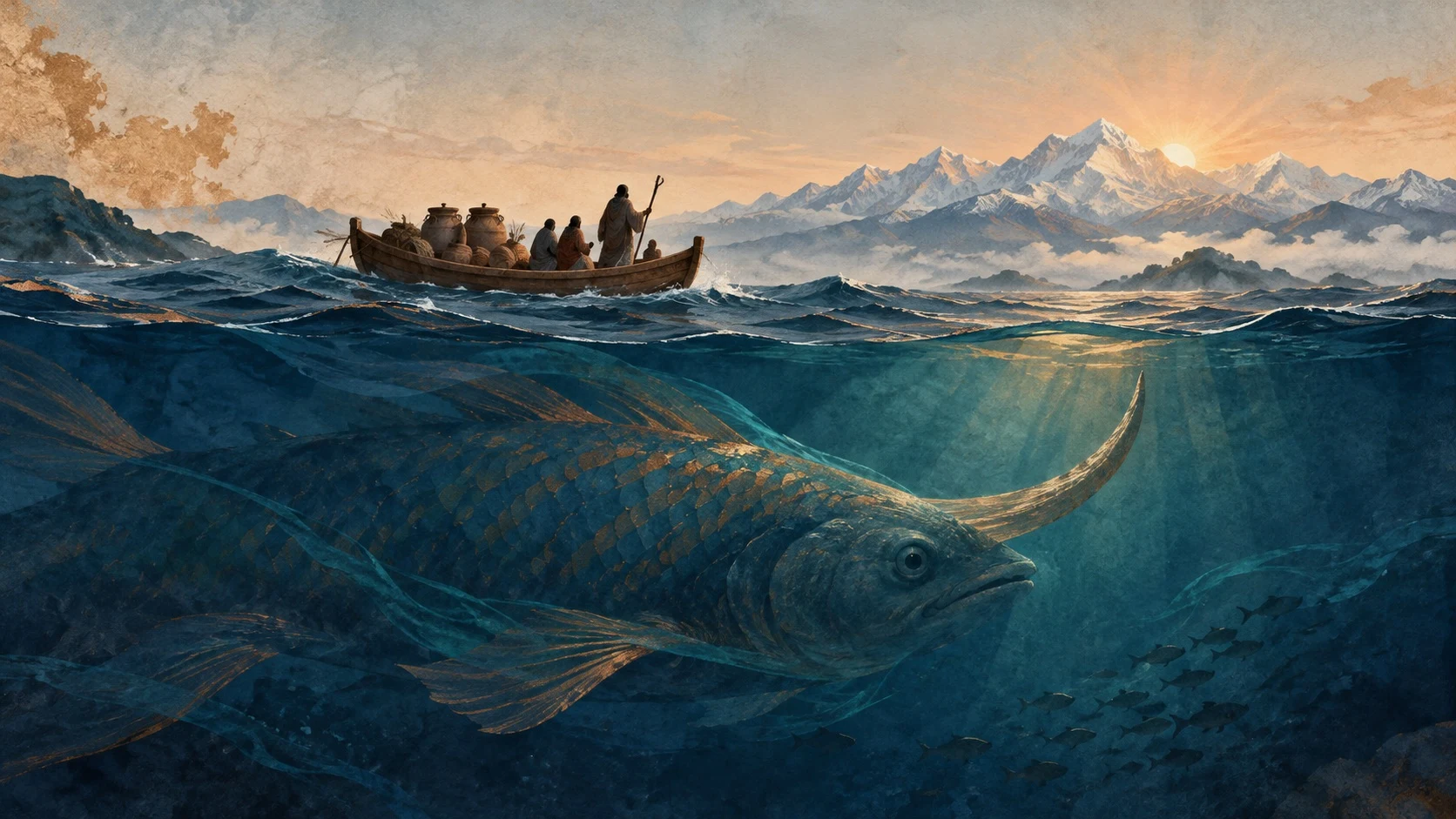
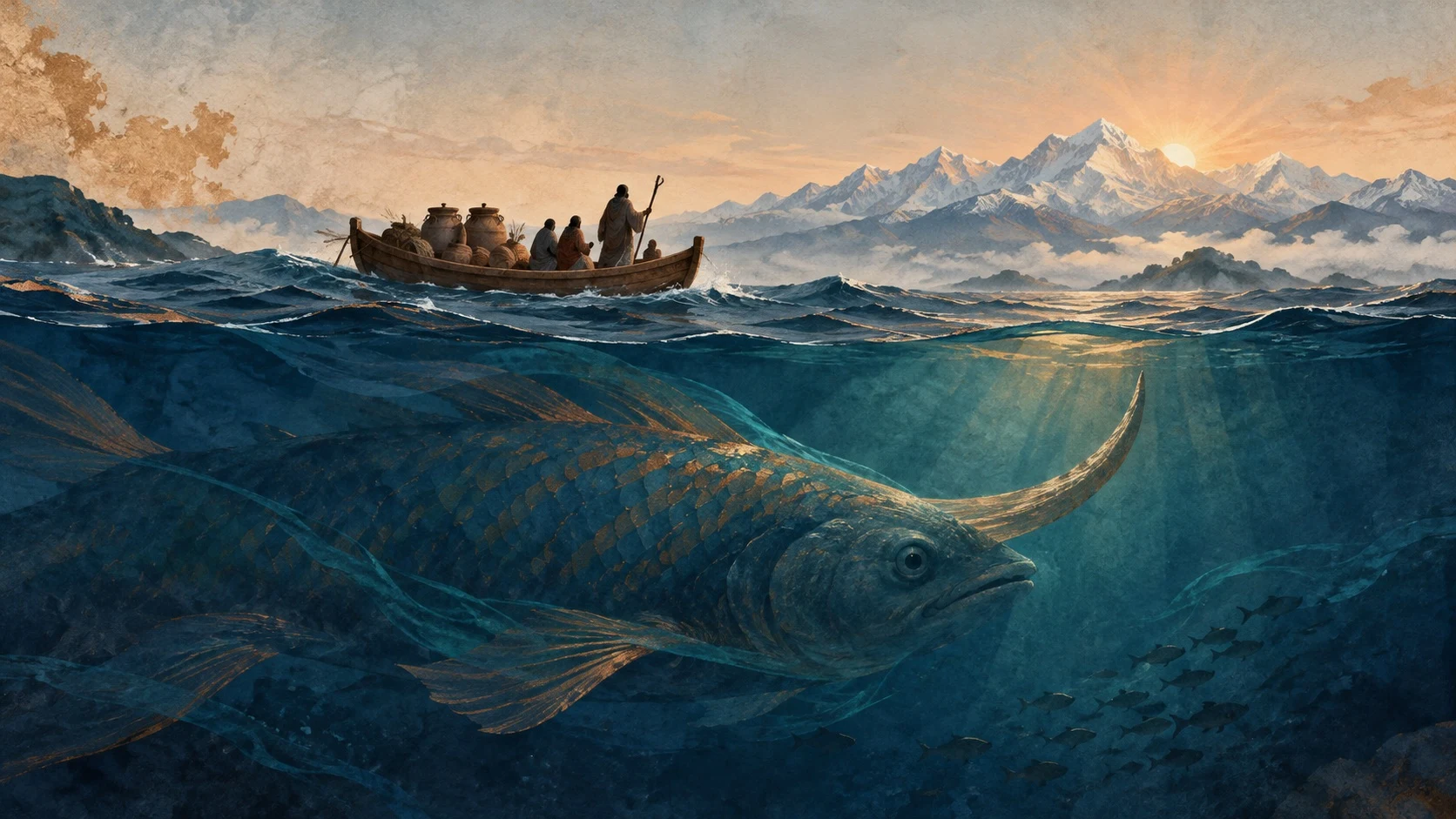
The accompanying cover is a retained modern conceptual illustration, not a photograph of a manuscript, an excavated object or a documented location. Its additional passengers and seed vessels better evoke epic elaborations than the precise Mādhyandina account. The Śatapatha Brāhmaṇa is most valuable here for showing how narrative is enlisted to explain ritual action and knowledge, and how its school versions and later retellings can be studied historically without blending them into a single ancient text.
References and notes (11)
- Śatapatha Brāhmaṇa, Mādhyandina recension, trans. Julius Eggeling, The Sacred Books of the East, vol. 12 (Oxford, 1882). Book 1, chapter 8, brāhmaṇa 1, paragraphs 1–44; printed pp. 216–230; story 1–11, subsequent rite 12–44. Return to the text ↑
- Guillaume Ducœur, Les mythes du déluge de l’Inde ancienne: Histoire d’un comparatisme sémitico-indien (Louvain: Peeters, 2019); comparative analysis and Sanskrit appendix. Printed pp. 288–289, 322–325; appendix ŚB 1.8.1.1–11, pp. 331–334 (text and translation 332–334); zero-index PDF pp. 330–331, 364–367, 373–376. Publication is 2019, not 2018. Return to the text ↑
- Lauren M. Bausch, “The Kāṇva Brāhmaṇas and Buddhists in Kosala,” Journal of the International Association of Buddhist Studies 41 (2018): 27–53. Consulted mainly printed pp. 30–35, zero-index PDF pp. 3–8: regional schools, composite text, Yājñavalkya and Śāṇḍilya sections, Upaniṣad links; not the entire article. Return to the text ↑
- Julius Eggeling, “Introduction” to vol. I of his Śatapatha Brāhmaṇa translation (1882), discussion of the White Yajurveda, recensions, organization and editorial history. Introduction, sections on the “hundred paths,” fourteen Mādhyandina and seventeen Kāṇva books, and composition. Its 1882 remarks on missing holdings are historical, not present-day availability claims. Return to the text ↑
- Mādhyandina Śatapatha Brāhmaṇa, published Sanskrit text of verse 1.8.1.2, Wisdom Library; checked against the Sanskrit Reading Room discussion. 1.8.1.2 only, especially “bibhṛhi mā pārayiṣyāmi tvā”; ordinary IAST transliteration without Vedic pitch accents; not a manuscript collation. Return to the text ↑
- Mādhyandina Śatapatha Brāhmaṇa 6.1.1.5, published Sanskrit text and accompanying preview of Julius Eggeling’s English translation, Wisdom Library. 6.1.1.5 only: the Person becoming Prajāpati and identification with Agni/the altar; short Sanskrit quotation, not the entirety of book 6. Return to the text ↑
- Śatapatha Brāhmaṇa 10.1.5, Julius Eggeling’s English translation via Wisdom Library, on fire-altar construction and its correspondences to other sacrifices. 10.1.5.1–3 read in English translation; Sanskrit not collated for this passage, nor was the whole unit read. Return to the text ↑
- Śatapatha Brāhmaṇa 11.5.3, Julius Eggeling, English translation, part V, Sacred Books of the East, vol. 44 (1900), agnihotra disputation. Paragraphs 1–7 and contextual reading of 8–13 in the published English translation; milk offering and Idā as Manu’s daughter. No Sanskrit collation of this section. Return to the text ↑
- Mahābhārata, Forest Book 3.185.1–54, Sanskrit text and French translation reproduced in Guillaume Ducœur, Les mythes du déluge de l’Inde ancienne (2019), appendix. Appendix, printed pp. 335–340 (zero-index PDF 377–382), notably 3.185.29–30 (seeds and sages), 44–47 (Himalayan peak), 48 (fish as Brahmā); selected passages only. Return to the text ↑
- Lidia Wojtczak, “Śatapatha-Brāhmaṇa: A Fish Saves Manu from the Flood,” Sanskrit Reading Room, 4 June 2018; published account of a grammar workshop led by Yūto Kawamura. Published article and analysis of 1.8.1.1–4, and its general approximation “ca. seventh century BCE”; the session audio was not listened to and the article does not date every layer. Return to the text ↑
- Indira Gandhi National Centre for the Arts (IGNCA), “Kāṇvaśatapathabrāhmaṇam,” institutional catalogue of C. R. Swaminathan’s Kāṇva edition with English translation. Institutional description and list of volumes dated 1994–2015 only; constituent digital books were not opened or collated. Return to the text ↑
Archive records may be reviewed and refined as better evidence or sources become available. Suggest a correction
Suggest a correction · Suggest a source for this record
Cite this record
IL Archive, «Śatapatha Brāhmaṇa», https://ilarchive.com/en/texts/satapatha-brahmana
Continue reading