Entity
Matsya: The Saving Fish in Indian Traditions
A reference page linking a name, group, or concept to the materials that discuss it.
- Names
- Matsya · Matsyāvatāra
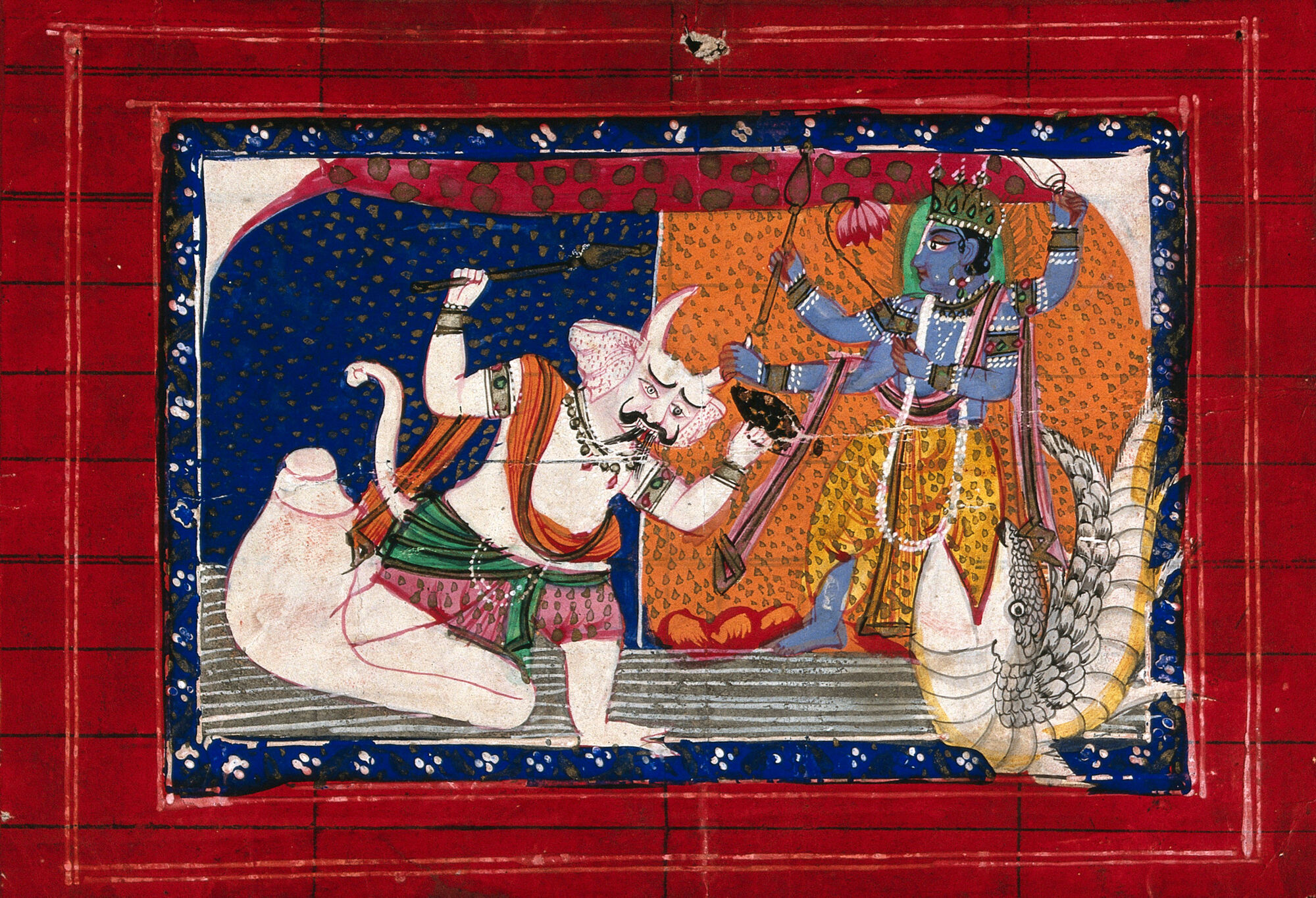
The fish saves Manu from a flood. The Śatapatha Brāhmaṇa does not name its deity; the Mahābhārata calls it Brahmā, while the Purāṇic versions examined identify Viṣṇu and vary in survivors and renewal.
Estimated reading time: 11 min Published Last reviewed:
Share article
Text
Introduction
When a small fish asks ManuManu, Survivor in Indian Flood TraditionsA central human figure in several Sanskrit accounts of the flood and human renewal; his position and role differ across the Śatapatha Brāhmaṇa, Mahābhārata and Purāṇas.Glossary · Click to read the explanation to save it from larger fish, it does not initially seem capable of saving anyone. Yet the story reverses their roles: the protector of a vulnerable creature becomes the one who needs protection when the flood comes. Matsya means “fish” in Sanskrit. In later Vaiṣṇava traditions the fish is celebrated as an avatāra, or manifestation, of the god Viṣṇu. This identity, however, is not declared in every account: the early Vedic narrative does not name the fish as a god, an epic version identifies it as Brahmā, and Purāṇic accounts identify it with Viṣṇu. [1]
This entry examines those narratives in their distinct settings, from the request for shelter to the preservation of life and knowledge at the dissolution of the world. It neither treats a worldwide flood as a verified historical event nor assumes that every detail derives from one complete original Indian story. Instead, it asks what each surviving witness says and what later traditions contribute.
Reading guide
- The sources and the limits of their dating
- The little fish: who saves whom?
- The boat, the horn, and the northern mountain
- Iḍā and sacrifice after the waters recede
- Reworking Manu's story in the Mahābhārata
- The seven sages, seeds, and mooring of the boat
- Brahmā's revelation and the making of a world
- The Matsya Purāṇa and the fish's Vaiṣṇava identity
- Cosmic dissolution and the preservation of life and learning
- The Bhāgavata Purāṇa and Satyavrata
- Purāṇic details that do not belong to every version
- Matsya in historical art and modern illustration
- Comparisons with other floods: possibilities and limits
- What the evidence establishes
The sources and the limits of their dating
The earliest surviving continuous account commonly cited here is the Śatapatha BrāhmaṇaŚatapatha BrāhmaṇaVedic Brāhmaṇa prose associated with the White Yajurveda, explaining sacrifices and their symbolism in differing school recensions. Includes the account of Manu’s flood rescue and Idā as a ritual explanation.Glossary · Click to read the explanation 1.8.1.1–11, embedded in an explanation of the sacrificial rite of Iḍā. A historical comparison then turns to book 3, section 185 of the MahābhārataMahābhārataSanskrit epic formed over centuries, preserving a version of Manu, the fish and the seeds.Glossary · Click to read the explanation, followed by multiple Purāṇic treatments, including chapters 1–2 of the Matsya PurāṇaMatsya PurāṇaSanskrit Purāṇic text framing religious instruction through the divine fish’s dialogue with Manu.Glossary · Click to read the explanation and chapter 8.24 of the Bhāgavata Purāṇa. These are different textual layers, not entries in a firmly dated composition timetable: epic and Purāṇic materials were transmitted, assembled, and revised over long periods. [2][3]
Guillaume DucœurGuillaume DucœurHistorian of religions specializing in Indian traditions, professor at Strasbourg since 2019.Glossary · Click to read the explanation places these Sanskrit versions in their Indian contexts and investigates the later European reception of flood myths. His Les mythes du déluge de l’Inde ancienne, published by Peeters in 2019, shows why a supposed universal history cannot safely be built from similarities removed from their setting. The fish's identity must therefore be determined witness by witness; the later label “Matsya avatāra” should not silently be inserted into the Vedic passage. [4][5]
The little fish: who saves whom?
In the Śatapatha Brāhmaṇa, water is brought to ManuManu, Survivor in Indian Flood TraditionsA central human figure in several Sanskrit accounts of the flood and human renewal; his position and role differ across the Śatapatha Brāhmaṇa, Mahābhārata and Purāṇas.Glossary · Click to read the explanation for washing his hands. A fish appears in it and asks to be raised, promising in return to save Manu from a flood that will sweep away living creatures. Its immediate problem is that big fish eat small ones. Manu shelters it first in a jar, then in a larger water-filled place, and finally releases it into the sea once it has grown beyond danger. The changing sizes dramatize a reversal of dependence: the being spared from predation will later become its guardian's rescuer. [6]
The passage never calls the fish Viṣṇu or describes it as his avatāra. A Vaiṣṇava reader may understandably recognize the god in the story, but that is a reading informed by another tradition, not a declaration in these Vedic paragraphs. Nor does the passage place seven sages with packets of seeds aboard the vessel: those details belong to another textual setting.
The boat, the horn, and the northern mountain
The fish warns Manu when the flood will come, allowing him to build a boat and board it as the water rises. The fish returns bearing a horn, to which Manu ties the boat's rope, and pulls it to a mountain in the north. There it instructs him to secure the vessel to a tree and descend slowly as the waters subside. The account explains a place-name associated with Manu's descent but supplies no independently verifiable coordinates for a historical landing site. [7]
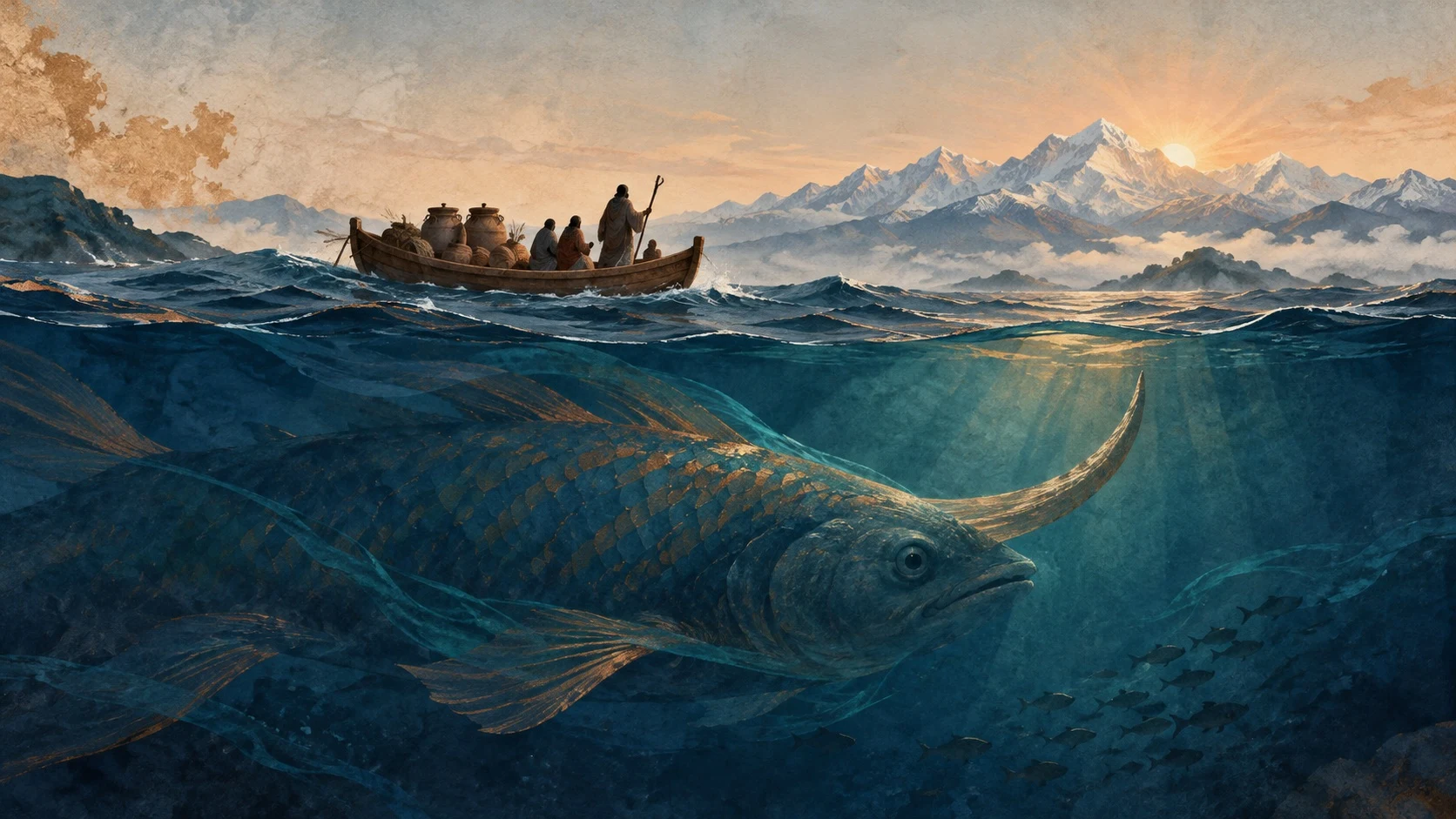
The passage ends this phase by saying that the flood swept away the creatures and Manu alone remained. This is a claim about the population of the boat in this particular witness, not a proposition that every Indian account imagines just one human survivor. An illustration showing several passengers must consequently not be mistaken for a literal depiction of this Vedic passage.
Iḍā and sacrifice after the waters recede
The Śatapatha Brāhmaṇa does not end with the rescued passenger. Desiring descendants, Manu undertakes observances and offers clarified butter and milk products into the water. From the offerings a woman emerges, calls herself his daughter, and is identified with IḍāIdā, sacrifice and human renewalFemale figure arising from Manu’s post-flood offering in the Śatapatha Brāhmaṇa.Glossary · Click to read the explanation and with the blessings of the sacrifice. Through continued rites involving her, Manu's line comes into being. This ending is central, not ornamental: it explains why the flood episode appears inside an exposition of sacrificial practice. [8]
The passage is not a natural-history report about a population recovering after a disaster. It presents an account of ritualRitualAn organised or distinguished practice meaningful to a community; it may leave traces, but its form alone does not reveal an associated doctrine.Glossary · Click to read the explanation effectiveness, blessings, and reproduction. Removing Iḍā while preserving only the striking image of a fish towing a boat makes the oldest continuous version look more like its later epic adaptations than it actually is.
Reworking Manu's story in the Mahābhārata
In the Mahābhārata's third book, the story belongs to a narrated account of an extraordinary past. Here Manu is the son of VivasvatVivasvat, Manu’s solar fatherSolar figure in Manu’s genealogy; the epic flood account calls Manu his son.Glossary · Click to read the explanation and is described especially through his ascetic power. As in the earlier version, the fish asks not to be eaten, and Manu moves it through successively more spacious bodies of water until he reaches the sea. The underlying reversal of protection remains, but the epic greatly develops its conversations, measurements, and span of time. [9]
Honorific royal language in a narrator's address does not by itself establish a separate royal biography of Manu within this episode. He is presented first as an ascetic son of Vivasvat, whereas his kingship becomes explicit in other, Purāṇic versions. These differences in characterization should not be erased merely to produce a seamless modern retelling.
The seven sages, seeds, and mooring of the boat
The Mahābhārata's fish tells Manu to have a strong boat made, to embark together with the seven sagesSeven sages in Manu’s flood storySages accompanying Manu aboard the boat in the Mahābhārata version, Sanskrit saptarṣi.Glossary · Click to read the explanation, and to take carefully preserved seeds aboard. Survival is now not just one person's deliverance followed by the ritual generation of descendants: it includes a company of wise men and provisions for renewed life. The importance of seeds is stated in the episode itself and need not be inferred from a painting or a modern illustration. [10]
The horned fish hauls the vessel across waters where little else is visible until it reaches a high summit in the HimalayasHimalaya mountain rangeMountain range separating the Tibetan Plateau from parts of the Indian subcontinent, named in Manu’s epic story.Glossary · Click to read the explanation. The summit is called Naubandhana, the “mooring of the boat,” within the tale. This is a narrative place-name, not a proven identification of a modern peak or evidence that the anchoring occurred as a historical event.
Brahmā's revelation and the making of a world
At Mahābhārata 3.185.48, the rescuer tells the gathered sages that it is BrahmāBrahmāCreator deity in Indian traditions, named as the fish’s identity in Mahābhārata 3.185.Glossary · Click to read the explanation, Prajāpati, lord of creatures, according to the text and French translation reproduced by Ducœur. Manu is entrusted with bringing forth beings and worlds anew, drawing on austerity and divinely given understanding. The deity's identity is now explicit, but it is not the name Viṣṇu that dominates later Purāṇic accounts and devotional imagery. [11]
The question “Was the fish Viṣṇu from the start?” thus depends on the kind of evidence being sought. A religious community can interpret the witnesses harmoniously within its own tradition; the historian instead records what each document actually names and how that naming shapes its account of creation.
The Matsya Purāṇa and the fish's Vaiṣṇava identity
In the selected Matsya Purāṇa passage, Manu is a king who has transferred his throne to his son and practices austerities on Mount Malaya. He asks Brahmā for the capacity to protect beings during cosmic dissolution. A little fish then appears while he makes a water offering to his ancestors, growing beyond a vessel, a well, a pool, a river, and finally the sea. On recognizing its extraordinary nature, Manu addresses it with names associated with ViṣṇuViṣṇuHindu deity with whom the saving fish is identified in later Vaiṣṇava versions.Glossary · Click to read the explanation, including Vāsudeva, Keśava, and Hṛṣīkeśa. The narrator confirms that Janārdana has taken the form of a fish. [12]
The identification is consequently not a guess made by a modern reader from a shared plot: it is carried by the dialogue and narration of this Purāṇic form. It does not, however, cancel the epic's explicit Brahmā identification or license the addition of Vaiṣṇava names to a translation of the Śatapatha Brāhmaṇa.
Cosmic dissolution and the preservation of life and learning
The Matsya Purāṇa embeds the rescue in a catastrophe larger than an ordinary flood. The boat, which the fish says the gods themselves constructed, is intended to shelter kinds of living things, from moving animals to plants. Subsequent verses describe prolonged drought, scorching fires, storms, and torrential rains before the worlds are submerged. Manu binds the boat to the fish's horn, and the episode describes a serpent serving as a rope, protected seeds, and the renewal of Vedic knowledge at the beginning of another creation. [13]
This is a religious model of successive dissolutions and re-creations, not an account that can simply be renamed an “Indian NoahNoahNoah is the flood-story figure in Genesis and a prophet in the Qur’anGlossary · Click to read the explanation's ark” or treated as an observed climatic sequence. The passage's references to the Vedas must also be distinguished from a separate Purāṇic narrative in which a demon steals them during Brahmā's sleep.
The Bhāgavata Purāṇa and Satyavrata
The Bhāgavata Purāṇa 8.24 likewise openly connects the fish to Viṣṇu, but introduces its own sequence. It describes the king Satyavrata, who later becomes Manu, son of Vivasvat, and tells how the demon Hayagrīva stole the Vedas while Brahmā slept, before the god in fish form recovered them. These are features of this particular later textual version. They must not be attributed to Śatapatha Brāhmaṇa or Mahābhārata 3.185 simply because those works also feature a boat and a miraculous fish. [14]
The narrative belongs to a Vaiṣṇava theology of protection and revealed knowledge. For this chapter the source consulted is a published devotional Vaiṣṇava English translation. The present account therefore identifies its linguistic intermediary rather than claiming to have independently translated the Sanskrit verses or resolved every textual variant.
Purāṇic details that do not belong to every version
The Satyavrata narrative repeats the fish appearing in someone's hands and needing ever larger waters, yet it places the dialogue within an avowed divine incarnation. The king's escape involves the seven sages, stores needed for a new beginning, and Vāsuki as the serpent used to tether the boat to the fish's horn. The saviour also imparts teaching during the journey. These details belong to this account's distinctive framing: neither the named serpent nor the recovery of stolen Vedas can be presented as features of every early Indian flood myth. [15]
The development of the narrative was thus more than adding a god's name to a stable plot. Manu's identity and duties, the number of survivors, what is saved, and the outcome all change: ritual and descendants, a renewed world of beings, or the safeguarding of sacred knowledge and cosmic order.
Matsya in historical art and modern illustration
Images can illuminate the reception of a saviour's form centuries later, but they do not establish the wording of an earlier Vedic text. The Cleveland Museum of Art holds a Kalighat painting, Matsya, Fish Avatara of Vishnu, from about 1890, accession 2003.102. It depicts a figure with a human torso and several arms joined to a fish's body. This is an identified, documented artwork, not an object dating from the composition of the Śatapatha Brāhmaṇa. [16]
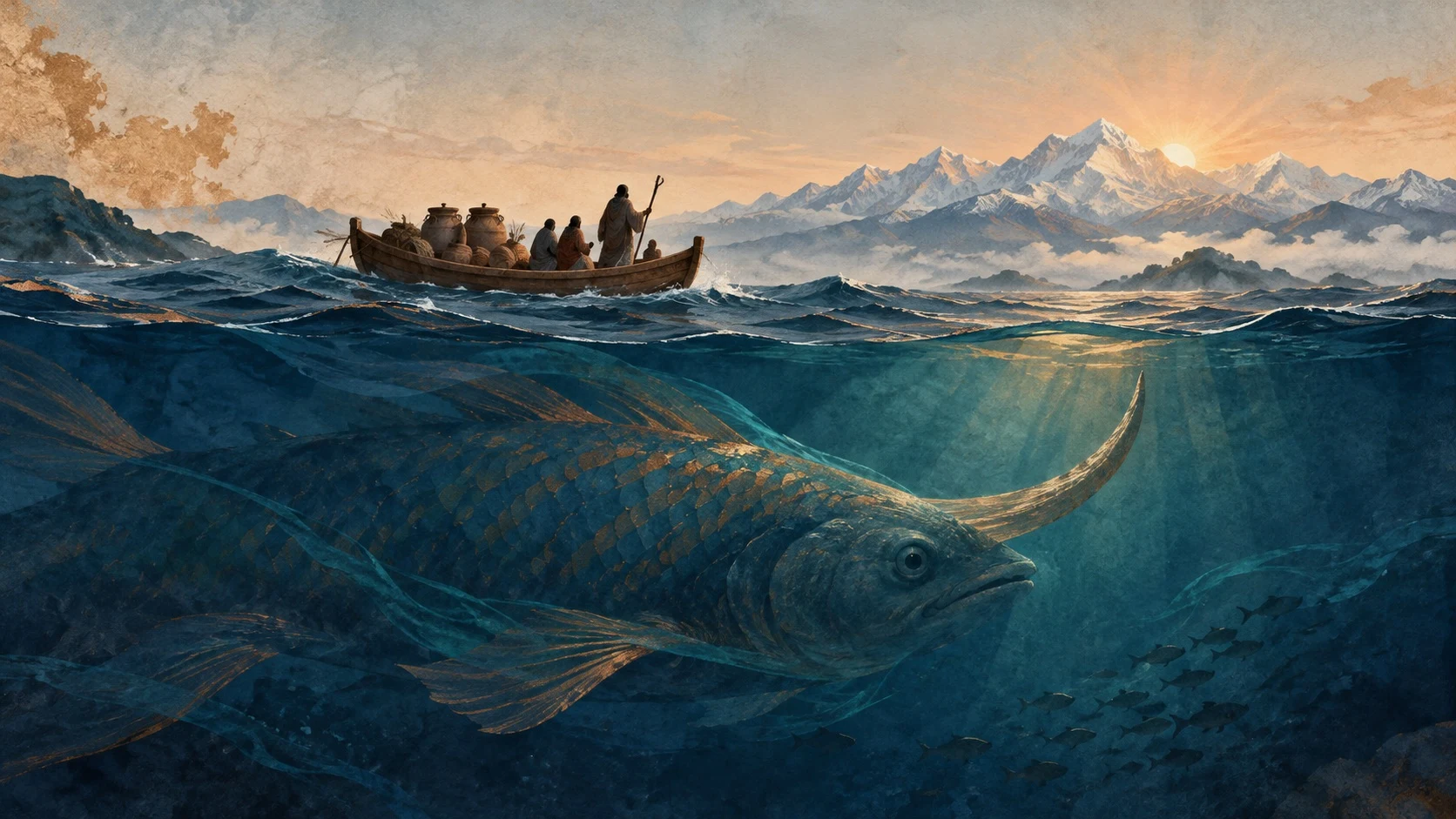
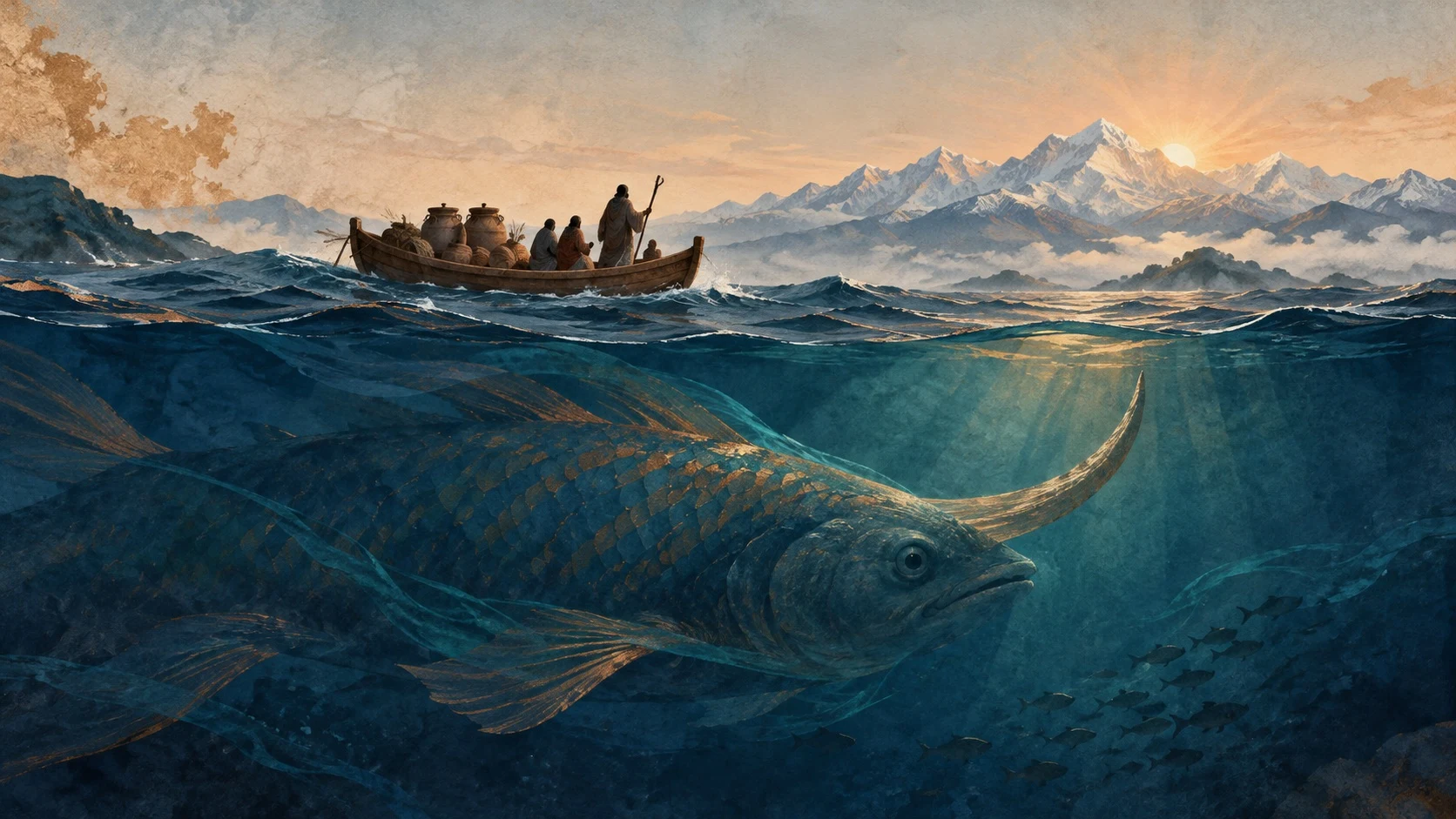
The Metropolitan Museum of Art also holds a bronze Fish Avatar of Vishnu, accession 48.30.8, dated by the museum to 18th–19th-century India. Both objects document later devotional imagery; neither establishes the historical reality of the flood or the age of a specific line of scripture. This entry's own cover is a modern conceptual illustration made for the archive in 2026, not a reproduction of either museum object. Its passengers and containers especially evoke the epic narrative, unlike the Vedic account in which only Manu survives. [17]
Comparisons with other floods: possibilities and limits
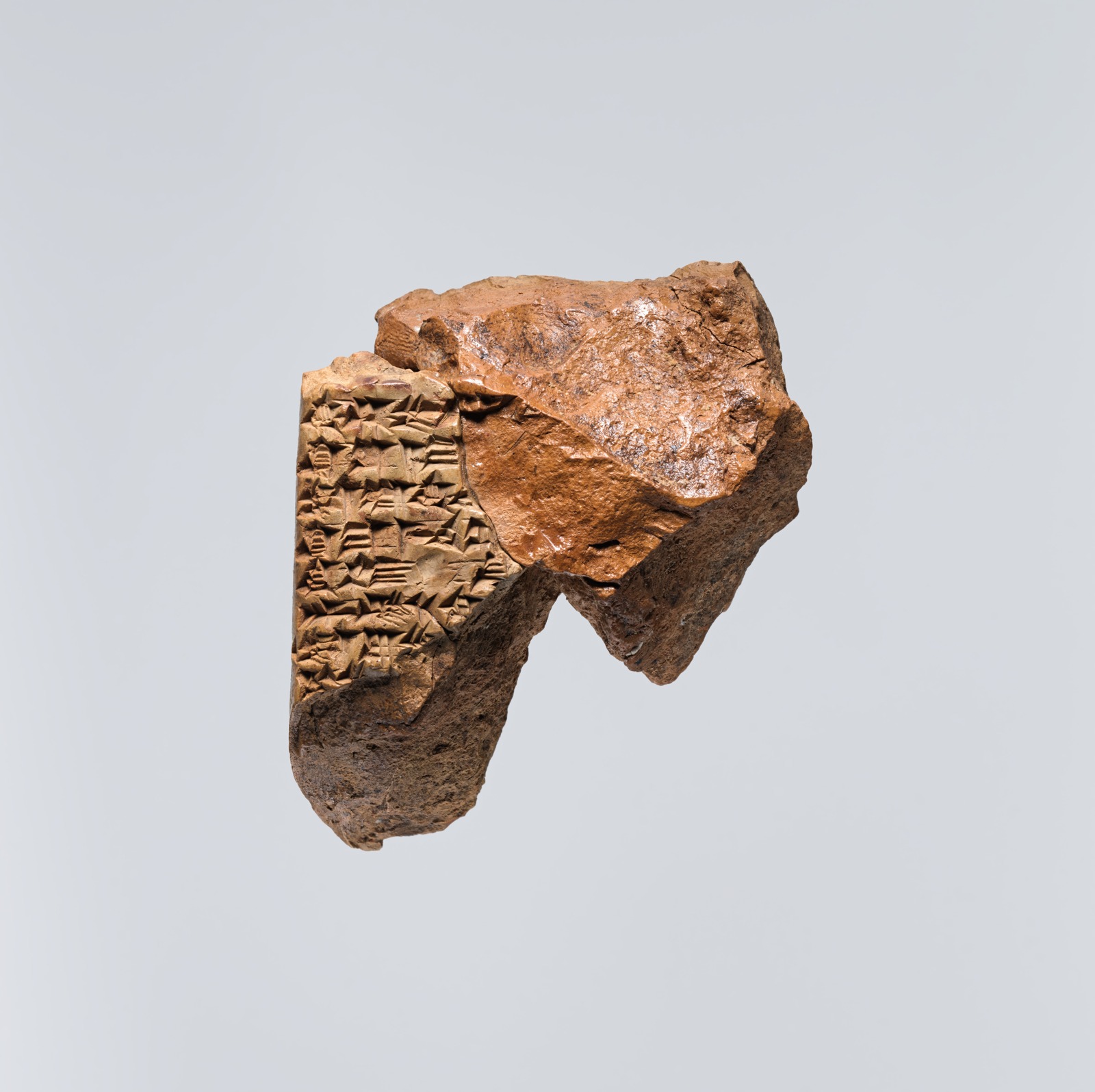
The flood, boat, and survivor naturally invite comparison with AtrahasisAtrahasis: Epic and HeroAkkadian narrative on human creation, relations with the gods and the flood, named for its survivor warned by Enki. Its surviving manuscripts differ in date and preservation; its hero must not be equated uncritically with every Utnapishtim version.Glossary · Click to read the explanation, the Epic of GilgameshEpic of GilgameshA Babylonian literary work with multiple recensions, preceded by separate Sumerian poems on Uruk’s king and Enkidu. Its standard form explores friendship, death, the flood and the limits of seeking eternal life.Glossary · Click to read the explanation, and NoahNoahNoah is the flood-story figure in Genesis and a prophet in the Qur’anGlossary · Click to read the explanation. Such comparisons are valuable when they specify which version of each tradition is being examined, whether the resemblance concerns a widespread motif or an unusual sequence, and whether chronology and contacts make particular paths of transmission plausible. Ancient cultural connections do not by themselves establish that this Indian scene was borrowed by a definite route; nor does the absence of a surviving transmission document make influence inherently impossible. [18]
Ducœur traces how European comparisons from the eighteenth century onward often used disparate Indian accounts to support a single account of world history, and how new textual knowledge altered those conclusions. Matching a “boat and mountain” is not enough to prove direct literary descent; differences in the divine rescuer do not, on their own, rule out a more complex comparative history either.
What the evidence establishes
Three distinct conclusions are supported by the passages examined: the Śatapatha Brāhmaṇa's fish saves Manu without declaring a divine name; the Mahābhārata's rescuer announces itself as Brahmā; and the Purāṇic passages read here identify the fish as Viṣṇu in Matsya form. The means of survival and the continuation of humankind, other creatures, and knowledge vary accordingly. These are findings about attested narratives, not proof of a field-documented global flood or a precise composition date for every verse.
Keeping these differences visible allows the myth to be studied as a history of religious expression within Indian literature. A tale that begins with shelter given to the vulnerable was repeatedly made to speak to questions of lineage, creation, cosmic time, and learning—without erasing the variety preserved in the sources.
References and notes (18)
- Śatapatha Brāhmaṇa, part I, English translation by Julius Eggeling (1882); The complete contiguous fish-to-Iḍā passage in Eggeling’s translation; not the whole Brāhmaṇa. Śatapatha Brāhmaṇa 1.8.1.1–11, Eggeling (1882) Return to the text ↑
- Guillaume Ducœur, Les mythes du déluge de l’Inde ancienne: Histoire d’un comparatisme sémitico-indien, Peeters, 2019; Preface and source appendix consulted for redactional setting; no exact composition dates are asserted. Preface pp. vii–viii; appendix printed pp. 331–347 Return to the text ↑
- Guillaume Ducœur, Les mythes du déluge de l’Inde ancienne: Histoire d’un comparatisme sémitico-indien, Peeters, 2019; The epic episode as printed alongside Ducœur’s French translation; no independent Sanskrit translation claimed. Appendix printed pp. 335–341; Mahābhārata 3.185.1–54 Return to the text ↑
- Guillaume Ducœur, Les mythes du déluge de l’Inde ancienne: Histoire d’un comparatisme sémitico-indien, Peeters, 2019; Author’s conclusion concerning reception history and the danger of decontextualized comparison. Conclusion, printed pp. 327–330 Return to the text ↑
- Guillaume Ducœur, Les mythes du déluge de l’Inde ancienne: Histoire d’un comparatisme sémitico-indien, Peeters, 2019; Selected Matsya Purāṇa passages in printed text and Ducœur’s French translation; not the full Purāṇa. Appendix printed pp. 341–347; Matsya Purāṇa 1.10–34 and 2.1–20 Return to the text ↑
- Śatapatha Brāhmaṇa, part I, English translation by Julius Eggeling (1882); The plea against predation by larger fish and progressive transfer to larger waters. Śatapatha Brāhmaṇa 1.8.1.1–3 Return to the text ↑
- Śatapatha Brāhmaṇa, part I, English translation by Julius Eggeling (1882); Warning, boat, horn, northern mountain and Manu as sole remaining human in this passage. Śatapatha Brāhmaṇa 1.8.1.4–6 Return to the text ↑
- Śatapatha Brāhmaṇa, part I, English translation by Julius Eggeling (1882); Offerings, birth of the woman, Iḍā and Manu’s descendants in a sacrificial context. Śatapatha Brāhmaṇa 1.8.1.7–11 Return to the text ↑
- Guillaume Ducœur, Les mythes du déluge de l’Inde ancienne: Histoire d’un comparatisme sémitico-indien, Peeters, 2019; Vivasvat, Manu’s ascetic characterization, the fish’s request and growth. Appendix printed pp. 335–339; Mahābhārata 3.185.1–24 Return to the text ↑
- Guillaume Ducœur, Les mythes du déluge de l’Inde ancienne: Histoire d’un comparatisme sémitico-indien, Peeters, 2019; Boat instructions, seven sages, carefully protected seeds and the passage over the waters. Appendix printed pp. 338–340; Mahābhārata 3.185.26–42 Return to the text ↑
- Guillaume Ducœur, Les mythes du déluge de l’Inde ancienne: Histoire d’un comparatisme sémitico-indien, Peeters, 2019; Himalayan summit and Naubandhana; the fish declares itself Brahmā at verse 48. Appendix printed pp. 340–341; Mahābhārata 3.185.43–50 Return to the text ↑
- Guillaume Ducœur, Les mythes du déluge de l’Inde ancienne: Histoire d’un comparatisme sémitico-indien, Peeters, 2019; Manu as king, austerity, Vaiṣṇava epithets, and the boat made by the gods. Appendix printed pp. 341–344; Matsya Purāṇa 1.11–34 Return to the text ↑
- Guillaume Ducœur, Les mythes du déluge de l’Inde ancienne: Histoire d’un comparatisme sémitico-indien, Peeters, 2019; Cosmic dissolution, drought, rain, seeds, serpent-rope and preservation involving the Vedas. Appendix printed pp. 344–347; Matsya Purāṇa 2.1–20 Return to the text ↑
- Bhāgavata Purāṇa, canto 8, chapter 24; English translation published by the devotional Vaiṣṇava VedaBase, not an independent critical edition; Satyavrata’s identity and the theft of the Vedas by Hayagrīva, as worded in this translation. Bhāgavata Purāṇa 8.24.7–11, devotional English translation Return to the text ↑
- Bhāgavata Purāṇa, canto 8, chapter 24; English translation published by the devotional Vaiṣṇava VedaBase, not an independent critical edition; Viṣṇu’s identity, boat, seven sages, Vāsuki as rope, and teaching on the voyage. Bhāgavata Purāṇa 8.24.25–52, devotional English translation Return to the text ↑
- Cleveland Museum of Art, Matsya, Fish Avatara of Vishnu, Kalighat painting, Bengal, c. 1890, acc. 2003.102; Museum object entry and open-access rights page examined, not an independent study of Kalighat painting; image not embedded. Cleveland Museum of Art, object 2003.102: object details and open-access rights Return to the text ↑
- Metropolitan Museum of Art, Fish Avatar of Vishnu, Indian bronze, 18th–19th century, acc. 48.30.8; Checked the bronze medium, dating and accession number; its image is not reproduced here. Metropolitan Museum of Art, object 48.30.8: collection entry, public-domain designation Return to the text ↑
- Guillaume Ducœur, Les mythes du déluge de l’Inde ancienne: Histoire d’un comparatisme sémitico-indien, Peeters, 2019; Comparative table and reception analysis; neither evidence nor conclusion establishes a specific direct borrowing route. Comparative table, printed p. 181; conclusion, printed pp. 327–330 Return to the text ↑
Suggest a correction · Suggest a source for this record
Cite this record
IL Archive, «Matsya: The Saving Fish in Indian Traditions», https://ilarchive.com/en/entities/matsya-fish-flood
Continue reading