Entity · Concept
Masoretic Text
A reference page linking a name, group, or concept to the materials that discuss it.
A Hebrew textual transmission and reading tradition, compared in textual criticism with ancient manuscripts and translations.
Text
A textual tradition
The Masoretic Text names a tradition of transmitting the HebrewHebrewA Northwest Semitic language in the Canaanite group, with ancient and modern forms.Glossary · Click to read the explanation text and regulating its reading, underlying many editions and translations. This does not make it the oldest surviving wording in every verse. Textual criticismTextual criticismComparing witnesses to explain variation and infer earlier readings or editions, distinguishing preserved from reconstructed text.Glossary · Click to read the explanation compares its witnesses with other Hebrew manuscripts and ancient translations, evaluating each passage individually.[1]
Deuteronomy 32:8 as an example
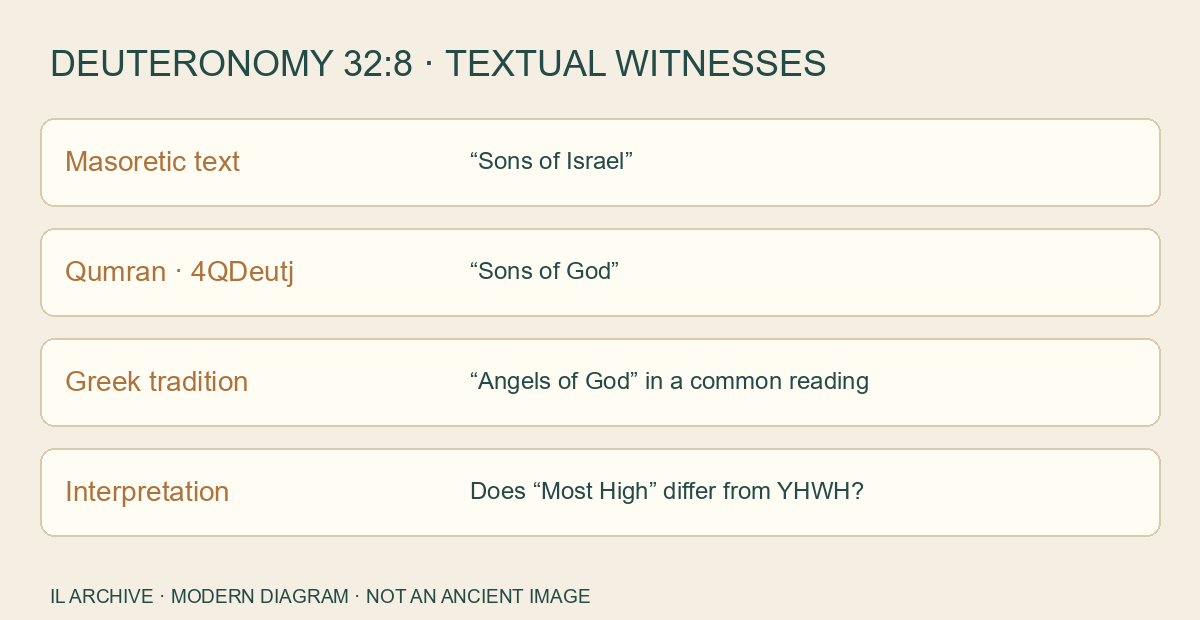
The Masoretic Text reads “sons of Israel,” whereas QumranDead Sea ScrollsJudaean Desert manuscripts, especially Qumran cave finds. Biblical copies and other works reveal textual diversity; a copy’s age is not the work’s initial date.Glossary · Click to read the explanation’s 4QDeutj preserves “sons of GodSons of GodA Hebrew expression for heavenly beings in texts such as Job; context determines its meaning, rather than biological descent or a fixed angelic roster.Glossary · Click to read the explanation”; a common Greek reading gives “angels of God.” This comparison helps evaluate the wording without assuming that every difference has a demonstrable doctrinal motive.[1][2]
Witness and interpretation
Favoring an earlier wording does not automatically establish the Most High and YahwehYahwehThe divine proper name written YHWH in the Hebrew Bible.Glossary · Click to read the explanation as separate gods. Reconstructing words is a textual-critical question; interpreting the divine world they describe is a further historical and theological question. The accompanying diagram is modern, not a reproduction of an ancient manuscript.
References and notes
- Eibert Tigchelaar (2012). Editing the Hebrew Bible: An Overview of Some Problems. In Editing the Bible: Assessing the Task Past and Present, ed. John S. Kloppenborg and Judith H. Newman, pp. 41–66, especially p. 46 n. 22. Selected pp. 41–46, especially p. 46 n. 22 identifying 4QDeutj for Deuteronomy 32:8. Page visually checked; not the whole volume. Witness identification does not prove El–Yahweh separation. Return to the text ↑
- NET Bible. Deuteronomy 32, textual note 14 on verse 8. Textual note 14: Qumran sons of God and common Greek angels of God against sons of Israel. Greek wording in the note read; not an independent collation of all Septuagint manuscripts. Identity interpretation is separate from textual preference. Return to the text ↑
Research history
Substantive changes are retained here. Minor copy edits remain in the internal operational log.
-
Substantive record update
Suggest a correction · Suggest a source for this record
Cite this record
IL Archive, «Masoretic Text», Edition 2, https://ilarchive.com/en/entities/masoretic-text