Artifact · Inscription
The Erra and Ishum Amulet from Ashur (BM 118998)
An object record bringing together its image, metadata, rights, and context.
- Timeline
- From 800 BCE to 612 BCE
- Region
- Mesopotamia
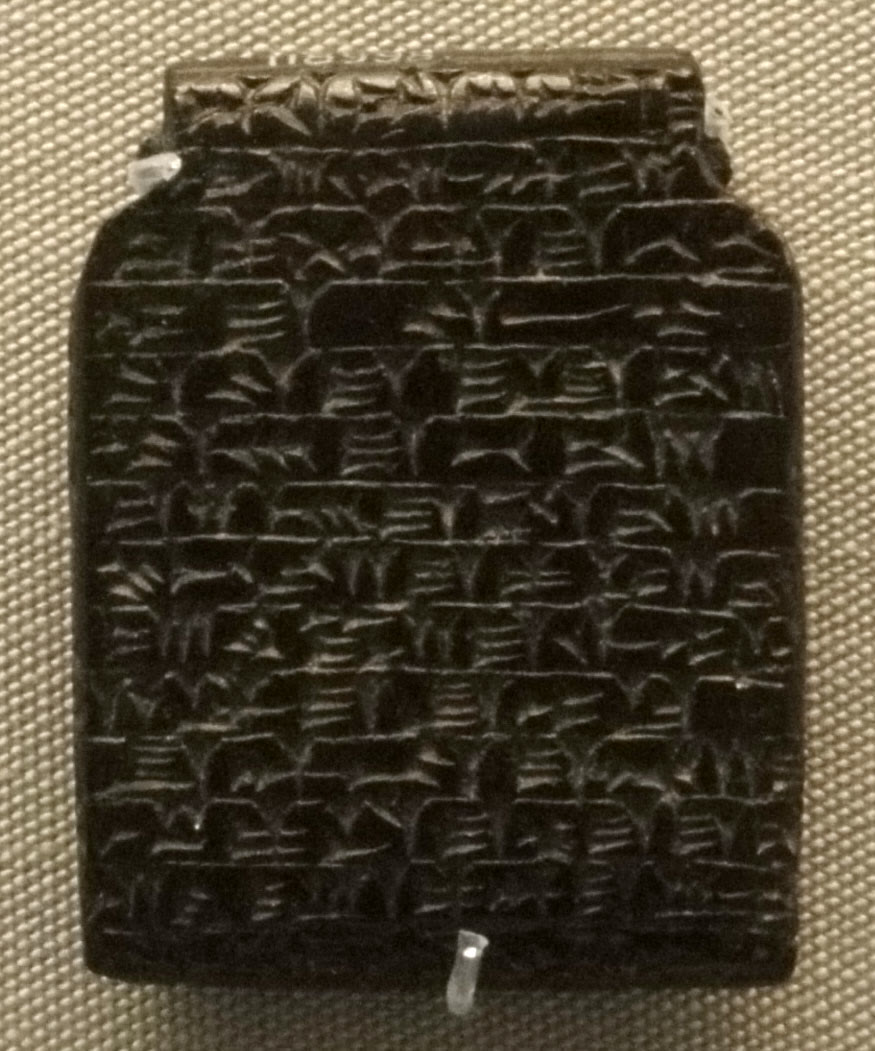
A black stone amulet from Ashur carries the closing verses of the third tablet of Erra and Ishum. Compact spellings fit the passage on the stone. A piece of copper survives in the hole from which the amulet hung.
Estimated reading time: 4 min Published Last reviewed:
Share article
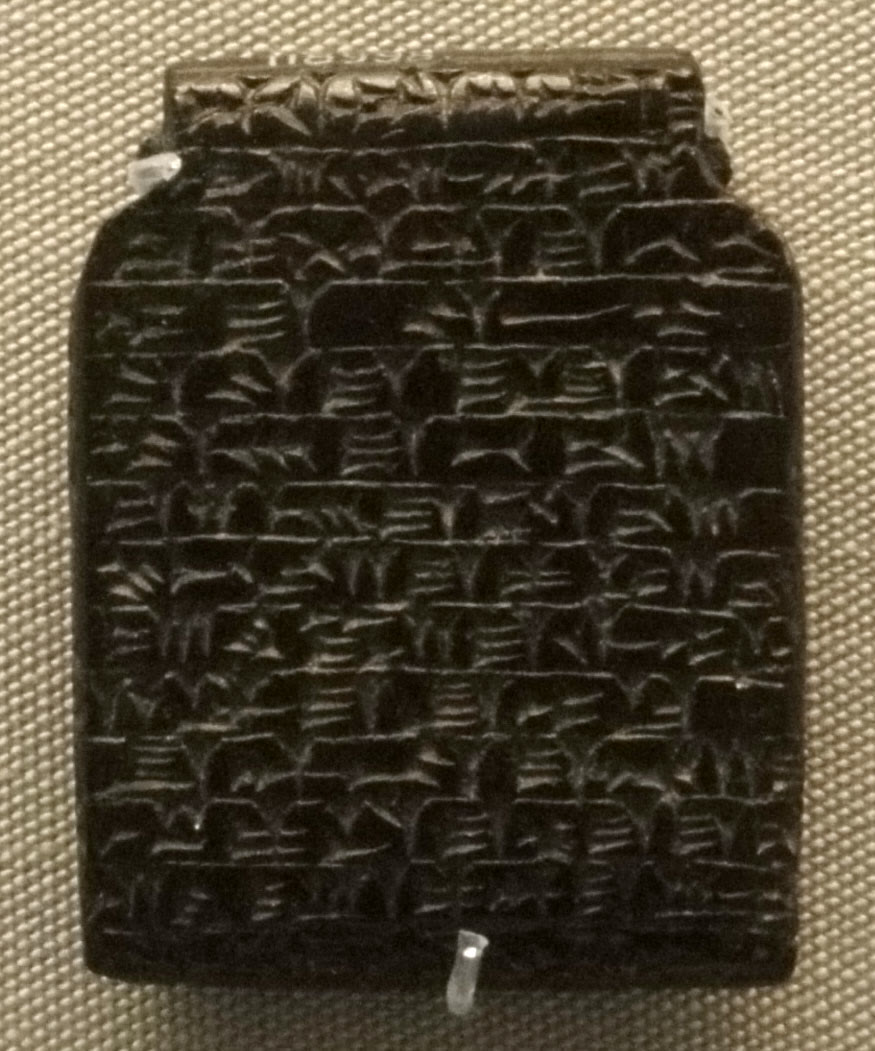
Photograph
Photograph by Fæ, via Wikimedia Commons, CC BY-SA 3.0. JPEG re-encoded.
Inscribed face and upper projection of the black stone amulet British Museum 118998, which carries an excerpt from Erra and Ishum
License · Image sourceObject details
- Title
- The Erra and Ishum Amulet from Ashur (BM 118998)
- Timeline
- From 800 BCE to 612 BCE
- Region
- Mesopotamia
- Rights
- CC BY-SA
Text
Introduction
British Museum 118998 is a black stone amulet incised with part of the AkkadianAkkadianAn ancient East Semitic language written in cuneiform from the third millennium BCE; its varieties include Babylonian and Assyrian, and it served in international diplomacy.Glossary · Click to read the explanation poem Erra and Ishum. It has the shape of a small tablet with a pierced projection at the top. Nils P. Heeßel identifies it with an object excavated at AshurAshur, Qal’at SherqatAncient Tigris city in Iraq, an Assyrian political and religious centre.Glossary · Click to read the explanation, ancient Assyria’s capital, under the find number Ass. 7780. The catalogue information accompanying the photograph dates it to the Neo-Assyrian period, about 800–612 BCE. The text is a passage of praise addressed to Erra. The projection and the choice of passage connect the poem with a practice of household protection. [1][2][3][5]
A stone tablet that could hang
The amulet measures about 4.6 × 3.2 cm. Signs cover the faces and extend onto the upper projection. Heeßel reports that a piece of copper remained in the hole through that projection, evidence of how the object was suspended. The excavation diary places the find in an area of houses north of the Anu-Adad temple at Ashur. The amulet’s original position within a house is unknown. [1][2]
Heeßel connects the museum object with photographs numbered 1065 and 1066 in the excavation archive. He also reports that the museum inventory records the purchase in Paris in 1928, from a woman named Madame Essad. The path from the excavations to that sale remains unclear. In her list of manuscripts, Kynthia Taylor places a question mark after NinevehNineveh and KuyunjikNineveh is an ancient Assyrian city near Mosul in northern Iraq; Kuyunjik is one of its archaeological moundsGlossary · Click to read the explanation for this copy. The excavation identification cited by Heeßel gives specific grounds for placing it at Ashur. [1][2][3]
Which part of the poem is on it?
Erica Reiner identified the passage in her 1960 study of inscribed amulets. Taylor designates the stone as copy O and matches its numbered lines 1–25 to verses 3–15 of Tablet III, fragment d. In the poem, these are words of praise spoken by Ishum to Erra. The difference between the number of inscribed lines and verses shows how the short rows of writing on the stone carry a passage laid out differently in a modern edition of the poem. [2][3][4]
Martin Worthington points to the use of fewer signs for some words as a way to fit the passage on the stone. For example, the amulet uses til-ta where a syllabic spelling runs gam-ma-ra-ta. The first spelling uses a sign that conveys a word in place of several signs that spell it in syllables. Another variation concerns the name Nergal. Taylor notes that it appears beside Erra where another copy gives a title meaning “warrior.” She leaves open whether that particular reading arose from a copying error. [3][4]
Why put a poem on an amulet?
The poem itself gives a reason to keep a written copy. Near the end of Tablet V, it promises that pestilence will stay away from a house where the tablet is placed, even if Erra and the Seven threaten destruction. Heeßel takes this ending as evidence for the protective intent of inscribed copies, including those that carry only an excerpt. The words engraved on BM 118998 are from Tablet III. The promise is preserved in the wider composition. [2][3][5]
Two clay amulets from Nineveh carry portions of Tablet V. Taylor lists them as Bu 91–5–9, 174 and Bu 91–5–9, 186. The surviving reverse of the latter contains the protective promise near the end of the poem. A clay manuscript from Ashur was shaped as an amulet and contains parts of all five tablets. The small stone from Ashur shows a different selection. It uses Ishum’s praise of Erra, the god whose anger threatens the land in the story. The residential find area and the copper remnant fit an interpretation of the object as something intended for household protection. [2][3][5]
Quick answers
What is British Museum 118998?
It is a Neo-Assyrian black stone amulet with a quotation from the Akkadian poem Erra and Ishum. [1][2][3]
Where was it found?
Heeßel identifies it as Ass. 7780, excavated in a residential area of Ashur north of the Anu-Adad temple. [2]
Which part of the poem is engraved on it?
Taylor identifies the passage as Tablet III, fragment d, verses 3–15. It is part of Ishum’s address to Erra. [2][3]
How was it suspended?
The upper projection has a hole. Heeßel reports that a piece of the copper used to hang it was still inside. [1][2]
References and notes
- Fæ, “Amulet to ward off plague.jpg”, Wikimedia Commons, 2010, including the British Museum catalogue information for 118998 File description and museum details. Inventory number, Neo-Assyrian dating, black stone, dimensions and copper in the suspension hole. Return to the text ↑
- Nils P. Heeßel, “Amulette und ‚Amulettform‘: Zum Zusammenhang von Form, Funktion und Text von Amuletten im Alten Mesopotamien”, in Joachim Friedrich Quack and Daniela Christina Luft, eds., Erscheinungsformen und Handhabungen Heiliger Schriften, De Gruyter, 2014, pp. 53–77 Pp. 59–60, notes 17–23. Ass. 7780, the excavation diary, photographs 1065–1066, the 1928 acquisition, copper, the passage from Tablet III and related amulets. Return to the text ↑
- Kynthia Taylor, The Erra Song: A Religious, Literary, and Comparative Analysis, doctoral dissertation, Harvard University, 2017 P. 45, Ishum’s speech. P. 109 and notes 206–207, Nergal on the stone. Appendix A, pp. 389–390, copies O, Q, S and W, line concordance and proposed origins. Return to the text ↑
- Martin Worthington, “Orality, Literacy, and the Psychology of Babylonian-Assyrian Orthography”, Oral Tradition 37, 2025, pp. 97–137 P. 116, note 65. Shorter spelling on BM 118998 and the use of Sumerian word signs to fit the passage on the stone. Return to the text ↑
- András Bácskay, “Járványok és dögvész az ókori Mezopotámiában”, Vallástudományi Szemle 16 (2), 2020, pp. 9–25 Pp. 14–16, notes 27 and 38. BM 118998 from Ashur, excerpts of the poem on amulets and the protective promise in Tablet V. Return to the text ↑
Archive records may be reviewed and refined as better evidence or sources become available. Suggest a correction
Suggest a correction · Suggest a source for this record
Cite this record
IL Archive, «The Erra and Ishum Amulet from Ashur (BM 118998)», https://ilarchive.com/en/artifacts/erra-amulet-bm118998
Continue reading