Artifact · Inscription
Kartīr at Naqsh-e Rajab: Priestly Authority and Certainty about the Afterlife
An object record bringing together its image, metadata, rights, and context.
- Names
- Kartīr inscription at Naqsh-e Rajab (KNRb) · Kerdir, Naqsh-e Rajab inscription
- Timeline
- From 276 CE to 293 CE
- Region
- Naqsh-e Rajab, Fars, Iran
A third-century CE Middle Persian rock inscription in which Kartīr presents, in 31 lines, his service, titles and teaching on the soul’s fate; the entry separates the priest’s own voice from independent evidence.
Estimated reading time: 6 min Published Last reviewed:
Share article
Photograph
Photograph by Philippe Chavin (Simorg), via Wikimedia Commons; source JPEG unmodified. · CC BY-SA
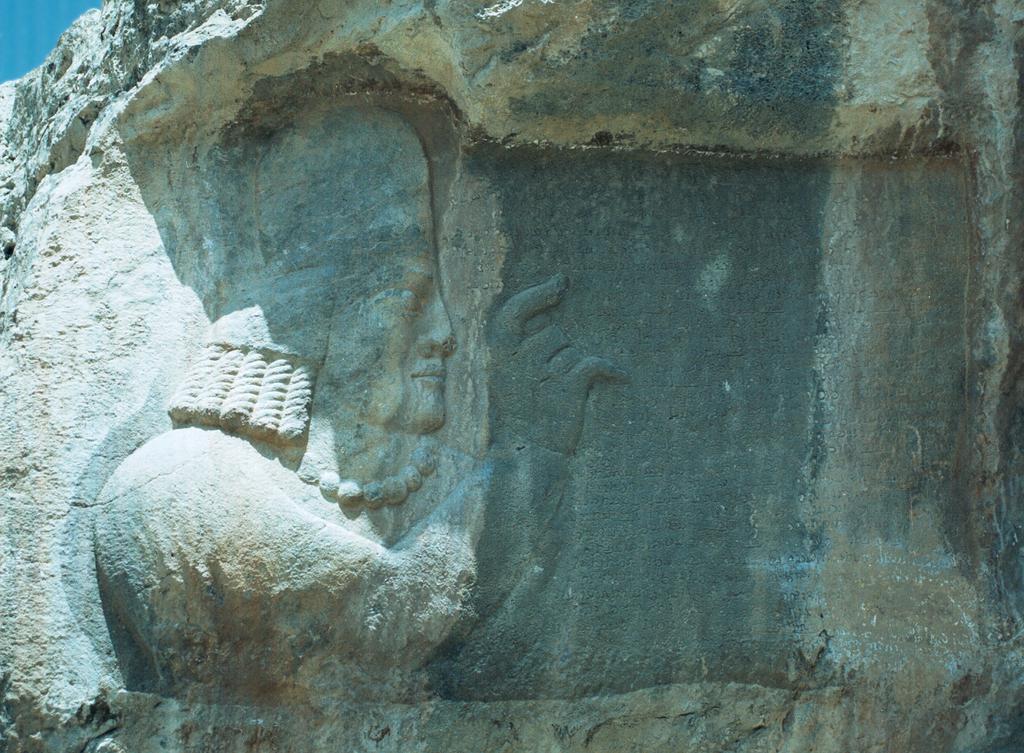
Carved figure identified by researchers as the priest Kartīr, at left, beside the KNRb rock-inscription panel at Naqsh-e Rajab. The image shows the head, raised hand and weathered surface but does not allow independent reading of all 31 lines
License · Image sourceObject details
- Title
- Kartīr at Naqsh-e Rajab: Priestly Authority and Certainty about the Afterlife
- Timeline
- From 276 CE to 293 CE
- Region
- Naqsh-e Rajab, Fars, Iran
- Rights
- CC BY-SA
Text
Introduction
Kartīr’s inscription at Naqsh-e Rajab (KNRb) is a priest’s statement of his authority and confidence about the fate of the soul, preserved on living rock. It differs in voice from the nearby royal reliefs, yet borrows the monumentality of publicly engraved writing and connects service to gods and kings with rewards in this life and the next. The question is not whether his spiritual claims are true but exactly what this particular witness says, and whom he wanted to address. The shorter Naqsh-e Rajab text does not narrate the long vision found in other inscriptions by the same priest. [1][2]
A fixed rock inscription, not a portable object
The inscription remains at Naqsh-e Rajab, near Persepolis in Fars, IranIranIran is the modern country containing Shush, ancient SusaGlossary · Click to read the explanation. Its letters are cut directly into the cliff, to the left of Ardashir I’s investiture relief according to the scholarly identification. It is neither a museum tablet nor the inscription at the Kaʿba-ye Zardošt or Naqsh-e Rostam. Scholars designate this version KNRb, distinguishing it from KNRm at Naqsh-e Rostam, KSM at Sar-e Mashhad and KKZ on the Kaʿba-ye Zardošt. The university Sasanika catalogue calls it a private inscription of 31 lines, a line numbering followed here as in Sprengling’s edition. Weathering calls for caution in checking the signs; the cover photograph documents the setting, not an independent textual edition. [1][3]
The photograph shows a carved figure on the left wearing a headdress and neck ornament and raising a hand; the inscription surface is to the right. Researchers identify the figure as Kartīr and interpret the headdress emblem and gesture within the representation of his status. The visible observations are the figure and a worn writing surface: this moderately sized photograph cannot support collation of all 31 lines. May 2002 is the date of the photograph, not of the carving. [2][11]
The priest’s lifetime and the carving’s date
Kartīr was active in the second half of the third century CE, under the Sasanians. The text retrospectively lists titles associated with successive rulers; a long career narrated in retrospect does not mean the stone was cut when the first office was conferred. Scholars have differently ordered the versions. Some place particular engravings near the end of Bahrām II’s reign (276–293 CE); others suggest KNRb may precede or follow some of the other witnesses. The object is therefore assigned a broad late-third-century horizon, not an exact regnal year; the date of a modern photograph has no bearing on it. [2][3]
Middle Persian in Inscriptional Pahlavi
The language is Middle Persian, written in Inscriptional Pahlavi. Pahlavi writing can contain Aramaic-derived heterograms conventionally read with Iranian equivalents. Their presence does not make the sentence Aramaic. An edition must distinguish a graphic transliteration of signs into Latin characters, an inferred linguistic reading and a translation. These operations are not identical; no independent reading of Pahlavi signs was made from the Commons photograph for this entry. [4][10]
“I, Kartīr”: constructing a priestly voice
Kartīr opens by naming himself and claiming renown for righteousness, along with service to gods and rulers. He then links increased ritualRitualAn organised or distinguished practice meaningful to a community; it may leave traces, but its form alone does not reveal an associated doctrine.Glossary · Click to read the explanation authority to greater confidence, merit before the gods and concern for his soul. In Sprengling’s reading of lines 1–13, an undertaking toward the gods, his rise in rank and teaching about the hereafter reinforce one another. These are claims advanced by the speaker, not an impartial administrative assessment of how religious institutions worked throughout the empire. [4][5]
A revealing distinction exists between scholarly renderings: Sprengling translated a verb in lines 3 and 7 in terms of a promise, while Skjærvø summarizes the inscription’s purpose as seeking a sign that would confirm confidence in the destinations of good and bad souls. These descriptions must not be silently fused into a fabricated transliteration; the later interpretation is not a set of newly preserved stone letters. [5][6]
Heaven, hell and a deliberate audience
In lines 13–22, Kartīr explicitly addresses whoever “sees” and “reads” the inscription, asking such readers to act rightly toward gods, lords and their own soul, and to gain conviction about currently practiced rites. He goes on to assert different destinations for well-doers and sinners, connecting conduct with recognition in embodied life and the fate of the soul. This is a priest’s affirmation and exhortation, not an independently verified journey to either place. Nor can one deduce from this carved declaration that every inhabitant of the Sasanian realm held a uniform view of the afterlife. [5][6]
A short example: sign, reading, translation, inference
On the published Latin transliteration in Sprengling, printed p. 65, line 18, the units vhysty and dvshvy appear (the latter is preceded by the conjunction written with W). His English translation on p. 67 gives the senses heaven and hell. These Latin letters represent the editor’s transcription convention for the Pahlavi writing, not a photograph of the rock signs. The English meanings are the editor’s translation, and the historical inference is narrower: Kartīr deployed rewards and punishments to support his exhortation. Neither two transcribed words nor this photograph establish the origin of these ideas or a detailed visionary itinerary. [7]
Offices, kings and the preservation of a name
In lines 22–31, the speaker states his desire to preserve his name, relates the establishment of ritual fires and the role of priests as he presents them, and lists titles he associates with Shapur, Hormizd I, Bahram I and Bahram II. This is his retrospective claim, not independent evidence of the implementation of every privilege or of KNRb’s exact year. Sprengling’s translation closes by naming Buhtak, Kartīr’s scribe, in line 31. [8]
Even the honorific involving Bahram’s soul must not be flattened into a single certain interpretation. Older translators understood it as meaning that Kartīr had “saved Bahram’s soul,” while Skjærvø considers alternative grammatical directions or referents. The controversy qualifies an interpretation of a title; it does not erase Kartīr’s own assertion of prestige. Nor do these offices automatically establish an unchanged, empire-wide priestly hierarchy or justify calling the entire political order a modern-style “state church.” [8][9]
Where is the longer vision narrative?
The background of Zoroastrian traditionZoroastrianism: Hymns, Rituals and the Changing TraditionA living Iranian religious tradition examined through Avestan hymns, Middle Persian writings and royal inscriptions, separating textual evidence, later interpretation and hypotheses of influence.Glossary · Click to read the explanation matters, but this witness must be read on its own terms. KNRb summarizes themes developed at much greater length elsewhere; it is not a copy containing all their scenes. The afterlife journey, imagery of judgment and Chinvat BridgeChinvat BridgeThe crossing associated with the soul’s judgment after death in Zoroastrian tradition. Named in the Gathas, it receives fuller descriptions of guardians, weighing and unequal passage in later texts; it is distinct from resurrection and world renovation.Glossary · Click to read the explanation discussed by scholars belong above all to the longer KNRm and KSM narratives and cannot be inserted into KNRb’s 31 lines because their author is the same. Likewise, the detailed lists of hostility toward religious communities in other inscriptional contexts are not inscribed in these 31 lines. [2][9]
Evidence gained, questions left open
The engraved witness and the edited text demonstrate that a priest connected with the Sasanian court publicly set forth his name, services, titles, views about recompense and expectations of his readers. They reveal how a non-royal figure could adopt monumental self-presentation. They do not establish the reality of a requested spiritual sign, the beliefs of every subject, the invention of afterlife doctrines at this site, or inevitable transmission to later works. Such claims require further witnesses and an independently supported chronology of transmission. This separation of artifact, reading and inference is also central to epigraphyEpigraphyThe study of writing preserved on physical objects and monuments: its documentation, reading, dating, translation, material context and historical interpretation.Glossary · Click to read the explanation. [6][9][10]
References and notes
- University of California Irvine, Sasanika, “Kartir Inscription, Naqš-e Rajab (KNRb)”; identification and 31-line description, not its bibliography as studies read. Project entry, description “31 lines” and bibliography only; page actually read. Return to the text ↑
- Prods Oktor Skjærvø, “KARTĪR,” Encyclopaedia Iranica (2011; updated 2018); placement, witnesses and disputed chronology. Sections i, “Dating of the inscriptions,” and iii examined; cited monographs not read through this entry. Return to the text ↑
- Martin Sprengling, Third Century Iran: Sapor and Kartir (1953), “Kartīr Naqsh-i-Rajab” introduction, used with later criticism. Printed pp. 63–64, actual extracted reading; no firsthand rock collation. Return to the text ↑
- Sprengling, “Kartīr Naqsh-i-Rajab,” printed Latin graphic transliteration; OCR artifacts excluded from independent epigraphic claims. Printed p. 65, lines 1–13, inspected in extracted text only. Return to the text ↑
- Sprengling, translation of “Kartīr Naqsh-i-Rajab”; Kartīr’s claims and the appeal to readers, not independent facts. Printed pp. 66–67, especially lines 1–22; read via PDF text extraction. Return to the text ↑
- Skjærvø, “KARTĪR,” discussion of the Naqsh-e Rajab summary and its requested sign about the afterlife. Sections iii–iv, passages directly consulted; not every work in the bibliography. Return to the text ↑
- Sprengling, line 18 transliteration (vhysty; dvshvy), with his corresponding heaven/hell translation; not independently checked Pahlavi glyphs. Printed p. 65 line 18 and p. 67 line 18 examined; OCR-caveated. Return to the text ↑
- Sprengling, KNRj conclusion, self-memorialization, titles and Buhtak’s scribal notice. Printed pp. 65 and 67, lines 22–31, consulted in text extraction. Return to the text ↑
- Skjærvø, “KARTĪR,” contested Bahram-related title and separation of KNRb from longer vision texts. Section ii on titles and section iii on visions; underlying editions not independently read. Return to the text ↑
- Encyclopaedia Iranica, “ARAMAIC i. General,” on Aramaic heterograms read as Iranian words. Paragraph on Middle Iranian heterograms read; not an edition of KNRb. Return to the text ↑
- Wikimedia Commons, “Naqsh-e Rajab - Kartir inscription.jpg,” photo by Philippe Chavin (Simorg), May 2002, chosen CC BY-SA 3.0 license. Exact file page and license checked; local original reviewed at 340px and enlarged. Return to the text ↑
Archive records may be reviewed and refined as better evidence or sources become available. Suggest a correction
Suggest a correction · Suggest a source for this record
Cite this record
IL Archive, «Kartīr at Naqsh-e Rajab: Priestly Authority and Certainty about the Afterlife», https://ilarchive.com/en/artifacts/kartir-naqsh-e-rajab-knrb
Continue reading