Artifact · Inscription
The Statue of Ebih-Il and the Il-Names of Mari
An object record bringing together its image, metadata, rights, and context.
- Names
- AO 17551 · AO 17551 A · Ebiḫ-Il · Statue of Ebih-Il
- Timeline
- From 2500 BCE to 2340 BCE
- Region
- The Levant
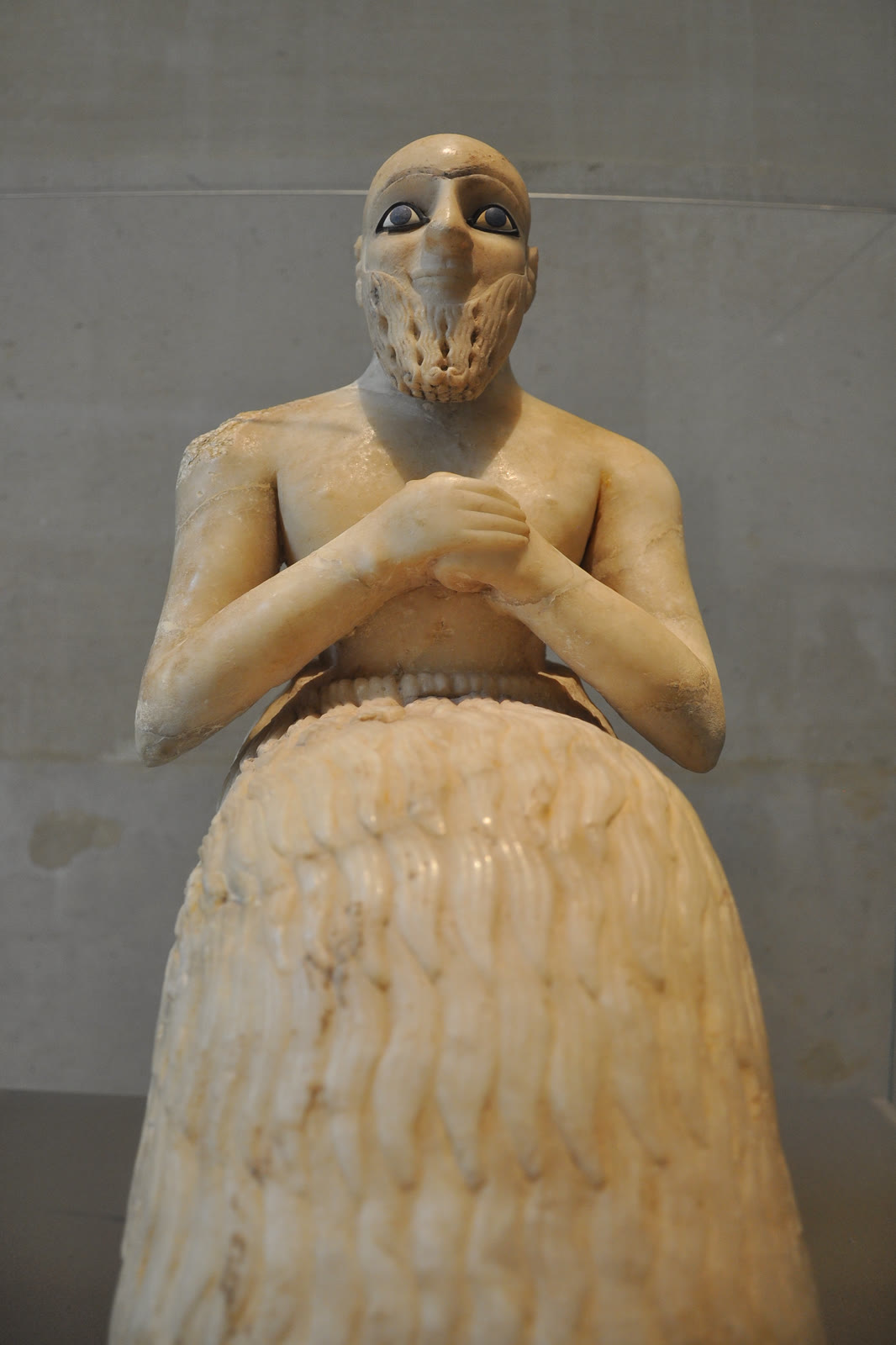
The seated Ebih-Il dedicated this statue to Ishtar at Mari around 2400 BCE. His name preserves the element Il, a separate piece of evidence from the dedication.
Estimated reading time: 5 min Published Last reviewed:
Share article
Photograph
Amaury Laporte / Wikimedia Commons / CC BY 2.0
Detail of the seated statue of Ebih-Il from the temple of Ishtar at Mari, about 2400 BCE. Musée du Louvre, AO 17551 A
Image sourceVideo
The Name No One Owns | The Road of El
More than four thousand years ago a palace burned at Ebla, and one small word waited in its clay: ʾl, El. We follow it through names and inscriptions, from Ebla, Mari and Ugarit to the kings of Samʾal, Karatepe and Saba and the stones of the basalt desert, then set the Torah's names and the Arabic question side by side. Some scenes are AI-generated illustrations.
The YouTube player loads only when you press play. Watch on YouTube
Object details
- Title
- The Statue of Ebih-Il and the Il-Names of Mari
- Timeline
- From 2500 BCE to 2340 BCE
- Region
- The Levant
- Rights
- CC BY
Text
Introduction
The statue of Ebih-Il from MariMariMari at Tell Hariri on the Syrian Euphrates was founded around 2900 BCE and rebuilt through three major urban phases. Its palace and cuneiform archives illuminate trade, royal government and religious practice, especially in the eighteenth century BCE.Glossary · Click to read the explanation shows a man sitting with his hands joined. An inscription names him, gives his title and records the dedication of the object to IshtarInanna / IshtarA prominent Mesopotamian goddess whose Sumerian name Inanna became associated with Akkadian Ishtar across diverse traditions. She was associated with desire, war, royal authority and Venus, while local forms and genealogies varied among texts.Glossary · Click to read the explanation. The Louvre dates the statue to around 2400 BCE and catalogues it as AO 17551 A. The dedication and the personal name provide two kinds of evidence. One specifies the goddess to whom this object was given. The other preserves an early written example of a name ending in Il on the middle Euphrates. [1]
A figure at prayer
The statue is 52.5 centimeters tall. The Louvre describes its pale stone as alabaster, and the Mari archaeological portal specifies gypsum. The sculpture shows a shaved head, a beard, a skirt with long tufts and a seat patterned like wickerwork. Shell and lapis lazuli make up the eyes, and the museum’s catalogue records bitumen among the secondary materials. The inlay is central to the effect of the face. The folds of the skirt and the shape of the hands remain features carved in the pale stone itself. The Louvre's visitor page singles out the blue gaze of lapis lazuli set against shell and underlined with black clay, which shows how much of the original effect depended on materials added to the carved stone. [1][2]
The joined hands belong to what museum descriptions call the position of an orant, a person in prayer. The Louvre explains this type of statue as a way to continue an act of devotion in the temple. The inscription reinforces that interpretation for this individual example. Ebih-Il, designated nu-banda, dedicated the image to Ishtar. The museum glosses the title as superintendent and describes it as a position with substantial responsibility. The statue thus gives a named official a durable place in the sanctuary and records the recipient of the gift in writing. [1][2][3]
The Louvre records the find on 23 January 1934, in courtyard 20 of the Ishtar temple. The account of André Parrot’s expedition describes a figure whose head and body were documented during the work and the discoveries from which the excavators began to identify the site and the sanctuary. They went on to uncover rooms containing other votive figures and sculpted vessels. At the division of finds, the Ebih-Il statue went to the Louvre and the statue of Ishqi-Mari went to Aleppo. The modern discovery history connects an object now seen in a gallery with its original archaeological setting. [1][4]
How much a name can tell us
The inscription on the shoulder gives an example of AkkadianAkkadianAn ancient East Semitic language written in cuneiform from the third millennium BCE; its varieties include Babylonian and Assyrian, and it served in international diplomacy.Glossary · Click to read the explanation written in cuneiformCuneiformWriting with wedge-shaped signs, developed from Mesopotamian recording traditions and used for several languages from the third millennium BCE.Glossary · Click to read the explanation at Mari. The archaeological portal discusses the language of the city’s texts and changes in how its scribes wrote over time. In the later age of Mari’s AmoriteAmoritesGroups associated with West Semitic speech in the Levant and Mesopotamia, whose dynasties were particularly prominent in the nineteenth and eighteenth centuries BCE (ca. 1900–1700 BCE).Glossary · Click to read the explanation rulers, the palace archives used Akkadian writing, while Amorite is especially visible in personal names. For an inscription containing both a dedication and a name, recognizing the language of the formula is therefore one step. Interpreting the structure of the personal name is a distinct question. The Louvre’s reading preserves the name Ebih-Il, including its final element. [1][2][5]
A later statue from Mari offers a comparison. A diorite figure of Ishtup-Ilum was found in the throne room of the palace, and an inscription on its right arm identifies him as shakkanakku of Mari. The Mari portal renders his name as “The god kept alive.” The two statues keep different names, titles and contexts in view. The early figure dedicated to Ishtar belongs to the temple, while the later governor’s praying figure was found in a royal room. The recognized structure of Ishtup-Ilum’s name supplies a comparison without settling the full meaning of the earlier name. [1][6]
Ichiro Nakata uses a much later group of Mari letters to examine variation in how scribes wrote divine names. In his study of Ikrub-El, he finds that different spellings of the same name alternate between El, Il and a divine sign. He argues on grammatical grounds that El or Il can represent a divine name in certain personal names and distinguishes these cases from the common Akkadian word ilum. The analysis applies to the forms and contexts he examines. It gives a method for reading names across different spellings, while the older inscription still supplies its own evidence for how Ebih-Il was written. [7]
Names and worship in the letters
The letters associated with Terqa provide a case in which a name containing the element appears in a cultic setting. The governor Kibri-Dagan names DaganDaganA god worshipped in Syria and Mesopotamia, especially at Tuttul and Terqa on the Euphrates, and associated with royal authority. His name appears as Dagon in the Hebrew Bible; no ancient image of him is securely identified.Glossary · Click to read the explanation alongside Ikrub-El, also written Yakrub-El, in greetings reporting that the gods and the district are well. Jack M. SassonJack M. SassonHebrew Bible and ancient Near Eastern cultures scholar, Vanderbilt professor emeritus, also specializing in Mari’s archives.Glossary · Click to read the explanation gives the proposed meaning of Ikrub-El as “El has blessed” and discusses what the letters reveal about the deity. The repeated pairing with Dagan and the local context give independent grounds for describing a deity known at Terqa. [7][8]
In the published English abstract of a separate study, Nakata compares twenty deities selected from the Old Babylonian Mari evidence and places El/Il among those prominent in personal names and less prominent or absent in his sample of official cult records. The comparison concerns a later archive, with different kinds of records available for names and cult. The early statue already illustrates why those kinds of evidence have to be read together. The name shows how its owner was known. The dedication states what he did with this particular sculpture and to whom he offered it. [1][9]
Further reading on IL Archive
References and notes (9)
- Musée du Louvre, Nu-banda Ebih-Il, AO 17551 A Read the catalogue entry for the date range, materials, dimensions, Akkadian inscription, find date and place. Return to the text ↑
- French Ministry of Culture, Mari, The Statue of Ebih-Il Read the object description, materials, date, pose and the archaeological context in the temple of Ishtar. Return to the text ↑
- Musée du Louvre, Ebih-Il, of Mari Read the discussion of the inlay, clothing, title, votive function and inscription. Return to the text ↑
- Pascal Butterlin, André Parrot et la découverte du temple d’Ishtar en perspective Read the account of the January 1934 discoveries, excavation of the rooms and division of finds. Return to the text ↑
- French Ministry of Culture, Mari, Writing and Language Read the account of cuneiform at Mari, the Amorite-era written conventions and personal names. Return to the text ↑
- French Ministry of Culture, Mari, The Statue of the Shakkanakku Ishtup-ilum Read the place of discovery, the title, the material, and the inscription on the arm. Return to the text ↑
- Ichiro Nakata, A Mari Note: Ikrub-El and Related Matters Read pp. 15–19 on the variant spellings, the grammatical discussion of El/Il and the greetings from Terqa. Return to the text ↑
- Jack M. Sasson, Ancestors Divine? Read the discussion of Ikrub-El and Yakrub-El in pp. 413–428, including the tentative name gloss and the letters of Kibri-Dagan. Return to the text ↑
- Ichiro Nakata, Official Pantheon and Popular Pantheon of Mari English abstract only. Read the size of the sample, the comparison groups and the description of El/Il. Return to the text ↑
Archive records may be reviewed and refined as better evidence or sources become available. Suggest a correction
Suggest a correction · Suggest a source for this record
Cite this record
IL Archive, «The Statue of Ebih-Il and the Il-Names of Mari», https://ilarchive.com/en/artifacts/statue-of-ebih-il-ao17551
Continue reading