Entity · Deity
Lahmu and Lahamu, the First Named Pair in Enuma Elish
A reference page linking a name, group, or concept to the materials that discuss it.
- Names
- Lahamu · Lahma and Lahama · Lahmu · Laḫmu · Laḫāmu
- Region
- Mesopotamia
Lahmu and Lahamu emerge from the primordial waters and later hear Anshar's appeal for the gods to assemble. A related name occurs in Tiamat's host and in protective ritual, in settings with distinct roles.
Estimated reading time: 5 min Published Last reviewed:
Share article
Text
Introduction
Lahmu and Lahamu are the first pair of gods named after the opening description of Apsu and TiamatTiamatTiamat is a primeval divine mother and watery figure in Enūma eliš who later opposes Marduk; he divides her body in making the cosmos. No Babylonian portrait of her is securely identified.Glossary · Click to read the explanation in the Babylonian poem Enuma ElishEnuma ElishA seven-tablet Babylonian creation poem in Akkadian, recounting Marduk’s rise, victory over Tiamat, cosmic ordering and human creation, and culminating in praise through fifty names. Its composition date is debated; later manuscripts and recitation traditions preserve it.Glossary · Click to read the explanation. The story returns to them when Anshar sends a messenger to the elders during the conflict with Tiamat. In both scenes their place in the divine family matters. The name of a creature in Tiamat's host and the Assyrian use of protective figurinesFigurineA small shaped object depicting a human, animal or abbreviated form, in clay, stone or another medium. Its form alone does not establish its use; manufacture, handling traces and find context matter.Glossary · Click to read the explanation called lahmu give the related terms other settings. The descriptions in each source determine what the names refer to there. [1][2]
The pair in the primordial waters
The first tablet begins before heaven and earth have received names, while the waters of Apsu and Tiamat mingle. The gods take shape within them. Lahmu and Lahamu emerge and receive names. They grow, and then Anshar and Kishar are formed and surpass them. Anu and NudimmudEnkiMesopotamian deity also known as Ea, linked with Eridu and the Abzu (deep fresh waters), wisdom, incantations, and narratives of creation and cosmic order. Later written attestations do not identify the deity of Eridu’s earliest layers.Glossary · Click to read the explanation, another name for Ea, follow. The poem presents the early sequence through successive generations and increases in stature and power. The first generation thus gives the later gods an ancestry within the world that the poem has begun to describe. [1][2]
The opening of Tablet I leaves the relationship of the first two pairs partly implicit. Andrew George points to the later address to Lahmu and Lahamu in Tablet III, where they are referred to as Anshar's forebears. He also compares independent god listsGod ListsTexts collecting divine names for preservation, teaching and classification, with varying theological organization.Glossary · Click to read the explanation and incantations in which variants of the pair's names occur among the ancestors of Anu. One sequence places them between Duri and Dari on one side and Alala and Belili on the other. The order recorded in that tradition helps show what the poet could select from older lists and give a new position in the story's opening. [1][2]
The line naming the pair survives through several broken manuscripts. The Ashmolean fragments recorded as CDLI P450752 preserve the end of the first name, the second name and traces of the account of their emergence on line 10. The parallel copies allow an edition to print the line as part of a continuous opening. This is one reason the order of names can be stated more securely than the interpretation of what their names meant. George reviews a proposal that the pair represents mud, between the primordial waters and the world to be formed, and another in which they are imagined as supports for the universe. Both seek to account for the pair's position in the genealogy. The passage itself gives their names and growth without assigning them a job or describing the material of their bodies. [1][2][3]
At the assembly of the older gods
In Tablet III, Anshar tells his messenger Kaka to go to Lahmu and Lahamu and call the gods together. Kaka takes them word of Tiamat's preparations and of the authority MardukMardukBabylon’s leading god, worshipped at Esagil and elevated in the Akkadian Enūma eliš. His symbols include a spade and mušḫuššu dragon. His earliest origins remain obscure; Nibiru is no evidence of a planetary homeland.Glossary · Click to read the explanation demands before going out to face her. When the pair hear him, they cry aloud. The other elders assemble, greet one another, eat and drink, and decree Marduk's destiny. The poem lets the message reach the rulers' ancestors before it relates the grant of power to their descendant. [1][4]
The pair appear again near the end of Tablet VI. Anshar, Lahmu and Lahamu each bestow three names on Marduk and ask the younger gods to take up the naming. This gives the pair a part in both his elevation and the later recognition of his place among the gods. At the beginning of the poem, they are named when they first come into being. In the later assembly they are among those who give names to the new king. [1][4]
The creature and the protective figure
A being with a related name also appears in Tablet I after Tiamat prepares for battle. One recent edition glosses its name as "hairy". It stands among creatures including a dragon, a scorpion-man and a fish-man, under the leadership Tiamat gives to QinguQinguQingu (Kingu): a god whom Tiamat appoints commander and gives the Tablet of Destinies; captured after Marduk’s victory, his blood is used to make humans in Tablet VI.Glossary · Click to read the explanation. This entry in a group of eleven has a different narrative role from the pair of ancestors visited by Kaka. The lists of creatures and generations are doing different work within the verse. [1][4]
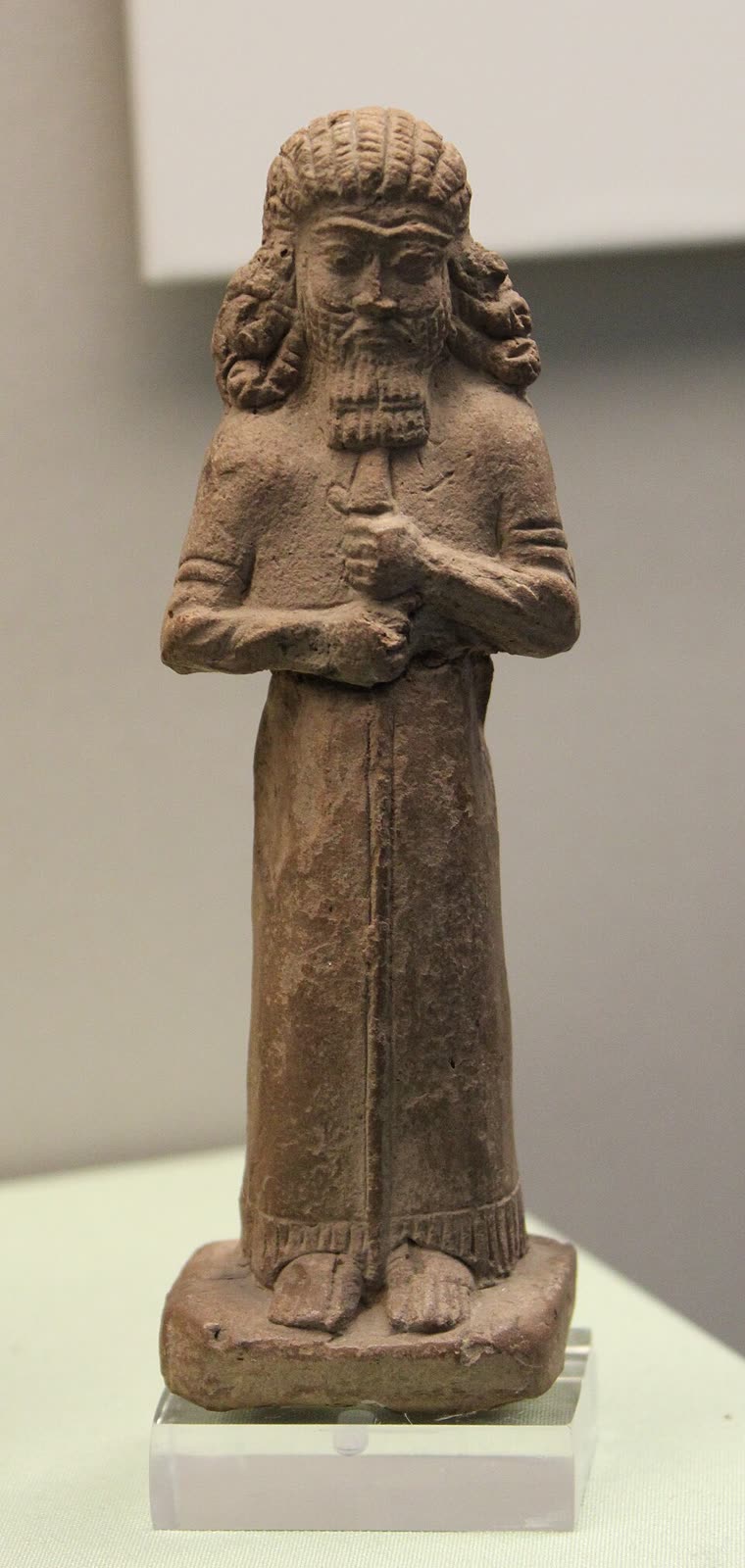
Assyrian protective texts prescribe clay figurines called lahmu. Frans Wiggermann describes a pair with a spade as an attribute and an inscription concerned with admitting a guardian of peace and expelling a harmful one. Luis Siddall discusses a figurine identified as a lahmu from deposits in the Burnt Palace at Nimrud, where clay figures were found in boxes under parts of the building. A comparable object in his study is British Museum ME 90996, from NinevehNineveh and KuyunjikNineveh is an ancient Assyrian city near Mosul in northern Iraq; Kuyunjik is one of its archaeological moundsGlossary · Click to read the explanation. The material evidence gives the protective use of the name a setting in the architecture of Assyrian residences. [5][6]
The Nineveh figurine has curls beside a bearded face and is shown holding its implement against its body. Richard Ellis notes how frequently long-haired or curly-haired male figures appear in Mesopotamian art, including on earlier seals. The labels proposed for those images have changed. Wiggermann's identification of some figures as lahmu draws on the combination of lexical evidence and instructions for making protective figurines. The comparison is valuable when an object has an appropriate context, and its force is weaker when an isolated figure has only a similar hairstyle. The photograph illustrates the Assyrian protective type discussed by Siddall. The poem describes the ancestors through their names, their position in the generations and their actions in the assembly. [1][5][6][7]
References and notes (7)
- Wilfred G. Lambert, Babylonian Creation Myths Read Enuma Elish I 1–20, 133–152, III 67–71 and 119–138, and VI 157 onward, including the early names, the creature list, Kaka's journey and the elders' assembly. Return to the text ↑
- Andrew R. George, Cosmogony in Ancient Mesopotamia Read pp. 4–6 and 13–14 on the Anu theogonies, the variants of the two names, procreation and the reading of the early generations. Return to the text ↑
- Cuneiform Digital Library Initiative, Literary 002718.01, ex. 036, P450752 Read the object record and obverse transliteration 1–16, especially the surviving parts of the names in line 10. Return to the text ↑
- Johannes Haubold, Sophus Helle, Enrique Jiménez and Selena Wisnom, Enuma Elish Read Tablets I, III and VI and the discussions of the monster list and the assembly's response to Kaka, including VI 157–165 on the names. Return to the text ↑
- F. A. M. Wiggermann, Mesopotamian Protective Spirits: The Ritual Texts Read the ritual entry on two clay lahmu figures, the implement and opening-and-closing function, and the discussion of its association with Ea. Return to the text ↑
- Luis R. Siddall, Apotropaic Figurines from Nimrud (Calah) in the Australian Institute of Archaeology Collection Read the excavation context, description of the Nimrud figure and identification of Nineveh ME 90996 in figure 2. Return to the text ↑
- Richard S. Ellis, The Trouble with Hairies Read the published extract discussing previous identifications of the curled figures and the types of evidence marshaled for the lahmu reading. Return to the text ↑
Suggest a correction · Suggest a source for this record
Cite this record
IL Archive, «Lahmu and Lahamu, the First Named Pair in Enuma Elish», https://ilarchive.com/en/entities/lahmu-and-lahamu