Entity · Deity
Ninurta, Warrior of Enlil and Restorer of the Fields
A reference page linking a name, group, or concept to the materials that discuss it.
- Names
- Ninurta
- Region
- Mesopotamia
Ninurta defeats Anzu and Asag in separate Mesopotamian poems, and brings water to fields in one of them. His temple at Kalhu gave the warrior god a place in Assyrian royal architecture.
Estimated reading time: 4 min Published Last reviewed:
Share article
Text
Introduction
Ninurta was a Mesopotamian god associated with combat, agriculture and royal authority. Sumerian poems call him a son of EnlilEnlilEnlil/Ellil: a major Mesopotamian god associated with destinies, kingship, and Ekur at Nippur, already prominent in third-millennium god lists. His name’s origin and cult beginnings remain debated.Glossary · Click to read the explanation and portray him bringing enemy powers under control. In the AkkadianAkkadianAn ancient East Semitic language written in cuneiform from the third millennium BCE; its varieties include Babylonian and Assyrian, and it served in international diplomacy.Glossary · Click to read the explanation Epic of Anzu, he defeats the bird that steals the Tablet of Destinies. In the Sumerian Exploits of Ninurta, he defeats Asag, sets the landscape in order and brings water to cultivated fields. The stories give him different opponents and connect his victories with different aspects of divine and human life. [1][2][3]
Nippur is the destination in a Sumerian poem describing his return from battle. At Kalhu, the Assyrian king Ashurnasirpal II built a temple for Ninurta during the ninth century BCE transformation of the city. Literary compositions and excavated buildings document different ways communities gave the god a place in their world. [2][4][5]
Anzu and the Tablet of Destinies
In the Standard Babylonian version of Anzu, the bird seizes the Tablet of Destinies from Enlil. The possession of the tablet gives Anzu power during the battle, and Ninurta’s first attempt fails. The god EaEnkiMesopotamian deity also known as Ea, linked with Eridu and the Abzu (deep fresh waters), wisdom, incantations, and narratives of creation and cosmic order. Later written attestations do not identify the deity of Eridu’s earliest layers.Glossary · Click to read the explanation gives advice that helps Ninurta prevail. In the third tablet, feathers carried on the wind reach EkurEkur: Enlil’s Temple at NippurEkur (“Mountain House”) was Enlil’s chief sanctuary at Nippur, present-day Iraq; the name may extend to its precinct. Hymns and royal inscriptions attest to its prestige and rebuilding across periods; it is not simply the ziggurat.Glossary · Click to read the explanation, the sanctuary of Enlil, and announce the outcome. The theft and recovery thus concern the use of divine authority as well as the outcome of a battle in the mountains. [1]
Selena Wisnom traces these features into other Akkadian poems. She argues that Enuma ElishEnuma ElishA seven-tablet Babylonian creation poem in Akkadian, recounting Marduk’s rise, victory over Tiamat, cosmic ordering and human creation, and culminating in praise through fifty names. Its composition date is debated; later manuscripts and recitation traditions preserve it.Glossary · Click to read the explanation, the Babylonian creation epic, gives MardukMardukBabylon’s leading god, worshipped at Esagil and elevated in the Akkadian Enūma eliš. His symbols include a spade and mušḫuššu dragon. His earliest origins remain obscure; Nibiru is no evidence of a planetary homeland.Glossary · Click to read the explanation a victory with echoes of Ninurta’s, including a sign carried on the wind. The Tablet of Destinies has a different role in the two stories. It gives Anzu a decisive advantage during his first encounter with Ninurta. In Wisnom’s reading of Enuma Elish, it functions more as an emblem of supreme authority. The distinction explains why the presence of a tablet in several tales need not imply that its powers are the same in each one. [1]
Asag and the water of the Tigris
The Sumerian Exploits of Ninurta, also known as Lugal-e, gives the god a different adversary, Asag. After overcoming him, Ninurta confronts another problem. Water is dispersed in the mountains and the Tigris fails to bring its flood in full. The poem describes him gathering stones and using them to control the powerful waters. He brings the water together and leads it down to the Tigris. Barley receives water, and gardens and orchards bear fruit. The poem puts the work of making fields productive after the account of combat. [3]
The same composition depicts Ninurta assigning destinies to stones. It describes their conduct during the conflict and gives them qualities and uses in response. For instance, a stone identified in the edition as emery is condemned and is said to be used on carnelian. These scenes treat familiar materials as participants in the story of the battle. The Oxford edition also records a variant in the passage about collecting the waters, where one manuscript has the name Ningirsu in place of Ninurta. Lagash’s god appears here within a tradition that associates the two figures closely enough for the names to vary between copies. [3]
Returning to Nippur
In the poem often called Angim, Ninurta brings back the creatures and other powers he overcame. They are carried on his chariot. The six-headed wild ram hangs on one part of it and the Anzud bird on another. As he nears Nippur, called Nibru in the Oxford translation, Nuska comes out of Enlil’s temple to meet him. Ninurta sets his whip, goad and mace aside before he enters the temple. Later he proceeds to his own sanctuary, Eshumesha, where he speaks to his wife Ninnibru. The return gives the city and its sanctuaries a role in what follows the display of victory. [2]
A different Sumerian story, Ninurta and the Turtle, gives him a less triumphant scene. It brings Ninurta to the dwelling of Enki and eventually depicts him falling into a pit with a turtle that will not let him go. The surviving text is damaged. Even in its fragmentary form, it shows that the successful warrior could also figure in a story about the limits of his power. [6]
The Assyrian temple at Kalhu
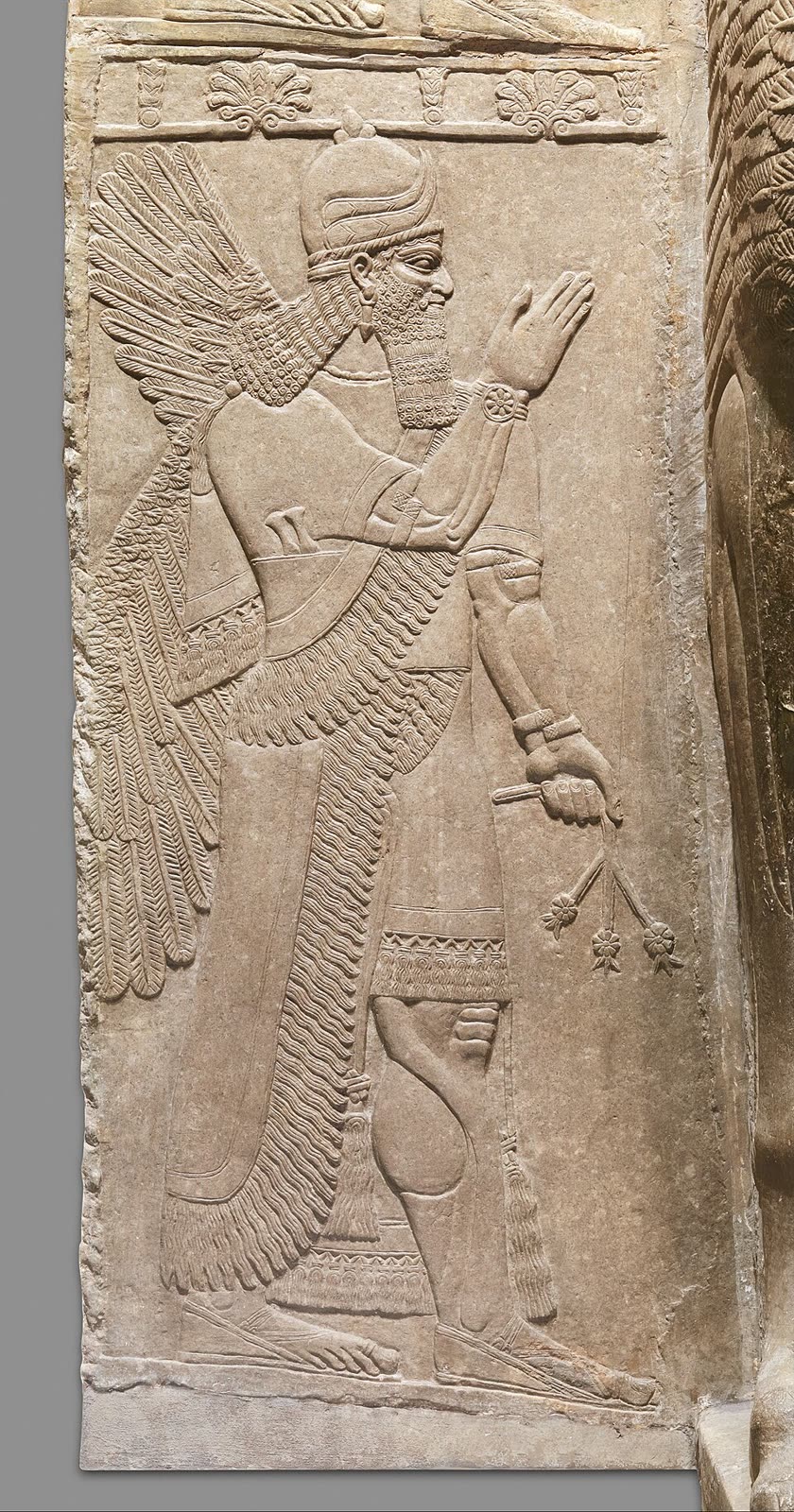
The excavators of Kalhu place the temple within the building programme that turned the city into Ashurnasirpal II’s administrative capital. They describe construction on the citadel in his reign and continued work under his son Shalmaneser III. A fragmentary inscription recovered at the site records Ashurnasirpal’s dedication of the temple. A relief panel now in the Metropolitan Museum of Art came from the same sanctuary. It shows a winged protective figure holding a plant whose branches end in rosettes. [4][5]
A separate combat scene from the temple is often read as Ninurta pursuing Anzu. Glynnis Maynard treats this as the likely identification and discusses an earlier proposal that the winged figure was connected instead with Adad. The temple’s dedication is one reason she favours Ninurta. The panel with the rosettes shown here is a distinct piece from the sanctuary. Together the carvings give a sense of the imagery that surrounded the worship of Ninurta at Kalhu. [5][7]
References and notes (7)
- Selena Wisnom, Blood on the Wind and the Tablet of Destinies: Intertextuality in Anzû, Enūma Eliš, and Erra and Išum Read the opening and notes on Standard Babylonian Anzu I 81–82, II 66–67 and III 22–23, and the discussion of the tablet and different outcomes of the battles. Return to the text ↑
- Electronic Text Corpus of Sumerian Literature, The Return of Ninurta to Nibru, 1.6.1 Read lines 1–12, 30–40, 52–101 and 175–198 on Enlil, the chariot, Nuska, the temples and the appeal for Nippur. Return to the text ↑
- Electronic Text Corpus of Sumerian Literature, The Exploits of Ninurta, 1.6.2 Read lines 310–367 on Asag and the Tigris, the Ningirsu variant at 347–359, and 411–447 on the destinies of the stones. Return to the text ↑
- Michael Danti, John MacGinnis, William Hafford and colleagues, The Excavations at Nimrud (Kalḫu), 2022–2023 Read the overview of the two temples, citadel construction and the report of the recovered dedication text. Return to the text ↑
- Metropolitan Museum of Art, Relief Panel, 32.143.9 Read the date, location, description of the protective figure and origin in the Ninurta Temple. Return to the text ↑
- Electronic Text Corpus of Sumerian Literature, Ninurta and the Turtle, 1.6.3 Read the fragmentary second segment on the meeting at the dwelling of Enki and the episode of the turtle and pit. Return to the text ↑
- Glynnis Maynard, The Intervisuality of Anzû in Neo-Assyrian Mythologies of Kingship Read the discussion accompanying fig. 2 and note 34 on the combat relief and different identifications of its figures. Return to the text ↑
Suggest a correction · Suggest a source for this record
Cite this record
IL Archive, «Ninurta, Warrior of Enlil and Restorer of the Fields», https://ilarchive.com/en/entities/ninurta