Reading path
From Witness to Comparison
A reading path through manuscript dates, an ancient object, editorial decisions and flood narratives: how can a conclusion remain proportionate to its evidence?
Estimated reading time: 5 min Published Last reviewed:
Share article
Text
Introduction
We may see a tablet photograph, read a fluent translation and then reach a conclusion about the relationship between two stories. Yet these steps raise different questions: what actually survives, when was the object copied, how was a damaged passage read, and when does resemblance support a historical relationship? This path separates those questions before bringing the answers together. A witness here means a physical object or copy preserving a text, not the literary work as a whole. You can enter at any station; the suggested order builds a line of inquiry, not a prerequisite for understanding the independent pages.
1. Which date do we mean?
The date of a story is not the date of its manuscript
Begin by distinguishing events within a narrative from composition, editing and the copying of the surviving witness. The study compares several examples, including the transmission of Atrahasis, to explain how a later tablet can preserve an older tradition.
What does this reading support? You can identify what the evidence itself dates: a particular copy, writing material, or a hypothesized stage in the formation of a text.
What does it not establish? Do not turn the oldest surviving copy into a certain date of first composition, or the antiquity of narrated events into evidence for the antiquity of their writing.
2. What are we looking at when we say “an Atrahasis tablet”?
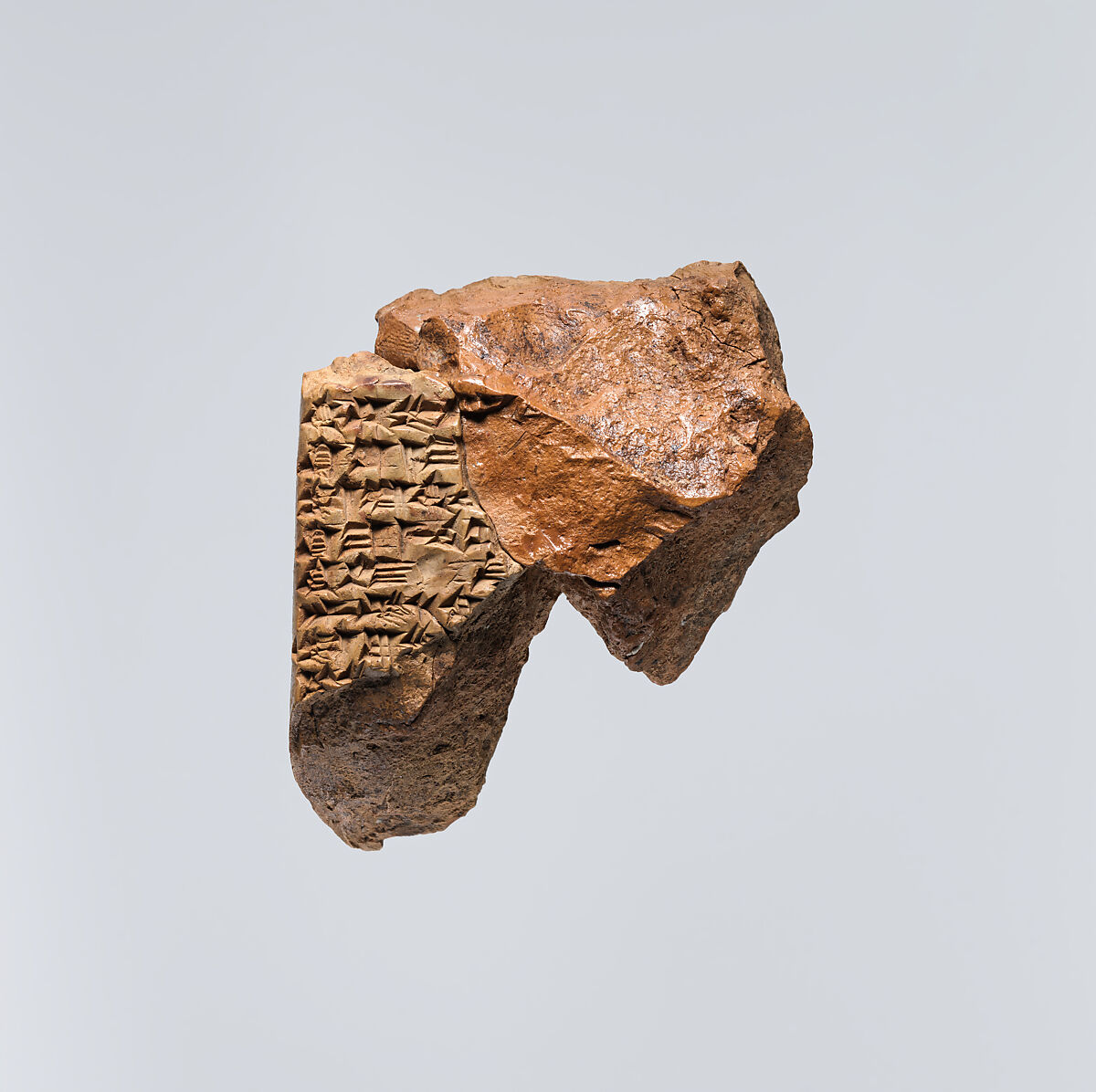
Atra-hasis Tablet Fragment at the Metropolitan Museum
Move from the name of a work to an object identified by its museum number. Examine the fragment’s identity, dating, photograph and surviving text, distinguishing the museum description from the edition’s presentation. It is a later witness within a tradition of multiple copies, not the whole epic or the Old Babylonian tablet discussed elsewhere.
What does this reading support? You can connect information and imagery to the correct object and understand how a later tablet attests the continued transmission of a textual tradition.
What does it not establish? A small photograph does not allow every sign to be read; nor does this object by itself identify the source used by the writer of Genesis.
3. Where does the surviving sign end and the editor’s reading begin?
This article explains how witnesses are compared, why editions differ, and how preserved wording is distinguished from restoration and conjecture. For any translated phrase, ask which witness supports it, whether all its words survive, and where a choice between readings is made explicit.
What does this reading support? You can distinguish a witness’s text from the text presented by an edition combining several kinds of evidence, and ask for a reasoned preference between readings.
What does it not establish? A restoration is not fabrication simply because it is restored, but it does not have the same certainty as preserved letters. Older or more numerous witnesses are not automatically correct.
4. What changes when we compare whole narratives?
The study situates ZiusudraZiusudraA literary king-priest in the fragmentary Sumerian Flood Story (ETCSL 1.7.4). He survives by boat, sacrifices, and receives divine life from An and Enlil in Dilmun. The surviving copy is Old Babylonian; his historicity is unproven.Glossary · Click to read the explanation, Atrahasis, UtnapishtimUtnapishtimThe flood hero of Standard Babylonian Gilgamesh, granted exceptional life with his wife by the gods. He tells Gilgamesh how he survived; his name overlaps with Atrahasis and Ziusudra traditions without making their narratives identical.Glossary · Click to read the explanation and NoahNoahNoah is the flood-story figure in Genesis and a prophet in the Qur’anGlossary · Click to read the explanation in their respective contexts and presents short, precisely located passages. Follow one scene—warning, birds or sacrifice—and ask where it occurs, what it does and how well it survives in each text, rather than attributing it to “the flood story” in general.
What does this reading support? You can weigh evidence of literary relationship alongside differences in the cause of disaster, the portrayal of the divine and the outcome of survival. Resemblance does not erase transformation.
What does it not establish? Do not fill a gap in Atrahasis with Gilgamesh’s birds as though those words survived, or turn literary relationship into proof of a global flood or a known chain of direct copying.
5. How strong is the conclusion compared with alternative explanations?
Similarity does not mean borrowing
Finish by examining the argument itself: chronological priority, availability of the tradition, contact, distinctive details and their order, and the explanation of differences. The article weighs direct borrowing, shared traditionShared traditionAn explanatory model in which several texts draw on circulating stories or imagery; it proves neither direct copying nor a particular lost original on its own.Glossary · Click to read the explanation, intermediaries and independent resemblance without assuming that they are equally strong.
What does this reading support? You can state a graded conclusion: a strong traditional relationship may be likely even when an intermediary text or route of transmission remains unknown.
What does it not establish? Possible contact does not establish the use of a particular text; an unreconstructed route does not rule out every relationship.
A short test after reading
Choose one claim about two narratives and write four sentences: What is the specific witness? What does it date? What survives, and what depends on a reading or restoration? Why does your interpretation explain the proposed relationship better than its alternatives? If an answer is missing, name the missing evidence rather than supplying certainty. The path then becomes a tool for other subjects, not a predetermined verdict that every resemblance is borrowing.
For the literary work’s structure, crises and conclusion, read Atrahasis: the epic and its hero independently or alongside the object record. The name of a work or its hero is not the identity of a particular tablet.
Suggest a correction · Suggest a source for this record
Cite this record
IL Archive, «From Witness to Comparison», https://ilarchive.com/en/paths/from-witness-to-comparison