Reading path
How Do We Read What Kings Say about Themselves?
- Names
- How Do We Read What Kings Say about Themselves?
A reading path on the language of power, legitimacy-making and victory rhetoric: Cyrus Cylinder, Taylor Prism and Tel Dan Stele, with an optional Siloam branch. Each stop has a question, a witness and an open conclusion.
Estimated reading time: 7 min Published Last reviewed:
Share article
Text
Introduction
How should we read a text that first calls its king righteous and then announces the submission of his opponents? This path moves among three royal inscriptions of different materials, languages, and states of preservation. It does not begin by asking whether the ruler was good or evil. Instead it asks who shaped the claim to authority, for what conceivable audience, and what an account of victory chooses to emphasize or leave unsaid. We proceed from Cyrus IICyrus IIFounder of the Achaemenid Empire; conquered Babylon in 539 BCE and died in 530 BCE.Glossary · Click to read the explanation in BabylonBabylonBabylon is an ancient city in central present-day Iraq, south of BaghdadGlossary · Click to read the explanation to SennacheribSennacherib, king of AssyriaAssyrian king, 704–681 BCE; part of Ahiqar’s story is set at his court.Glossary · Click to read the explanation in Judah, then to the broken voice of an Aramaean victor whose name is no longer on the stone. A short optional detour examines a commemorative inscription without a king's name.
This is a journey through the language of power, not another general lesson about manuscript dating and editorial restoration. Every stop poses a focused question, directs you to a published object entry, and supplies a question to carry to the next. The inscriptions need not describe the same events or beliefs for their claims to authority to be compared.
Before the stops — who wants us to believe them?
Royal writing can preserve invaluable historical information, yet the source of an account helps determine its meaning. Identify the speaker, the audience addressed or possibly expected to encounter the work, the ruler's self-description, and the divine, military, or building achievements invoked to justify power. Do not presume one audience for every inscription. A foundation inscription may seek architectural permanence and remembrance; a stele might stand in another setting. Whether people could actually see or read the original text requires separate evidence.
Attend to verbs as well. A king's “I restored” or “I subdued” is a royal claim. Its political purpose neither erases it as evidence nor turns it into a neutral investigation simply because it was carved in clay or stone. A statement absent from the text can prompt a legitimate question, but absence does not itself supply the answer.
Stop one — the Cyrus Cylinder and the grant of legitimacy
Question — Why does the victor need to appear chosen by the god of the city he entered?
Read The Cyrus Cylinder: Royal Inscription and the Limits of Inference, especially the movement from accusations against Nabonidus and Babylonian cult practice to MardukMardukBabylon’s leading god, worshipped at Esagil and elevated in the Akkadian Enūma eliš. His symbols include a spade and mušḫuššu dragon. His earliest origins remain obscure; Nibiru is no evidence of a planetary homeland.Glossary · Click to read the explanation choosing Cyrus and the king's presentation of himself. In the published rendering, the narrator's account precedes the royal first-person titles at line 20. Marduk seeks a just ruler, while the text claims that Cyrus entered Babylon without battle. This is a means of constructing the conquest's legitimacy in a Babylonian idiom, not an independent vote by the inhabitants.[1]
Ask what changes when the “return of gods and inhabitants” is read against the places and cult images the text names, rather than turned into universal freedom for humanity. Calling the cylinder a modern charter of rights belongs to the history of its reception, not its ancient literary genre. Van der Spek's comparison of Assyrian and Persian practices helps explain why mercy or religious accommodation should not automatically be treated as unprecedented, while leaving the impact of specific measures open to inquiry.[2][3]
Take to the next stop — Cyrus presents a worthy ruler by discrediting his predecessor and showing concern for Babylon. The next text constructs success less through a rescuing king than through a conqueror's controlled presentation of victory.
Stop two — the Taylor Prism and what the victor counts as success
Question — If a king reports taking many towns, how does that differ from saying he only confined a ruler within his capital?
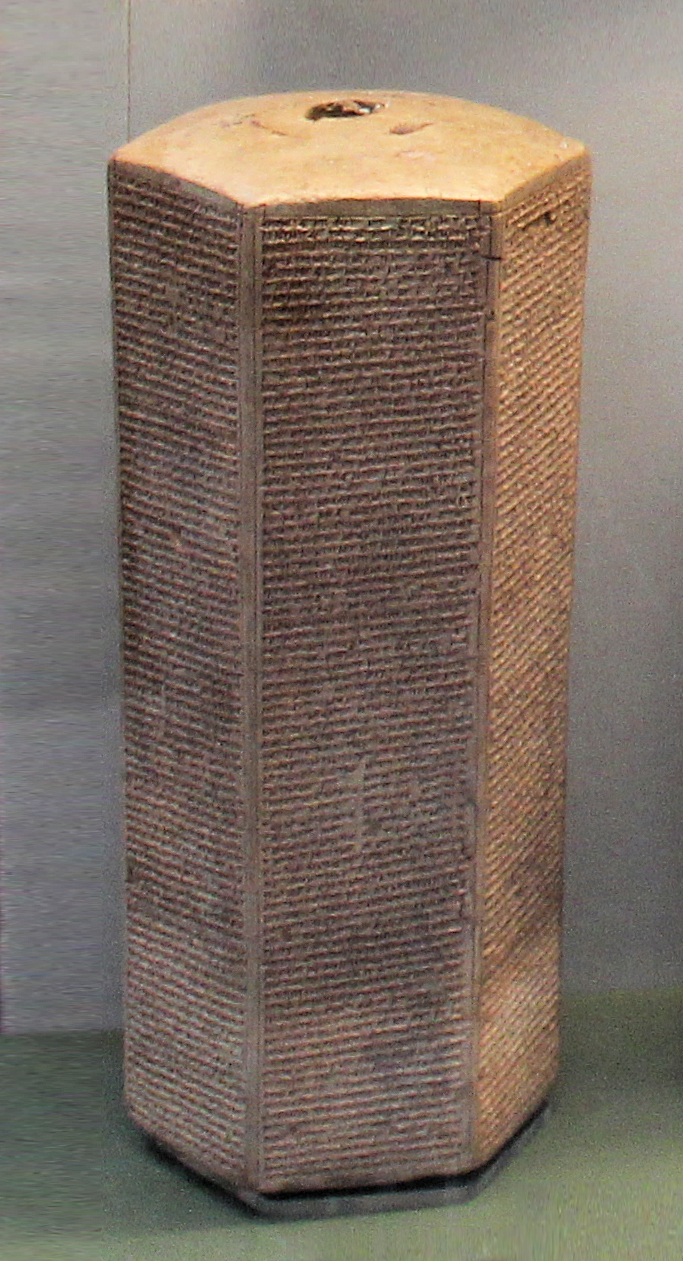
Read The Taylor Prism: Sennacherib and Judah in a Royal Inscription. First notice the royal titles, campaigns beyond Judah, and building accounts. This clay witness carries an account of the campaign in 701 BCE, though the object itself dates to 691 BCE. It is not the Chicago Prism, nor should all edited copies be assumed identical in every sign and line.
In the Judah section Sennacherib claims to have taken 46 fortified towns, along with smaller settlements, captives, and spoils. He then presents HezekiahHezekiah, king of JudahKing of Judah in the late eighth century BCE, named in Sennacherib’s Assyrian accounts of the 701 BCE campaign.Glossary · Click to read the explanation as enclosed in JerusalemJerusalemJerusalem is a city of religious importance in Judaism, Christianity and IslamGlossary · Click to read the explanation “like a bird in a cage” and includes tribute in the account of submission. Compare the verbs of taking with those of confinement. The text does not explicitly claim Jerusalem's capture as it does for other towns, but it does not explain how the confrontation ended. Its silence cannot prove either a capture or a withdrawal caused by illness or supernatural intervention. The deportation number too is part of the king's assertion, not an independent census.[4]
Take to the next stop — “Who speaks?” now meets a question about preservation. In the Taylor Prism the ruler is named in a long royal narrative; at Tel Dan much of the boast survives while the victor's own name is lost.
Stop three — Tel Dan when the boast survives but the speaker's name does not
Question — How strong is a victory claim when its rhetoric survives but the author's signature does not?
Read The Tel Dan Stele: Preserved Text, Restorations, and Limits of Inference and distinguish fragment A from B1 and B2. The royal speaker uses victory rhetoric and credits the god Hadad, but Hazael's name is not preserved on the fragments; identifying him remains a widespread historical inference. Fragment A preserves bytdwd at line 9, widely interpreted as “House of David,” a political or dynastic designation. It does not reconstruct David's biography or verify every related narrative.[5]
Do not read a modern continuous edition as if every edge of the stone physically joined. B1 and B2 do join, whereas the position of A relative to them has been debated. Langlois's 2024 study reconsidered letter shapes and the proposed arrangement. We need neither treat every editorial reading as a certainty nor dismiss every restoration as fabrication. A reading may be preferable while remaining distinct from marks that survive on the object. Similarly, a victorious king's claim to have killed opponents is not automatically an independently verified account of the persons involved and their deaths.[6]
Take to the next stop — Royal character may sometimes be inferred from diction and subject matter despite the lost name. Does every inscription celebrating a large building project therefore speak for a king?
Optional detour — Siloam and an accomplishment without a named king
Question — Is every commemorative text about construction or water a royal proclamation?
Briefly read The Siloam Tunnel Inscription: Excavation, Water, and the Limits of Dating. Its six lines recall the tunnellers meeting and the arrival of water, and give a distance of 1,200 cubits, yet name neither king nor god. A major tunnel may imply organization, labor, and resources; the inscription does not explicitly assign the project to Hezekiah or anyone else. The biblical comparisons therefore remain external to the carved wording.
This detour does not require revisiting the entire debate over the tunnel's date. Compare instead the center of the commemoration. Taylor foregrounds titles and royal accomplishments; Siloam foregrounds the meeting of tools and the flowing water. Not naming a king does not demonstrate that political authority played no part, but it cautions against turning every record of skilled labor into the king's own speech.
After the witnesses — how do the questions change?
The cylinder legitimates a favored king chosen by Babylon's god. The prism frames success through captured cities, deportees, and tribute without expressly claiming the capture of the capital. Tel Dan preserves a damaged victor's claim, partly attested and partly reconstructed. These objects do not form a scale running from “true” to “false.” Each supplies evidence for a particular political utterance and potentially for events, though the necessary external checks differ.
Identifying who made a claim is only the beginning. Ask why it takes this form, what divine names, titles, and numbers accomplish, whether you are reading one object or a composite edition, and what other evidence would test the assertion. Historians can agree about preserved letters while disagreeing about an event's significance. That is a disagreement about historical inference, not necessarily about the existence of the inscription.
A short exercise — leave one question honestly open
Choose the Taylor Prism's statement that Sennacherib took 46 fortified towns. Alongside it, write a sentence beginning “The inscription claims”, identifying its speaker and setting. Follow with a sentence beginning “To test this, we would need”, naming an appropriate independent kind of evidence. Finally, formulate one question that the prism does not answer, such as why it does not report entering Jerusalem. Do not guess the ending or force a model answer. The point is to defend a limited piece of knowledge while leaving the unresolved question visible.
If you need a broader grounding in manuscript dates, editorial choices, and literary comparison, continue separately to From Witness to Comparison. It is a complement, not a stop repeated here; this path retains its distinct inquiry into the voice of power.
References and notes
- CDLI, P386349, “Cyrus Cylinder,” digital transliteration and displayed English rendering for object BM 90920. Lines 9–26, especially 12–20; the displayed transliteration and English rendering were consulted, not an independent cuneiform collation. Return to the text ↑
- Muhammad A. Dandamayev, “CYRUS iv. The Cyrus cylinder,” Encyclopaedia Iranica, originally published 1993, updated 2013; not presented as a 2026 scholarly consensus. Complete accessible entry, especially passages on the foundation genre and the return of gods and inhabitants; cited bibliography not independently read. Return to the text ↑
- R. J. van der Spek, “Cyrus the Great, Exiles, and Foreign Gods: A Comparison of Assyrian and Persian Policies on Subject Nations,” in Extraction & Control, SAOC 68 (2014). Selected passages on printed pp. 233–235 and 260–261, accessed in the PDF text; the entire pp. 233–264 chapter and its sources were not read. Return to the text ↑
- CDLI, P421809, “RINAP 3/1 Sennacherib 022, ex. 002,” transliteration of Taylor Prism BM 91032, not the Chicago Prism or an independently collated composite. Column i 1–18 and column iii 11–41, especially 13–21 and 29–34; published transliteration consulted, no independent sign reading from the photograph. Return to the text ↑
- Avraham Biran and Joseph Naveh, “An Aramaic Stele Fragment from Tel Dan,” Israel Exploration Journal 43 (1993), 81–98; the initial edition of fragment A. Printed p. 90, inspected page image showing fragment A and the line-numbered translation, especially line 9; not the full paper. Return to the text ↑
- Michael Langlois, “The Tel Dan Inscription after 30 Years: A Fresh Look,” Israel Exploration Journal 74/2 (2024), 59–79; a reconsideration of the scripts and fragment placement. Printed pp. 59 (abstract) and 72 were inspected as page images; no claim to have read the whole article. Return to the text ↑
Suggest a correction · Suggest a source for this record
Cite this record
IL Archive, «How Do We Read What Kings Say about Themselves?», https://ilarchive.com/en/paths/reading-royal-inscriptions