Person · Literary figure
Asushunamir and the Release of Ishtar
- Names
- Asushunamir · Aṣnamer · Aṣûšu-namir · Aṣūšu-namir
- Region
- Mesopotamia
In the Akkadian Descent of Ishtar, Ea creates Asushunamir to approach the queen of the underworld. A request for a waterskin brings a curse and leads to Ishtar’s release.
Estimated reading time: 5 min Published Last reviewed:
Share article
Text
Introduction
In the AkkadianAkkadianAn ancient East Semitic language written in cuneiform from the third millennium BCE; its varieties include Babylonian and Assyrian, and it served in international diplomacy.Glossary · Click to read the explanation Descent of IshtarInanna / IshtarA prominent Mesopotamian goddess whose Sumerian name Inanna became associated with Akkadian Ishtar across diverse traditions. She was associated with desire, war, royal authority and Venus, while local forms and genealogies varied among texts.Glossary · Click to read the explanation, Asushunamir is the figure EaEnkiMesopotamian deity also known as Ea, linked with Eridu and the Abzu (deep fresh waters), wisdom, incantations, and narratives of creation and cosmic order. Later written attestations do not identify the deity of Eridu’s earliest layers.Glossary · Click to read the explanation creates to intervene after the goddess has been detained below ground. Ea sends the new arrival through the gates to EreshkigalEreshkigalMesopotamian goddess ruling the netherworld; Inanna’s sister in descent texts, with varying accounts of her relationship with Nergal.Glossary · Click to read the explanation. His instructions include an oath and a request for a waterskin. Ereshkigal curses the visitor and then orders Namtar to sprinkle Ishtar with the water of life and bring her out. [1]
The poem uses the Akkadian term assinnu for Asushunamir in its NinevehNineveh and KuyunjikNineveh is an ancient Assyrian city near Mosul in northern Iraq; Kuyunjik is one of its archaeological moundsGlossary · Click to read the explanation version. Ilan Peled compares this with a Middle Assyrian manuscript from Ashur, where the corresponding figure has a different form of the name and is called a kulu’u. Ancient copies therefore preserve more than one way of naming and identifying the figure whom Ea entrusts with the task. [1][2]
The crisis above the gates
Ishtar goes to a realm described as a place of no return. She passes seven gates. At each, the gatekeeper takes away part of her clothing or equipment. After she comes before Ereshkigal, Ishtar is prevented from leaving. Conception and sexual activity cease on earth. The damage to ordinary life is what brings the case before the other gods. Ea’s creation of a messenger follows this account of what has stopped while Ishtar is away. [1][3]
Ea’s instructions use the opening of the seven gates a second time. He tells Asushunamir to go to the entrance of Kurnugi, the underworld, and says that its gates should open. He expects Ereshkigal to be pleased when she sees the visitor. Once she has been calmed, Asushunamir is to have the queen swear an oath by the great gods. The address lays out how a new arrival can gain a hearing from someone who controls passage through all seven gates. [1]
A request and a curse
The unusual request concerns the waterskin. Ea tells Asushunamir to ask Ereshkigal to have it given to the visitor, who wants to drink from it. Ereshkigal hears the request and responds by striking her thigh and biting her finger. In the composite translation, she says that the request is one that should never have been made. David Instone-Brewer understands the waterskin as a reference to Ishtar’s body and connects that reading with the account of the goddess’s treatment in the Sumerian version. The Akkadian dialogue leaves the connection implicit. The vessel is the stated object of the request, and the queen’s subsequent command concerns the goddess herself. The poem places these two parts of the exchange next to each other without an explanation from the narrator. [1][4]
Ereshkigal’s curse assigns the visitor water from the city’s drains, standing places in the shadows of walls and a dwelling at thresholds. The picture it draws is one of exposure in public places. The image of a threshold returns immediately when Ereshkigal gives a different series of orders to Namtar. He is to attend to the thresholds, seat the AnunnaAnunna / AnunnakiAnunna/Anunnaki is a collective designation for Mesopotamian gods whose scope varies by text and period; it is not a group with one fixed membership or number.Glossary · Click to read the explanation on golden thrones and sprinkle Ishtar with life-giving water. Those directions move the story from the curse to the release. [1]
Who brings Ishtar out
Namtar carries out Ereshkigal’s decision. He sprinkles Ishtar, takes her before the queen and leads her out. On the ascent he restores the things taken from her at the gates, starting with the clothing closest to her body and ending with her headgear. The order reverses the dismantling of her appearance on the way down. Asushunamir has brought about the exchange on which the decision turns. Namtar performs the acts that let Ishtar leave. [1][3]
The Sumerian Descent of Inanna assigns comparable work to two figures. Enki forms a gala-tura and a kur-jara from dirt under his fingernails and gives them life-giving water and a life-giving plant. They enter and respond to Ereshkigal’s distress, receive Inanna’s body and revive her. The comparison makes the distribution of actions in the Akkadian poem easier to see. One person makes the request, the queen issues the command and a member of her household carries it out. [1][2][5]
The name in a manuscript and an archive
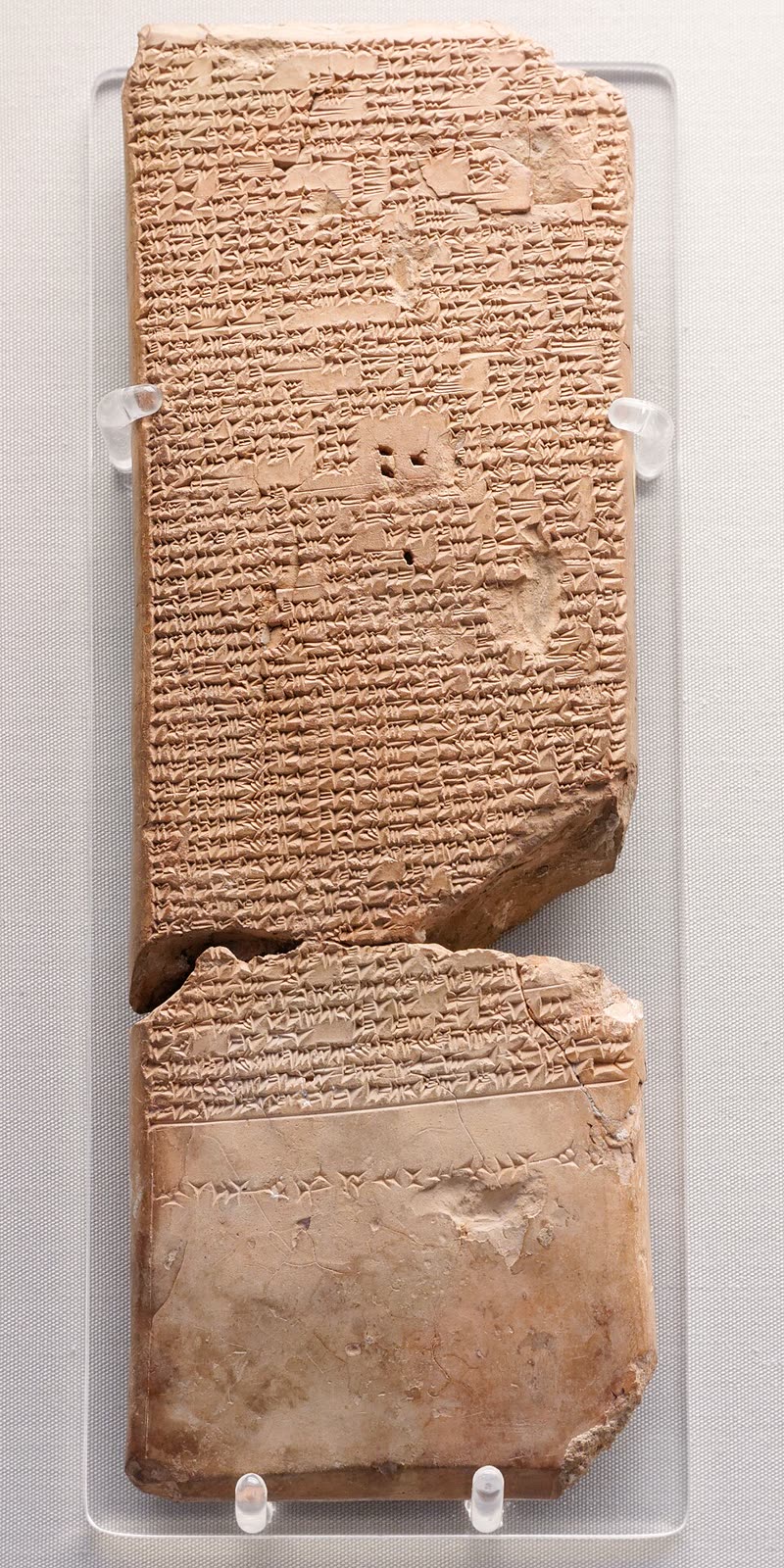
The British Museum tablet K.162 is a Neo-Assyrian copy from Nineveh. Its Akkadian text is one witness used to establish the composition. The identification of Asushunamir as an assinnu in that tradition is evidence for the poem’s use of an ancient role. Peled sets out several proposals about its relationship to gender and cult and notes disagreement. Leaving the Akkadian word visible keeps the identification tied to what this witness actually says. [1][2][3][6]
Peled also notes a difference in how the two labels are written. In the Nineveh copy the word for Asushunamir’s role is preceded by a cuneiformCuneiformWriting with wedge-shaped signs, developed from Mesopotamian recording traditions and used for several languages from the third millennium BCE.Glossary · Click to read the explanation sign marking a person. The corresponding label in the Ashur copy lacks that sign. Peled treats this as a clue that the labels may have differed in function. [2]
Francis Joannès records that a person bears the name Aṣūšu-namir in a legal document from the EannaEanna at UrukAn archaeological precinct and institutional centre at Uruk associated with Inanna; its name does not fix every early building’s function.Glossary · Click to read the explanation archive at UrukUrukAncient city at Warka in southern Iraq, a major urban centre around 3200 BCE that preserved early writing and accounting tablets.Glossary · Click to read the explanation. The document attests the use of the name outside the poem. In the story itself, Asushunamir enters at a particular moment, when the gods need someone able to reach Ereshkigal and obtain her oath. The curse and the orders given to Namtar are the consequences the narrative follows. [1][7]
References and notes (7)
- Cuneiform Digital Library Initiative, Descent of Ishtar, P497322 Read the composite Akkadian text and its translation for the detention of Ishtar, Ea’s instructions, the oath, the waterskin request, the curse and the return through the gates. Return to the text ↑
- Ilan Peled, Kula’ūtam Epēšum: Gender Ambiguity and Contempt in Mesopotamia Read the comparison of the Sumerian and Akkadian witnesses, the forms Aṣnamer and Aṣušunamir, and the discussion of competing interpretations of assinnu and kulu’u. Return to the text ↑
- British Museum, Cuneiform Tablet Telling the Legend of Ishtar’s Descent to the Underworld Read the description of K.162, the Akkadian narrative, the divestment at the gates and the return with her regalia. Return to the text ↑
- David Instone-Brewer, Are There Two Types of Men in Leviticus 20:13? Read the analysis and rendering of the waterskin request, including note 37 on the suggestion that the waterskin refers to Ishtar’s body. Return to the text ↑
- Electronic Text Corpus of Sumerian Literature, Inana’s Descent to the Nether World Read lines 217–289 on the two figures Enki creates, their instructions, the encounter with Ereshkigal and Inanna’s revival. Return to the text ↑
- Cuneiform Digital Library Initiative, Descent of Ishtar, Example 001, P345482 Read the witness record for the Neo-Assyrian tablet, the Nineveh provenance and the museum number. Return to the text ↑
- Francis Joannès, Social Aspects of Babylonian Names, in Personal Names in Cuneiform Texts from Babylonia Read the discussion of historically and mythologically derived names and the attestation of Aṣūšu-namir in YOS 7 118 from Uruk. Return to the text ↑
Suggest a correction · Suggest a source for this record
Cite this record
IL Archive, «Asushunamir and the Release of Ishtar», https://ilarchive.com/en/people/asushunamir