Person · Figure
Bardiya and the Behistun Succession
- Names
- Bardiya · Barziya · False Smerdis · Gaumata · Gaumata the Magian · Pirtiya · Pseudo-Smerdis · Smerdis · Tanyoxarkes
- Timeline
- 522 BCE
- Region
- The Near East
Cyrus's younger son, whom the Greeks called Smerdis. Darius says a magus named Gaumata ruled in his name in 522 BCE; whether that is true has long been debated.
Estimated reading time: 6 min Published Last reviewed:
Share article
Text
Introduction
Bardiya was the younger son of Cyrus IICyrus IIFounder of the Achaemenid Empire; conquered Babylon in 539 BCE and died in 530 BCE.Glossary · Click to read the explanation, the founder of the Persian empire, and the brother of King Cambyses. Greek writers called him Smerdis. He is remembered for a single year, 522 BCE, when a king ruled the empire under his name for a few months. Who that king really was is one of the oldest open questions in Persian history. [1][2]
The fullest account comes from the man who ended that reign, Darius IDarius IPersian king of the late sixth and early fifth centuries BCE, responsible for the Behistun inscription.Glossary · Click to read the explanation. On the cliff at BehistunBehistun and Darius I’s inscriptionIranian site preserving a royal inscription in three languages from the late sixth century BCE.Glossary · Click to read the explanation in western IranIranIran is the modern country containing Shush, ancient SusaGlossary · Click to read the explanation, Darius says that Bardiya had been murdered in secret years before, and that the king was an impostor: a magus, that is, a member of a priestly group, named Gaumata. Many historians accept this. Others think the king Darius killed was the real Bardiya, and that Gaumata was a story told to justify a seizure of the throne. This entry sets out what each source says and where the evidence stops. [3][4]
One prince, many names
Bardiya is the name in Old Persian, the language of the Persian kings. It probably comes from a word meaning "to be high". The Elamite version of the Behistun text writes it Pirtiya, and the Babylonian version, like everyday contracts from Babylonia, writes Barziya. HerodotusHerodotusFifth-century BCE Greek historian whose account of the Persian Wars includes reports on peoples, court and empire.Glossary · Click to read the explanation calls him Smerdis. Ctesias, a Greek doctor at the Persian court about a century later, calls him Tanyoxarkes, "the big-bodied one", perhaps a nickname. [2]
Darius and Herodotus agree that Bardiya and Cambyses had the same father and mother. Before 522 the prince is hardly visible. Greek writers say that Cyrus gave him lands to govern, but they disagree on which, and none of this can be checked. [2]
What Darius says
The Behistun inscription tells the story in the first person. Cambyses killed his brother before he left to conquer EgyptEgyptEgypt lies mainly in northeastern Africa and includes the Sinai Peninsula in AsiaGlossary · Click to read the explanation in 525 BCE, and the people did not know. While the king was away, "the Lie", Darius's word for rebellion and falsehood, spread through Persia and Media. Then, on 11 March 522, a magus named Gaumata rose up on a mountain in Persia and announced: [1]
Behistun inscription, column I, §11, in the 1907 translation of L. W. King and R. C. Thompson, where "Smerdis" stands for Bardiya. [1]
Persia, Media and other lands went over to him, and on 1 July 522 he took the kingship. Cambyses died soon after. According to Darius, the new king killed many who had known the real Bardiya, so that no one could expose him. With a few men, Darius killed him on 29 September 522 at a fortress called Sikayauvatish in Media. Darius adds that he rebuilt the places of worship that Gaumata had destroyed and gave back the pastures, herds, workers and houses that Gaumata had taken from the people. Near the end of the text he names six Persian nobles who helped him. [1][4]
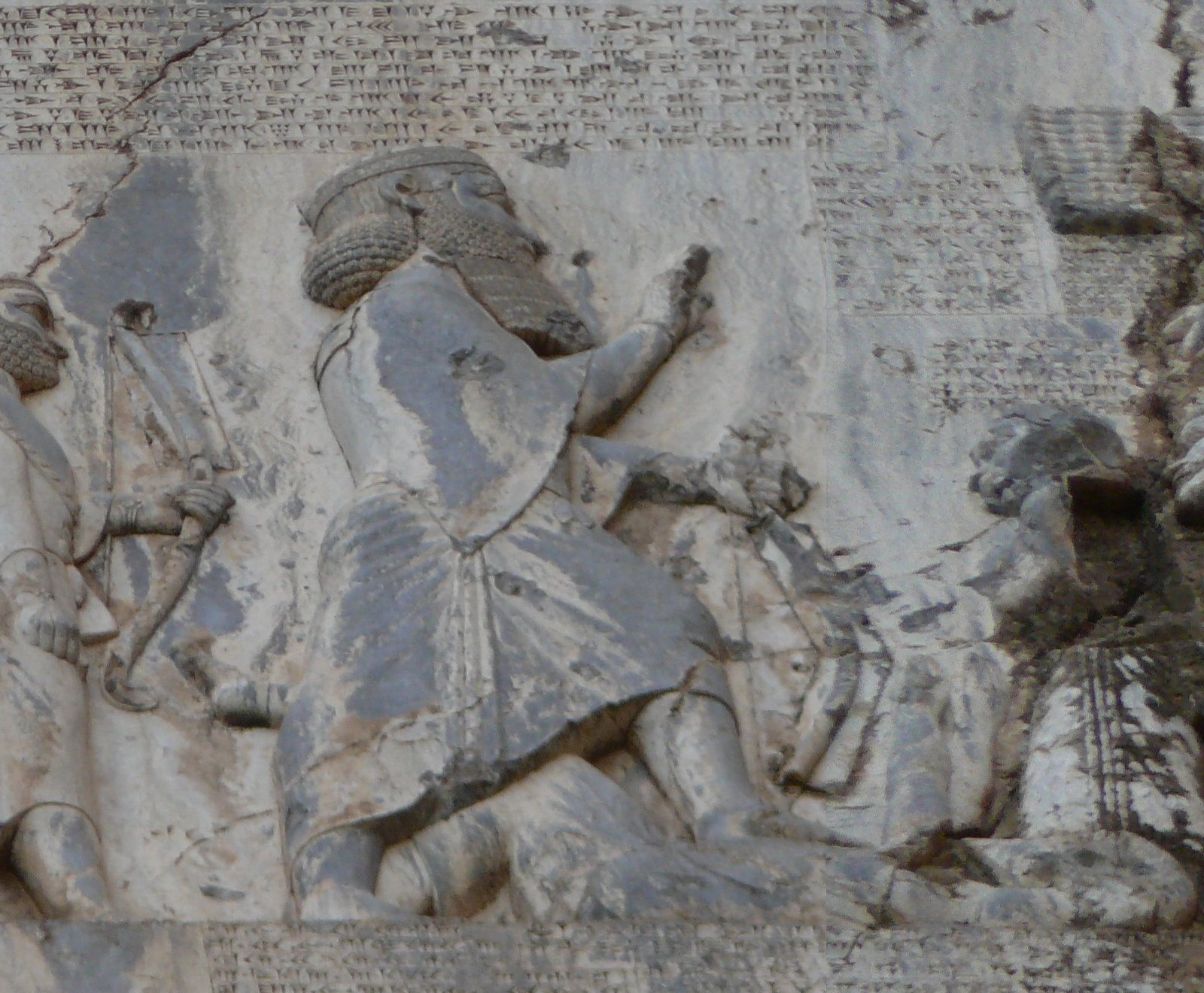
The carving above the text shows the same claim. Darius stands with one foot on a man lying on the ground, and a short label identifies the fallen man as Gaumata. The monument was made between about 520 and 518 BCE. Copies were sent across the empire: fragments of one were found at BabylonBabylonBabylon is an ancient city in central present-day Iraq, south of BaghdadGlossary · Click to read the explanation, and an AramaicAramaicNorthwest Semitic language varieties documented since the early first millennium BCE, including Old and Imperial Aramaic, Syriac, Jewish dialects, and living Neo-Aramaic forms.Glossary · Click to read the explanation translation was still being copied at ElephantineElephantine / YebElephantine / Yeb, near Aswan at the Nile’s First Cataract, preserves a long-lived Egyptian town, temples of Khnum and Satet, and Persian-period garrisons. Aramaic papyri document several communities, including Judeans and Yaho’s temple, whose rebuilding was sought in 407 BCE; claims and archaeological interpretations must be distinguished.Glossary · Click to read the explanation in Egypt around 420 BCE. [5]
The Greek stories
Herodotus, writing about a century later, tells a longer version. After dreaming that his brother sat on the royal throne, Cambyses sent a trusted man, Prexaspes, to kill him in secret. Later two magi, who were brothers, took power. One, Patizeithes, ran the palace. He set his brother, who looked like the dead prince and even had the same name, on the throne. [6]
In Herodotus the false Smerdis reigned for seven months and freed the peoples of the empire from military service and tribute for three years, so that everyone in Asia except the Persians wished him back. A noble named Otanes grew suspicious, and his daughter, one of the royal wives, found that the king had no ears: Cyrus had once cut off a magus's ears as a punishment. Seven nobles then killed both magi, and Darius was chosen king. Herodotus adds that Darius married Parmys, the daughter of the real Smerdis. [6]
Other writers give the impostor other names: Sphendadates in Ctesias, Cometes and Oropastes in the Roman historian Justin. The plot stays the same: a murdered prince, a priest who looks like him, and a secret. [2][3]
Was Darius telling the truth?
Scholars have long been divided into two camps. One accepts Darius's account: a magus really did pretend to be the dead prince. The Greek writers agree with Darius on the secret murder and the impostor, and Herodotus's list of the seven nobles matches his except for one name. [3][4][5]
The other camp thinks Darius covered up his own coup against a lawful king. The American historian A. T. Olmstead argued in 1948 that the man who took power was Cambyses's real brother and heir, and that Darius killed him and invented the false Bardiya. The French historian Pierre Briant notes that Darius had no strong claim to the throne, and that kings who seize power often say they removed an obscure impostor who had broken the laws of gods and men. [2][4]
The Greek accounts may not be independent witnesses: Darius had his version copied across the empire, and some of Herodotus's sentences look like translations of the inscription. The historian M. Rahim Shayegan also argues that the murder of a prince, and his replacement by a look-alike, could hardly have been kept secret. In his view both Bardiya and Gaumata were real people, and Darius's scribes merged them into one illegitimate ruler. [3][5]
The question is still open. The historian Muhammad Dandamayev, writing for the Encyclopaedia Iranica, judged that the theory of an invented Gaumata "must remain hypothetical". [2]
What can be said
Some points are firm. Babylonian scribes dated documents to a king named Barziya for a few months in 522 BCE, so a king of that name was officially recognised. Darius killed that king on 29 September 522 and took the throne. In the year that followed he fought revolts across the empire, including one in Persia led by a man named Vahyazdata who also claimed to be Bardiya, son of Cyrus. [1][4]
What the sources cannot settle is whether the king killed at Sikayauvatish was Cyrus's son or a priest using his name. Even his acts are read in two ways: Darius says Gaumata seized land and herds, Herodotus says he lifted taxes, and Briant suggests that any confiscations targeted nobles who rebelled against him. Every account we have was shaped by the winner, so both readings remain possible. [4][6]
References and notes (6)
- Darius I, Behistun inscription (DB), translated by L. W. King and R. C. Thompson, The Sculptures and Inscription of Darius the Great on the Rock of Behistûn in Persia (London, 1907), as presented with minor changes by Jona Lendering, Livius.org, “Behistun (3)” Columns I §§1–15 (titles, the murder of Smerdis, Gaumata's revolt, the dates 11 March, 1 July and 29 September 522, Sikayauvatish in Nisaya, the restoration in §14); III §§40–41, 45 (Vahyazdata, the second man who claimed to be Smerdis); IV §§52–68 (the nine “liar kings”, the oath of truth, the six helpers). Return to the text ↑
- Muhammad A. Dandamayev, “Bardiya,” Encyclopaedia Iranica III/8 (1988), pp. 785–786 Whole article: the forms of the name in Old Persian, Elamite, Babylonian, Greek and Latin; Tanyoxarkes in Ctesias; the accounts of Darius, Herodotus, Ctesias, Justin and Xenophon; Olmstead's view and the author's judgement that it “must remain hypothetical”; Vahyazdata; Parmys. Return to the text ↑
- M. Rahim Shayegan, Aspects of History and Epic in Ancient Iran: From Gaumāta to Wahnām (Hellenic Studies 52; Washington, DC: Center for Hellenic Studies, 2012), online edition Introduction (the two camps of scholarship and the author's thesis); chapter 1, “The Sources” (Herodotus, Justin, Ctesias, the minor Greek and Latin witnesses); chapter 2, “On the Historical Personae Bardiya and Gaumāta” (the argument that both were historical). Return to the text ↑
- Pierre Briant, “Gaumāta,” Encyclopaedia Iranica X/3 (2000), pp. 333–335 Whole article: the official version and its circulation; DB §14; comparison with Herodotus (the list of the seven, Otanes, the Median link); the Babylonian tablets dated to Barziya as the only certainty; the case for a cover story by Darius; the meaning of kāra-; Bardiya's confiscations as aimed at rebel nobles. Return to the text ↑
- Rüdiger Schmitt, “Bisotun iii. Darius's Inscriptions,” Encyclopaedia Iranica IV/3, pp. 299–305 (online edition 2000, updated 2016) Sections on the date and stages of the monument (520–518 BCE), the arrangement of the texts, the minor label DBb under the figure of Gaumata, the copies found at Babylon and Elephantine, the contents of §§10–14, and the evaluation (correspondences with Herodotus). Return to the text ↑
- Herodotus, The Histories, translated by A. D. Godley (Cambridge, MA: Harvard University Press, 1921), Perseus Digital Library Book 3, chapters 30 and 61–88 (the murder of Smerdis, the two magi Patizeithes and Smerdis, the tax remission, Otanes and Phaedyme, the killing of the magi, the choice of Darius, his marriages including Parmys). Return to the text ↑
Suggest a correction · Suggest a source for this record
Cite this record
IL Archive, «Bardiya and the Behistun Succession», https://ilarchive.com/en/people/bardiya
Continue reading
Related readings