Person
Urshanabi, the Boatman of Gilgamesh
- Names
- Sursunabu · Ur-shanabi · Ur-šanabi
- Region
- Mesopotamia
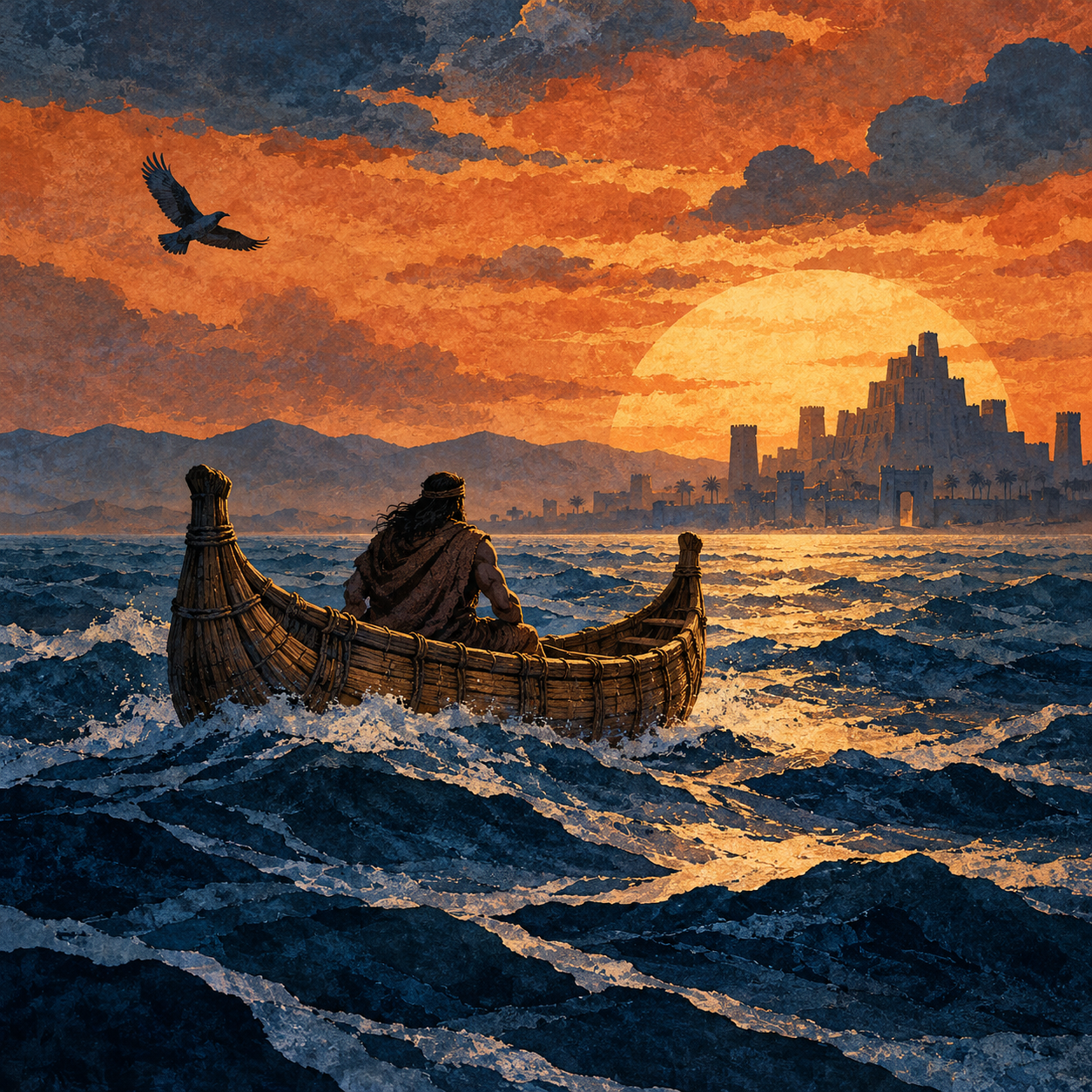
Urshanabi ferries Gilgamesh across the Waters of Death to the flood survivor Utnapishtim. Banished from the ferry, he accompanies Gilgamesh home and hears the king’s last speech at Uruk.
Estimated reading time: 5 min Published Last reviewed:
Share article
Text
Introduction
Urshanabi is the boatman who takes GilgameshGilgameshA king of Uruk in Mesopotamian tradition and the hero of Sumerian poems and a multi-tablet Akkadian epic, with his companion Enkidu, the loss of a friend and the search for life. In standard Tablet XI, Utnapishtim tells him of the flood.Glossary · Click to read the explanation across the Waters of Death to UtnapishtimUtnapishtimThe flood hero of Standard Babylonian Gilgamesh, granted exceptional life with his wife by the gods. He tells Gilgamesh how he survived; his name overlaps with Atrahasis and Ziusudra traditions without making their narratives identical.Glossary · Click to read the explanation, the survivor of the flood. After the crossing he loses his place at the ferry and makes the return journey with the king. His role stretches from the difficult passage in Tablet X of the Standard Babylonian Epic of GilgameshEpic of GilgameshA Babylonian literary work with multiple recensions, preceded by separate Sumerian poems on Uruk’s king and Enkidu. Its standard form explores friendship, death, the flood and the limits of seeking eternal life.Glossary · Click to read the explanation to the moment at the close of Tablet XI when the two men arrive at the wall of UrukUrukAncient city at Warka in southern Iraq, a major urban centre around 3200 BCE that preserved early writing and accounting tablets.Glossary · Click to read the explanation. [1] [2]
At the edge of the sea
Gilgamesh learns about the boatman from the tavern keeper. He wants to know the way to Utnapishtim, whose fate is the exception that has brought him so far from home. The tavern keeper describes the ocean as a route the sun god ShamashShamashMesopotamian god of the sun and justice, shown before Hammurabi on an eighteenth-century BCE stele preserved in the Louvre.Glossary · Click to read the explanation can cross and says that the Waters of Death block the way farther on. She tells him where to look for Urshanabi and the companions that George’s translation calls the Stone Ones. She leaves open whether the boatman will be able to take him. [1]
Gilgamesh approaches armed and attacks. The text is damaged, and some of the actions and the exact relation of the Stone Ones to the craft depend on restoration. Their destruction is central to what follows. Urshanabi tells Gilgamesh that he has deprived himself of the means of crossing by smashing them. The boatman asks about his visitor and hears the account of Enkidu’s death and of the fear that drove Gilgamesh into the wild. The poem gives Urshanabi the chance to hear the answer before he tells the stranger what work will make a crossing possible. [1] [3]
Working the boat
Urshanabi tells Gilgamesh to cut long punting poles in the forest and prepare their ends. George’s translation restores a total of three hundred. Both men crew the boat, and the narrative compresses a journey of a month and a half into three days before they reach the dangerous waters. At that point Urshanabi tells Gilgamesh to take up each pole in turn and warns him to keep his hand out of the water. The text counts through twelve poles before saying that the supply has been used. Its damaged account of what follows describes raised arms serving as a yardarm. [1] [3]
The crossing ends with Utnapishtim looking out at the boat from a distance. He wonders why its Stone Ones are broken and who the unfamiliar person is. The passage confirms that the boat’s arrival is recognizable to him while its crew and condition require explanation. Urshanabi has brought a visitor through a route known to him, and the changes visible on the boat already tell the man on shore that something has happened along the way. [1]
Banishment and return
In Tablet XI Utnapishtim tells the story of the flood and challenges Gilgamesh to stay awake. Gilgamesh falls asleep and fails the test. Utnapishtim turns to Urshanabi, declares that the quay should reject him, and sends him away from the shore he used to walk. He also instructs him to take Gilgamesh to wash. The pelts Gilgamesh has been wearing go into the water, and Gilgamesh receives clothes befitting his rank for the journey home. The last act of service ordered by the boatman’s former master is to prepare the traveler whom he brought there. [1] [2] [3]
When Gilgamesh learns of the rejuvenating plant, the boatman hears his plan to take it home and test it on an old man. A snake steals it while Gilgamesh bathes. Urshanabi is also there to hear Gilgamesh grieve over the loss. At Uruk the king addresses him once more, this time asking him to inspect the city wall, its foundations, and its fired bricks. The surviving words leave the boatman standing at the end of the journey as the person to whom Gilgamesh shows what he has at home. Andrew George describes him in this scene as also standing in for the poem’s reader. The wall and the brickwork featured in the opening of Tablet I, where the poem invited its audience to inspect them. The repetition gives Urshanabi a place in the closing frame even though he only entered the story near the end. [1] [2] [3]
The name on the tablets
Surviving copies preserve several forms of the name. George gives Sursunabu for an Old Babylonian tablet probably from Sippar, and forms close to Urshanabi occur in the Hittite adaptation and later AkkadianAkkadianAn ancient East Semitic language written in cuneiform from the third millennium BCE; its varieties include Babylonian and Assyrian, and it served in international diplomacy.Glossary · Click to read the explanation copies. An ancient bilingual name list equates a form of the name with an Akkadian name meaning man of EaEnkiMesopotamian deity also known as Ea, linked with Eridu and the Abzu (deep fresh waters), wisdom, incantations, and narratives of creation and cosmic order. Later written attestations do not identify the deity of Eridu’s earliest layers.Glossary · Click to read the explanation. Sebastian Fink connects the second element with the fraction two thirds and suggests that it could allude to Gilgamesh, who is described as two thirds divine. These are explanations of the name from textual evidence. The poem consistently gives the man who bears it the practical work of getting Gilgamesh there and back. [2] [4]
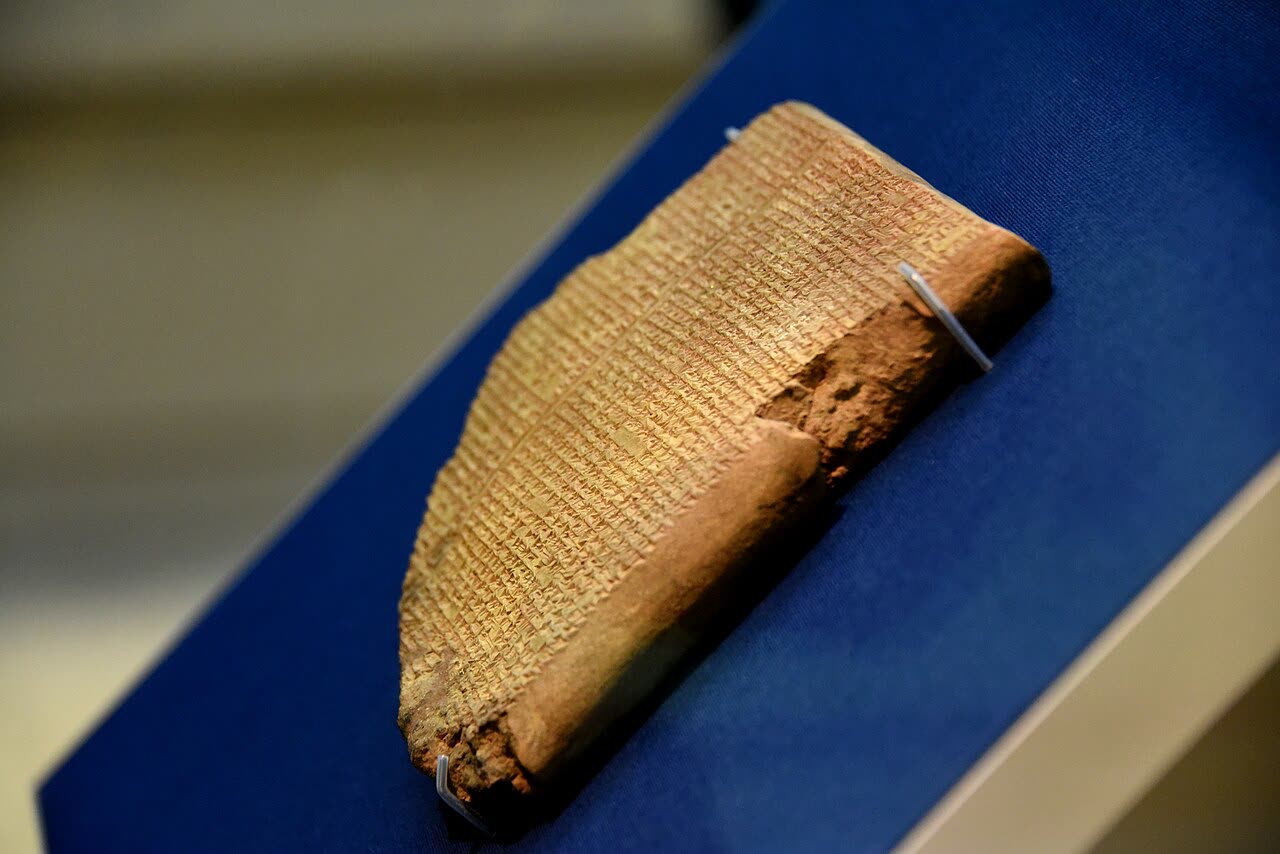
The CuneiformCuneiformWriting with wedge-shaped signs, developed from Mesopotamian recording traditions and used for several languages from the third millennium BCE.Glossary · Click to read the explanation Digital Library Initiative identifies a fragment group in the British Museum, including K.3382 and K.8589, as a Neo-Assyrian witness to Tablet X from NinevehNineveh and KuyunjikNineveh is an ancient Assyrian city near Mosul in northern Iraq; Kuyunjik is one of its archaeological moundsGlossary · Click to read the explanation. The object shown here, K.3375, is a clay fragment of Tablet XI from Kuyunjik, the site of ancient Nineveh. It preserves part of the flood account in the same tablet of the epic in which the boatman is later banished and travels back to Uruk. [5] [6] [1]
References and notes (6)
- Andrew R. George, The Epic of Gilgamesh Standard Babylonian Tablet X, lines 73–204, and Tablet XI, lines 197–328; the crossing, washing, plant, and return Return to the text ↑
- Andrew R. George, Ur-šanabi (Sursunabu) Complete Reallexikon der Assyriologie entry, spellings, role in Tablets X–XI, bilingual name list, and possible interpretations Return to the text ↑
- Andrew R. George, The Epic of Gilgamesh, in The Cambridge Companion to Epic Pp. 9–10, synopses of Tablets X and XI Return to the text ↑
- Sebastian Fink, Gilgameš ja Uršanabi, translated by Vladimir Sazonov and Sirje Kupp-Sazonov Pp. 134–136, Old Babylonian spelling, numeral, and proposal linking the name to Gilgamesh Return to the text ↑
- Cuneiform Digital Library Initiative, P273211, witness to Gilgamesh Epic Tablet X Object identification, Nineveh provenance, and accession numbers of the K.3382 tablet group Return to the text ↑
- Getty Cultural Objects Name Authority, The Flood Tablet Entry 700009476, British Museum K.3375, seventh-century BCE witness to Tablet XI from Kuyunjik Return to the text ↑
Suggest a correction · Suggest a source for this record
Cite this record
IL Archive, «Urshanabi, the Boatman of Gilgamesh», https://ilarchive.com/en/people/urshanabi
Continue reading
Related readings