Period
The Early Dynastic Period in Mesopotamia (c. 2900–2350 BCE)
- Timeline
- From 2900 BCE to 2350 BCE
- Region
- Mesopotamia
In southern Mesopotamia, city-states such as Ur and Lagash competed for power. The royal tombs of Ur and the Stele of the Vultures show how rulers displayed their authority. The dates of the period remain approximate.
Estimated reading time: 6 min Published Last reviewed:
Share article
Text
Introduction
The Early Dynastic period is the name modern scholars give to the centuries after the Jemdet Nasr period and before the empire of Sargon of Akkad. In southern MesopotamiaMesopotamiaHistorical region associated with the Tigris and Euphrates: Uruk, Ur, Eridu, cuneiform, Sumer, Akkad, Babylon and Assyria, their languages and cults, and the limits of archaeological evidence.Glossary · Click to read the explanation it was a time of rival city-states, where temples and the households of rulers both held power. [8][10] The royal tombs of Ur and the earliest royal inscriptions offer different kinds of evidence for these centuries. [15][24]
A name and a scheme
In the 1930s Henri Frankfort and the Diyala excavators distinguished three phases, Early Dynastic I, II and III. Their scheme drew on several sites east of the Tigris. The succession of buildings at the Abu Temple in Tell Asmar gave it its three-part form. [7][8] The Diyala sequence is a local starting point. For sites such as Tell Beydar and Tell Brak, archaeologists use the regional Early Jezirah sequence. [9]
Dates, and why they are loose
The Metropolitan Museum of Art uses about 2900–2350 BCE for the period as a whole. [10] In the south, Camille Lecompte treats the first two phases together, about 2900–2600 BCE. Early Dynastic III is further divided into IIIa and IIIb. The Penn Museum places the royal tombs of Ur in IIIa, about 2600–2500 BCE, and the Louvre assigns the Stele of the Vultures to IIIb. [13][15][18] Maciej Wencel found that the available radiocarbon dates were too sparse to fix the chronology precisely. Walther Sallaberger’s comparison of historical chronologies gives different dates for the beginning of Sargon’s reign, and the transition to AkkadianAkkadianAn ancient East Semitic language written in cuneiform from the third millennium BCE; its varieties include Babylonian and Assyrian, and it served in international diplomacy.Glossary · Click to read the explanation rule is difficult to place exactly in some excavation sequences. [11][9][8]
Cities and canals
Southern cities such as UrukUrukAncient city at Warka in southern Iraq, a major urban centre around 3200 BCE that preserved early writing and accounting tablets.Glossary · Click to read the explanation, Ur, Lagash, Umma, Nippur, Adab, EriduEriduEridu (Abu Shahrain), a multi-mound site in southern Iraq occupied since the Ubaid, later home to a religious precinct associated with Enki. Its eighteen sounding levels are not proof that every early building was a temple.Glossary · Click to read the explanation, Larsa, Kish and Shuruppak stood in a landscape of rivers and canals. SumerianSumerian languageAncient language of southern Mesopotamia, clearly attested in third-millennium BCE texts and maintained in learning and ritual after its spoken use declined.Glossary · Click to read the explanation is attested in writing, and several cities had their own rulers and patron gods. [10][13][19][21] At Shuruppak, a magnetic survey traced part of the city wall on the eastern side of the site. [12]
Other urban centres flourished in the same centuries, among them Mari on the Euphrates, EblaEblaAncient city at Tell Mardikh, southwest of Aleppo, Syria. Its Palace G archives illuminate third-millennium BCE administration, language, and cult; the site has later occupation phases.Glossary · Click to read the explanation in western Syria, and Nagar (Tell Brak) and Tell Beydar in the Upper Khabur region. The archives of Ebla and the tablets from the Jezirah document their own political networks. [9]
Temples and the language of rule
Temples remained important institutions, and palaces attest to the growing visibility of royal authority. These institutions could coexist in the same city. [8][10] Rulers used several titles. In their inscriptions, Entemena calls himself ensi, ruler of Lagash, and Lugal-zage-si calls himself lugal, king of Uruk. [21][26] Thorkild Jacobsen proposed that assemblies had once shared in governing cities. His proposal is a reconstruction from written evidence. [30]
The tombs of Ur
Leonard Woolley directed excavations at Ur from 1922 to 1934. The Penn Museum counts about 1,800 burials in the Royal Cemetery, sixteen of which Woolley classified as royal. It dates those royal tombs to about 2600–2500 BCE. [14][15] Puabi’s tomb was found intact, with a gold headdress and beads of lapis lazuli and carnelian. One of her three seals, a cylinder sealCylinder sealSmall engraved cylinder rolled over soft clay to leave an extended image. Used to secure, document and identify administrative actions; its pictures do not automatically constitute writing.Glossary · Click to read the explanation, gives her name and title. [15] Woolley proposed that attendants in the death pits had taken poison. In 2011 Aubrey Baadsgaard and colleagues used CT imaging to study two skulls and concluded that both people had been killed by blows to the head. The sample was limited to those two individuals. [16] The Standard of Ur, a decorated box from one of these graves, has its own entry on this site (record 1199).
The first royal words
Early writing was used to keep accounts, but its recorded uses broadened. The archaic texts from Ur, from the first part of the Early Dynastic period, include non-administrative documents that show how scribes learned to write. They provide some of the first clear written evidence for Sumerian. [13][29] Royal inscriptions are known from the period, and archives and other groups of tablets have been found at sites including Lagash, Ebla, Ur, Mari, Abu Salabikh and Shuruppak. [9][13][19][24] At Shuruppak, the German expedition of 1902–1903 recovered about a thousand cuneiformCuneiformWriting with wedge-shaped signs, developed from Mesopotamian recording traditions and used for several languages from the third millennium BCE.Glossary · Click to read the explanation tablets according to the modern survey report. The site was extensively occupied from Early Dynastic I through IIIa. [12]
The Sumerian King List names rulers of Kish, Uruk, Ur and other cities. The oldest surviving copy dates to the Third Dynasty of Ur and names King Shulgi in its closing lines. Later versions differ, and the list gives a retrospective account of how kingship passed from city to city. [17] The contemporary written record is sparse in the earlier centuries, so its political history remains fragmentary. [13] This site has an entry on the king list itself (record 1207).
Wars over land
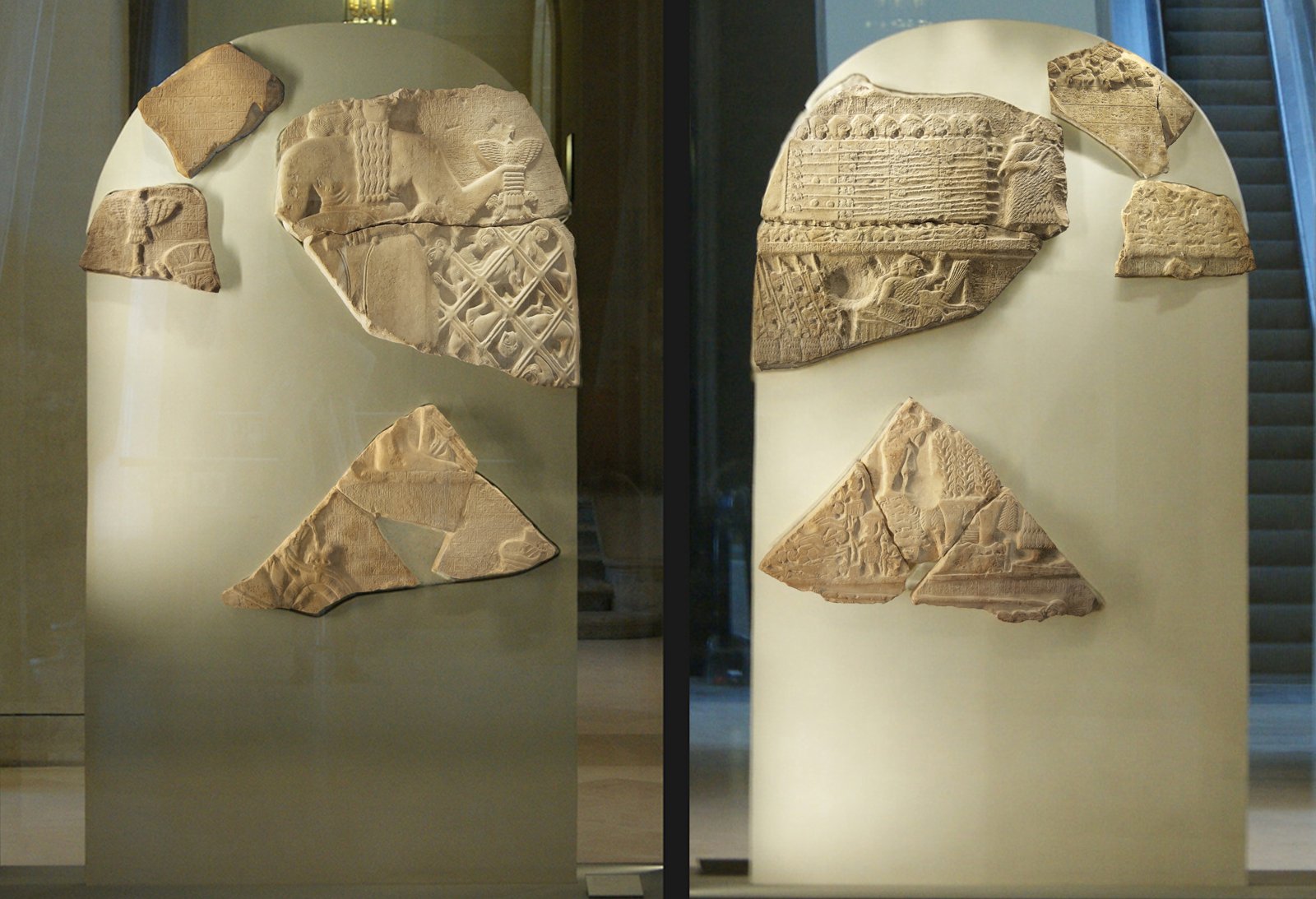
The best-known conflict is between Lagash and its neighbour Umma, over farmland. The Stele of the Vultures commemorates Eannatum of Lagash’s victory. The Louvre dates it to about 2450–2425 BCE and records seven surviving fragments from Girsu, now Tello. [18] The Louvre identifies the figure with a net full of captives as Eannatum. Nies and Keiser’s edition of the Entemena cylinder identifies the figure as the god Ningirsu. On the other face Eannatum appears with his troops, soldiers tread on the fallen, and vultures fly over the scene. [18][31] The Sumerian inscription presents the ruler of Umma swearing oaths. They include a pledge to leave the boundary markers and irrigation works intact and to respect the boundary of Ningirsu’s land. [19]
A clay cone of Entemena in the Louvre (AO 3004, about 2420–2400 BCE in the museum catalogue) retells the dispute from Lagash’s point of view. It says that EnlilEnlilEnlil/Ellil: a major Mesopotamian god associated with destinies, kingship, and Ekur at Nippur, already prominent in third-millennium god lists. His name’s origin and cult beginnings remain debated.Glossary · Click to read the explanation fixed the boundary, that Mesilim, king of Kish, set up a stele, and that Ush, ruler of Umma, pulled it out. [20][21] A separate inscription on clay foundation nails commemorates the building of the E-mush temple in Bad-Tibira and records that Entemena of Lagash and Lugal-kinishe-dudu of Uruk established a bond that the text calls brotherhood. [22]
Kings, legends and the end
The Sumerian poem Gilgamesh and Aga names Enmebaragesi as Aga’s father. Scholars usually identify him with Mebaragesi, named in an Early Dynastic inscription. The poem is a literary witness to the tradition surrounding Gilgamesh. [23][24][25] Near the end of the period, a dedicatory inscription styles Lugal-zage-si king of Uruk and names his father as ruler of Umma. Sargon of Akkad’s inscription claims that he captured Lugal-zage-si and defeated Uruk. [26][27] In Lagash, surviving royal inscriptions describe reforms attributed to Urukagina, including changes in charges and a pledge concerning widows and orphans. [28]
What can be said
The Early Dynastic period has left us walled cities, temples and palaces, elaborate tombs, a wider use of writing and inscriptions in which rulers speak in their own names. The surviving evidence for its first centuries is fragmentary, and stories written down later need to be read alongside the objects and texts from the period itself.
References and notes
- Wikipedia, 'Early Dynastic Period (Mesopotamia)' (secondary summary) First 100,000 of 197,319 characters: dates and subdivisions in middle and short chronology, Frankfort's Diyala scheme, cities, sources, writing, temples, titles, rulers, Jacobsen, Ur trade, debates Return to the text ↑
- Wikipedia, 'Sumer' (secondary summary) First 100,000 of 253,649 characters, the Early Dynastic section: subphase dates, walled cities, priestly to secular rule, Lagash-Umma rivalry, Lugal-zage-si, Sargon, Gilgamesh historicity Return to the text ↑
- Wikipedia, 'Royal Cemetery at Ur' (secondary summary) First 100,000 of 104,905 characters: Woolley's excavation 1922-34, number of graves, Puabi, great death pit, interpretation of the deaths, Baadsgaard 2011, carnelian Return to the text ↑
- Wikipedia, 'Shuruppak' (secondary summary) Page read: location, 1902-1903 and later excavations, tablet counts, ration texts, city size in ED II and ED III Return to the text ↑
- Wikipedia, 'Stele of the Vultures' (secondary summary) Page read: Louvre numbers, discovery by de Sarzec at Tello, seven fragments, size, two sides, inscription, oath of Umma, earliest victory monument Return to the text ↑
- Wikipedia, 'Entemena' (secondary summary) Page read: reign, Lagash-Umma boundary story on the cone (Louvre AO 3004), alliance clay nail with Lugal-kinishe-dudu; the article itself is inconsistent on who started the conflict Return to the text ↑
- Henri Frankfort, Progress of the Work of the Oriental Institute in Iraq, 1934/35: Fifth Preliminary Report of the Iraq Expedition. Oriental Institute Communications 20. Chicago: University of Chicago Press, 1936. Chapter I, subdivisions at pp. 35–59, and the chronological table at the end, especially Tell Asmar and Khafaje. Return to the text ↑
- Jean M. Evans, “A Reconsideration of the So-Called Single-Shrine Temple at Tell Asmar.” In Mark Altaweel and Carrie Hritz, eds., From Sherds to Landscapes: Studies on the Ancient Near East in Honor of McGuire Gibson. SAOC 71. Chicago: Oriental Institute, 2021. Pp. 92–93 and 96–98, including Frankfort’s basis for the tripartite scheme, the comparison with the palace levels and the limits of the archaeological transition. Return to the text ↑
- Walther Sallaberger, “History and Philology.” In Marc Lebeau, ed., Jezirah, ARCANE I. Turnhout: Brepols, 2011. Sections 12.1–12.2, table 3 (different proposed dates for Sargon), and the texts from Beydar and Brak. Return to the text ↑
- Metropolitan Museum of Art, “Mesopotamia, 8000–2000 B.C.” Heilbrunn Timeline of Art History. Timeline and the Early Dynastic section, with city-state rivalry, palaces and long-distance trade. Return to the text ↑
- Maciej Mateusz Wencel, “Radiocarbon Dating of Early Dynastic Mesopotamia: Results, Limitations, and Prospects.” Radiocarbon 59, no. 2 (2017), 635–645. Publisher’s abstract, including the limits of the available series of radiocarbon dates. Return to the text ↑
- Sandra E. Hahn, Jörg W. E. Fassbinder, Adelheid Otto, Berthold Einwag and Abbas Ali Al-Hussainy, “Revisiting Fara: Comparison of Merged Prospection Results of Diverse Magnetometers with the Earliest Excavations in Ancient Šuruppak from 120 Years Ago.” Archaeological Prospection 29, no. 4 (2022), 623–635. Introduction, earlier excavations, occupation through Early Dynastic IIIa and the eastern city wall in the survey results. Return to the text ↑
- Camille Lecompte, “The Significance of the ED I–II Texts from Ur for the Beginning of the Third Millennium BC.” In J. Nicholas Postgate and David C. Thomas, eds., Ur 1922–2022: Papers Marking the Centenary of Sir Leonard Woolley’s First Season of Excavations at Ur. London: British Institute for the Study of Iraq, 2024. Pp. 95–97 and conclusion with table 6: dates, early evidence for written Sumerian and limits of the corpus. Return to the text ↑
- Penn Museum Archives, “Ur Expedition Records.” Biographical and historical note on the joint expedition, 1922–1934. Return to the text ↑
- Penn Museum, “Queen Puabi’s Headdress.” Tomb, three cylinder seals, burial count, Woolley’s sixteen royal tombs and their dating. Return to the text ↑
- Aubrey Baadsgaard, Janet Monge, Samantha Cox and Richard L. Zettler, “Human Sacrifice and Intentional Corpse Preservation in the Royal Cemetery of Ur.” Antiquity 85, no. 327 (2011), 27–42. Publisher’s extract, describing the two skulls examined by CT and the authors’ interpretation. Return to the text ↑
- Piotr Michalowski, “The Mortal Kings of Ur: A Short Century of Divine Rule in Ancient Mesopotamia.” In Nicole Brisch, ed., Religion and Power: Divine Kingship in the Ancient World and Beyond, 33–45. Chicago: Oriental Institute, 2008. P. 38, on the Ur III exemplar, its terminal reign and the subscript naming Shulgi (open PDF under Download PDF on the publication page). Return to the text ↑
- Musée du Louvre, “Stèle des vautours,” AO 50 and associated fragments. Description of both faces, inventory of seven fragments, find history at Girsu and catalogue date ca. 2450–2425 BCE. Return to the text ↑
- Cuneiform Digital Library Initiative, “RIME 1.09.03.01 (Vulture Stele) composite,” P431075. Text and translation, especially lines 390′–422′ on the oaths, and the witness from Girsu. Return to the text ↑
- Musée du Louvre, “Cone A d’Enmetena,” AO 3004. Object description, Girsu findspot and catalogue date ca. 2420–2400 BCE. Return to the text ↑
- Cuneiform Digital Library Initiative, “RIME 1.09.05.01 composite,” P431117 (Enmetena’s boundary inscription). Text and translation, lines 1–21 on the boundary and lines 32–41 on the titles of Eannatum, Enmetena and Enakale. Return to the text ↑
- Deena Ragavan, “Cuneiform Texts and Fragments in the Harvard Art Museum / Arthur M. Sackler Museum.” Cuneiform Digital Library Journal 2010:1. Section 3.1, foundation nail 2000.274, and especially §3.1.2 on the E-mush and the final seven lines of RIME 1.09.05.03. Return to the text ↑
- Maciej Mateusz Wencel, Towards an Absolute Chronology of Early Mesopotamia: A Radiocarbon Perspective. DPhil thesis, University of Oxford. P. 162, n. 109, on the proposed identification of Enmebaragesi with Mebaragesi. Return to the text ↑
- Cuneiform Digital Library Initiative, “RIME 1.07.22.01 composite,” P431026. Catalogue and witnesses for the early inscription referenced in [23]. Return to the text ↑
- Electronic Text Corpus of Sumerian Literature, University of Oxford, “Gilgameš and Aga,” composition 1.8.1.1. Translation, lines 1–4 and 48–54, naming Enmebaragesi as Aga’s father. Return to the text ↑
- Cuneiform Digital Library Initiative, “RIME 1.14.20.01 composite,” P431232 (inscription of Lugalzagesi). Text and translation, lines 1–12, on Lugalzagesi’s title and his father’s position in Umma. Return to the text ↑
- Cuneiform Digital Library Initiative, “Text of RIME 2.01.01.01 composite,” P461926 (Sargon). Text and translation, lines 12–30, on Uruk’s defeat and Lugalzagesi’s capture. Return to the text ↑
- Cuneiform Digital Library Initiative, “Text of RIME 1.09.09.01 (Reforms of Urukagina) composite.” Text and translation, especially the charges around burials and lines 313–319 on the undertaking regarding widows and orphans. Return to the text ↑
- Camille Lecompte and Giacomo Benati, “Nonadministrative Documents from Archaic Ur and from Early Dynastic I–II Mesopotamia: A New Textual and Archaeological Analysis.” Journal of Cuneiform Studies 69 (2017), 3–31. Publisher’s abstract, describing the non-administrative texts and their bearing on scribal training. Return to the text ↑
- Thorkild Jacobsen, “Early Political Development in Mesopotamia.” Zeitschrift für Assyriologie 52 (1957), 91–140. Passage from pp. 136–137 reproduced in the Yale Human Relations Area Files record, where Jacobsen summarises his hypothesis about assemblies. Return to the text ↑
- James B. Nies and Clarence E. Keiser, Historical, Religious and Economic Texts and Antiquities. Babylonian Inscriptions in the Collection of James B. Nies II. New Haven: Yale University Press, 1920. P. 2, discussion of the Net-Cylinder of Entemena and identification of Ningirsu on the Stele of the Vultures. Return to the text ↑
Suggest a correction · Suggest a source for this record
Cite this record
IL Archive, «The Early Dynastic Period in Mesopotamia (c. 2900–2350 BCE)», https://ilarchive.com/en/periods/early-dynastic-period-mesopotamia