Period
The Uruk Period (c. 4000–3100 BCE)
- Timeline
- From 4000 BCE to 3100 BCE
- Region
- Mesopotamia
The age of southern Mesopotamia’s first large cities, centred on Uruk. Mass-produced bowls, seals, clay accounting tokens and some of the earliest writing survive; its dates and the reach of its influence remain debated.
Estimated reading time: 5 min Published Last reviewed:
Share article
Text
Introduction
The UrukUrukAncient city at Warka in southern Iraq, a major urban centre around 3200 BCE that preserved early writing and accounting tablets.Glossary · Click to read the explanation period is the part of the fourth millennium BCE in which UrukUrukAncient city at Warka in southern Iraq, a major urban centre around 3200 BCE that preserved early writing and accounting tablets.Glossary · Click to read the explanation grew into one of the largest cities of its time. Some of the earliest known clay tablets with writing come from this city in southern MesopotamiaMesopotamiaHistorical region associated with the Tigris and Euphrates: Uruk, Ur, Eridu, cuneiform, Sumer, Akkad, Babylon and Assyria, their languages and cults, and the limits of archaeological evidence.Glossary · Click to read the explanation. [8][10] This entry gives the usual dates and says why they are uncertain, names the main sites, and sets out what the sources show and where they stop.
Dates, and why they are loose
The period takes its name from Uruk, now Warka, where German excavators numbered the construction levels in the Eanna precinctEanna at UrukAn archaeological precinct and institutional centre at Uruk associated with Inanna; its name does not fix every early building’s function.Glossary · Click to read the explanation. The local sequence helps order the finds. At the Red Temple, however, rebuilding and levelling mixed tablets discarded at different times, complicating the link between a tablet’s script and the layer where it was found. [9][10]
The dates in this entry follow the broad convention of about 4000–3100 BCE. In the scheme described by Helga Vogel, the early and late phases correspond to Eanna levels XIII–IX and VIII–IV respectively. [21] Sallaberger and Schrakamp give a separate working chronology for the script, with Uruk IVa about 3500–3250 BCE and Uruk III about 3250–3000 BCE in their comparison of Uruk and Susa. [10] The period follows the Ubaid cultureUbaid cultureAn archaeological designation for material traditions associated with southern Mesopotamia and its regional connections. The broad southern sequence spans c. 6500–3800 BCE, with regional variation; the label alone identifies neither a people nor a language.Glossary · Click to read the explanation and precedes the Jemdet Nasr and Early Dynastic periods in the broad convention used here. [8][21]
Uruk, a major early city
Late Uruk pottery from a surface survey covered at least 250 hectares. Hans J. Nissen estimated 20,000–40,000 inhabitants around 3200 BCE, assuming 100–200 residents per inhabited hectare and setting aside about 50 hectares for streets and public areas. [9] The Anu precinct had the White Temple on its high platform. Eanna contained monumental buildings such as the one excavators call Temple D. The functions of some of these buildings are debated. [9][12] Later sources identify Eanna as the sanctuary of the goddess InannaInanna / IshtarA prominent Mesopotamian goddess whose Sumerian name Inanna became associated with Akkadian Ishtar across diverse traditions. She was associated with desire, war, royal authority and Venus, while local forms and genealogies varied among texts.Glossary · Click to read the explanation. [22]
The survey of Tell Brak in northeastern Syria traces a different path to early urban growth. In the late fifth and early fourth millennia BCE, separate areas of settlement gradually grew together into a city of about 130 hectares. [11]
Tools of the new administration
Several inventions of this age belong to one habit: keeping track of goods.
- Tokens and sealed clay envelopes. Small clay tokensClay tokensSmall shaped clay objects from West Asia since the Neolithic; some served counting or recording, but there is no evidence of one universal accounting function for all.Glossary · Click to read the explanation helped track quantities of goods. Hollow clay envelopes, called bullae, sometimes enclosed tokens and carried seal impressions. Both are attested before the earliest proto-cuneiformProto-cuneiformEarly southern Mesopotamian script (c. 3350–3000 BCE): clay tablets with counting systems and signs for commodities, people and offices, as well as lexical lists; not yet a full rendering of speech.Glossary · Click to read the explanation tablets. [10][23]
- Cylinder sealsCylinder sealSmall engraved cylinder rolled over soft clay to leave an extended image. Used to secure, document and identify administrative actions; its pictures do not automatically constitute writing.Glossary · Click to read the explanation. A cylinder sealCylinder sealSmall engraved cylinder rolled over soft clay to leave an extended image. Used to secure, document and identify administrative actions; its pictures do not automatically constitute writing.Glossary · Click to read the explanation is a small stone roller. Rolled over wet clay it leaves a repeating picture. On one archaic barley tablet in the Metropolitan Museum, a seal impression shows a man with hunting dogs and boars. The museum identifies him as the figure conventionally called the priest-king. [24][20]
- Bevelled-rim bowls. These plain, mass-produced bowls occur at sites from southern Mesopotamia to the highlands of eastern AnatoliaAnatoliaAnatolia is the region occupying the Asian part of present-day TurkeyGlossary · Click to read the explanation and IranIranIran is the modern country containing Shush, ancient SusaGlossary · Click to read the explanation. Proposed uses include serving cereal rations and baking bread. Analyses of ten bowls from Shakhi Kora in northeastern IraqIraqIraq is a modern country encompassing much of ancient MesopotamiaGlossary · Click to read the explanation found evidence of foods containing meat and possibly dairy, suggesting a wider range of uses at that site. [13]
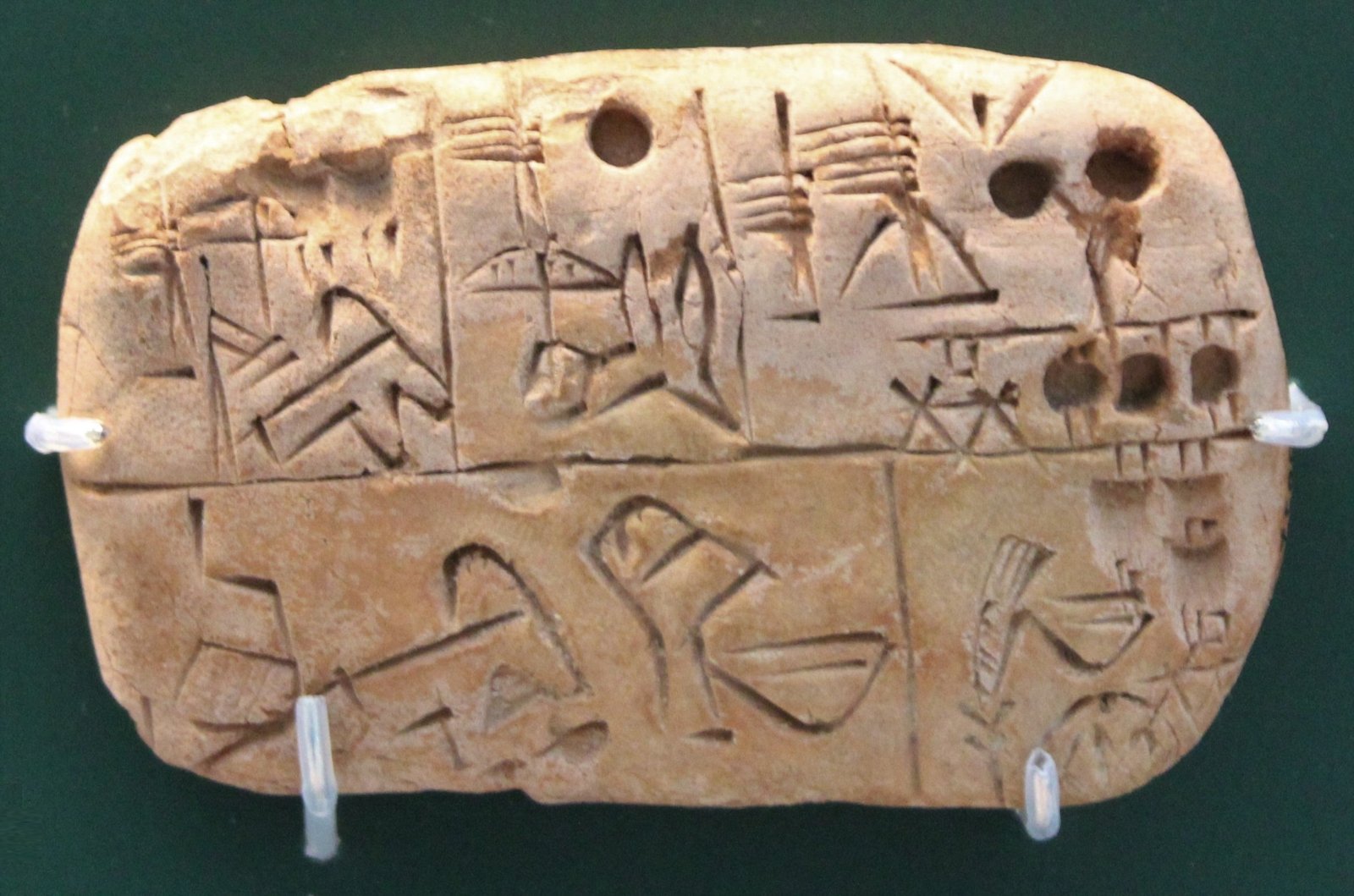
- The first writing. The earliest tablets in proto-cuneiformProto-cuneiformEarly southern Mesopotamian script (c. 3350–3000 BCE): clay tablets with counting systems and signs for commodities, people and offices, as well as lexical lists; not yet a full rendering of speech.Glossary · Click to read the explanation come from the latter part of the fourth millennium BCE. Uruk supplied the largest group. In Robert Englund’s 1998 count of 5,820 archaic texts from several sites and collections, about 85 percent were administrative accounts and 11 percent were lists of words or school exercises. Later publications added further texts to the corpus. [10]
The tablet on the cover, BM 140852, records food supplies. The British Museum identifies a human head next to a triangular sign for bread, a combination typical of ration texts, and distinguishes three types of numerical sign. It dates the tablet to about 3300–3100 BCE. [14] The CuneiformCuneiformWriting with wedge-shaped signs, developed from Mesopotamian recording traditions and used for several languages from the third millennium BCE.Glossary · Click to read the explanation Digital Library Initiative classifies the same tablet as Uruk III, about 3200–3000 BCE in its catalogue. [15]
Many signs can be identified because they are ancestors of later cuneiformCuneiformWriting with wedge-shaped signs, developed from Mesopotamian recording traditions and used for several languages from the third millennium BCE.Glossary · Click to read the explanation signs. Many others remain uncertain. Sumerian is a common proposal for the language behind the tablets. The script often records goods and quantities with little indication of how people put words together, so identifying the language remains difficult. [10][19]
The Uruk "expansion"
In the later fourth millennium BCE, Uruk-style pottery, seals and buildings appear far from southern Mesopotamia. At Habuba Kabira-South on the Euphrates in Syria, excavators documented a fortified town that may have covered up to 18 hectares. The main wall was about three metres thick. Streets had drainage channels and appear to have been paved with gravel and pebbles. Finds included clay tokens and sealings. [17][23] Evidence for contact with the south also comes from Jebel Aruda in Syria, Godin Tepe in the Zagros and Hacınebi in Anatolia. [10][18]
How to read this is debated. Guillermo Algaze interpreted southern-style settlements outside Mesopotamia’s alluvial plain as trading colonies. Excavations also show a range of responses by local communities. At Shakhi Kora in the upper Diyala region, a building with mainly southern-style material followed earlier public buildings with mainly local material. [16] At Hamoukar, the excavators interpreted a burned layer dated to about 3500 BCE as evidence of warfare. The identity of the attackers remains uncertain. [25]
Ending and what followed
Several settlements with Uruk-style material were abandoned near the end of the fourth millennium BCE, while Uruk itself continued to grow. [8][16] At Shakhi Kora, the excavators judge that the abandonment of the pillared complex preceded the climatic event around 5,200 years ago. They explain the changes in the lower Sirwan valley in terms of local communities withdrawing from centralised institutions. [16] In southern Mesopotamia, the Jemdet Nasr phase marks the transition to the Early Dynastic period, which begins around 2900 BCE in the Metropolitan Museum’s chronology. [8][21]
The Uruk period left monumental buildings and thousands of tablets, most of them administrative. The buildings and objects give clues about institutions and ritualRitualAn organised or distinguished practice meaningful to a community; it may leave traces, but its form alone does not reveal an associated doctrine.Glossary · Click to read the explanation. The early texts make some kinds of accounting visible, and many personal names, religious identifications and readings remain uncertain. [9][10]
References and notes
- Wikipedia, 'Uruk period' (secondary summary; cites Algaze, Butterlin, Liverani, Englund, Nissen, Santa Fe chronology 2001) Read first 100,000 of 228,571 characters: dates and sub-phases, chronology problems, main sites, Uruk expansion debate, Eanna/Anu buildings, population, end of period Return to the text ↑
- Web search summary of radiocarbon-based chronologies of Mesopotamia (Oxford University Research Archive thesis; Radiocarbon 2016 supplement), search-result snippet only Only snippets seen: Middle Uruk c. 3750–3500, Late Uruk c. 3500–3250 BCE; the full works were not read Return to the text ↑
- Wikipedia, 'Eanna' (secondary summary) Page read: meaning 'House of Heaven', residence of Inanna, dating, later cult Return to the text ↑
- Wikipedia, 'Uruk period' (secondary summary), second part Characters 100,000–200,000 of 228,571: state formation, priest-king imagery, tokens, bullae, cylinder seals, proto-cuneiform counts, contested points Return to the text ↑
- Wikipedia, 'Bevelled rim bowl' (secondary summary; cites Nissen 1988, Millard 1988, Potts, Goulder 2010) Page read: description, sizes, dates, distribution, interpretations Return to the text ↑
- Wikipedia, 'Proto-cuneiform' (secondary summary; cites Englund 2015, Nissen 2016, Damerow 2006); photo description from Wikimedia Commons, file BM 140852 First 100,000 of 167,696 characters: dates, tablet counts, content, numerals, decipherment status; Commons file description for BM 140852 (MSVO 3,70) Return to the text ↑
- Wikipedia, 'Habuba Kabira' (secondary summary) Page read: location, excavation 1969–1975, size, wall, finds, occupation length, Jebel Aruda Return to the text ↑
- Department of Ancient Near Eastern Art, “Uruk: The First City,” Heilbrunn Timeline of Art History, Metropolitan Museum of Art, October 2003. Opening three paragraphs, on Uruk’s size around 3200 BCE, monumental buildings, administrative writing, the contraction of Uruk influence and the Early Dynastic dates. Return to the text ↑
- Hans J. Nissen, “Uruk: Key Site of the Period and Key Site of the Problem,” in J. N. Postgate, ed., Artefacts of Complexity: Tracking the Uruk in the Near East (British School of Archaeology in Iraq, 2002). Figs. 1–4 on excavation and the Eanna levels, p. 7 on area and population assumptions, and the discussion of how large public buildings have been interpreted. Return to the text ↑
- Walther Sallaberger and Ingo Schrakamp, “Philological Data for a Historical Chronology of Mesopotamia in the 3rd Millennium,” in History & Philology, ARCANE III (Turnhout: Brepols, 2015). §§4.1–4.2, pp. 53–55, including table 16 on Uruk and Susa, on the sample used for the genre counts, the Eanna contexts, and the writing phases. Return to the text ↑
- Jason A. Ur, Philip Karsgaard and Joan Oates, “The Spatial Dimensions of Early Mesopotamian Urbanism: The Tell Brak Suburban Survey, 2003–2006,” Iraq 73 (2011), pp. 1–19. Open abstract, on the survey’s 130-hectare estimate and the gradual coalescence of separate settlement zones in the late fifth and early fourth millennia BCE. Return to the text ↑
- ZRS Ingenieure, “Emergency Conservation of the White Temple in Uruk – South Iraq.” Project account of the surviving White Temple on the Anu platform and the conservation project led by the German Archaeological Institute. Return to the text ↑
- Elsa Perruchini, Claudia Glatz, Synnøve Gravdal Heimvik, Robin Bendrey, Mette Marie Hald, Francesco Del Bravo, Salh Mohammed Sameen and Jaime Toney, “Revealing Invisible Stews: New Results of Organic Residue Analyses of Beveled Rim Bowls from the Late Chalcolithic Site of Shakhi Kora, Kurdistan Region of Iraq,” Journal of Archaeological Science: Reports 48 (2023), 103730. Abstract and bibliographic record, on distribution, the ten sampled bowls, earlier interpretations, and meat and possible dairy residues at the site. Return to the text ↑
- British Museum, “Tablet,” museum number BM 140852, registration 1989,0130.1. Description, production date, inscription note and curator’s comments, including the triangular bread sign and three types of numerical symbol. Return to the text ↑
- Cuneiform Digital Library Initiative, “MSVO 3, 70 (P005381),” BM 140852. Chronology, genre and transliteration fields. The detailed Provenance field marks the attribution to Warka as uncertain. Return to the text ↑
- Claudia Glatz et al., “There and Back Again: Local Institutions, an Uruk Expansion and the Rejection of Centralisation in the Sirwan/Upper Diyala Region,” Antiquity 99, no. 403 (2025), pp. 48–63. ‘Early complex societies in Greater Mesopotamia’, ‘Against centralisation’ and ‘Discussion’, on the trade-colony hypothesis, the succession of buildings and material at Shakhi Kora, and locally divergent settlement trajectories. Return to the text ↑
- Deutsche Orient-Gesellschaft, “Habuba Kabira. Ein Handelszentrum am mittleren Euphrat: Stadtmauer, Straßen, Häuser.” ‘Die Stadtmauer’ and ‘Straßen, Kanäle und Bautechnik’, on the possible 18 hectares, the main wall and evidence for street paving and drainage. Return to the text ↑
- Gil J. Stein et al., “Uruk Colonies and Anatolian Communities: An Interim Report on the 1992–1993 Excavations at Hacinebi, Turkey,” American Journal of Archaeology 100, no. 2 (1996). Open abstract, on the sequence of contact at Hacınebi and the larger settlements at Habuba Kabira-South and Jebel Aruda. Return to the text ↑
- Ira Spar, “The Origins of Writing,” Heilbrunn Timeline of Art History, Metropolitan Museum of Art, October 2004. Discussion of the composition and reading of the earliest writing corpus, including the proposed identification of its language as Sumerian. Return to the text ↑
- Metropolitan Museum of Art, “Proto-Cuneiform tablet with seal impressions: administrative account of barley distribution with cylinder seal impression of a male figure, hunting dogs, and boars,” 1988.433.1. Object description and date, including the figure referred to as the priest-king in modern scholarship. Return to the text ↑
- Helga Vogel, Wie man Macht macht: Eine macht- und genderkritische Untersuchung der frühesten Repräsentationen von Staatlichkeit (Freie Universität Berlin, 2009). Part I, §1.1.1 and n. 12, on the Eanna levels, the 4000–3100 BCE working range and the Jemdet Nasr sequence. Return to the text ↑
- Wiebke Meinhold, “Zum Verhältnis von Inana/Ištar und Nanāja in Uruk,” in Margarete van Ess, ed., Uruk – altorientalische Metropole und Kulturzentrum (Wiesbaden, 2021), pp. 285–295. Pp. 285–286, on Inanna’s place in the later sources for the Eanna sanctuary. Return to the text ↑
- Deutsche Orient-Gesellschaft, “Habuba Kabira. Ein Handelszentrum am mittleren Euphrat: Verwaltungs- und Kultzentrum.” Small finds discussion, including tokens, hollow clay envelopes containing tokens and sealings. Return to the text ↑
- Metropolitan Museum of Art, “Cylinder seal and modern impression: ritual scene before a temple facade,” 1983.314.1. Object description and interpretation, on how cylinder seals were used to impress clay. Return to the text ↑
- Clemens D. Reichel, “Hamoukar,” Oriental Institute, University of Chicago, 2005–2006 Annual Report, pp. 65–77. Pp. 70, 72–74 and fig. 17, on the radiocarbon dating of the destruction in Area B and the excavators’ interpretation. Return to the text ↑
Suggest a correction · Suggest a source for this record
Cite this record
IL Archive, «The Uruk Period (c. 4000–3100 BCE)», https://ilarchive.com/en/periods/uruk-period