Artifact
The Lachish Letters: Potsherd Messages from the Last Years of Judah
An object record bringing together its image, metadata, rights, and context.
- Timeline
- From 590 BCE to 586 BCE
- Region
- The Levant
Twenty-one inked potsherds found at Lachish in the 1930s give a rare first-hand glimpse of a Judean fortress shortly before the Babylonian conquest of about 588–586 BCE. How much they really tell us is still debated.
Estimated reading time: 6 min Published Last reviewed:
Share article
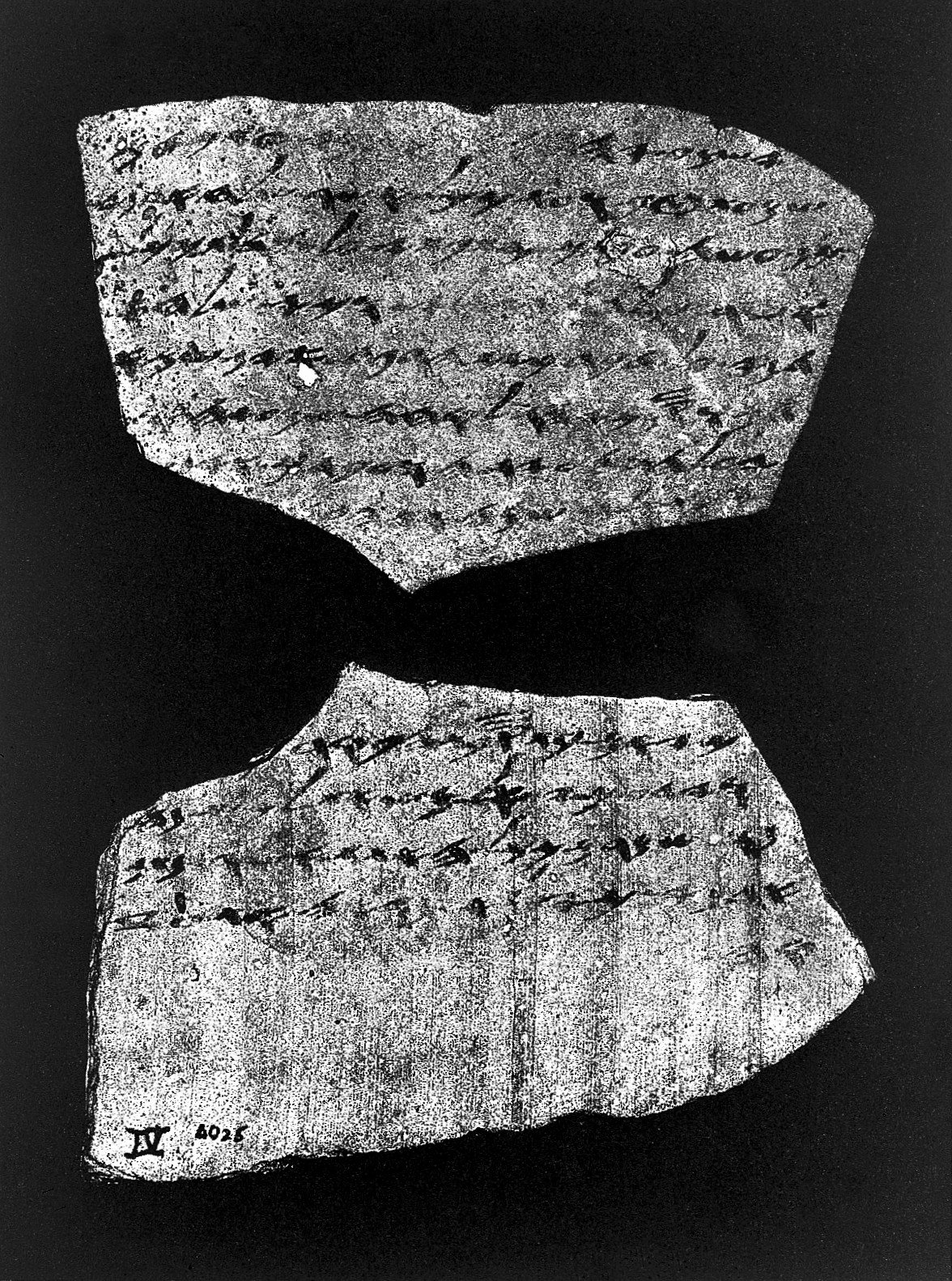
Photograph
Photo: Wellcome Collection (Lachish, Tell ed Duweir, Letter 4), CC BY 4.0, via Wikimedia Commons
Lachish Letter 4 (Lachish ostracon IV): ink on a potsherd, shown front and back. It is the letter that says "we cannot see Azekah". Excavated at Tell ed-Duweir in 1935; Level II, shortly before 588/6 BCE
License · Image sourceObject details
- Title
- The Lachish Letters: Potsherd Messages from the Last Years of Judah
- Timeline
- From 590 BCE to 586 BCE
- Region
- The Levant
- Rights
- CC BY
Text
Introduction
In 1935 and 1938 the British excavators of Lachish, a fortified city south-west of JerusalemJerusalemJerusalem is a city of religious importance in Judaism, Christianity and IslamGlossary · Click to read the explanation, found a small group of broken pots with writing in ink on them. Known as the Lachish Letters, they are short notes in HebrewHebrewA Northwest Semitic language of the Canaanite group, encompassing Iron Age epigraphy, Biblical, Rabbinic, medieval and Modern Hebrew; its scripts and pronunciations changed over time.Glossary · Click to read the explanation written by soldiers and officials in the years before Lachish was burnt by the Babylonians. They are not royal chronicles or scripture, only everyday correspondence, which is exactly why they matter: they show how people in the Kingdom of JudahKingdom of JudahJudah was an ancient southern Levantine kingdom centered on Jerusalem in the Iron AgeGlossary · Click to read the explanation wrote to each other as their world was about to end. They also invite over-reading, and scholars have spent eighty years separating what the sherds say from what readers would like them to say. [1][2]
The objects
An ostracon (plural ostraca) is a piece of broken pottery used as scrap paper. The Lachish ostraca are 21 inscribed sherds from the site now called Tell ed-Duweir, which most scholars identify with ancient Lachish. They were found by the Wellcome-Marston expedition led by James Leslie Starkey, and the first group was published by Harry Torczyner in 1938. [1][3] Sixteen of them (Letters 1–15 and 18) came from one small room beside the outer city gate, which the excavators called the "guardroom". They lay in a layer of ash and burnt debris from the last phase of the city, called Level II. Starkey noted that they were only a few among hundreds of jar fragments in that room, and that many more written sherds may have been lost in the fire. [1]
The writing is in ink, in the cursive form of the old Hebrew script. The scribe of Letter 3 seems to have used a soft brush or a rush pen, and the ink survives best on the smooth, burnished parts of the pot, while on rough surfaces most of it has faded. [1] Because of this, only a handful of the ostraca can be read at length. The letters that can be read in part are Letters 2 to 6, with fragments of 8 and 9; the rest are mostly lists of personal names or too faded to read. The three longest legible letters, 3, 4 and 6, are now kept in Jerusalem (Israel Antiquities Authority numbers 1938.127, 1938.128 and 1938.129), while many of the others are in the British Museum. [1]
What the letters say
Most of the readable letters are addressed to a man named Yaush (Ya'osh), who is usually taken to be the commander at Lachish. They follow a polite pattern: the writer calls himself "your servant" and wishes his lord good news and peace. [1][2]
- Letter 3, the longest (21 lines), is the only one where the sender gives his name: Hoshaiah ("YahwehYahwehThe proper name of Israel’s deity, written יהוה (YHWH), the Tetragrammaton. Its exact ancient pronunciation is not directly preserved; texts and inscriptions witness its history.Glossary · Click to read the explanation has saved"). He says he is "sick at heart" because his superior seems to have reproached him, and scholars still argue about why. One reading is that he was accused of not being able to read a letter; an older reading is that he had looked at letters he should not have seen. The same letter reports that Coniah son of Elnathan, the army commander, has gone down to Egypt, and mentions a letter of a "servant of the king" and a warning, "Beware!", associated with "the prophet". [1][2]
- Letter 4 is the famous one. The writer says that he and his men are watching for the fire-signals of Lachish, following the signs his lord gave, "for we cannot see Azekah". It also mentions a place called Bet-harapid, which is apparently empty. [1]
- Letter 6 begins with a wish that Yahweh show "my lord" peace "at this time". The writer says the words of the letters he has read, most likely the officers' words, are "not good", and speaks of weakening hands; the end of the letter is badly damaged, and he asks Yaush to write. [1][2]
Notice how little of this is dramatic. The letters mention supplies, messengers, men sent to other posts and a delicate question of who read what. Another ink-written jar label from the same destruction layer carries the date "the ninth year", which many scholars take to mean the ninth year of King ZedekiahZedekiah, king of JudahEarly-sixth-century BCE king of Judah associated in Jeremiah 34 with a release covenant and its reversal.Glossary · Click to read the explanation (that is about 589–588 BCE), though the label itself does not name the king. [1]
The connection with Jeremiah
The Book of Jeremiah (34:7) says that when the Babylonian army of Nebuchadnezzar IINebuchadnezzar IIBabylonian king, 605–562 BCE, appearing in Daniel and independently attested in inscriptions and building remains.Glossary · Click to read the explanation was fighting against Jerusalem, only Lachish and Azekah were left among the fortified cities of Judah. Letter 4 is the only ostracon that names both places, and that coincidence made it famous at once. Torczyner proposed that the letter was written just when Azekah had fallen: its signal fire was out because the city had been stormed. [1][2]
Others see a simpler explanation. The writer may have been at a fort from which Azekah could never be seen, and he was just reporting what his post could see. One suggestion places him at Mareshah, about seven kilometres north-east of Lachish, from where there would be a line of sight to Lachish but not to Azekah. [1][2] The sentence is short and the sherd is broken, so both readings remain possible.
The same caution applies to "the prophet" of Letter 3. Torczyner thought of Uriah (Jeremiah 26:20–23), and many popular accounts say Jeremiah. But the text gives no name, the dates do not fit Uriah's story, which belongs to an earlier reign, and Jeremiah is only one candidate among several prophets of that time. [1][2] Even the trip of Coniah to Egypt cannot be tied to any event in the Bible: it may have been a mission to seek Egyptian help, or a routine journey. [1]
Letters sent, or letters drafted?
Were these letters received by Yaush, or were they written at the gate and kept there? Yigal Yadin argued that they were drafts of messages later sent to Jerusalem on papyrus, while Anson Rainey defended the view that they were letters sent to Yaush at Lachish. [2] A recent reappraisal concludes that the room held a mixed archive: some lists made on the spot, and some messages brought in from outside. [1] A related point is that an ostracon is a one-off find. The 21 sherds are not a complete archive and they do not even come from one single context: not all were found in the guardroom. [1]
What we can and cannot say
The Lachish ostraca come from a well-dated destruction layer, which the Babylonian campaign of 588/6 BCE closed. They show that Judean outposts used letters, messengers and signal fires, that reading and writing were familiar enough for an officer to be stung by a reproach about them (on one reading of Letter 3), and that names such as Hoshaiah, Shemaiah and Coniah were in use. They also fit, in a general way, the world described in the Book of JeremiahBook of JeremiahProphetic book addressing Judah and the Babylonian crisis; chapter 34 recounts liberation followed by renewed subjection.Glossary · Click to read the explanation, and they are an independent witness to it. [1]
What they do not do is describe the siege or the fall of Lachish. No Babylonian is named in the legible lines, and the situation in them still looks like a time of tension rather than total collapse. Whether a named person is the same as someone in the Bible is, in each case, a possibility to be weighed, and the Lachish Letters were not written to confirm or refute anything. A comparable small Hebrew ostracon from another fortress is the Meṣad Ḥashavyahu ostraconMeṣad Ḥashavyahu ostraconWorker’s complaint on a potsherd from a southern Levantine coastal fortress, late seventh century BCE, read as including “before Sabbath.”Glossary · Click to read the explanation, and together such finds are the best direct evidence for everyday writing in Judah before the exile. [1][2]
Photograph
The photograph shows Letter 4 (the front and back of the sherds, with the number IV marked on the object) and comes from the Wellcome Collection, which released it under the Creative Commons CC BY 4.0 licence. [4]
References and notes
- Abigail Zammit, The Lachish Letters: A Reappraisal of the Ostraca Discovered in 1935 and 1938 at Tell ed-Duweir, DPhil thesis, University of Oxford 2016, vol. I Read: abstract; sections 1.3-1.4 (Level II and the guardroom); 3.1.3, 3.1.4, 3.1.6 (Letters 3, 4, 6); 5.9-5.10 (Lachish, Azekah, nature of the archive); 6.3 (historical value, prophet, Coniah, ninth year, Azekah); museum table Return to the text ↑
- Bryan Windle, 'Letters from the Biblical World: The Lachish Letters', Bible Archaeology Report, 29 August 2025 Whole article: number of ostraca, destruction layer, contents of Letters 3, 4 and 6, debates on Azekah, the prophet, Coniah and drafts versus letters (Yadin, Rainey) Return to the text ↑
- Wikipedia, 'Lachish letters' (secondary summary) First 100,000 characters: discovery by Starkey, publication by Torczyner 1938, contents of letters, references Return to the text ↑
- Wikimedia Commons, file 'Lachish,Tell ed Duweir, Letter 4 Wellcome L0005980.jpg' (Wellcome Collection, CC BY 4.0) File page metadata via the Commons API: description, credit, licence Return to the text ↑
Archive records may be reviewed and refined as better evidence or sources become available. Suggest a correction
Suggest a correction · Suggest a source for this record
Cite this record
IL Archive, «The Lachish Letters: Potsherd Messages from the Last Years of Judah», https://ilarchive.com/en/artifacts/lachish-letters
Continue reading