Artifact
MUL.APIN (British Museum BM 86378): The Babylonian Star Compendium
An object record bringing together its image, metadata, rights, and context.
- Timeline
- From 700 BCE to 500 BCE
- Region
- Mesopotamia
A small clay tablet in the British Museum carries Tablet 1 of MUL.APIN, a Babylonian handbook of stars, sky paths and calendar rules. It was copied for centuries, but when it was first composed is still debated.
Estimated reading time: 5 min Published Last reviewed:
Share article
Photograph
Photo: British Museum, CC BY-SA 4.0, via Wikimedia Commons
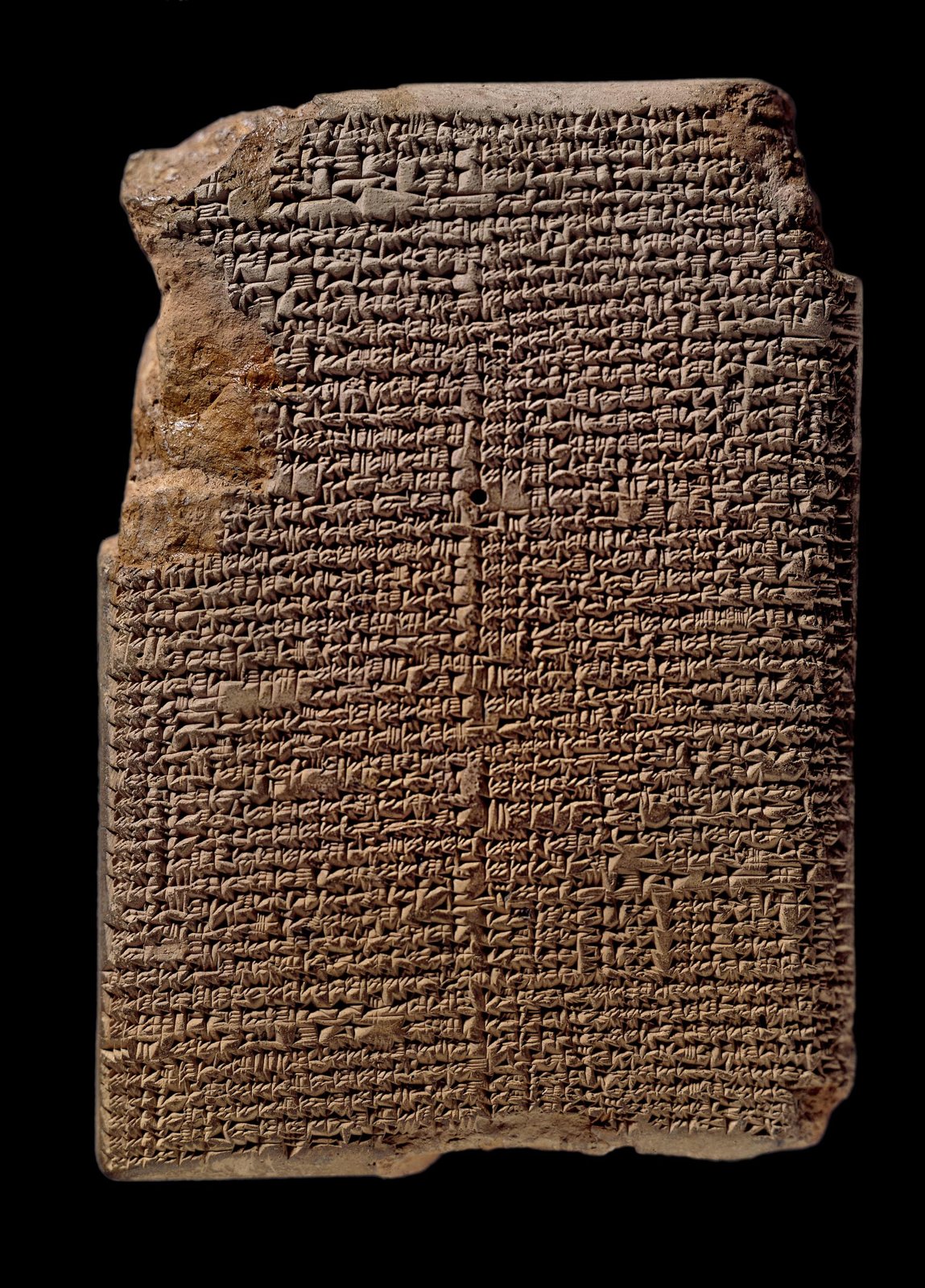
BM 86378: a nearly complete clay tablet with two columns of tiny cuneiform, Tablet 1 of the Babylonian star compendium MUL.APIN (a late copy, Neo-Babylonian period)
License · Image sourceObject details
- Title
- MUL.APIN (British Museum BM 86378): The Babylonian Star Compendium
- Timeline
- From 700 BCE to 500 BCE
- Region
- Mesopotamia
- Rights
- CC BY-SA
Text
Introduction
Long before telescopes, Babylonian scholars needed to know which stars rise when, because the calendar, the festivals and the omens all depended on the sky. One text gathered this knowledge in an orderly form and was copied for centuries: MUL.APIN, named after its opening words, "The Plough" (a star group). A clay tablet in the British Museum, BM 86378, preserves almost all of its first tablet. The text is one of the oldest handbooks of astronomy that we have, though we cannot say exactly when it was first put together. [1][2]
The object
BM 86378 is a clay tablet inscribed in cuneiformCuneiformWriting with wedge-shaped signs, developed from Mesopotamian recording traditions and used for several languages from the third millennium BCE.Glossary · Click to read the explanation with two columns of very small writing. The British Museum describes it as Tablet 1 of the series Mul-Apin, "nearly complete", and the Museum's own note on the photograph says it includes a list of the three divisions of the heavens, the dates of the rising of the principal stars, and the constellations in the path of the Moon. [6] It entered the Museum in 1899 (registration 1899-0610-108). The online catalogue of cuneiform texts (CDLI) assigns it to the Neo-Babylonian period, roughly 626–539 BCE, says its findspot is uncertain, and records that its colophon at the end of the second column reads "Tablet 1 of MUL.APIN". It was published in hand copy by L. W. King in 1912. [3] So this is a late copy of a text that is certainly older.
Steele identifies two dated copies: an Assyrian manuscript whose colophon gives 687 BCE and a Babylonian manuscript of the Hellenistic period. [7] Another tablet in the British Museum, K 12376, comes from NinevehNineveh and KuyunjikNineveh is an ancient Assyrian city near Mosul in northern Iraq; Kuyunjik is one of its archaeological moundsGlossary · Click to read the explanation, the city of the Assyrian king AshurbanipalAshurbanipalAshurbanipal was an Assyrian king of the seventh century BCE, reigning about 668–631 BCEGlossary · Click to read the explanation, and is also catalogued as a MUL.APIN manuscript. [4] The text survived in many libraries because scholars kept needing it.
Two tablets, many lists
The compendium consists of two tablets in the standard edition. [7][10]
- Tablet 1 describes the sky as it stands. It has six lists: the stars and constellations, the dates on which they first rise at dawn, groups that rise and set together, the intervals between risings, the stars that cross the meridian at night, and the stars along the path of the Moon. [2]
- Tablet 2 describes how the sky changes. It names the Sun, Moon and planets, gives rules for adding a leap month, lists the stars that go with the four winds, and gives day and night lengths and shadow lengths for the solstices and equinoxes. It ends with a short group of omens. [2]
The English edition most used is by Hermann Hunger and David Pingree (1989). A newer edition with translation and a full commentary, by Hunger and John Steele, appeared in 2019. [1][2]
The three paths in the sky
Tablet 1 groups the stars into three “paths,” named for EnlilEnlilEnlil/Ellil: a major Mesopotamian god associated with destinies, kingship, and Ekur at Nippur, already prominent in third-millennium god lists. His name’s origin and cult beginnings remain debated.Glossary · Click to read the explanation, AnuAn / AnuAn is the Sumerian sky god, called Anu in Akkadian. The sign AN by itself does not identify him: it also denotes sky or divinity.Glossary · Click to read the explanation and EaEnkiMesopotamian deity also known as Ea, linked with Eridu and the Abzu (deep fresh waters), wisdom, incantations, and narratives of creation and cosmic order. Later written attestations do not identify the deity of Eridu’s earliest layers.Glossary · Click to read the explanation (known in Sumerian as EnkiEnkiMesopotamian deity also known as Ea, linked with Eridu and the Abzu (deep fresh waters), wisdom, incantations, and narratives of creation and cosmic order. Later written attestations do not identify the deity of Eridu’s earliest layers.Glossary · Click to read the explanation). The names correspond to northern, middle and southern sectors of the eastern horizon. The text counts 33 objects for Enlil, 23 for Anu and 15 for Ea, giving a total of 71, including five planets. [9][10]
A plain example shows why this was useful. Think of a village shepherd who knows that when a certain bright star first appears just before sunrise, it is time to move the flocks. The Babylonians turned that kind of knowledge into a table. MUL.APIN gives dates for the first appearance of stars and constellations at dawn, an event called the heliacal rising. [7][10]
A calendar that is deliberately simple
The text uses an ideal year of 12 months of 30 days, or 360 days. The equinoxes fall on the 15th of the first and seventh months, and the solstices on the 15th of the fourth and tenth. The intercalation rules also use other dates. One gives a conjunction of the Moon and the Pleiades on the third day of a month. [7][8]
The civil calendar followed the Moon. Twelve lunar months are about eleven days shorter than a solar year, so a thirteenth month was added every two or three years. This is called intercalation. MUL.APIN describes two schemes for it. Some rules use the first visibility of stars, and others use the position of the Moon among them. In one rule, stars first seen a month later than expected signal a year that needs an extra month. It is uncertain whether the schemes were followed in practice. [8]
How old is it?
The date of MUL.APIN is still debated. Steele places the compilation tentatively in the late second or early first millennium BCE. Estimates based on star risings concern the material on which the compilation draws. Steele cautions that the estimates depend on assumptions about the observations behind the lists. The compendium shares the division into three paths with the earlier “Three Stars Each” lists. [7][9]
A step toward later science
MUL.APIN combines lists of visible phenomena with mathematical schemes. Tablet 2 relates shadow length to time of day and gives a worked multiplication. [7] It stands alongside the great omen series Enūma Anu Enlil, which linked sky events to omens for kings, as in the Venus Tablet; MUL.APIN itself contains only a small group of omens. [2][5]
What we should and should not say
MUL.APIN shows that Babylonian scribes organised the sky into paths, kept a simplified calendar and thought hard about leap months. It does not show that they had a modern scientific theory, and its star identifications are still debated. It is a window onto how ancient people read the sky, written in their own terms.
Photograph
The photograph shows BM 86378 and was published by the British Museum under the Creative Commons CC BY-SA 4.0 licence. [6]
References and notes
- Hermann Hunger and John Steele, The Babylonian Astronomical Compendium MUL.APIN (Scientific Writings from the Ancient and Medieval World), Routledge, Abingdon 2019 Publisher's description and catalogue records only (the book itself was not read); also cited there: Hunger and Pingree 1989 Return to the text ↑
- Wikipedia, 'MUL.APIN' (secondary summary of Hunger and Pingree 1989, Hunger and Steele, Watson and Horowitz 2011, Schaefer, de Jong, Brack-Bernsen) Whole article: structure of Tablets 1 and 2, three paths, 360-day year, intercalation rules, manuscripts, dating debate Return to the text ↑
- Cuneiform Digital Library Initiative (CDLI), entry P479385, BM 86378 Whole entry: period, colophon, publication (King, CT 33, 1912), accession 1899-06-10,0108 Return to the text ↑
- Cuneiform Digital Library Initiative (CDLI), entry P239110, MUL.APIN text a (K 12376) Whole entry: provenience Nineveh, period, genre Return to the text ↑
- Wikipedia, 'Babylonian astronomy' (secondary summary citing Hunger and Pingree 1999, Rochberg, Pingree 1998) Sections on MUL.APIN, Enuma Anu Enlil, intercalation and the later mathematical astronomy Return to the text ↑
- Wikimedia Commons, file 'MulApin-BritishMuseum.jpg' (British Museum, CC BY-SA 4.0) File metadata via the Commons API: licence, museum description of BM 86378, 1795 x 2500 px Return to the text ↑
- John M. Steele, “Shadow-Length Schemes in Babylonian Astronomy,” SCIAMVS 14 (2013), 3–39. Section 3, pp. 6–8, dated manuscripts, the date of compilation and Tablet II ii 21–42. Return to the text ↑
- Eshbal Ratzon, “Early Mesopotamian Intercalation Schemes and the Sidereal Month,” Mediterranean Archaeology and Archaeometry 16, no. 4 (2016), 143–151. Sections 1–2.2, pp. 144–146, tables I–II and the stellar visibility example at II ii 5–6. Return to the text ↑
- Francesca Rochberg, “Enuma Elish, knowledge of the heavens, and world order,” in Enuma Elish: The Babylonian Epic of Creation, ed. Johannes Haubold, Sophus Helle, Enrique Jiménez, and Selena Wisnom (Bloomsbury Academic, 2025). Chapter 9, pp. 237–238, the Three Stars Each tradition, the MUL.APIN tallies and the five planets. Return to the text ↑
- Alexander Jones, “A Babylonian Astronomical Handbook,” review of Hermann Hunger and David Pingree, MUL.APIN: An Astronomical Compendium in Cuneiform, Journal for the History of Astronomy 22 (1991). P. 328, the two tablets, the interpretation of the paths and Tablet I’s six lists. Return to the text ↑
Archive records may be reviewed and refined as better evidence or sources become available. Suggest a correction
Suggest a correction · Suggest a source for this record
Cite this record
IL Archive, «MUL.APIN (British Museum BM 86378): The Babylonian Star Compendium», https://ilarchive.com/en/artifacts/mul-apin-tablets
Continue reading