Artifact
Serabit el-Khadim and Wadi el-Hol: The Earliest Alphabetic Inscriptions
An object record bringing together its image, metadata, rights, and context.
- Timeline
- From 1800 BCE to 1550 BCE
- Region
- Egypt
A small stone sphinx from a Sinai turquoise-mining site carries what many scholars regard as the oldest consonant-alphabet writing. Where, when and by whom it was made is still debated.
Estimated reading time: 6 min Published Last reviewed:
Share article
Photograph
Photo: Onceinawhile, CC BY-SA 4.0, via Wikimedia Commons
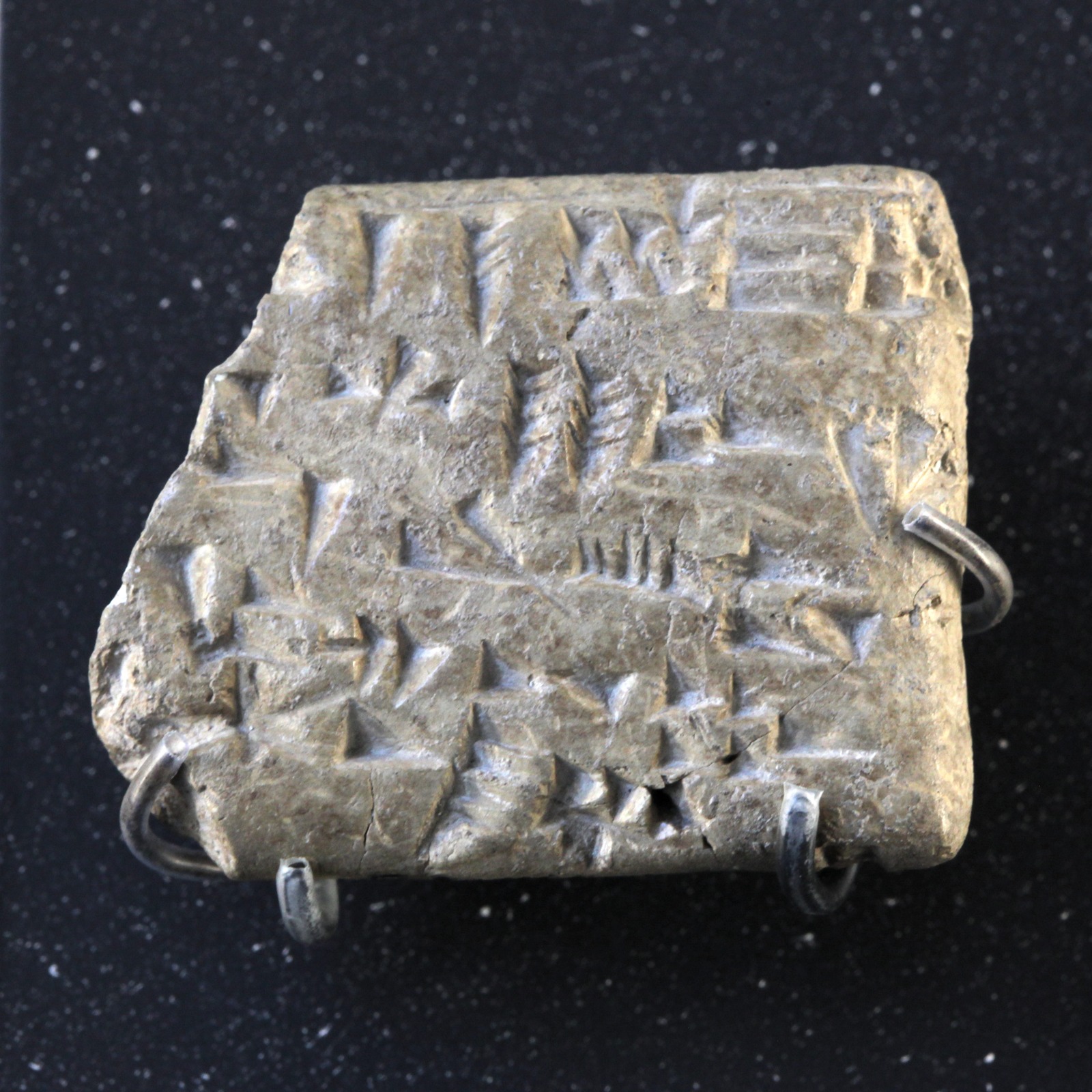
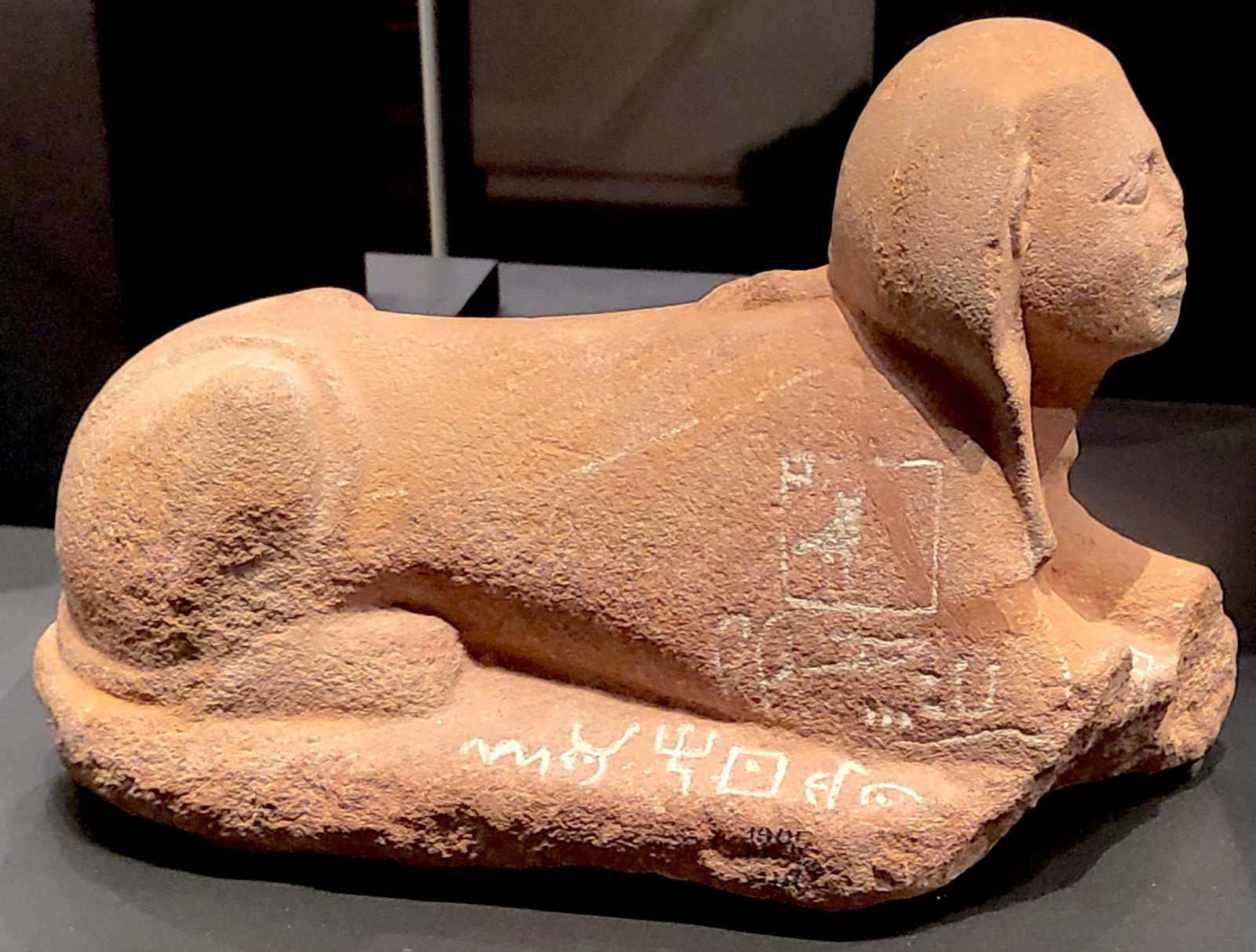
The sphinx Sinai 345 (British Museum EA 41748), found in the Hathor temple at Serabit el-Khadim. Inscribed signs, picked out in white, can be seen on its shoulder and along its base. The Proto-Sinaitic text is read as "beloved of the Lady"
License · Image sourceVideo
The First Letter: How a Picture of an Ox Became Your Alphabet
The letter A began as a picture: the head of an ox, scratched into the rock of the Sinai desert perhaps close to four thousand years ago. Along the way we say plainly which answers are firm and which are still argued: when the alphabet was born, and whether miners or scribes made it. Some scenes are AI-generated illustrations.
The YouTube player loads only when you press play. Watch on YouTube
Object details
- Title
- Serabit el-Khadim and Wadi el-Hol: The Earliest Alphabetic Inscriptions
- Timeline
- From 1800 BCE to 1550 BCE
- Region
- Egypt
- Rights
- CC BY-SA
Text
Introduction
Most of the world's alphabets descend from one idea: one simple sign for each consonant sound. The oldest known traces of that idea are a few dozen short inscriptions scratched on rock and stone in the SinaiSinai: peninsula and biblical mountainSinai is a peninsula in eastern Egypt; in the Torah the name also denotes the mountain of revelation to MosesGlossary · Click to read the explanation desert, plus two tiny texts in Egypt's Western Desert. They are called Proto-Sinaitic. Their meaning is only partly understood, and even their date is argued over. This entry sets out what the objects are, what can be read on them, and where the evidence stops.
The place: a temple for Hathor in a mining district
Serabit el-Khadim lies in the south-west of the SinaiSinai: peninsula and biblical mountainSinai is a peninsula in eastern Egypt; in the Torah the name also denotes the mountain of revelation to MosesGlossary · Click to read the explanation peninsula. Egyptian expeditions came here to mine turquoise and copper. A temple was built at the site for the Egyptian goddess Hathor, called "Lady of Turquoise". It was founded in the Middle Kingdom, in the reign of Senusret I, and was partly rebuilt later. [1][2] The expedition leaders left hieroglyphic stelae and rock inscriptions in and around the temple and near the mines. [1]
Some of the workforce came from the LevantThe LevantThe Levant is a regional name for lands along the eastern MediterraneanGlossary · Click to read the explanation. Egyptian texts from the reign of Amenemhat III (about 1800 BCE) mention non-Egyptians at Serabit, most likely Semitic speakers, including a "brother of the prince of Retjenu", an Egyptian name for the Levant or part of it. [1] Egyptian and Proto-Sinaitic texts stand in the same places, which is why scholars connect the two groups.
The inscriptions
In the winter of 1904–1905 Flinders Petrie's expedition found signs that looked like hieroglyphs but did not behave like Egyptian writing. [2] Alan Gardiner numbered the first group 345–355 in 1916, a numbering still used. [3] Counts of the whole corpus vary with how fragments are counted: about 30 in some lists, about 50 in Haring's recent survey. [1][2] Most inscriptions are short and many are badly worn. They are found at Serabit and in nearby valleys, mostly on rock panels near the mines, and a few on small objects such as statuettes. [3]
The sphinx
The best-known piece is Sinai 345, a small stone sphinx found in the Hathor temple and now in the British Museum (EAEnkiMesopotamian deity also known as Ea, linked with Eridu and the Abzu (deep fresh waters), wisdom, incantations, and narratives of creation and cosmic order. Later written attestations do not identify the deity of Eridu’s earliest layers.Glossary · Click to read the explanation 41748). [1][3] Petrie found it, and Gardiner published it in 1916. [3] The sphinx has an Egyptian hieroglyphic line on its shoulder, which says "beloved of Hathor, Lady of Turquoise". Beside it are Proto-Sinaitic signs. [1]
Here is how the first reading worked. A string of signs that kept coming back could be read as baʿlat, "Lady" (the Semitic word that corresponds to Hathor's title). Longer strings were read as lbʿlt, "for the Lady" (Kurt Sethe), and mʾhbʿlt, "beloved of the Lady" (Robert Eisler). The second matches the Egyptian line on the sphinx closely. [1] Today these readings are broadly accepted. Longer strings of signs are not: specialists do not agree on them. [1]
How the signs work
The key idea is called acrophony, from Greek words meaning "first sound". A picture stands for the first sound of the word for the thing pictured, much as if we drew an apple and used it for the sound "a". An ox head is an example. The Semitic word for "ox" began with a glottal sound, so the ox head came to stand for that sound. A house plan, bayt, gave "b". A zigzag of water, mem, gave "m". An eye gave ʿayin, and a head gave resh. [1]
This method is a reconstruction. Scholars assume that the signs have the same values as the matching later letters and that the words behind them resembled the later letter names. The assumption has worked well for the short, repeated phrases, but it cannot be tested on long texts, because we do not know the spoken language well enough. Most specialists think the language was a West Semitic one, related to HebrewHebrewA Northwest Semitic language of the Canaanite group, encompassing Iron Age epigraphy, Biblical, Rabbinic, medieval and Modern Hebrew; its scripts and pronunciations changed over time.Glossary · Click to read the explanation, Phoenician and Aramaic. [1] The repertoire of signs is small, with estimates ranging from 21 to 31. [1]
Some signs look like Egyptian hieroglyphs, and the Egyptian origin of the idea was argued by Gardiner. Others may simply picture the same objects without copying a hieroglyph, so Haring cautions that "inspired by hieroglyphs" and "copied from hieroglyphs" are different claims. [1]
Wadi el-Hol
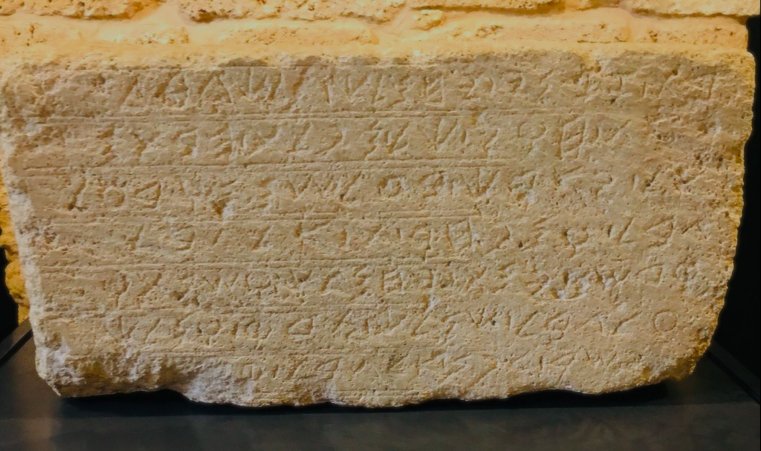
In the 1990s John and Deborah Darnell found two short rock inscriptions in Wadi el-Hol, on the desert road that cuts across the bend of the Nile near Thebes (Luxor). One is a line of 16 signs and the other a column of 12. Together they use 14 different signs, all of which have matches in the Sinai corpus. They were published in 2005 by the Darnells and colleagues. [1][4] The Darnells proposed a date of about 1900–1800 BCE. [4] Nearby Egyptian inscriptions of Amenemhat III's reign mention a Levantine army general named Bebi, which would again put Semitic speakers on the spot. [1] But no reading of the two texts has been generally accepted, so a later date cannot be ruled out. [1]
Who wrote them, and when?
The date is the central debate. The "early" view puts the Serabit texts in the Twelfth Dynasty, around the expeditions of Amenemhat III, about 1800 BCE. [1] Orly Goldwasser has argued further that the alphabet was invented by Canaanite miners at Serabit in the mid-nineteenth century BCE, men who could not read hieroglyphs but were inspired by the pictures on the temple walls. [5] Anson Rainey replied that such a development was more likely the work of educated Northwest Semites writing on papyrus, which has not survived. [5] The "late" view dates the texts several centuries after 1800 BCE, perhaps even around 1550 BCE. [1][2] The choice also changes the name: under the early date the script is called Proto-Sinaitic and the invention is placed in Egypt, under the late date it is Proto-Canaanite and the invention is placed in Canaan. [2]
We cannot settle this with the evidence in hand. The shapes of a few signs can help to date inscriptions, but, as Haring notes, this is hazardous with such small bodies of text. [1]
From Sinai to later alphabets
Later West Semitic scripts, such as the PhoenicianPhoeniciansCommunities of Levantine coastal cities known for Mediterranean contact during the first millennium BCE.Glossary · Click to read the explanation alphabet, look like descendants of this tradition, and Greek, Hebrew, Aramaic and, through Nabataean, Arabic letters follow from them. [2] The step between the Sinai signs and the better-documented Phoenician inscriptions of the early first millennium BCE is thinly documented. [1][2]
A separate tradition also existed. The Ugaritic alphabetUgaritic alphabetAlphabetic cuneiform system of Late Bronze Age Ugarit, using thirty chiefly consonantal written signs, distinct from Akkadian syllabic cuneiform.Glossary · Click to read the explanation of the fourteenth and thirteenth centuries BCE is the oldest well-understood consonant script. It is written in cuneiformCuneiformWriting with wedge-shaped signs, developed from Mesopotamian recording traditions and used for several languages from the third millennium BCE.Glossary · Click to read the explanation wedges, not hieroglyph-like pictures, and it is the subject of the Ras ShamraUgaritAncient city and kingdom at Ras Shamra on the Syrian coast, flourishing between the fourteenth and early twelfth centuries BCE and preserving multilingual archives.Glossary · Click to read the explanation abecedary entry on this site. [1] An ostracon from Theban Tomb 99 (fifteenth century BCE) shows the letter sequence known as halaam beside Semitic words written in Egyptian script, which suggests that several related traditions of listing consonants existed side by side. [1]
What we can and cannot say
- The Proto-Sinaitic signs are consonant signs, and the language is probably West Semitic. This is widely agreed. [1]
- The phrases baʿlat and mʾhbʿlt are read with confidence, helped by the Egyptian text on the sphinx. [1]
- The date, about 1800 BCE or several centuries later, is open. [1][2]
- Who invented the system, illiterate miners or trained scribes, is argued, not shown. [5]
- Wadi el-Hol is probably the same writing system, but no reading has won general agreement. [1]
References and notes
- Ben Haring, 'The Egyptian background of early alphabetic writing', in G. Kim & H. Kim (eds.), The Dawn of Writing Systems, National Museum of World Writing Systems, Incheon 2025, pp. 239-254 (CC BY 4.0) Read: whole chapter; sections 2 (Proto-Sinaitic inscriptions), 3 (Wadi el-Hol), 4 (Theban Tomb 99 ostracon), 5 (Egyptian inspiration), references Return to the text ↑
- Wikipedia, 'Proto-Sinaitic script' (secondary summary) First 100,000 characters: Petrie's 1904-5 find, Gardiner's decipherment, number of inscriptions, early versus late dating, descendants Return to the text ↑
- Wikipedia, 'Serabit el-Khadim proto-Sinaitic inscriptions' (secondary summary) Table of inscriptions 345-375 with museum numbers, findspots and publication history; bibliography Return to the text ↑
- J. C. Darnell, F. W. Dobbs-Allsopp, M. J. Lundberg, P. K. McCarter, B. Zuckerman, C. Manassa, 'Two Early Alphabetic Inscriptions from the Wadi el-Hol', Annual of the American Schools of Oriental Research 59 (2005), pp. 63-124; with Wikipedia, 'Wadi el-Hol inscriptions' Not read directly: citation, publisher's description and the Wikipedia summary of the discovery and the proposed date; the readings are taken from Haring 2025 Return to the text ↑
- Bible History Daily (Biblical Archaeology Society), 'Who Really Invented the Alphabet: Illiterate Miners or Educated Sophisticates?' (Goldwasser and Rainey exchange) Page read: Goldwasser's 2010 thesis (Canaanite miners at Serabit, Amenemhat III) and Rainey's reply; the linked full critiques were not read Return to the text ↑
Archive records may be reviewed and refined as better evidence or sources become available. Suggest a correction
Suggest a correction · Suggest a source for this record
Cite this record
IL Archive, «Serabit el-Khadim and Wadi el-Hol: The Earliest Alphabetic Inscriptions», https://ilarchive.com/en/artifacts/proto-sinaitic-inscriptions
Continue reading