Study
The Objects Behind the Stories: A Guide to Thirteen Tablets, Stones and Potsherds from the Ancient Near East
An extended study of a topic, with evidence and references.
- Region
- The Near East and the Mediterranean
Flood, laws, alphabet, stars: the stories we know from the ancient Near East come from real objects in museums. A guide to thirteen of them, what each one is, and why the object and the story must be kept apart.
Estimated reading time: 6 min Published Last reviewed:
Share article
Text
Introduction
Most people meet the ancient Near EastAncient Near EastModern scholarly label for ancient societies of Mesopotamia, the Levant, Anatolia and Iran, sometimes extending to Egypt and other neighbours depending on the study; not one civilization or religion.Glossary · Click to read the explanation through stories: a great flood, a code of laws, the first letters of the alphabet, a king named on a stone. Behind each story stands a physical thing, a broken tablet, a black pillar, a few inked potsherds, that someone dug up, carried to a museum and learned to read.
This guide walks through thirteen of those objects, each described in its own entry on this site. For every one we ask the same plain questions: what is the thing, where and when was it found, what is written or shown on it, and what do scholars still argue about? The object, the story it carries and the world it came from are three different things, and the entries try never to blur them.
Why start from the object?
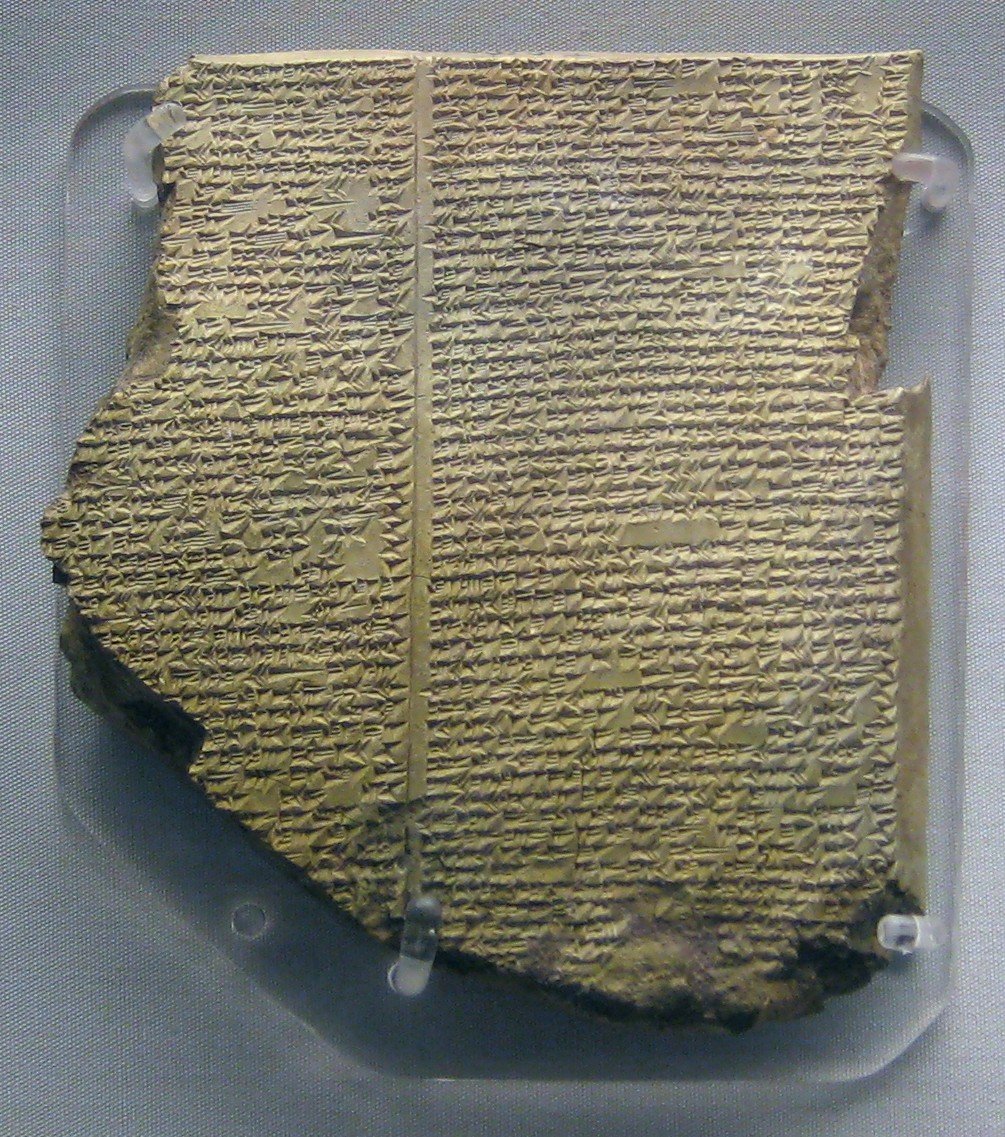
A tablet is not a story. It is a lump of clay or stone, made by a particular person at a particular time, kept or broken or buried by accident. The Flood Tablet in the British Museum (K.3375) is a seventh-century BCE copy from the library of AshurbanipalAshurbanipalAshurbanipal was an Assyrian king of the seventh century BCE, reigning about 668–631 BCEGlossary · Click to read the explanation at NinevehNineveh and KuyunjikNineveh is an ancient Assyrian city near Mosul in northern Iraq; Kuyunjik is one of its archaeological moundsGlossary · Click to read the explanation. It is not the flood story itself, and the traditions behind it are much older. [1]
Starting from the object keeps three questions apart: what the thing is (material, size, museum number), what it says or shows (the text, the picture), and what scholars infer from it (dates, authors, meanings). When a museum number, a findspot and a date come first, a reader can tell what is observed and what is only proposed.
Texts that came out of the ground
Five of the objects carry writing that changed how history is read.
- The Flood Tablet (K.3375) is the piece in which a museum assistant, George Smith, recognised a Mesopotamian flood story in 1872. [1]
- The Weld-Blundell Prism (Ashmolean AN1923.444) is a four-sided clay column, about 20 cm tall, written around 1800 BCE. It holds the fullest copy of the Sumerian King List, which begins with kings before a flood.
- The Code of Hammurabi stele (Louvre Sb 8) is a black basalt pillar 2.25 metres tall. It was made in Babylonia, yet it was found at Susa, in IranIranIran is the modern country containing Shush, ancient SusaGlossary · Click to read the explanation, and the entry explains the journey.
- The Black Obelisk of Shalmaneser III (British Museum ME 118885) was found at Nimrud in 1846. One caption names "Jehu, son of Omri", and the entry shows why that name is still discussed.
- The Lachish letters are twenty-one inked potsherds found in 1935 and 1938. They are everyday notes written shortly before the Babylonian conquest of about 588–586 BCE, and they show how far a handful of sherds can be read, and where the reading becomes wishful.
Pictures in clay and stone
Three objects speak mainly through images.
- The Baal with Thunderbolt stele (Louvre AO 15775), found in 1932 near the Temple of Baal at UgaritUgaritAncient city and kingdom at Ras Shamra on the Syrian coast, flourishing between the fourteenth and early twelfth centuries BCE and preserving multilingual archives.Glossary · Click to read the explanation, shows a striding storm god and a much smaller king. Its date is only a range, and the stele often illustrates texts that it does not quote.
- The Burney Relief, the "Queen of the Night", is a baked-clay plaque of a winged, bird-footed woman with owls and lions. Its place of discovery is unknown and her name is debated.
- The Standard of Ur (British Museum 1928,1010.3) is a small inlaid box from the Royal Cemetery, with a battle on one side and a banquet on the other. Nobody can say what it was for; "standard" is only a nickname.
The WarkaUrukAncient city at Warka in southern Iraq, a major urban centre around 3200 BCE that preserved early writing and accounting tablets.Glossary · Click to read the explanation Vase, an offering procession from Uruk, already has its own record on this site: see the study The Warka Vase and Head.
Where the alphabet begins
Two entries follow the story of writing that uses one sign for each sound.
- The Proto-Sinaitic inscriptions from Serabit el-Khadim and Wadi el-Hol are a few dozen short texts, including one on a small stone sphinx in the British Museum, regarded by many scholars as the oldest consonant-alphabet writing. Where, when and by whom they were made is still argued. [2]
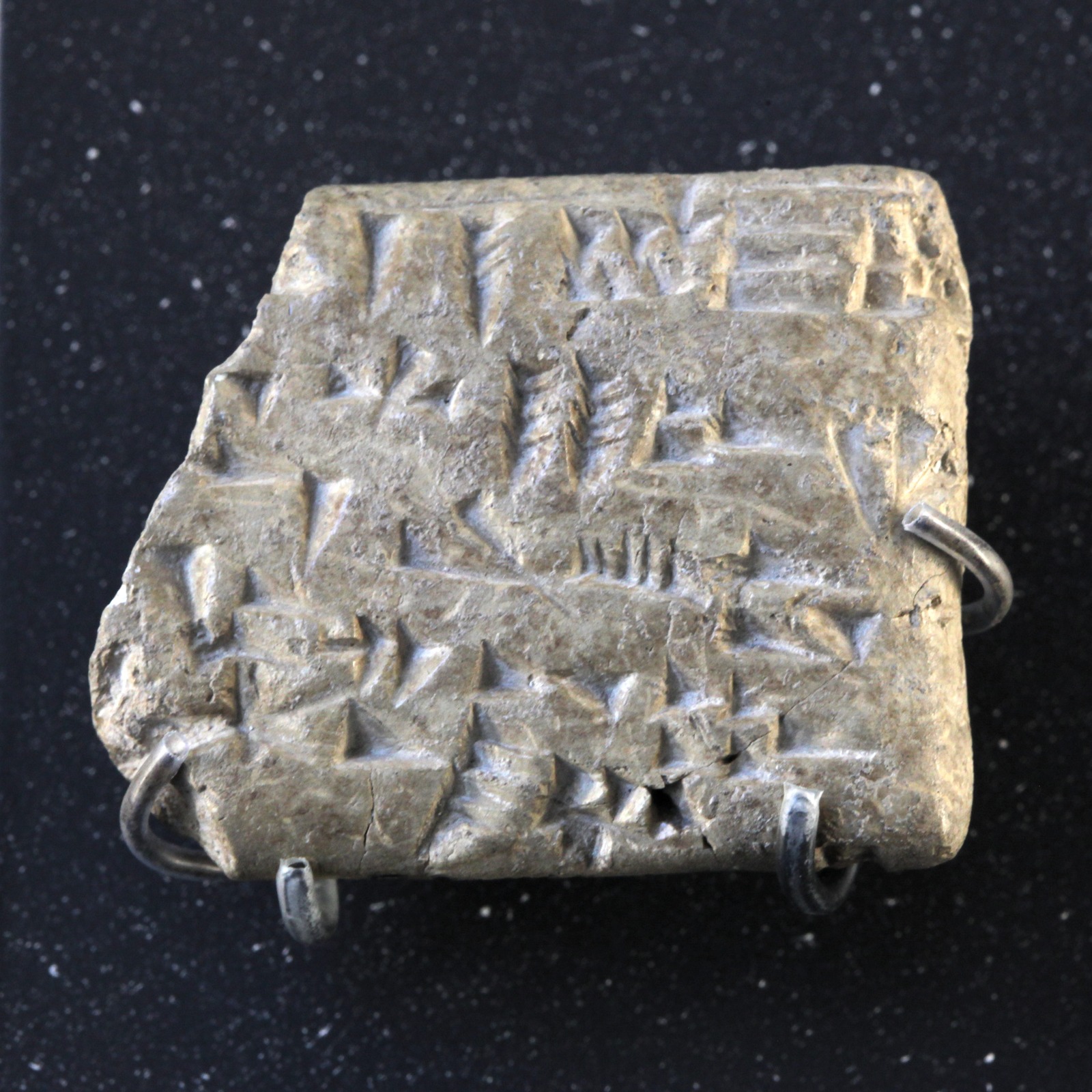
- The Ras Shamra abecedary (Louvre AO 19992) is a clay fragment from Ugarit that lists letters of the Ugaritic alphabetUgaritic alphabetAlphabetic cuneiform system of Late Bronze Age Ugarit, using thirty chiefly consonantal written signs, distinct from Akkadian syllabic cuneiform.Glossary · Click to read the explanation in a fixed order, the "ABC" that scribes once had to write down for the first time.
Watching the sky and drawing the world
Three tablets show how Babylonian scholars looked up, and out.
- The Venus Tablet of Ammisaduqa (K.160) records when Venus vanished and reappeared over 21 years, with an omen for each event. Its dates once seemed to fix Babylonian chronology, but the text is damaged and scholars still disagree.
- MUL.APIN (BM 86378) is a handbook of stars, sky paths and calendar rules, copied for centuries. When it was first composed is debated.
- The Babylonian Map of the World (BM 92687) is a broken tablet from Sippar. It draws the earth as a disc ringed by a "bitter river", with BabylonBabylonBabylon is an ancient city in central present-day Iraq, south of BaghdadGlossary · Click to read the explanation at the centre.
Objects already on the site
Some objects that readers ask about already have records of their own, so they are not repeated here. The site page on Kuntillet ʿAjrud and the page on Khirbet el-Qom cover the inscriptions that mention YahwehYahwehThe proper name of Israel’s deity, written יהוה (YHWH), the Tetragrammaton. Its exact ancient pronunciation is not directly preserved; texts and inscriptions witness its history.Glossary · Click to read the explanation and his asherah, and the study Yahweh and Asherah sets out how scholars read them.
How to read an object
Four habits help with any of these entries.
- Look for the museum number. It tells you the object is a real, catalogued thing that others can check.
- Separate the copy from the composition. A seventh-century copy can carry a text that is far older.
- Notice what is missing. A broken tablet, a plundered tomb or an unknown findspot limits what can be said, and honest entries say so. [3]
- Treat a caption or a title as a claim, not a fact. Names such as "Queen of the Night" or "Standard of Ur" are modern nicknames.
Read this way, the objects do not prove stories, and they do not undo them. They give us the writing and the pictures of people who lived in these lands, in their own materials, and that is where careful reading starts.
References and notes
- IL Archive, entry "The Flood Tablet (Gilgamesh Tablet XI, British Museum K.3375)" (record 1193) Whole entry re-read on 13 Nov 2026: K.3375, seventh-century BCE copy from the library of Ashurbanipal, Nineveh; recognition by George Smith in 1872; the distinction between tablet, story and older traditions Return to the text ↑
- IL Archive, entry "Serabit el-Khadim and Wadi el-Hol: The Earliest Alphabetic Inscriptions" (record 1205) Whole entry re-read on 13 Nov 2026: Proto-Sinaitic inscriptions, the sphinx (British Museum EA 41748), and the debate on date and authorship (main source there: Haring 2025) Return to the text ↑
- IL Archive, entry "The Standard of Ur" (record 1199) and entry "The Burney Relief" (record 1198) Both entries re-read on 13 Nov 2026: the plundered tomb and unknown use of the Standard; the unknown findspot and debated identity of the Burney Relief Return to the text ↑
Suggest a correction · Suggest a source for this record
Cite this record
IL Archive, «The Objects Behind the Stories: A Guide to Thirteen Tablets, Stones and Potsherds from the Ancient Near East», https://ilarchive.com/en/studies/objects-behind-the-stories
Continue reading