Artifact
The Baal with Thunderbolt Stele from Ugarit (Louvre AO 15775)
An object record bringing together its image, metadata, rights, and context.
- Timeline
- From 2000 BCE to 1150 BCE
- Region
- The Levant
A limestone stele from Ugarit showing a striding storm god and a small king, found in 1932 near the Temple of Baal: what the object is, how it is dated and what its image can and cannot show.
Estimated reading time: 5 min Published Last reviewed:
Share article
Photograph
Photo: Jastrow (Marie-Lan Nguyen), Public domain, via Wikimedia Commons; object: Musée du Louvre
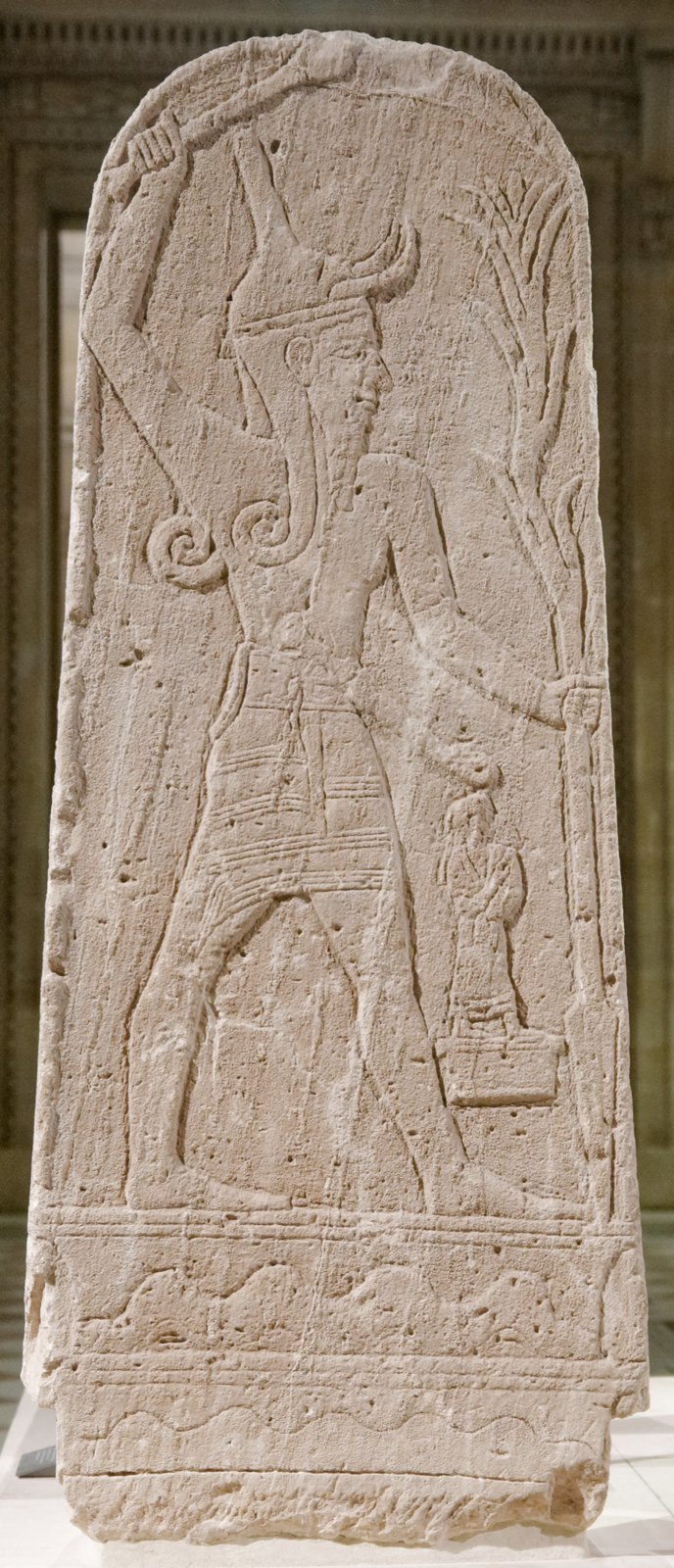
The Baal with Thunderbolt stele from Ugarit (Louvre AO 15775 / RS 4.427): oolitic limestone, found in 1932 on the Ras Shamra acropolis; a striding god with a raised weapon and a spear, a small figure beside him, and bands of mountain and waves below
Image sourceObject details
- Title
- The Baal with Thunderbolt Stele from Ugarit (Louvre AO 15775)
- Timeline
- From 2000 BCE to 1150 BCE
- Region
- The Levant
- Rights
- Public domain
Text
Introduction
Among the sculptures found at UgaritUgaritAncient city and kingdom at Ras Shamra on the Syrian coast, flourishing between the fourteenth and early twelfth centuries BCE and preserving multilingual archives.Glossary · Click to read the explanation, one tall slab of pale limestone is known to almost every visitor to the Louvre: a god stepping forward with a raised weapon, and beside him a much smaller figure on an altar. It is called the Baal with Thunderbolt stele, or "Baal au foudre" in French.
This entry describes the object itself: where and when it was found, what it is made of, what it shows and why its date is only a range. It also keeps apart what the stone shows from the stories told about it, because the stele is often used to illustrate texts that it does not quote.
The object
The stele is kept in the Department of Near Eastern Antiquities of the Louvre under the number AO 15775. Its excavation number is RS 4.427, where RS stands for Ras Shamra, the modern name of the mound of Ugarit. The museum record gives its size as 144 cm high, 57.5 cm wide and 29 cm thick, and the material as an oolitic limestone, that is, a fine-grained limestone made of tiny rounded grains. A laboratory note of 1990 quoted in the record calls the stone light beige and rather soft. [1]
Other works give slightly different sizes, for example about 142 by 50 cm. [2] Differences of a few centimetres are common between catalogues, and this entry follows the museum's own record.
Where and when it was found
The Louvre records that the stele was found on 28 May 1932, on the acropolis of Ras Shamra, west of the Temple of Baal. [1] The excavations were directed by Claude Schaeffer, whose French mission worked at Ras Shamra and the nearby harbour of Minet el-Beida. His first report on the 1932 season appeared in the journal Syria in 1933, and the museum lists a dedicated article by him in 1934. [1][5]
Other accounts say the stele lay about 20 metres from the temple and was probably once inside it. [2] That is an inference from where it was lying, not a recorded fact. The acropolis held two large temples, one of Baal and one of DaganDaganA god worshipped in Syria and Mesopotamia, especially at Tuttul and Terqa on the Euphrates, and associated with royal authority. His name appears as Dagon in the Hebrew Bible; no ancient image of him is securely identified.Glossary · Click to read the explanation, and stelae of various dedications were found around them. [3] After the excavation the stele came to the Louvre by the usual division of finds between the excavators and the state. [1]
What the relief shows
The main figure is a god in a striding pose, one arm raised and holding a club or mace. In the other hand he holds a long spear whose shaft ends in a plant-like shape; scholars call it a thunderbolt, a spear or a "vegetation spear". He wears a horned headdress with a tall central element, a kilt and a belt with a dagger. [1][2] A much smaller figure, usually read as the king of Ugarit, stands in front of the god on a block, with one hand raised. [2] At the bottom the god stands over a band of mountain shapes and a band of waves, which the museum's description terms mountain and sea. [1]
The style mixes Egyptian and Syrian habits. The museum describes the crown as Egyptianising, and Nicolas Wyatt has used the stele as evidence of Egyptian influence on art in Syria. [1][2]
Is it Baal? A conventional identification
The stele carries no inscription in the museum's record. [1] The god is named Baal because of what he holds and wears: the storm weapon and the horned headdress fit the picture of the storm god Baal (also called Hadad) in the Ugaritic texts of the same age, and the stele was found beside his temple. This is a reasonable reading, but it is an identification made from the image and the findspot, not one written on the stone. Our entry on BaalBaalUgaritic storm god and warrior king who defeats Yamm, builds his palace with El’s consent and confronts Mot. References to El and Dagan as fathers do not define a single genealogy.Glossary · Click to read the explanation explains who this god is, and the Baal CycleBaal CycleA group of Late Bronze Age Ugaritic religious texts recounting Baal’s conflicts, relationships with the gods and the building of his palace.Glossary · Click to read the explanation is the group of texts in which he appears.
The scene should not be read as a picture of any one story. The small figure is a worshipper, not a character in a myth. Scholars have read the scene as a king receiving the god's protection, and the plant-like spear as a sign that the storm brings the rain on which the harvest depends. [2] These are interpretations of the image. Nor does the stele show anything about the god ElElEl is a senior deity in Late Bronze Age Ugaritic texts, portrayed as father of the divine family and a council authority, alongside his consort Athirat. This entry does not cover every linguistic use of El.Glossary · Click to read the explanation: it depicts Baal, and it gives no evidence that Baal replaced El.
How it is dated
The Louvre dates the stele only broadly, from the Middle to the Late Bronze AgeLate Bronze AgeAn archaeological period around 1600–1200 BCE in much of the Near East, with international diplomacy, exchange and religious diversity; its endpoints vary by region.Glossary · Click to read the explanation, about 2000 to 1150 BCE. [1] Some descriptions say the 15th century BCE, within the Late Bronze Age. [2] The two statements do not contradict each other: one is a cautious range, the other a narrower proposal. The temple area itself has a long history. A description of the site says that the Temple of Baal was probably destroyed by an earthquake in the middle of the 13th century BCE and not rebuilt. [3] The date of the carving therefore cannot be set by the temple alone. A technical study of the stone and its carving, published in 2025, is listed in the museum's bibliography; its text was not read for this entry. [1]
Why it matters
The stele is one of the best-known images of an Ugaritic god, and a rare case where a god, a king and the landscape of the myth (mountain and sea) are carved together. It is not a source for what the people of Ugarit believed in the way a tablet is, because it has no words. Used with care, it shows how the city's artists chose to picture its storm god, and it stands beside the texts rather than explaining them.
Photograph
The image on this page is a photograph of the whole stele in the Louvre, by Jastrow (Marie-Lan Nguyen), released into the public domain. [4]
References and notes
- Musée du Louvre, Département des Antiquités orientales, collection record 'Stèle du Baal au foudre' (AO 15775, RS 4.427) Whole record: numbers, dimensions 144 x 57.5 x 29 cm, oolitic limestone, discovery 28 May 1932 west of the Temple of Baal, dating c. 2000-1150 BCE, decoration terms, no inscription listed, acquisition by division, bibliography Return to the text ↑
- Wikipedia, 'Baal with Thunderbolt' (secondary summary citing Schaeffer 1933, Yon 2006, Smith 2009, Green 2003, Wyatt) Whole article: discovery, dimensions, 15th-century date, iconography, interpretations; used as a pointer to the scholarship, not as a primary source Return to the text ↑
- Wikipedia, 'Ugarit' (secondary summary citing Yon 2006, Gates 2011) First 100,000 characters: acropolis temples of Baal and Dagan, destruction of the Baal temple, stelae found there Return to the text ↑
- Wikimedia Commons, file 'Baal thunderbolt Louvre AO15775.jpg' (Jastrow / Marie-Lan Nguyen, public domain) File page: description, author, licence, original size Return to the text ↑
- Claude F.-A. Schaeffer, 'Les fouilles de Minet-el-Beida et de Ras-Shamra. Quatrième campagne (printemps 1932)', Syria 14 (1933), pp. 93-127 Title block and opening pages only (campaign April to July 1932); the pages on the stele were not accessible and are not cited Return to the text ↑
Archive records may be reviewed and refined as better evidence or sources become available. Suggest a correction
Suggest a correction · Suggest a source for this record
Cite this record
IL Archive, «The Baal with Thunderbolt Stele from Ugarit (Louvre AO 15775)», https://ilarchive.com/en/artifacts/baal-with-thunderbolt-stele
Continue reading