Artifact · Tablet
The Weld-Blundell Prism and the Sumerian King List (Ashmolean AN1923.444)
An object record bringing together its image, metadata, rights, and context.
- Timeline
- From 1827 BCE to 1800 BCE
- Region
- Mesopotamia
A four-sided clay prism in Oxford, written about 1800 BCE, carries the fullest copy of the Sumerian King List: kings before the flood, cities taking turns at kingship, and what scholars debate about it.
Estimated reading time: 6 min Published Last reviewed:
Share article
Photograph
Photo: M.atkinsonross, CC BY-SA 4.0, via Wikimedia Commons
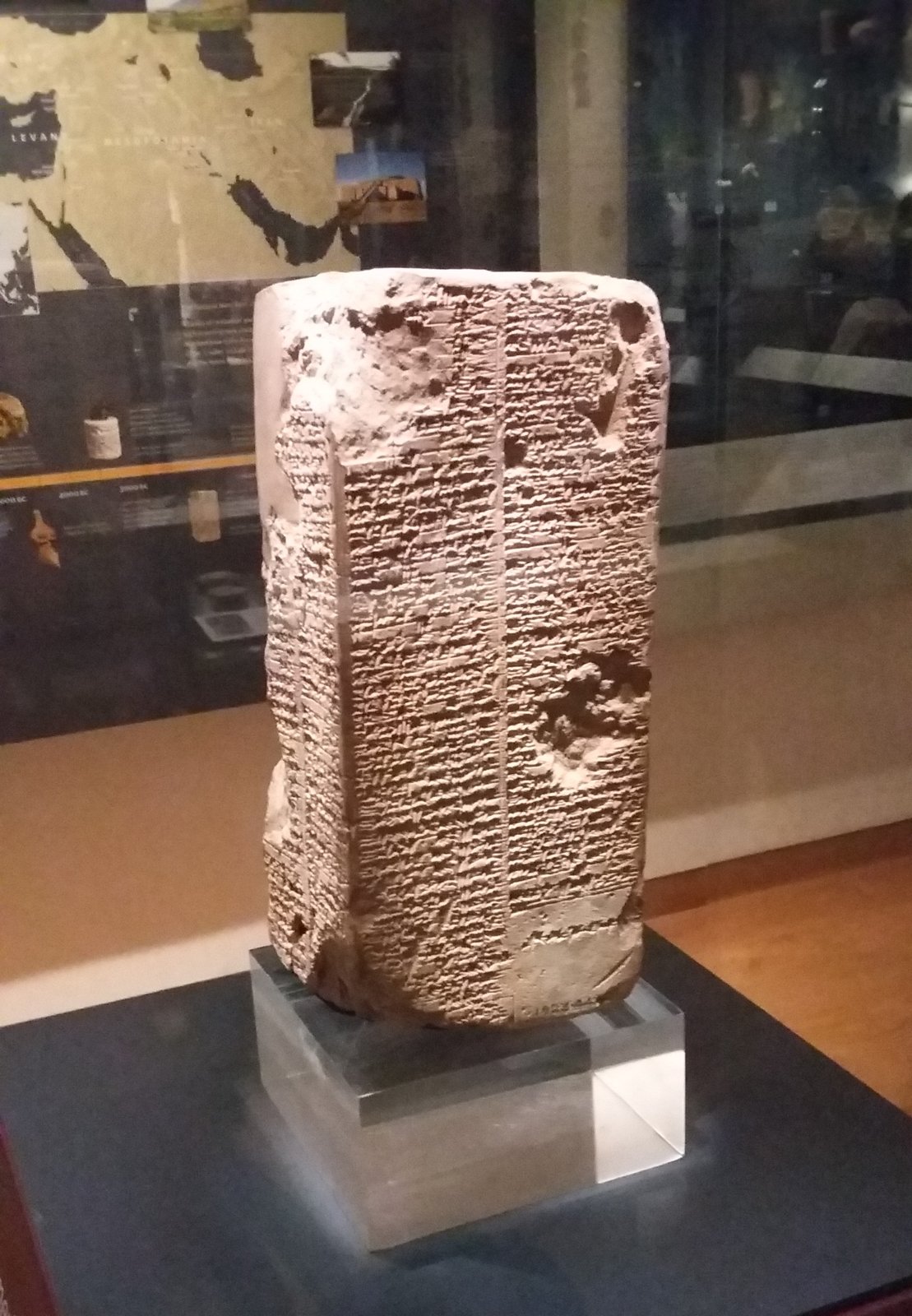
The Weld-Blundell Prism (Ashmolean Museum AN1923.444), the fullest copy of the Sumerian King List: a baked clay prism about 20 cm high, written in Sumerian cuneiform around 1800 BCE, shown in its museum case
License · Image sourceObject details
- Title
- The Weld-Blundell Prism and the Sumerian King List (Ashmolean AN1923.444)
- Timeline
- From 1827 BCE to 1800 BCE
- Region
- Mesopotamia
- Rights
- CC BY-SA
Text
Introduction
In the Ashmolean Museum in Oxford stands a baked clay column, about 20 cm tall, covered on all four sides with tiny cuneiformCuneiformWriting with wedge-shaped signs, developed from Mesopotamian recording traditions and used for several languages from the third millennium BCE.Glossary · Click to read the explanation signs. It is the Weld-Blundell Prism, the most complete surviving copy of the Sumerian King List: a list of cities and kings that begins before a great flood and ends with a ruler of the city of Isin.
This entry looks at the object: what it is, when it was written, what its first lines say, and why historians read it carefully but do not take it at face value. It keeps apart three things that are often mixed: the prism itself (a copy made around 1800 BCE), the composition it carries (older than the prism), and the history the list claims to describe.
The object
The prism is made of clay and measures about 20 cm in height and 9 cm in width. [1] It has four faces, and each face carries two columns of Sumerian cuneiform. [2] The Ashmolean registers it as AN1923.444. Older publications call it "W-B 444", from the Weld-Blundell collection. [1][3]
The museum dates it to about 1800 BCE and says it is probably from the city of Larsa, in southern IraqIraqIraq is a modern country encompassing much of ancient MesopotamiaGlossary · Click to read the explanation. [1] The word "probably" matters. The online catalogue of cuneiform tablets (CDLI) records no findspot for it, so the place rests on attribution and not on a documented excavation. [3] Some popular accounts speak of a discovery at Larsa in 1922, but they give no excavation record, and this entry does not repeat that as fact. [2][4] What is certain is the name of the collection: it is named after Herbert Weld Blundell, an English collector and traveller. [2][4] Stephen Langdon first published its text in Oxford Editions of Cuneiform Texts, volume 2, in the book The Weld-Blundell Collection: Historical Inscriptions. [2][3]
What the king list is
Think of a list of names built on one organising idea: at any moment, only one city holds "kingship", and when that city is defeated, kingship moves to another. The Sumerian King List is built on exactly this idea. In its own wording, kingship "descended from heaven" and was first in the city of EriduEriduEridu (Abu Shahrain), a multi-mound site in southern Iraq occupied since the Ubaid, later home to a religious precinct associated with Enki. Its eighteen sounding levels are not proof that every early building was a temple.Glossary · Click to read the explanation, then passed from city to city. [5] The museum's commentary stresses the same point: dominion over MesopotamiaMesopotamiaHistorical region associated with the Tigris and Euphrates: Uruk, Ur, Eridu, cuneiform, Sumer, Akkad, Babylon and Assyria, their languages and cults, and the limits of archaeological evidence.Glossary · Click to read the explanation was given by the gods, could be held by only one city at a time, and only for a limited period. [1]
The prism is the most extensive version, and its last entry fixes its date. The list ends with Sin-magir, a king of the Isin dynasty who ruled in the early 1800s BCE (the museum gives 1827–1817 BCE). [1] A reference work on the list says the prism was written in the Old Babylonian period, probably in the last years of his reign or soon after. [2] Most other known copies are also Old Babylonian. At least sixteen tablets or fragments are known, most of them from NippurNippur / NuffarAncient Nippur (modern Nuffar, Iraq), major cult centre of Enlil and Ekur; excavations revealed sanctuaries, houses and thousands of cuneiform tablets across many periods.Glossary · Click to read the explanation. [6]
The first lines
The opening section lists eight kings in five cities, all before the flood. In summary: after kingship came down from heaven, it was in Eridu, where Alulim ruled 28,800 years and Alalgar 36,000 years. Then Eridu "fell" and kingship moved to Bad-tibira (three kings), then to Larag (one king), Zimbir (one king) and finally to Shuruppak, where Ubara-Tutu ruled 18,600 years. [5] The section closes with a total: "in 5 cities 8 kings; they ruled for 241,200 years." [5] The first of these cities, EriduEriduEridu (Abu Shahrain), a multi-mound site in southern Iraq occupied since the Ubaid, later home to a religious precinct associated with Enki. Its eighteen sounding levels are not proof that every early building was a temple.Glossary · Click to read the explanation, and the last, ShuruppakŠuruppakSumerian city at Tell Fara, Iraq, associated with Sud; distinct from Ereš in Enlil and Sud.Glossary · Click to read the explanation, have their own entries on this site.
Then, in the translation, comes a short sentence, "Then the flood swept over", and kingship begins again after it, in the city of Kish. [5] The list says nothing more about the flood. Fuller stories belong to other texts: the Sumerian flood story of ZiusudraZiusudraA literary king-priest in the fragmentary Sumerian Flood Story (ETCSL 1.7.4). He survives by boat, sacrifices, and receives divine life from An and Enlil in Dilmun. The surviving copy is Old Babylonian; his historicity is unproven.Glossary · Click to read the explanation, and the stories of Atrahasis and UtnapishtimUtnapishtimThe flood hero of Standard Babylonian Gilgamesh, granted exceptional life with his wife by the gods. He tells Gilgamesh how he survived; his name overlaps with Atrahasis and Ziusudra traditions without making their narratives identical.Glossary · Click to read the explanation, compared in our study The Flood Before NoahNoahNoah is the flood-story figure in Genesis and a prophet in the Qur’anGlossary · Click to read the explanation. The King List is a list, not a narrative, so it should not be called "the Sumerian flood account".
What the numbers do
The reigns before the flood are huge, counted in units of 60, 600 and 3,600 years. [2][6] After the flood the first dynasty of Kish still has reigns of hundreds of years, and Etana of Kish is given 1,500. Later reigns shrink to lengths that look like human lives. [1][6]
Scholars explain this in different ways. One view says the large figures express the importance of rulers regarded as more than ordinary men. Another suggests that the units of 3,600 and 600 should be read differently, for example as years and months. [2] Some reigns look artificial: several are multiples of 60, and others are squares, such as 900 (30 × 30) and 324 (18 × 18). [6] These patterns suggest a scribal system of numbers, not counts from real calendars. None of the eight kings before the flood has been verified in any inscription of their own time. [6]
Is it history?
The museum's page calls the text a mixture of myth, legend and history. [1] The scholarly debate is about how much of it can be used.
- In 1939 Thorkild Jacobsen treated the names as historical, since they come from older records, and tried to build a fixed chronology by replacing the long reigns with averages of about 20 to 30 years. Critics have said this trusted the list too much, and noted that only about seven rulers before the AkkadianAkkadianAn ancient East Semitic language written in cuneiform from the third millennium BCE; its varieties include Babylonian and Assyrian, and it served in international diplomacy.Glossary · Click to read the explanation dynasty are attested in inscriptions of their own time. [6]
- Other scholars read the list as a political text, not a neutral record. Piotr Steinkeller argued that it was first composed under the Akkadian dynasty to present Akkad as heir to the power of Kish, and that later rulers, among them the Isin kings, revised it to support their own claims. [6] The museum puts it in similar terms: the list helped the rulers of Isin present themselves as rightful successors of earlier powers. [1]
- The "one king at a time" scheme is a simplification. Even in its own final section the list names Isin kings as contemporaries of rulers of Larsa and BabylonBabylonBabylon is an ancient city in central present-day Iraq, south of BaghdadGlossary · Click to read the explanation, which shows that several kingdoms existed side by side. [7] The later part of the list agrees better with other sources than the early part. [6]
Our site has entries on rulers of the periods the list covers, such as Sargon of AkkadSargon of AkkadSargon of Akkad was a historical third-millennium BCE ruler and founder of the Akkadian dynasty; royal accounts of his campaigns must be distinguished from later stories of his birth and rise.Glossary · Click to read the explanation, whose dynasty comes in the later part of the list.
Reading the object today
The photograph shows the prism in its museum case: a tall column whose faces are covered with columns of small wedge-shaped signs, with some chipped areas. [8] A visitor can see the object but cannot read it without a transliteration. The Electronic Text Corpus of Sumerian Literature uses this prism as its main source for the composition and notes where other manuscripts differ. [5] The prism is a witness to what Old Babylonian scribes believed and wished to preserve. That is already a historical fact, even where the names it gives cannot be checked.
References and notes
- Ashmolean Museum, Oxford, collection page 'Sumerian King List' (Weld-Blundell Prism, AN1923.444) Whole page: material, size, date c. 1800 BCE, 'probably from Larsa', four sides in Sumerian, the museum's commentary on kingship and Isin Return to the text ↑
- Wikipedia, 'Weld-Blundell Prism' (secondary summary citing Langdon 1923, Milstein 2016, Van De Mieroop 2016) Whole article: inventory number, dimensions, four faces with two columns, date, Sin-magir, reign-length explanations, Langdon's publication Return to the text ↑
- Cuneiform Digital Library Initiative (CDLI), artifact P384786 (Ashm 1923-0444, W-B 444) Catalogue entry: museum number, period, provenience 'not recorded', publication OECT 2 (1923) Return to the text ↑
- Center for Online Judaic Studies (COJS), 'Weld-Blundell Prism, c. 1800 BCE' Whole page: description of the object and the popular claim of a 1922 discovery at Larsa, used only to report that claim Return to the text ↑
- Electronic Text Corpus of Sumerian Literature (ETCSL), t.2.1.1, 'The Sumerian king list', translation Lines 1-39 (antediluvian kings and the totals), the source note that numerical data come from manuscript WB Return to the text ↑
- Wikipedia, 'Sumerian King List' (secondary summary citing Jacobsen 1939, Michalowski 1983, Steinkeller 2003, Rowton 1960) First 100,000 characters: manuscripts, structure, reign lengths, Jacobsen and his critics, Steinkeller's view Return to the text ↑
- Wikipedia, 'Sumerian King List', Isin dynasty listing Late part of the page (from character 100,000): Isin kings and the Larsa and Babylon rulers named as their contemporaries Return to the text ↑
- Wikimedia Commons, file 'The Sumerian King List, Ashmolean Museum, Oxford.jpg' (M.atkinsonross, CC BY-SA 4.0) File page: description, author, licence, original file Return to the text ↑
Archive records may be reviewed and refined as better evidence or sources become available. Suggest a correction
Suggest a correction · Suggest a source for this record
Cite this record
IL Archive, «The Weld-Blundell Prism and the Sumerian King List (Ashmolean AN1923.444)», https://ilarchive.com/en/artifacts/weld-blundell-prism
Continue reading