Ancient text
The Sumerian King List: Kings Before and After the Flood, and Cities Taking Turns at Kingship
A text for line-by-line reading, with transliteration, translation, and resources.
- Names
- SKL · Sumerian King List
- Timeline
- From 2000 BCE to 1700 BCE
- Region
- Mesopotamia
A Sumerian composition in which kingship passes from city to city, from eight kings before the flood to the rulers of Isin. A key source for early Mesopotamia, but not a plain chronicle.
Estimated reading time: 6 min Published Last reviewed:
Share article
Text
Introduction
Imagine a list of kings that does not follow one family or one country. Instead, "kingship" is a kind of prize that comes down from heaven, rests in one city for a time, and then moves to another when that city is defeated. This is the Sumerian King List, one of the best-known compositions from ancient IraqIraqIraq is a modern country encompassing much of ancient MesopotamiaGlossary · Click to read the explanation, and one of the most debated.
This card describes the text: how it is built, which copies survive, what its totals and its famous entries say, and why scholars use it with great care. The object that carries the fullest copy has its own entry on this site, the Weld-Blundell Prism; here the subject is the composition itself.
What kind of text it is
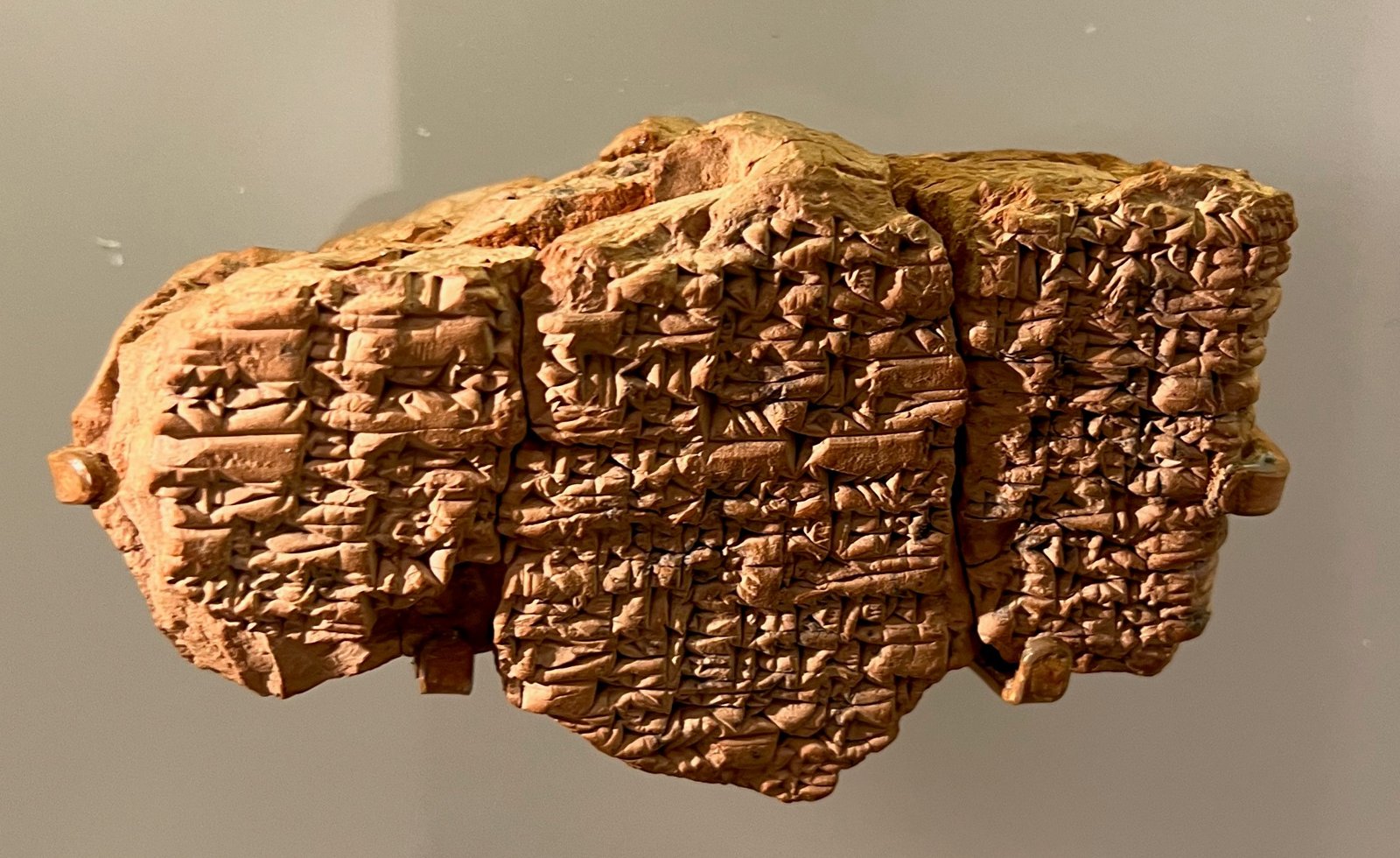
The Sumerian King List is written in SumerianSumerian languageAncient language of southern Mesopotamia, clearly attested in third-millennium BCE texts and maintained in learning and ritual after its spoken use declined.Glossary · Click to read the explanation and survives on clay tablets and prisms. Known findspots include NippurNippur / NuffarAncient Nippur (modern Nuffar, Iraq), major cult centre of Enlil and Ekur; excavations revealed sanctuaries, houses and thousands of cuneiform tablets across many periods.Glossary · Click to read the explanation, Isin, Susa and Tell Leilan. Gösta GabrielGabriel / JibrīlA Semitic theophoric name for an interpreter of visions in Daniel and a messenger in Luke; named Jibrīl in the Qurʾan. His functions depend on each textual context.Glossary · Click to read the explanation’s inventory counts 26 copies, treating joined fragments as parts of the same copy. [6][13] The most complete version is the Weld-Blundell Prism (Ashmolean Museum, AN1923.444), which ends with Sin-magir of Isin. [8] The fragment CBS 14220, in the Penn Museum, was excavated at Nippur. CDLI assigns it to the Old Babylonian period, about 1900–1600 BCE. [7]
The surviving copies form a family of versions. Names, their order and the lengths of reigns vary. [12] The oldest known manuscript ends with Ur-Namma. The scribe’s closing wish for Shulgi’s long life points to his reign as the time of copying. Piotr Steinkeller published this Ur III witness in 2003. [9]
How the list is built
The text follows a repeating formula. A city "receives kingship"; its kings are named, each with a number of years; then a closing line says that the city was defeated and kingship was taken to another. [1][2] Because kingship belongs to a city and not to a family, the word "dynasty" fits only loosely. Labels such as "Kish I" or "Ur III" are modern; the ancient text does not use them. [1]
In the translation of the Electronic Text Corpus of Sumerian Literature (ETCSL), the list falls into two parts. [2]
- Before the flood: five cities (EriduEriduEridu (Abu Shahrain), a multi-mound site in southern Iraq occupied since the Ubaid, later home to a religious precinct associated with Enki. Its eighteen sounding levels are not proof that every early building was a temple.Glossary · Click to read the explanation, Bad-tibira, Larag, Zimbir and Shuruppak) with eight kings, who together reign 241,200 years. [2] Our entries on EriduEriduEridu (Abu Shahrain), a multi-mound site in southern Iraq occupied since the Ubaid, later home to a religious precinct associated with Enki. Its eighteen sounding levels are not proof that every early building was a temple.Glossary · Click to read the explanation and ShuruppakŠuruppakSumerian city at Tell Fara, Iraq, associated with Sud; distinct from Ereš in Enlil and Sud.Glossary · Click to read the explanation describe the first and the last of these places.
- After the flood: the text says "Then the flood swept over," and that kingship came down from heaven again, this time to Kish. [2] It then follows successive transfers through places including E-ana (the temple district of UrukUrukAncient city at Warka in southern Iraq, a major urban centre around 3200 BCE that preserved early writing and accounting tablets.Glossary · Click to read the explanation), Ur, Awan, Hamazi, Akkad (Agade) and Gutium, and ends with Isin. Some cities, including Kish and Uruk, receive kingship more than once. [2]
The closing summary in the ETCSL translation counts eleven cities that held kingship, and gives totals of kings and years. [2]
Famous entries
A few entries explain why the list is so widely quoted.
- Etana of Kish is called a shepherd "who ascended to heaven and consolidated all the foreign countries." [2]
- Gilgamesh is listed as lord of Kulaba, who ruled 126 years, with a father described as a "phantom (?)" in the ETCSL translation. [2] His possible reign at Uruk is known from later traditions, and it remains uncertain whether he was a historical ruler. [10] Our entries on GilgameshGilgameshA king of Uruk in Mesopotamian tradition and the hero of Sumerian poems and a multi-tablet Akkadian epic, with his companion Enkidu, the loss of a friend and the search for life. In standard Tablet XI, Utnapishtim tells him of the flood.Glossary · Click to read the explanation and the Epic of GilgameshEpic of GilgameshA Babylonian literary work with multiple recensions, preceded by separate Sumerian poems on Uruk’s king and Enkidu. Its standard form explores friendship, death, the flood and the limits of seeking eternal life.Glossary · Click to read the explanation treat the literary hero; EnmerkarEnmerkarEnmerkar is a ruler of Uruk in Sumerian literature and the protagonist of a poem about rivalry with Aratta’s lord.Glossary · Click to read the explanation, the hero of poems about Aratta, belongs to the same early Uruk sequence. [1]
- Sargon of Akkad The list presents him as the son of a gardener and says that he served as Ur-Zababa’s cupbearer before becoming king. [2] The Oxford composite gives him 56 years. Other manuscripts give 55 or 54. [2] His story is also told in Sargon and Ur-ZababaSargon and Ur-ZababaFragmentarily preserved Sumerian composition depicting Sargon as Ur-Zababa’s cupbearer and naming his father La’ibum, distinct from the Akkadian birth legend.Glossary · Click to read the explanation; see also Sargon of AkkadSargon of AkkadSargon of Akkad was a historical third-millennium BCE ruler and founder of the Akkadian dynasty; royal accounts of his campaigns must be distinguished from later stories of his birth and rise.Glossary · Click to read the explanation.
- The Gutians In the Oxford composite, the opening of the Gutian sequence describes the first three years as a time when the Gutians were their own rulers. The closing reckoning gives twenty-one Gutian kings. The witness P4+Ha gives twenty-three. [2]
- The last entry is Isin. It begins with Ishbi-Erra, whose reign is given as 33 years in the Oxford composite. The subtotal at the end of the Isin sequence is fourteen kings. The later closing reckoning gives eleven, with sixteen in the witness P4+Ha. [2]
What the numbers are
The reigns before the flood run to thousands of years. After the flood the first kings of Kish still rule for hundreds of years or more. The later reigns are shorter. Different copies sometimes give different figures for the same ruler. For example, the Oxford composite gives Meš-ki-aĝ-gašer of E-ana 324 years, while the witness P2+L2 gives him 325. [2]
How scholars read it
Thorkild Jacobsen published the first critical edition in 1939. He regarded the list as a historical source of considerable value. When reconstructing the sequence at Kish, he replaced certain very long reigns with estimates of about twenty years, or thirty in some cases of succession from father to son. [11] Later studies stress how unevenly the early rulers can be checked against contemporary evidence. [12]
Later work reads the list as a political composition. In their catalogue of witnesses, Walther Sallaberger and Ingo Schrakamp consider it possible that the Ur III manuscript published by Steinkeller drew on an Akkadian-period version. Piotr Michalowski places the composition under Ur III, probably in Shulgi’s reign. [9][12] The Ashmolean interprets the ending of the Weld-Blundell Prism at Isin as a claim that Isin’s rulers were the rightful successors of the earlier kingdoms. [8]
The picture of one king at a time is also a simplification. Other sources show several kingdoms existing side by side, and this is visible even in the late part of the list itself. [1] The sensible modern use is therefore double: the list is evidence for how Old Babylonian and Ur III scribes and rulers imagined the past, and, with checks against inscriptions, a partial guide to the names and order of early rulers.
Reading the fragment today
The photograph shows a small, brown, damaged clay tablet whose lines of wedge-shaped signs run in several columns, with chipped edges. [5] A visitor can see the surface but could not read it without a transliteration. The tablet is a reminder of how the text lived: copied again and again by scribes at Nippur, trusted by some and adapted by others, for centuries.
The flood itself occupies a single sentence in the ETCSL translation: "Then the flood swept over." It is one line in a list, not a story. For the stories of the flood, read the studies elsewhere on this site, such as The Flood Before NoahNoahNoah is the flood-story figure in Genesis and a prophet in the Qur’anGlossary · Click to read the explanation.
References and notes
- Wikipedia, 'Sumerian King List' (secondary summary citing Jacobsen 1939, Michalowski 1983, Steinkeller 2003, Rowton 1960) Whole article in two fetches (about 160,000 characters): manuscripts and sites, recensions, formula, reign figures, Jacobsen and critics, Steinkeller, Gutians, Gilgamesh, Sargon, Isin Return to the text ↑
- Electronic Text Corpus of Sumerian Literature (ETCSL), t.2.1.1, 'The Sumerian king list', translation Header and source note, lines 1-40 (before the flood), the table of post-flood dynasties to Isin (lines 40-377), the closing summary, and the passages on Etana, Gilgamesh, Sargon, the Gutians and Isin Return to the text ↑
- Key to Umbria (web page), 'Mesopotamian Kingship: SKL' (secondary summary of Jacobsen 1939, Steinkeller 2003 and 2017, Michalowski 1983 and 2013) Whole page: summary of the scholarly positions only; the original works were not read Return to the text ↑
- P. Steinkeller, 'An Ur III Manuscript of the Sumerian King List', in Literatur, Politik und Recht in Mesopotamien: Festschrift fuer Claus Wilcke (2003), pp. 267-292 Bibliographic record only (KeiBi, Tuebingen); the article itself was not read Return to the text ↑
- Wikimedia Commons, file 'CBS14220 SKL Penn Museum.jpg' (Onceinawhile, CC BY-SA 4.0; museum label: Tablet, fragment of the Sumerian King List, Nippur, 1900-1600 BC, Penn Museum CBS14220) File page: description, author, licence, dimensions, source Return to the text ↑
- University of Oxford, Electronic Text Corpus of Sumerian Literature, “The Sumerian King List: Bibliography” (2.1.1). Cuneiform sources, the manuscript list and named proveniences. Return to the text ↑
- Cuneiform Digital Library Initiative, “CDLI Literary 000371, ex. 003,” P269188. Museum Number, Chronology and Provenience, Penn Museum CBS 14220, Nippur, Old Babylonian. Return to the text ↑
- Ashmolean Museum, University of Oxford, “Sumerian King List,” Weld-Blundell Prism AN1923.444. Description of the most complete witness, the last named ruler Sin-magir, and the interpretation of Isin’s position at the end. Return to the text ↑
- Piotr Michalowski, “The Mortal Kings of Ur: A Short Century of Divine Rule in Ancient Mesopotamia,” in Religion and Power: Divine Kingship in the Ancient World and Beyond, ed. Nicole Brisch (Oriental Institute of the University of Chicago, 2008), pp. 33–45. P. 38, the Ur III witness published by Steinkeller, Shulgi’s subscript and Michalowski’s dating of the composition. Return to the text ↑
- Ira Spar, “Gilgamesh,” The Metropolitan Museum of Art, April 2009. Opening discussion of the literary tradition concerning the king of Uruk and uncertainty about his historicity. Return to the text ↑
- Thorkild Jacobsen, The Sumerian King List, Assyriological Studies 11 (University of Chicago Press, 1939). Pp. 167–168, the conclusion on historical value and the test case using estimated reign lengths at Kish. Return to the text ↑
- Walther Sallaberger and Ingo Schrakamp, “Philological Data for a Historical Chronology of Mesopotamia in the 3rd Millennium,” in History & Philology, ARCANE III, ed. Walther Sallaberger and Ingo Schrakamp (Brepols, 2015). §2.1, the discussion of how to use the list, catalogue entry USKL and the variants across surviving manuscripts. Return to the text ↑
- Gösta Ingvar Gabriel, Die ‚Sumerische Königsliste‘ als Werk der Geschichte: Kritische Edition sowie text-, stoff- und konzepthistorische Analyse (Habilitationsschrift, Freie Universität Berlin, 2020). §1.2, table 1.1 and the following paragraph on the 26 copies counted with joins. Return to the text ↑
Archive records may be reviewed and refined as better evidence or sources become available. Suggest a correction
Suggest a correction · Suggest a source for this record
Cite this record
IL Archive, «The Sumerian King List: Kings Before and After the Flood, and Cities Taking Turns at Kingship», https://ilarchive.com/en/texts/sumerian-king-list
Continue reading
Related readings