Artifact
The Tablet of Destinies
An object record bringing together its image, metadata, rights, and context.
- Names
- Tablet of Destiny · ṭuppi šīmāti
- Region
- Mesopotamia
Mesopotamian poems imagine a tablet that gives force to divine commands. Anzu steals it from Enlil, while the Babylonian creation poem traces its passage from Tiamat through Qingu and Marduk to Anu.
Estimated reading time: 5 min Published Last reviewed:
Share article
Photograph
Zunkir, Wikimedia Commons, CC BY-SA 4.0
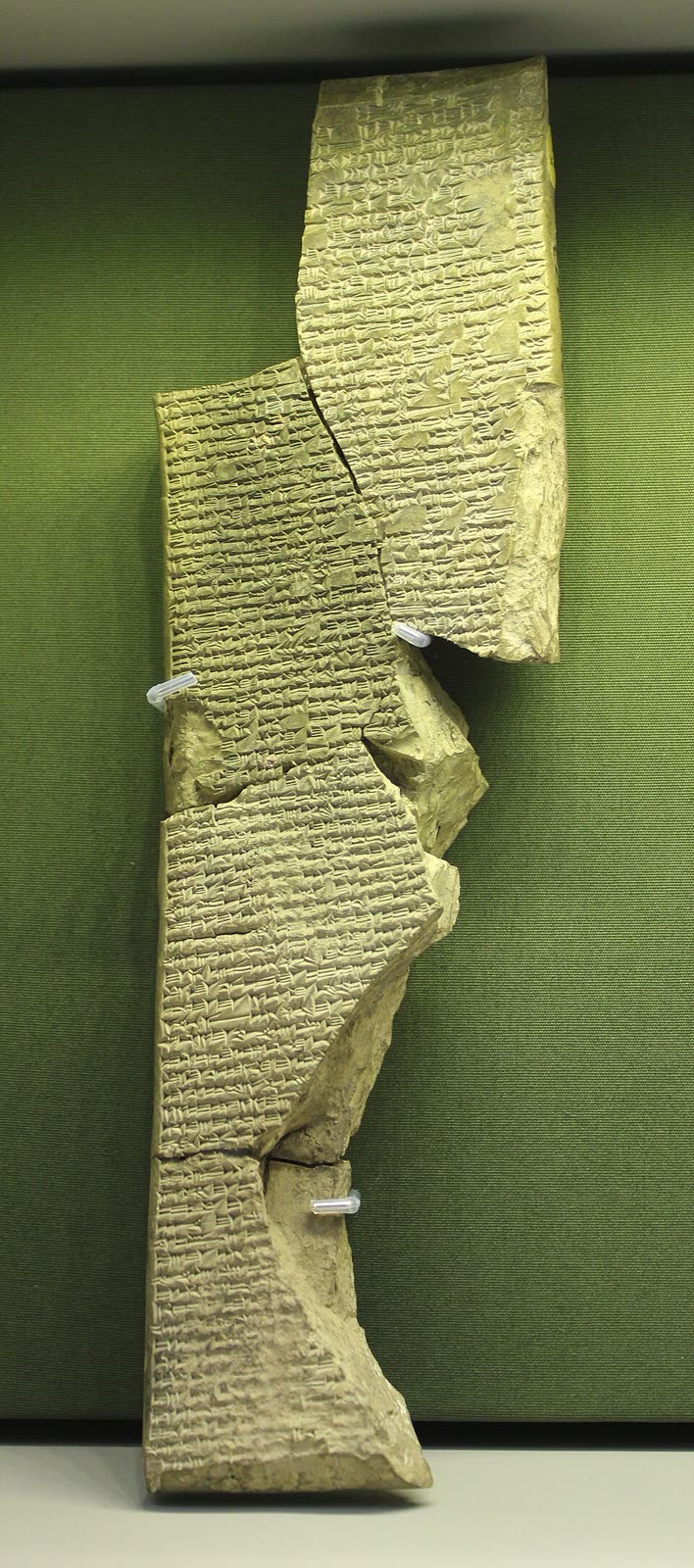
Enuma Elish Tablet III, British Museum K.3473 and joins, from Nineveh. The manuscript preserves part of the account of Tiamat giving the Tablet of Destinies to Qingu
License · Image sourceObject details
- Title
- The Tablet of Destinies
- Region
- Mesopotamia
- Rights
- CC BY-SA
Text
Introduction
The Tablet of Destinies is an object in Mesopotamian literature whose possession can make a god’s commands effective. In the AkkadianAkkadianAn ancient East Semitic language written in cuneiform from the third millennium BCE; its varieties include Babylonian and Assyrian, and it served in international diplomacy.Glossary · Click to read the explanation poem of Anzu, a bird seizes it from EnlilEnlilEnlil/Ellil: a major Mesopotamian god associated with destinies, kingship, and Ekur at Nippur, already prominent in third-millennium god lists. His name’s origin and cult beginnings remain debated.Glossary · Click to read the explanation. In the Babylonian creation poem Enuma ElishEnuma ElishA seven-tablet Babylonian creation poem in Akkadian, recounting Marduk’s rise, victory over Tiamat, cosmic ordering and human creation, and culminating in praise through fifty names. Its composition date is debated; later manuscripts and recitation traditions preserve it.Glossary · Click to read the explanation, TiamatTiamatTiamat is a primeval divine mother and watery figure in Enūma eliš who later opposes Marduk; he divides her body in making the cosmos. No Babylonian portrait of her is securely identified.Glossary · Click to read the explanation gives it to QinguQinguQingu (Kingu): a god whom Tiamat appoints commander and gives the Tablet of Destinies; captured after Marduk’s victory, his blood is used to make humans in Tablet VI.Glossary · Click to read the explanation, and MardukMardukBabylon’s leading god, worshipped at Esagil and elevated in the Akkadian Enūma eliš. His symbols include a spade and mušḫuššu dragon. His earliest origins remain obscure; Nibiru is no evidence of a planetary homeland.Glossary · Click to read the explanation takes and seals it after defeating her side. The surviving evidence consists of manuscripts and inscriptions that describe the tablet. The photograph shows a clay manuscript that preserves one such passage. [1] [2] [3]
Enlil’s authority seized
In the poem of Anzu, the bird plans to hold the gods’ responsibilities, occupy the throne, and direct the divine assembly. He waits by the entrance to Enlil’s chamber. When the god is bathing and his crown is set aside, Anzu takes the tablet. The passage gives this act a consequence greater than the loss of a possession. In the translation discussed by Eleanor Robson, the bird has seized the power of Enlil’s office along with the object that embodies it. The subsequent search for a divine champion turns on the difficulty of recovering that authority. [1]
Ninurta ultimately confronts Anzu. In the first confrontation, the bird commands the parts of his opponent’s equipment to go back to their origins. The shaft is told to return to its reeds and the feathers to the birds. The text places the tablet in Anzu’s hand as he gives these orders. Robson reads the episode as a reversal of time, with things that artisans have already shaped ordered back toward earlier states. The story gives the tablet practical force by showing the strange effects of the commands issued in its presence. Ninurta eventually recovers it for Enlil. [1]
Tiamat, Qingu and Marduk
In Enuma Elish Tablet I, Tiamat raises Qingu above the gods in her force and entrusts him with command. She attaches the tablet to his chest and declares that his utterance will hold. Tablet III retells this elevation in a messenger’s account. The clay witness shown here is from the Neo-Assyrian collection at KuyunjikNineveh and KuyunjikNineveh is an ancient Assyrian city near Mosul in northern Iraq; Kuyunjik is one of its archaeological moundsGlossary · Click to read the explanation, ancient Nineveh. In the manuscript represented by fragment K.3473 and its joins, the signs for the tablet appear in Tablet III, line 47, where the retelling reaches Tiamat’s transfer of the object. The next line concerns the force of Qingu’s command. [2] [3] [4]
The assembled gods also grant Marduk authority before he confronts Tiamat. At the start of Tablet IV they give him a princely seat and declare that his command will stand. After the victory, Marduk takes the tablet from Qingu, seals it, and fastens it to his own breast. The narrator says Qingu had no rightful claim to it. Tablet V then describes Marduk presenting it to Anu. This last transfer matters because the conferral of command and the eventual destination of the tablet are narrated as distinct events. The tablet passes from one bearer to another while the poem continues to establish Marduk’s standing among the gods. [2] [5]
The tablet returns to the Abzu
The Sumerian composition conventionally called Ninurta and the Turtle connects a tablet of destinies with the Abzu, the realm of EnkiEnkiMesopotamian deity also known as Ea, linked with Eridu and the Abzu (deep fresh waters), wisdom, incantations, and narratives of creation and cosmic order. Later written attestations do not identify the deity of Eridu’s earliest layers.Glossary · Click to read the explanation. The opening is fragmentary. In the surviving speech, the Anzud chick tells Ninurta that the divine powers and a divine plan returned to the Abzu when he lost possession of them. The tablet is said to have returned there as well. Ninurta and the bird then approach Enki’s place. Enki initially honors Ninurta, and later fashions a turtle from the clay of the Abzu when the hero raises his hand against Enki’s minister Isimud. The surviving episode places the return of the tablet inside a dispute at Enki’s domain. [6]
A seal and a royal prayer
The poems describe the object through acts familiar from the handling of documents. It is held in the hand, fastened to the body and sealed. Szilvia Sövegjártó compares the importance of physical possession in these passages with the transfer of legal documents when debts were repaid or property changed hands. The analogy helps explain the force of Marduk’s sealing gesture. A reader could recognize in this divine transfer a wider practice of establishing and protecting a claim through possession of an authenticated document. [2] [5]
There is also an Assyrian royal reference. A joined clay tablet from Kuyunjik, K 6177 and K 8869, preserves a text attributed to Sennacherib that describes the Tablet of Destinies in connection with Aššur, the god of Assur. Andrew George argues that the description may refer to an image of the god made by a seal impression, followed by a representation of the king paying homage. The text ends with a prayer for the king. A. Kirk Grayson and Jamie Novotny discuss the possibility that the copy or draft relates to inscriptions on metal plating for a cult installation. The clay manuscript is a witness to the written royal description and its interpretation remains distinct from the enacted transfers in the poems. [7] [8]
The language of taking, carrying and sealing allows each composition to give visible form to an otherwise intangible claim. Anzu’s possession disrupts an established office, Tiamat’s gift installs a commander, and Marduk’s sealing accompanies a transfer judged legitimate by the poem. The royal inscription adapts the same vocabulary to a scene of divine authority and a king’s homage. [1] [2] [7]
References and notes (8)
- Eleanor Robson, Scholarly Conceptions and Quantifications of Time in Assyria and Babylonia pp. 74–76, Anzu Tablets I and II in Dalley’s translation and their interpretation Return to the text ↑
- Wilfred G. Lambert, Babylonian Creation Myths Enuma Elish I 145–162, III 37–52 and witness A, IV 1–14 and 119–122, V 69–70 Return to the text ↑
- British Museum, Cuneiform tablet telling the Epic of Creation Collection record for K.3473, material, findspot and period, via Google Arts & Culture Return to the text ↑
- Theosis Library, Enuma Elish, Tablet III Manuscript presentation of the eBL edition, section 29–55, Akkadian traces at lines 47–48 Return to the text ↑
- Szilvia Sövegjártó, Divine Authorship in the Mesopotamian Literary Tradition Manuscript Cultures 21, pp. 12–13, physical possession, seals and legal analogy Return to the text ↑
- Electronic Text Corpus of Sumerian Literature, Ninurta and the turtle 1.6.3, segment B 1–46, surviving Sumerian narrative in translation Return to the text ↑
- A. R. George, Sennacherib and the Tablet of Destinies Article extract, identification and interpretation of Text B on the joined fragment Return to the text ↑
- A. Kirk Grayson and Jamie Novotny, The Royal Inscriptions of Sennacherib, Part 2 Introduction, pp. 20–22 and note 56, link proposed between text 158 and cult furnishings Return to the text ↑
Archive records may be reviewed and refined as better evidence or sources become available. Suggest a correction
Suggest a correction · Suggest a source for this record
Cite this record
IL Archive, «The Tablet of Destinies», https://ilarchive.com/en/artifacts/tablet-of-destinies