Entity · Concept
Dating texts
A reference page linking a name, group, or concept to the materials that discuss it.
How ancient texts are dated: distinguishing a story’s setting, the development of a work and the age of its witness, with Sargon, parchment and the Dead Sea Scrolls.
Estimated reading time: 8 min Published Last reviewed:
Share article
Text
Introduction
How can we tell when an ancient text was written? A tablet may tell the story of a king who lived centuries before its scribe; a late manuscript may preserve a version of an older work. Dating texts therefore involves three different questions: when the narrated events are set, when a work took shape and was revised, and when the surviving physical witness was produced. These questions do not necessarily have one answer.
This article examines what a witness's material, handwriting and archaeological context can tell us, and what comparison among copies and scientific measurements can add. A tablet from NinevehNineveh and KuyunjikNineveh is an ancient Assyrian city near Mosul in northern Iraq; Kuyunjik is one of its archaeological moundsGlossary · Click to read the explanation and manuscript evidence from other traditions demonstrate how to state a date together with its grounds and degree of uncertainty, rather than borrow a date from a story's protagonist or a sheet of parchment.
Three times that must be distinguished
Narrated time is when the events take place within a story, whether the setting is historical or an imagined past. Composition time is when a literary form emerged, materials were assembled or a work underwent editing; it may cover several phases rather than one act of authorship. Witness date refers to the manufacture or inscription of the particular tablet or manuscript we can actually examine. The dates of modern translations and scholarly editions form a further, separate layer.
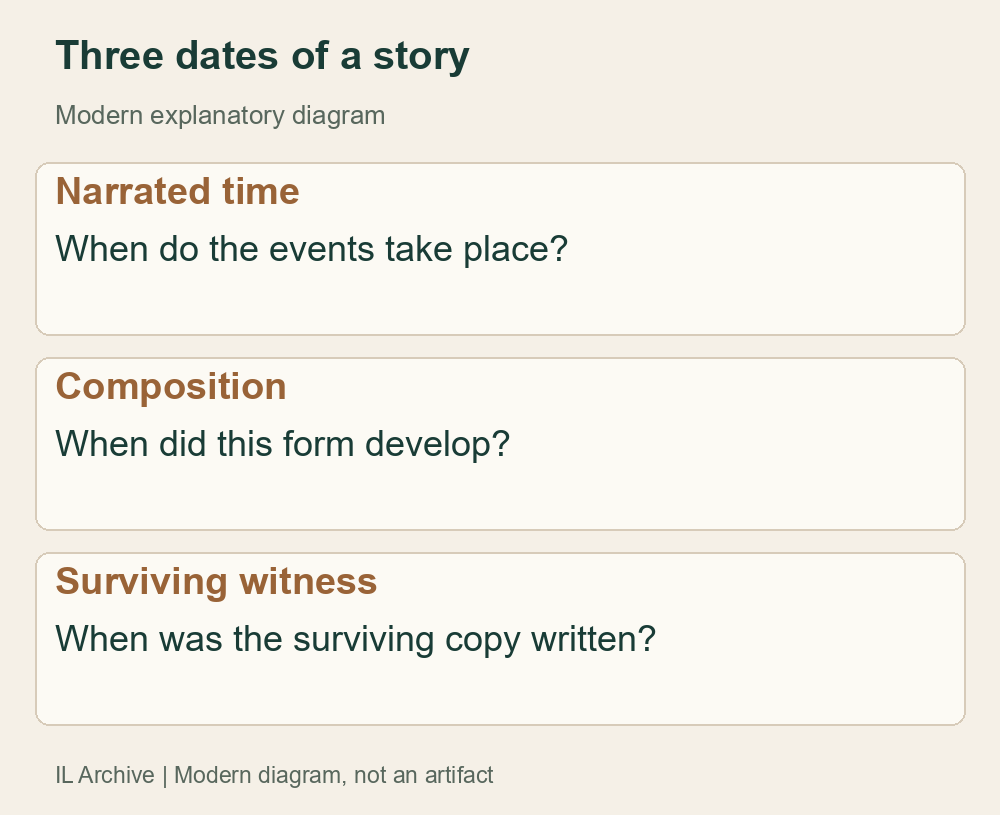
If a manuscript securely places a particular passage in the seventh century BCE, it demonstrates that the passage, or its attested form, existed by then. It does not prove that the passage was composed in that century. The story may be much older, but determining how much older requires other evidence. We therefore distinguish the earliest known witness from a hypothesized first composition, and a text physically preserved on one object from a composite edition reconstructed out of multiple objects.
How is a surviving witness dated?
The first step is to describe the object: clay, parchment or paper; dimensions; damage, joins and findspot. Documented archaeological context, especially a sealed deposit associated with independently dated finds, can help constrain chronology. A museum registration number or a modern discovery date, on the other hand, is not the date of writing. An object removed from its archaeological context without adequate records has lost a valuable source of evidence.
Palaeography, the study of historical forms of writing, compares the shapes of signs, the direction of strokes and scribal habits with more securely dated specimens. It provides relative evidence, not an automatic calendar year: older styles may persist and scribal schools may differ. Ruler names, dated formulas, linguistic features and scribal notes can strengthen an assessment, but a king named in a narrative does not automatically date the act of copying.
Methods also depend on the material. Radiocarbon analysis is useful for organic matter such as parchment, not for directly dating cuneiformCuneiformWriting with wedge-shaped signs, developed from Mesopotamian recording traditions and used for several languages from the third millennium BCE.Glossary · Click to read the explanation strokes pressed into clay. When an explicit date occurs in a manuscript's final note, we still have to ask whether it dates the existing copy or an exemplar mentioned by the scribe, and whether the note belongs to the same phase as the manuscript.
From the copy to the history of the work
The next step is collation of witnesses: which words are shared, and where do passages differ in order, expansion or omission? Differences may indicate revision or alternative recensions, but they can also arise from copying mistakes. Relationships between witnesses are tested against patterns of readings, errors and contextual evidence, rather than a single similar phrase. A critical edition assembling lines from multiple tablets does not constitute another ancient tablet.
Language, literary form and references to institutions or datable events may help establish a plausible period of composition. An allusion to a known event may support a date after it if the passage can be shown to refer back to that event; in another context it might be a prophecy within the narrative or a later addition. Archaic language, too, may preserve an old layer or imitate one, and cannot date an entire work on its own. A justified range and the reasons for and against it are more informative than an unsupported single year.
Nineveh: a third-millennium king and a later tablet
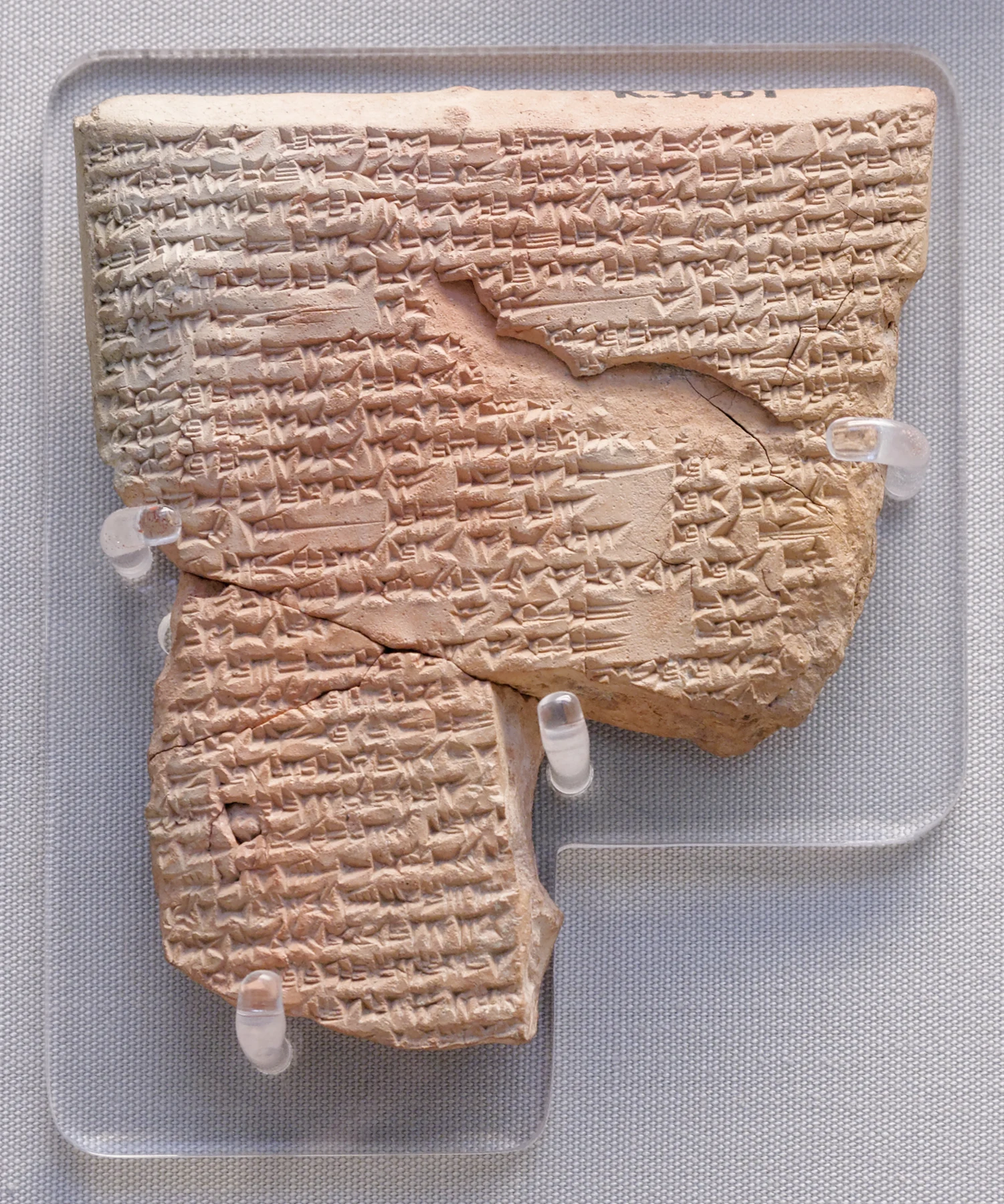
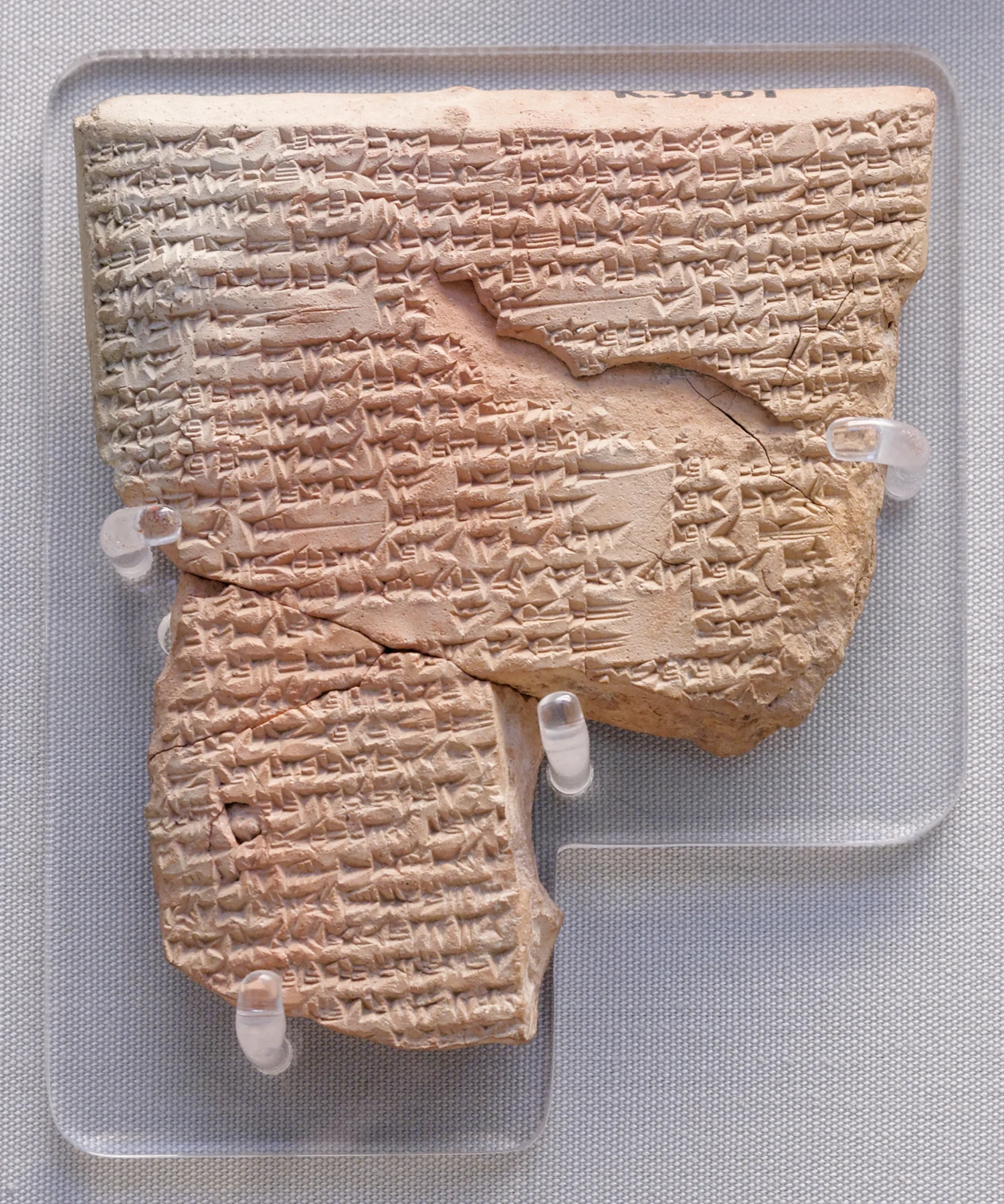
The Cuneiform Digital Library Initiative, or CDLI, catalogs witness P365306 as an AkkadianAkkadianAn ancient East Semitic language written in cuneiform from the third millennium BCE; its varieties include Babylonian and Assyrian, and it served in international diplomacy.Glossary · Click to read the explanation literary clay tablet from Nineveh (Kuyunjik)Nineveh and KuyunjikNineveh is an ancient Assyrian city near Mosul in northern Iraq; Kuyunjik is one of its archaeological moundsGlossary · Click to read the explanation, in present-day northern IraqIraqIraq is a modern country encompassing much of ancient MesopotamiaGlossary · Click to read the explanation, belonging to the Neo-Assyrian period (approximately 911–612 BCE). Its joined museum identifiers are K.3401 + Sm.2118: these identify a particular physical witness, not every version of the story. [1]
The British Museum describes K.3401 as a clay-tablet fragment transmitting a legend concerning the birth of Sargon of AkkadSargon of AkkadSargon of Akkad was a historical third-millennium BCE ruler and founder of the Akkadian dynasty; royal accounts of his campaigns must be distinguished from later stories of his birth and rise.Glossary · Click to read the explanation, associated with the library of AshurbanipalAshurbanipalAshurbanipal was an Assyrian king of the seventh century BCE, reigning about 668–631 BCEGlossary · Click to read the explanation. Sargon of Akkad ruled in the late third millennium BCE; he must not be confused with Sargon IISargon IISargon II was an Assyrian king of the late eighth century BCE; ORACC dates his reign about 721–705 BCEGlossary · Click to read the explanation, a much later Assyrian king. The museum's identification establishes the fragment's subject and Neo-Assyrian copying context, not that it was written during the lifetime of its protagonist. [2] [3]
It is equally important to separate tablet K.3401Sargon birth tablet K.3401Akkadian clay tablet from Nineveh preserving Sargon’s birth story in the Neo-Assyrian period, many centuries after the king’s lifetime.Glossary · Click to read the explanation from the Sargon Birth LegendSargon Birth LegendAn Akkadian pseudo-autobiography of Sargon’s concealed birth, basket rescue and rise to kingship; its manuscripts are late and the date of composition disputed.Glossary · Click to read the explanation as a textual work whose witnesses and transmission can be studied. Moving directly from the tablet's later date to a date for the first shaping of every detail of the legend would exceed the evidence. An earlier origin may be argued for, but that argument needs independent witnesses and reasoning; the antiquity of the king or the remarkable birth motif is not itself a date.
What can scribal colophons tell us?
In MesopotamiaMesopotamiaHistorical region associated with the Tigris and Euphrates: Uruk, Ur, Eridu, cuneiform, Sumer, Akkad, Babylon and Assyria, their languages and cults, and the limits of archaeological evidence.Glossary · Click to read the explanation, scribes sometimes added a colophon, a note at the end of a tablet. It might record ownership, the scribe, an exemplar from which the text was copied, or a date. The British Museum-associated Ashurbanipal Library Project explains that royal-library colophons are not uniformly dated and that many identify ownership rather than the year of production; the collection also includes tablets with other individuals' colophons. A phrase naming the 'Palace of Ashurbanipal' does not therefore yield an exact copying date. [4]
This describes a practice in the wider collection; it does not claim that the Sargon birth tablet K.3401 itself contains a colophon of the type discussed. Nor does a scribe's assertion that a tablet was copied 'according to the original' prove that every word escaped change, or reveal when that exemplar was first composed.
Dating parchment: the Birmingham example
The Cadbury Research Library at the University of BirminghamBirmingham, United KingdomBirmingham is a city in England whose university preserves early Qur’anic parchment leavesGlossary · Click to read the explanation holds a Qur'an manuscript bifolio catalogued Mingana Islamic Arabic 1572a, preserving passages from surahs 18, 19 and 20. The university reports that radiocarbon analysis places the parchment in a calibrated interval of 568–645 CE, at 95.4% probability, alongside palaeographic identification of its Hijazi script. The measurement concerns the organic writing support, not the exact day on which its letters were written or the first composition of the passages. The university also states that the manuscript's place of production and scribe remain uncertain. [5]
This example shows why laboratory evidence, handwriting and historical analysis must be considered together. Measuring the age of animal skin is not a reading of the text; an early date for the skin does not eliminate a possible delay before writing. The bifolio witnesses particular passages that survive on it, not the earliest date of every work or collection to which those passages subsequently belonged.
The Dead Sea Scrolls: revising a chronology
In a 2025 study, Mladen Popović and colleagues combined radiocarbon measurements with handwriting-shape analysis to date samples of the Dead Sea ScrollsDead Sea ScrollsManuscript collections from the Judaean Desert, best known through Qumran: diverse works, languages and textual forms, with copying distinguished from composition.Glossary · Click to read the explanation. They trained a model named 'Enoch' using 24 radiocarbon-dated samples, then examined its predictions for 135 previously undated manuscripts. Expert reviewers of these predictions judged 107, or about 79%, plausible. This was a post-hoc assessment of plausibility, not proof that 79% of the manuscripts have independently established writing years. The researchers envisage refinement as the dated sample grows. [6]
One witness, 4Q114, preserves sections of Daniel 8–11. The paper reports an accepted calibrated approximately 95% range of 230–160 BCE for this manuscript, overlapping with a scholarly proposed composition period for part of Daniel in the 160s BCE. The authors expressly distinguish their selected accepted range from the full calibrated probability distribution. Chronological overlap does not establish that the manuscript was written by the work's author or that the entire work arose in a single year. Dating its literary composition remains a separate argument based on the text. [6]
How to communicate a dating claim
Conclusions differ in strength. It may be documented that an object belongs to a museum and was excavated at Nineveh, probable that it was copied during a broad historical period, while the date when its story first took shape remains unknown. Multiple independent witnesses and convergent linguistic and historical arguments can narrow a plausible range; merely repeating the date of one witness cannot.
A useful discussion of textual dating therefore identifies the object and inventory number when known; the language and literary type; the proposed witness date and the method behind it; the distinct question of composition; and variants or losses that affect the conclusion. Reconstructed words must not be presented as if they survived on a broken object, nor should the photograph of one tablet stand as proof of lines assembled from others. New finds can change earlier chronologies; dating claims should therefore remain open to revision, with their evidential status clearly stated.
References and notes (6)
- CDLI, artifact P365306, “CT 13, pl. 42, K 03401 +”; joined inventory K 03401 + Sm 2118. Artifact fields: Akkadian, literary genre, Nineveh, Neo-Assyrian period and joined inventory; no independent reading of the cuneiform. Return to the text ↑
- British Museum, collection record K.3401, “tablet”, W_K-3401. Description, period, findspot and Ashurbanipal Library association, from the indexed museum-record excerpt; direct access returned HTTP 403. Return to the text ↑
- British Museum, authority record “Sargon I”, BIOG62864. Indexed authority entry and approximate reign (2334–2279 BCE); not a full biography. Return to the text ↑
- Jonathan Taylor, “Colophons”, Ashurbanipal Library Project (British Museum / ORACC), 2022. Indexed page excerpts on the definition and varieties of colophons; full-page access timed out or failed; no colophon on K.3401 examined. Return to the text ↑
- University of Birmingham, Cadbury Research Library, “The Birmingham Qur’an: Frequently Asked Questions”. Sections identifying Mingana Islamic Arabic 1572a, the calibrated parchment result (568–645 CE, 95.4%), the script and the limits on provenance. Return to the text ↑
- Mladen Popović et al., “Dating ancient manuscripts using radiocarbon and AI-based writing style analysis,” PLOS ONE 20 (2025): e0323185, doi:10.1371/journal.pone.0323185. Abstract, §§1, 2.1–2.2, 4–6, Fig. 1 and Table 2 in the open full-text article; the twelve supplements and underlying model code were not read in full. Return to the text ↑
Suggest a correction · Suggest a source for this record
Cite this record
IL Archive, «Dating texts», https://ilarchive.com/en/entities/dating-texts
Continue reading