Person · Literary figure
Lugal-Ane
- Names
- Lugal-Ane · Lugalanne
- Region
- Mesopotamia
The rebel named in the Exaltation of Inanna, who drove the high priestess Enheduanna from her temple. Almost all we know of him comes from that one poem.
Estimated reading time: 6 min Published Last reviewed:
Share article
Text
Introduction
Lugal-Ane is the villain of the Exaltation of InannaInanna / IshtarA prominent Mesopotamian goddess whose Sumerian name Inanna became associated with Akkadian Ishtar across diverse traditions. She was associated with desire, war, royal authority and Venus, while local forms and genealogies varied among texts.Glossary · Click to read the explanation, a Sumerian poem in which Enheduanna, high priestess of the moon god and daughter of Sargon of AkkadSargon of AkkadSargon of Akkad was a historical third-millennium BCE ruler and founder of the Akkadian dynasty; royal accounts of his campaigns must be distinguished from later stories of his birth and rise.Glossary · Click to read the explanation, tells how she was thrown out of her temple. In the poem he is a rebel who seizes holy places, drives her into exile and dares to make himself her equal. She asks the goddess InannaInanna / IshtarA prominent Mesopotamian goddess whose Sumerian name Inanna became associated with Akkadian Ishtar across diverse traditions. She was associated with desire, war, royal authority and Venus, while local forms and genealogies varied among texts.Glossary · Click to read the explanation to bring him down. [1][2]
Almost everything we know about him comes from this one poem, and the poem is a prayer, not a chronicle. Outside it, a similar name appears in a later story about a great revolt against the AkkadianAkkadianAn ancient East Semitic language written in cuneiform from the third millennium BCE; its varieties include Babylonian and Assyrian, and it served in international diplomacy.Glossary · Click to read the explanation kings, and scholars disagree on whether the two are the same man. This entry sets out what the poem says, how it has been read, and where the evidence stops. [3][4]
What the poem says
The Exaltation of Inanna has 154 lines in the Oxford edition. The speaker is Enheduanna, high priestess of NannaNanna / Su’en / SinMesopotamian moon god known as Nanna, Su’en and Sîn/Sin. Worshipped especially at Ur and Harran, he is associated with the crescent and lunar cycle; names and myths have different histories.Glossary · Click to read the explanation, the moon god of UrUr of the ChaldeansCity named in Genesis’s account of Abraham’s family, commonly associated with archaeological Ur near Nasiriyah in southern Iraq.Glossary · Click to read the explanation. In the middle of the poem she turns to Nanna, also called Suen, and asks him to tell An, the god of heaven, about "Lugal-ane and my fate". The Sumerian text writes his name only twice, in lines 74 and 77. Elsewhere he is simply "he" or "this man", though some translations add the name for clarity. [1][2]
The charges against him are serious. He has disturbed the purification rites of An, the ritualsRitualAn organised or distinguished practice meaningful to a community; it may leave traces, but its form alone does not reveal an associated doctrine.Glossary · Click to read the explanation that kept priests and holy objects clean. He has "stripped An of the E-ana": the EannaEanna at UrukAn archaeological precinct and institutional centre at Uruk associated with Inanna; its name does not fix every early building’s function.Glossary · Click to read the explanation, the great temple of An and Inanna at UrukUrukAncient city at Warka in southern Iraq, a major urban centre around 3200 BCE that preserved early writing and accounting tablets.Glossary · Click to read the explanation, about 55 kilometres from Ur. He does not fear the greatest of the gods, and he has turned the temple into "a house of evil". In Sophus Helle's reading, envy drove him to make himself her equal. [1][2]
Then the poem describes her fall. He stepped out of the temple in triumph and made her fly "like a swallow" through the window. In Helle's translation:
He then handed her a knife and a dagger and told her they suited her. Helle notes that this may be a taunt: a hint that she should take her own life, or a mockery of her, since these blades belonged to ritual performers who crossed the usual roles of men and women. [2]
Nanna does not answer her. So she prays to Inanna, praises her power, and asks her to chase and seize "this man". At the end the goddess accepts the prayer and her heart is calmed. The poem never describes what became of Lugal-Ane. [1][2]
Lines that can be read in more than one way
Sumerian verbs often leave the doer unnamed, so translators must decide who did what. The lines about Lugal-Ane are among the hardest in the poem. [2]
- Line 74: the Oxford translation has "tell An about Lugal-ane and my fate". Helle reads "My fate, Suen, this Lugal-Ane", meaning he will be the death of her. Benjamin Foster reads it as a question: "is this Lugalanne my destiny?" [1][2]
- Line 77: some take it to mean that Inanna will take away his good fortune. Pascal Attinger reads it as saying that a woman, Inanna, will be his death. [2]
- Line 90: Helle reads envy. Others see a man who came close pretending to be a partner. William Hallo and J. J. A. van Dijk, and later Foster, saw a sexual advance; Helle rejects this. [2][3]
- Line 104: the older reading "he forced me out of the temple" is now doubted because of how most copies write the verb. [2]
Ur or Uruk?
Popular retellings often call Lugal-Ane a ruler of Ur. The poem never names his city. What it says is that he took Enheduanna's place and the Eanna temple of Uruk. Helle concludes that he seems to have held both cities. [2]
In the first full edition of the poem (1968), Hallo and van Dijk saw him as a usurper at Uruk. In their reading, Uruk rose against the Akkadian kings, and Ur at least did not stand by them, so Enheduanna lost her place in both cities. They add that excavations at the Eanna show a gap in building during the Akkadian period, which might fit the charge that he ruined the temple. They offer this only as a possibility. [3]
Evidence outside the poem
The Akkadian king Naram-Sin, Sargon's grandson, faced a "Great Revolt" across southern MesopotamiaMesopotamiaHistorical region associated with the Tigris and Euphrates: Uruk, Ur, Eridu, cuneiform, Sumer, Akkad, Babylon and Assyria, their languages and cults, and the limits of archaeological evidence.Glossary · Click to read the explanation. His own inscriptions, known from later copies, name two rebel leaders: Iphur-Kish of Kish in the north and Amar-girid of Uruk in the south. Naram-Sin won, and was then honoured as a living god. Hallo and van Dijk note that Enheduanna was still in office in his reign. [3][5]
Centuries later, scribes retold the revolt as a story. One Old Babylonian tablet, now in Geneva (MAH 10829), lists the rebel kings, and among them is "Lugal-Anna king of Uruk". Hallo and van Dijk found it hard to separate this figure from the villain of the poem. They also cite the same name, spelled Lugal-an-ne, in a document of the Akkadian period, and suggest it may be a short form of a longer royal name. [3][4]
The limits are clear:
- The Geneva tablet is a later retelling, and such retellings changed details freely. Naram-Sin's own inscriptions name Amar-girid, not Lugal-Anna, as the leader at Uruk. [4][5]
- No inscription, seal or building record from his own time is known that names this man as a ruler.
- Scholars still debate whether Enheduanna wrote the poem herself or later scribes wrote it in her name. If it is later, Lugal-Ane may be partly a figure of story.
So Lugal-Ane may echo a real rebel of Naram-Sin's time, but this cannot be proved.
How the poem reached us
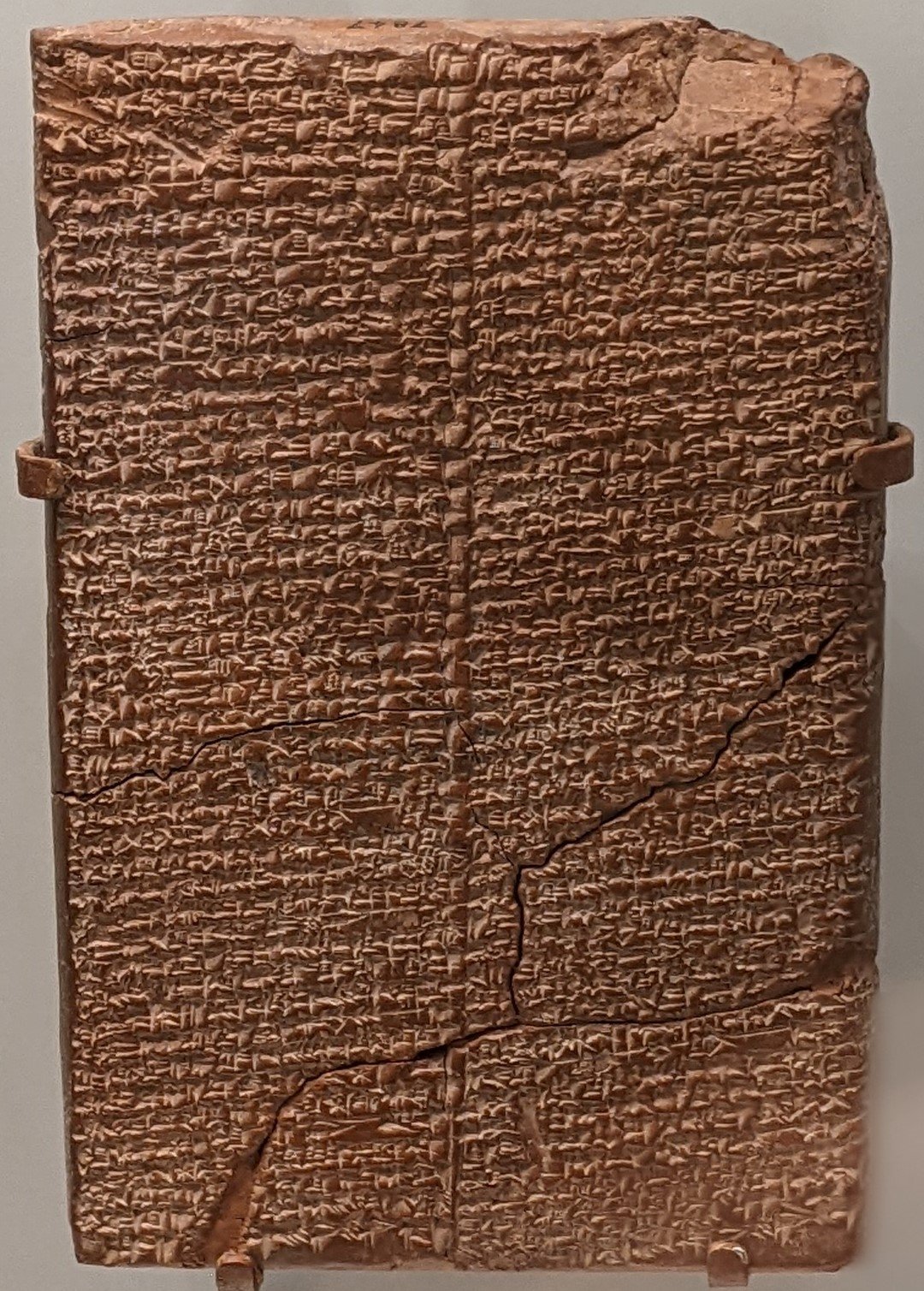
The poem survives on clay tablets copied in the scribal schools of the Old Babylonian period, several centuries after Enheduanna. Annette Zgoll's 1997 edition used 107 manuscripts, and more have come to light since. One nearly complete copy from Nippur, written in four columns, is in the Penn Museum (CBS 7847). [2][6]
Quick answers
Who was Lugal-Ane?
The rebel who, in the Exaltation of Inanna, takes over the temples and drives the high priestess Enheduanna into exile. [1][2]
Was he a real person?
Possibly. A later story names a Lugal-Anna of Uruk among the rebels against Naram-Sin, but no record from his own time confirms it. [3][4][5]
References and notes (6)
- J. A. Black, G. Cunningham, E. Robson and G. Zólyomi, “A hymn to Inana (Inana B),” c.4.07.2, The Electronic Text Corpus of Sumerian Literature, Oxford, 1998–2006 English translation, lines 66–110 (Suen asked to speak to An about Lugal-ane, the indictment in lines 81–90, the expulsion) and lines 122–154 (the appeal to Inana and her acceptance); the poem has 154 lines. Return to the text ↑
- Sophus Helle, “The Exaltation of Inana,” annotated line-by-line translation, enheduana.org, 2022 P. 1 (introduction and textual basis: Hallo and van Dijk 1968, Zgoll 1997 with 107 manuscripts, Delnero 2006, Attinger); commentary on lines 74–110 (readings of lines 74, 77, 86, 88–90, 104–108 by Helle, Black et al., Foster, Zgoll and Attinger) and line 146. Return to the text ↑
- William W. Hallo and J. J. A. van Dijk, The Exaltation of Inanna, Yale Near Eastern Researches 3, Yale University Press, 1968 Pp. 1–2 (Enheduanna in office under Naram-Sin), p. 9 with n. 59 (Lugalanne/Lugalanna in the tradition of the great revolt against Naram-Sin; spellings Lugal-an-ne and Lugal-an-na), pp. 56–59 (commentary on the Lugalanne stanzas: usurper at Uruk, Ur's failure to side with the Akkadian king, the gap at the Eanna in the Sargonic period, the possible longer names), and the glossary entry lugal-an-ne. Return to the text ↑
- Sources of Early Akkadian Literature (SEAL), “MC 7, 16B (The Great Revolt against Narām-Sîn B),” Geneva, Musée d'Art et d'Histoire MAH 10829; editions Boissier 1919, Westenholz 1997: 238–245, Haul 2009: 319–329 Whole entry: catalogue data, transliteration and translation; lines 12–15 (the rebel cities) and lines 27–38 (the list of rebel kings, line 36 “Lugal-Anna king of Uruk”). Return to the text ↑
- Seyed Shahrooz Tavakoli and Hossein Badamchi, “The Great Revolt against Naram-Sin: Historical Tradition and Literary Representation,” Historical Sciences Studies 17/2 (2025–2026): 75–94 Pp. 75–77 (English abstract and extended summary: the royal version in Old Babylonian copies, the coalitions of Iphur-Kish of Kish and Amar-girid of Uruk, Naram-Sin's deification, the later literary versions including the Geneva text). Return to the text ↑
- Penn Museum (University of Pennsylvania Museum of Archaeology and Anthropology), “Tablet,” object CBS7847, collection record Whole record: Old Babylonian period, Nippur, clay, 20.5 × 13.5 × 3.5 cm; literary text Inanna B (ETCSL 4.07.02), “Ninmesharra; the exaltation of Inanna”; two columns on each side (44, 46, 44 and 29 lines, 2 on the edge); joins 29-15-422; bibliography. Return to the text ↑
Suggest a correction · Suggest a source for this record
Cite this record
IL Archive, «Lugal-Ane», https://ilarchive.com/en/people/lugal-ane
Continue reading
Related readings