Period
The Third Dynasty of Ur (Ur III, c. 2112–2004 BCE)
- Timeline
- From 2112 BCE to 2004 BCE
- Region
- Mesopotamia
During this century, the kings of Ur ruled southern Mesopotamia and kept their administrative records on clay tablets. Its dates, its reforms and the reasons for its fall are all debated.
Estimated reading time: 6 min Published Last reviewed:
Share article
Text
Introduction
The Third Dynasty of Ur, usually called "Ur III", was a line of five kings who ruled most of southern MesopotamiaMesopotamiaHistorical region associated with the Tigris and Euphrates: Uruk, Ur, Eridu, cuneiform, Sumer, Akkad, Babylon and Assyria, their languages and cults, and the limits of archaeological evidence.Glossary · Click to read the explanation from about 2112 to about 2004 BCE. It is known above all from a large body of administrative clay tablets, including lists of workers, sheep, barley and wool. [8][9] This entry gives the dates and their uncertainty, the kings in order, how the state worked, what the tablets can and cannot tell us, and the competing explanations for its end. Modern historians also call it the "Neo-Sumerian" period, because Sumerian was the language of its records. [1]
Dates and the numbering
The dynasty takes its number from the Sumerian King List, which counts the successive dynasties of Ur; the supposed "second dynasty" is apparently not attested in other sources. [1] The most widely used ("middle chronology") dates run from about 2112 to about 2004 BCE. Lower chronologies place the same dynasty about 60 years later, roughly 2048 to 1940 BCE or even to 1911 BCE. Even the date of the Gutian defeat that opened the way for the dynasty is given as about 2120 or about 2055 BCE. [1] Read every date here as "about".
The kings in order
- Ur-Namma (also written Ur-Nammu), about 2112–2094 BCE. He took the title "king of Sumer and Akkad". He restored cities and temples, dug canals and died in battle in the eastern highlands. [1]
- Shulgi, about 2094–2047 BCE. His reign of about 48 years is half the life of the dynasty. [1][2]
- Amar-Sin, about 2046–2038 BCE, and Shu-Sin, about 2037–2029 BCE, brothers who reigned nine years each. [1]
- Ibbi-Sin, about 2028–2004 BCE, the last king. [1]
Before them, Utu-hegal of UrukUrukAncient city at Warka in southern Iraq, a major urban centre around 3200 BCE that preserved early writing and accounting tablets.Glossary · Click to read the explanation defeated the Gutian king Tirigan, and was then pushed aside by court notables led by Ur-Namma, who was probably his brother. [1] Ur-Namma probably also fought Elamite troops in the north-east, perhaps with help from GudeaGudeaRuler of Lagash in the late third millennium BCE, whose inscriptions document temple construction and the name Anunna.Glossary · Click to read the explanation of Lagash. [1]
What Ur-Namma and Shulgi built
Ur-Namma is credited with a law collection, the Laws attributed to Ur-Namma (record 887 on this site). It survives only in late, fragmentary copies and has about 40 legal sentences. Scholars doubt it was meant to be applied word for word, and read it as a text showing the king as a just ruler. It is the earliest of its kind and older than the code of HammurabiHammurabiKing of Babylon in Mesopotamia, reigning around 1792–1750 BCE. A celebrated legal text preserved on a stele and cuneiform copies bears his name.Glossary · Click to read the explanation. [1] He also began a great building programme. The Great ZigguratZigguratZiggurat: a monumental stepped or terraced cult structure of ancient Mesopotamia. Not every raised temple platform was a ziggurat, and the form and specific use of lost upper stages often remain uncertain.Glossary · Click to read the explanation at Ur was dedicated to the moon god Nanna. Its mudbrick core is faced with fired brick, and the lowest terrace measures about 62.5 by 43 metres at ground level. Ur-Namma began the monument, and Shulgi completed it. The two lower terraces remain visible, but the original height is uncertain. [6][7] A zigguratZigguratZiggurat: a monumental stepped or terraced cult structure of ancient Mesopotamia. Not every raised temple platform was a ziggurat, and the form and specific use of lost upper stages often remain uncertain.Glossary · Click to read the explanation is a stepped temple tower. The outer shell and main staircase have undergone modern rebuilding. [6]
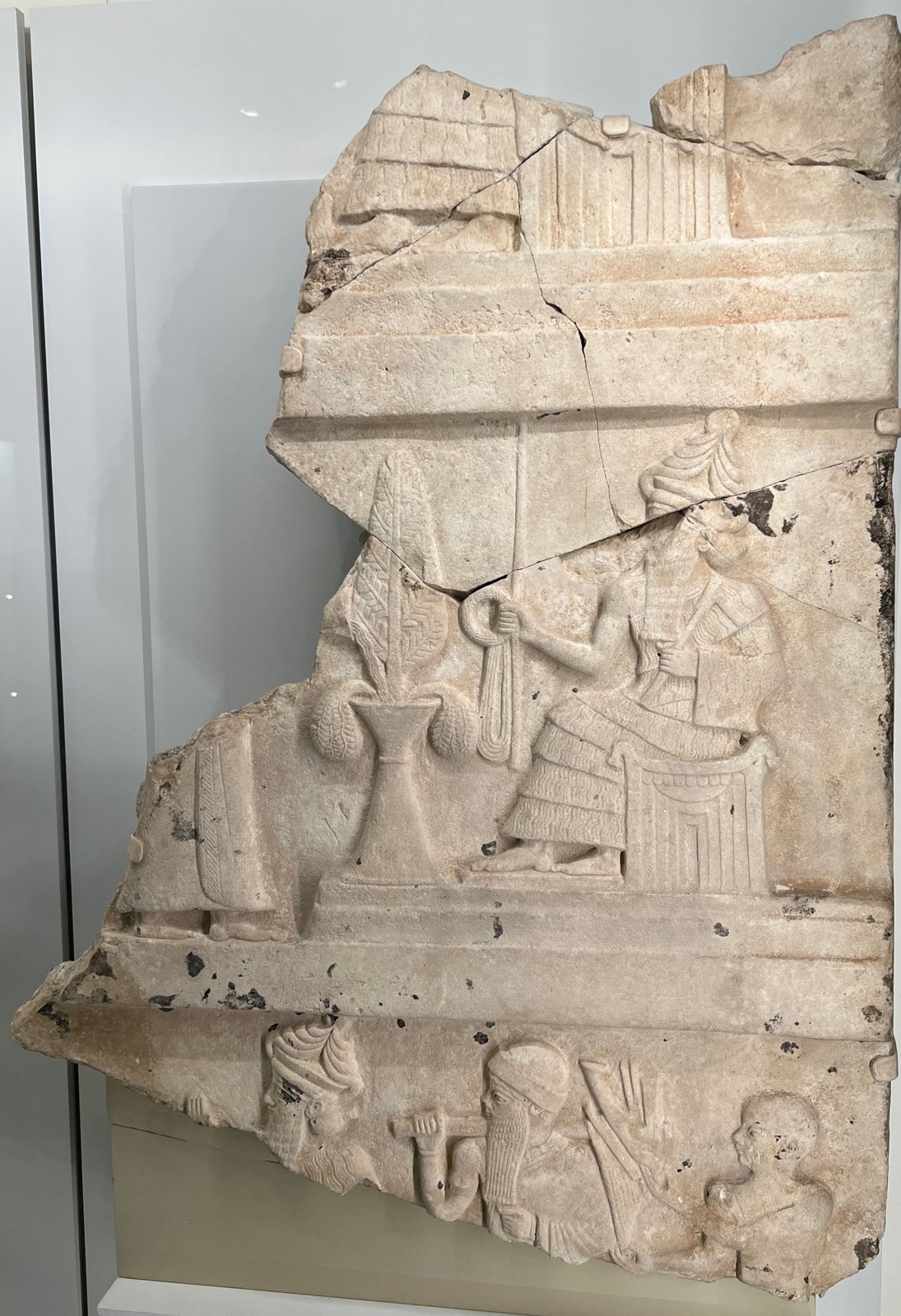
The Ur-Namma stele survives in fragments. The Penn Museum catalogues the fragment pictured here, B16676.14, as a piece from Ur showing a king before a deity. [10]
Shulgi is credited with an unusually wide set of reforms: a unified tax system, standard weights and measures, a reorganised army, a royal calendar, reform of scribal training, and the bala system of regional contributions. Some of these may have been started by his father, so the credit given to one king is uncertain. [1][2] He added the divine sign to his name, claiming godhood from at least his 21st year, and was the first king of the dynasty to be worshipped. [1][2] Twenty-six hymns in his honour are known, some only in later copies; how far they reflect his own time is debated. [2] He also built the administrative centre of Puzrish-Dagan. In his 37th year he built a long wall against nomads, which the year-name calls "the wall of the land". [1][2]
How the state worked
The state was "patrimonial": a hierarchy of households under the royal household, in which land, workers and animals were treated as belonging to the king and his family. [1] There was no single capital. Ur was the dynastic seat, Nippur the holy city and Uruk the third centre, and kings were crowned in all three. Legitimacy came mainly from EnlilEnlilEnlil/Ellil: a major Mesopotamian god associated with destinies, kingship, and Ekur at Nippur, already prominent in third-millennium god lists. His name’s origin and cult beginnings remain debated.Glossary · Click to read the explanation of Nippur. [1] About twenty provinces were run by governors (ensi) who collected taxes, and by military governors who rotated so that they would not take root. Frontier zones paid a tax in livestock instead. [1]
Under the bala system, the provinces took turns making payments to the state, with obligations rotating month by month. [11] At Puzrish-Dagan, now Drehem, scribes kept records of livestock managed by a central agency. The records document such transactions as allocations for cults and provisions for envoys. Tsouparopoulou interprets most transfers credited to Drehem as entries in the accounts. In some cases animals were brought to Drehem itself. [8] Workers were paid in rations of barley, wool and oil, and one textile office at Girsu oversaw about 6,000 workers, mostly women and children. [1]
What the tablets show, and what they do not
The Database of Neo-Sumerian Texts estimates that museums and private collections worldwide hold at least 120,000 tablets from this period, with an additional, undetermined number held at the IraqIraqIraq is a modern country encompassing much of ancient MesopotamiaGlossary · Click to read the explanation Museum. In May 2026 the database listed 105,187 administrative documents, including some unpublished texts. Large groups come from the Umma region, Girsu and Drehem. [9] At Drehem, Tsouparopoulou identifies over 13,500 tablets that document the central livestock agency. Other offices had separate archives. [8]
About two thirds of the tablets in the database’s table of proveniences are assigned to Girsu or to Umma and its region. The surviving records therefore give a clearer view of some places and offices than of others. The picture of a tightly managed empire may overstate how far the state could enforce its decisions. [8][9] The administration also demanded targets that may have strained its workers. [1]
The end of the dynasty
From about the third year of Ibbi-Sin the archives of the central centres dry up. Campaigns against Elam stopped around his fourteenth year. Eshnunna and Isin became independent, with a renegade official, Ishbi-Erra, ruling Isin. Amorite raids grew and food shortages spread. [1] About 2004 BCE a coalition from Anshan and Shimashki, in Elam, took Ur. [1]
Proposed causes are the weaknesses of a heavy bureaucracy, governors growing more independent, unresolved conflicts with Elam and the AmoritesAmoritesGroups associated with West Semitic speech in the Levant and Mesopotamia, whose dynasties were particularly prominent in the nineteenth and eighteenth centuries BCE (ca. 1900–1700 BCE).Glossary · Click to read the explanation, and possible climate-related food shortages, which are put forward only as a possibility. [1] Much of the story rests on later sources, including letters presented as correspondence between kings and officials that are often regarded as invented in school. [1][2] The Lament for Ur (record 1209 on this site) mourns the fall as the will of the gods. The kings of Isin, who claimed Ur's heritage, had laments of this kind written. [1]
Why it matters
Ur III left far more written records than most early states, and they give a rare look at labour, food and law around 2000 BCE. It also shaped later memory. The earliest known copy of the Sumerian King List (record 1207) comes from this period. [1] It never matched the prestige of Akkad in later tradition, perhaps because its kings made fewer dramatic conquests. [1] The sources are strongest on the central administration and weakest on ordinary people and on the true extent of royal power.
References and notes
- Wikipedia, 'Third Dynasty of Ur' (secondary summary) First 100,000 of 198,029 characters plus a second pass from character 100,000: chronology, kings, government, provinces, law, economy, bala, tablet counts, Ur-Namma stele, ziggurats, literature, fall under Ibbi-Sin, aftermath; the final part of the page was not read Return to the text ↑
- Wikipedia, 'Shulgi' (secondary summary) First 100,000 of 104,178 characters: reign dates, reforms, deification, hymns, wall in year 37, campaigns, scribal schools, debated points Return to the text ↑
- Wikipedia, 'Great Ziggurat of Ur' (secondary summary) Page read: builder, dimensions, materials, Woolley excavation, Nabonidus restoration, 1980s reconstruction, uncertain height Return to the text ↑
- Wikipedia, 'Drehem' (Puzrish-Dagan) (secondary summary) Page read: purpose, Shulgi, tablet counts, looting from 1909-1910, livestock accounting Return to the text ↑
- Wikimedia Commons file page, 'Ur Namma stele detail king and god Penn Museum.jpg', with the Penn Museum object link File page read: author, licence CC BY-SA 4.0, description (fragment found 1927 at Ur, Penn Museum), size Return to the text ↑
- Republic of Iraq, nomination dossier for The Ahwar of Southern Iraq: Refuge of Biodiversity and the Relict Landscape of the Mesopotamian Cities, submitted to the UNESCO World Heritage Centre. Section II, Significance, the description of Ur, paragraphs on the ziggurat and Directorate General of Antiquities restoration. Return to the text ↑
- Julian Edgeworth Reade, “The background and status of the ziggurrat of Ur,” in Ur 1922–2022: Papers marking the centenary of Sir Leonard Woolley’s first season of excavations at Ur, ed. J. Nicholas Postgate and David C. Thomas (British Institute for the Study of Iraq, 2024). Discussion of the Ur III ziggurat, figs. 3–5, the base dimensions and alternative reconstructions. Return to the text ↑
- Christina Tsouparopoulou, “A Reconstruction of the Puzriš-Dagan Central Livestock Agency,” Cuneiform Digital Library Journal 2013, no. 2. Sections 1.1–1.5, 2.1.2–2.1.3 and 3.1.1, archive scope, separate accounts and animal transfers. Return to the text ↑
- Database of Neo-Sumerian Texts (BDTNS), edited by Manuel Molina, “About BDTNS.” Project description and May 2026 figures, including the estimate for tablets in collections, the catalogue total and provenience table. Return to the text ↑
- Penn Museum, “Ur-Namu Stele,” B16676.14. Object Number, Provenience, Materials and Description, and the expedition credit. Return to the text ↑
- Tonia M. Sharlach, Provincial Taxation and the Ur III State (Brill, 2004). Publisher’s open synopsis of the province-by-province rotation of payments under bala. Return to the text ↑
Suggest a correction · Suggest a source for this record
Cite this record
IL Archive, «The Third Dynasty of Ur (Ur III, c. 2112–2004 BCE)», https://ilarchive.com/en/periods/ur-iii-period