Site · City
Akkad, the Unlocated Capital of Sargon’s Dynasty
- Names
- Agade · Akkad · Akkade
- Region
- Mesopotamia
Royal inscriptions name Akkad as the city of Sargon’s dynasty. Its location remains unsettled, while a later poem tells how its prosperity turned to ruin.
Estimated reading time: 5 min Published Last reviewed:
Share article
Text
Introduction
Akkad, also called Agade or Akkade, was the royal city of the dynasty founded by SargonSargon of AkkadSargon of Akkad was a historical third-millennium BCE ruler and founder of the Akkadian dynasty; royal accounts of his campaigns must be distinguished from later stories of his birth and rise.Glossary · Click to read the explanation. An inscription of one of his successors, Naram-Sin, names him as king of Agade and records that the people of the city built him a temple. That is direct evidence for the city’s name and status. Its precise location in MesopotamiaMesopotamiaHistorical region associated with the Tigris and Euphrates: Uruk, Ur, Eridu, cuneiform, Sumer, Akkad, Babylon and Assyria, their languages and cults, and the limits of archaeological evidence.Glossary · Click to read the explanation remains uncertain. [1][2][3]
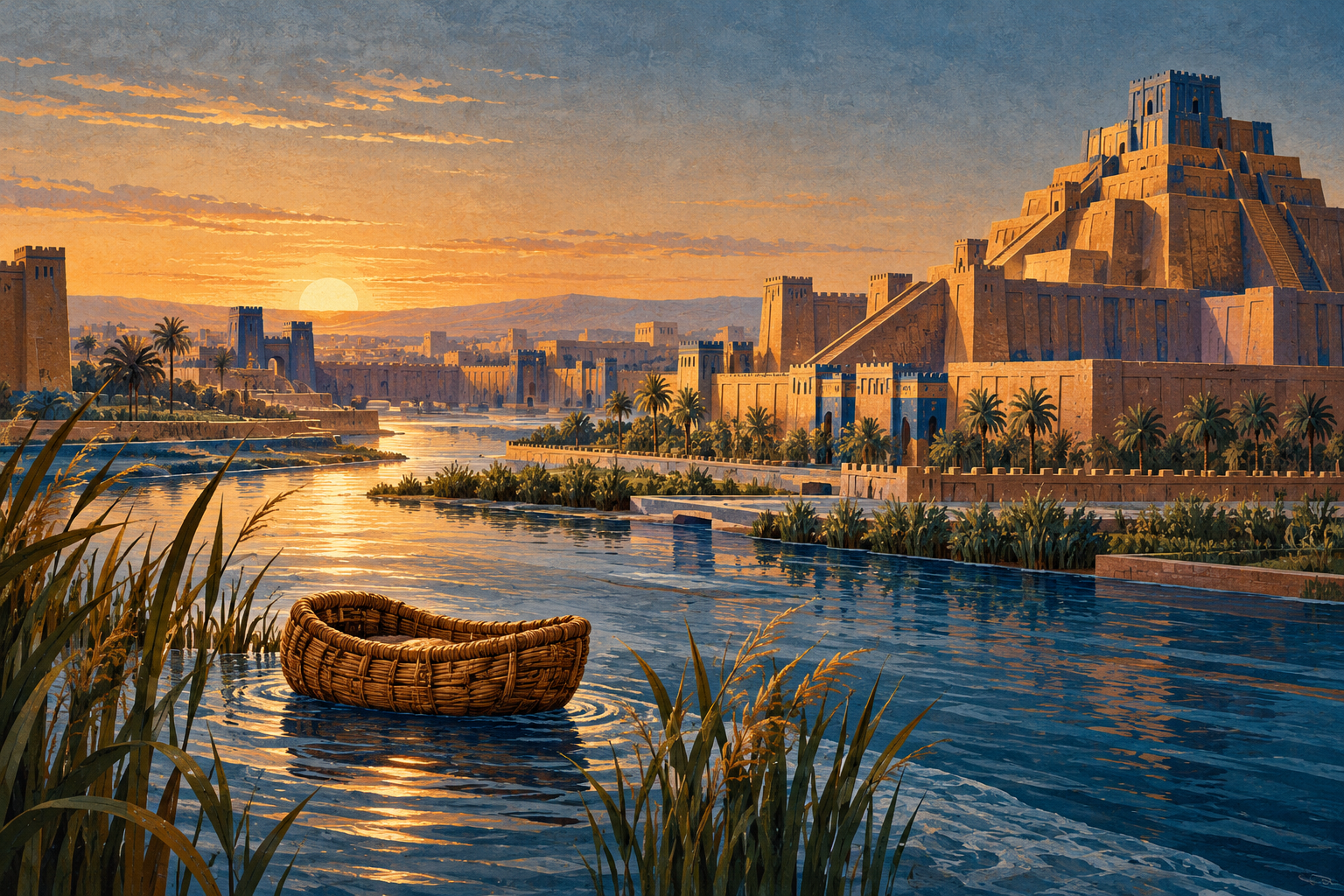
In a later poem known as The Cursing of Agade, the city has busy gates and a harbour full of ships. The story then describes the gods withdrawing their support and cursing the city. The inscription presents Agade from the viewpoint of a reigning king. The poem gives another account of the city’s place in Mesopotamian memory. [1][4]
The city and its king
The inscription on the Bassetki statue calls Naram-Sin king of Agade at the beginning. It says that rulers rebelled against him and that he won nine battles in one year. It credits the victory to the support of IshtarInanna / IshtarA prominent Mesopotamian goddess whose Sumerian name Inanna became associated with Akkadian Ishtar across diverse traditions. She was associated with desire, war, royal authority and Venus, while local forms and genealogies varied among texts.Glossary · Click to read the explanation. Next, the account moves from the fighting to the people of his city. They ask deities in several places, including EnlilEnlilEnlil/Ellil: a major Mesopotamian god associated with destinies, kingship, and Ekur at Nippur, already prominent in third-millennium god lists. His name’s origin and cult beginnings remain debated.Glossary · Click to read the explanation at Nippur and EaEnkiMesopotamian deity also known as Ea, linked with Eridu and the Abzu (deep fresh waters), wisdom, incantations, and narratives of creation and cosmic order. Later written attestations do not identify the deity of Eridu’s earliest layers.Glossary · Click to read the explanation at EriduEriduEridu (Abu Shahrain), a multi-mound site in southern Iraq occupied since the Ubaid, later home to a religious precinct associated with Enki. Its eighteen sounding levels are not proof that every early building was a temple.Glossary · Click to read the explanation, to make Naram-Sin the god of Agade. The inscription says they built a temple for him in the middle of the city. Those are claims made by the royal monument. Its repeated use of the city’s name makes clear whose people and temple the inscription means. [1]
Sargon’s relation to the city’s origins is less certain. Naohiko Kawakami describes Akkad as Sargon’s foundation on the authority of the Sumerian King List. The Metropolitan Museum of Art’s account says the city was probably founded before Sargon. The two accounts agree that it became the city of his dynasty. The royal title and the account of Naram-Sin’s temple concern its role after the dynasty was established. [1][2][3]
Why the location is unresolved
Kawakami reviews proposals near tributaries of the Tigris, including the mouths of the Diyala and the Adheim, and another proposal near Samarra. He also discusses an earlier suggestion that Akkad was another name for Sippar-ša-Anunītu. One reason for that suggestion was that both places had temples called Eulmaš. Kawakami points to inscriptions of Nabonidus that refer separately to the two sanctuaries. The shared name led scholars to a possible identification. The separate references give them reason to question it. None of these proposed locations has been securely identified as the ancient city. [3]
Prosperity and ruin in the poem
The Old Babylonian version of The Cursing of Agade begins with Sargon’s rule and the favour of InannaInanna / IshtarA prominent Mesopotamian goddess whose Sumerian name Inanna became associated with Akkadian Ishtar across diverse traditions. She was associated with desire, war, royal authority and Venus, while local forms and genealogies varied among texts.Glossary · Click to read the explanation. It describes well-stocked warehouses, celebrations, foreign goods and ships at the harbour. Naram-Suen, the form of the king’s name used in the Oxford translation, then sees a vision of disaster. After failing to obtain a favourable omen, he attacks Enlil’s temple at Nippur. In the curse that follows, the gods wish for grass to grow over the city’s roads and paths, and for its fresh water to turn brackish. The narrator then describes those changes taking place. [4][5]
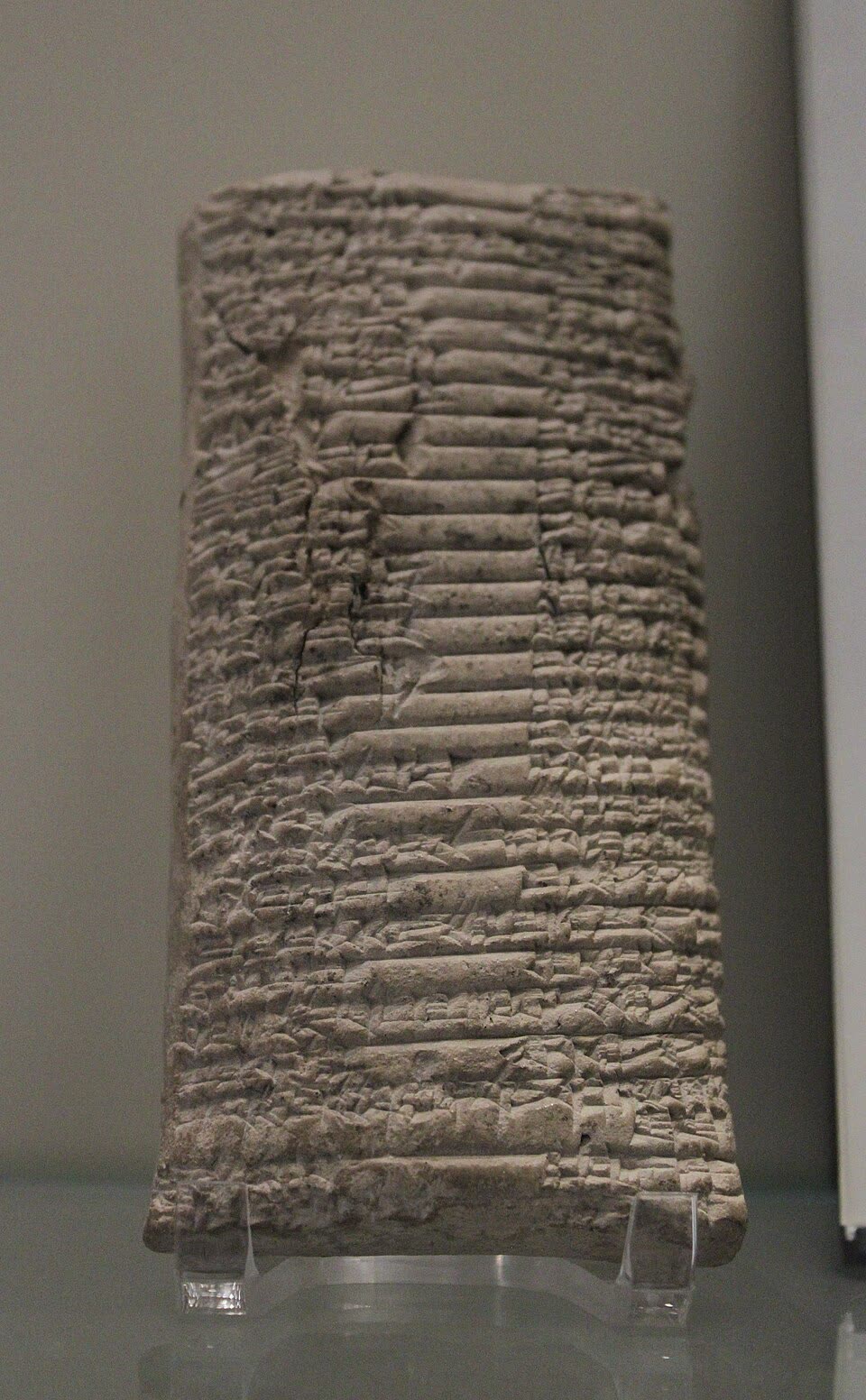
The Louvre dates the clay copy shown here, AO 6890, to 1800–1700 BCE, during the First Dynasty of BabylonBabylonBabylon is an ancient city in central present-day Iraq, south of BaghdadGlossary · Click to read the explanation. The museum’s catalogue labels the tablet AkkadianAkkadianAn ancient East Semitic language written in cuneiform from the third millennium BCE; its varieties include Babylonian and Assyrian, and it served in international diplomacy.Glossary · Click to read the explanation. The Oxford editors include the same tablet among the sources for their edition of the Sumerian poem. They also publish fragments of an earlier version from Nippur. The later copies show that the story continued to circulate. The ruined city in its closing lines belongs to a literary account in which the gods answer the king’s attack on a sanctuary. [4][5][6]
The name in works from different periods
In the Sumerian King List, kingship comes to Agade after UrukUrukAncient city at Warka in southern Iraq, a major urban centre around 3200 BCE that preserved early writing and accounting tablets.Glossary · Click to read the explanation is defeated. Sargon is introduced as the cupbearer of a ruler of Kish. Some manuscripts call Sargon the man who built Agade, while others say the city was built under him. At the end of the section, Agade loses its kingship and the list gives it back to Uruk. The work presents these transitions as changes in the seat of power and records Sargon’s building activity as part of his rise. The wording leaves room for the possibility that there was a settlement there before he made it his capital. [2][7]
A much later text shows how the name acquired a wider use. The Babylonian chronicle of Nebuchadnezzar II calls him king of Akkad and describes him returning to Babylon. The same chronicle calls his father, Nabopolassar, king of Akkad in one line and king of Babylon in another. In this setting, Akkad is the name used for the kingdom over which they ruled. It cannot, by itself, put either king’s court at the site of Sargon’s city. [8]
Places within the capital are much harder to locate. The Bassetki inscription puts Naram-Sin’s temple in the middle of Agade. The poem gives the city gates, roads, grain stores and a harbour. These details help a reader picture the city each text describes. To put any of them on a map would require a securely identified site, and the geographical evidence discussed above has yet to supply one. [1][3][4]
References and notes (8)
- Cuneiform Digital Library Initiative, Bassetki statue inscription, RIME 2.01.04.10 ex. 01, P216558 Read the translation below columns 1–3, including the title, the claims about the revolt and victories, the named gods, and the request to make Naram-Sin the god of the city where his temple was built. Return to the text ↑
- Metropolitan Museum of Art, The Akkadian Period (ca. 2350–2150 B.C.) Read the opening discussion of Agade, the dynasty, the unlocated site and the museum’s view that the city was probably founded before Sargon. Return to the text ↑
- Naohiko Kawakami, The Location of the Ancient City of Akkade, Al-Rafidan 44 (2023) Read the abstract, introduction and section II, printed pp. 45–47, including the proposed regions, the foundation tradition and the distinction between the temples at Akkad and Sippar-ša-Anunītu. Return to the text ↑
- Electronic Text Corpus of Sumerian Literature, The Cursing of Agade, 2.1.5, English translation Read Old Babylonian version lines 1–99, the attack on the temple in lines 100–148, and curse and outcome in lines 222–281. Read the introductory heading and surviving passages of the earlier Nippur version. Return to the text ↑
- Musée du Louvre, Tablette dite « la malédiction d’Akkad », AO 6890 Read the object identification, dating, material and description of the literary text. The museum page labels the tablet Akkadian, while the Oxford Sumerian edition lists it as a manuscript of its composition. The article does not resolve the difference in language labels. Return to the text ↑
- Electronic Text Corpus of Sumerian Literature, The Cursing of Agade, bibliography and cuneiform sources Read the edition’s Cuneiform sources list and checked its identification of AO 6890 with TCL 16 64. Return to the text ↑
- Electronic Text Corpus of Sumerian Literature, The Sumerian King List, 2.1.1, English translation Read lines 259–307, including the transfer of kingship to Agade, manuscript variants on the city’s building, and the later transfer to Uruk. Return to the text ↑
- ABC 5, Chronicle Concerning the Early Years of Nebuchadnezzar II, translation on Livius Read obverse lines 1–15 and reverse lines 3′–8′, checking the title king of Akkad and the notices that locate his court at Babylon. Return to the text ↑
Suggest a correction · Suggest a source for this record
Cite this record
IL Archive, «Akkad, the Unlocated Capital of Sargon’s Dynasty», https://ilarchive.com/en/sites/akkad-city
Continue reading
Related readings