Study · Academic article
ʾIl in Ancient Arabian Names, from Saba to the Basalt Desert
An extended study of a topic, with evidence and references.
- Names
- Il in Ancient Arabian Names · ʾIl in Ancient Arabian Names
Royal records from Saba, names from Dadan and rock inscriptions from the basalt desert preserve the letters ʾl in different settings. A Greek text offers evidence for how some of the names were pronounced.
Estimated reading time: 5 min Published Last reviewed:
Share article
Video
The Name No One Owns | The Road of El
More than four thousand years ago a palace burned at Ebla, and one small word waited in its clay: ʾl, El. We follow it through names and inscriptions, from Ebla, Mari and Ugarit to the kings of Samʾal, Karatepe and Saba and the stones of the basalt desert, then set the Torah's names and the Arabic question side by side. Some scenes are AI-generated illustrations.
The YouTube player loads only when you press play. Watch on YouTube
Text
Introduction
The letters transliterated ʾl recur in ancient Arabian personal names. The names survive in very different settings, from a royal inscription at Ṣirwāḥ to short texts carved by individuals in the northern basalt desert. A royal title, a family line or a parallel text in another language can help explain what the letters are doing. Three sets of evidence from SabaSaba: the ancient South Arabian kingdomAn ancient South Arabian kingdom centered in present-day Yemen and prominent in the first millennium BCE; its attestation does not establish the Queen of Sheba's biography.Glossary · Click to read the explanation, Dadan and the basalt desert show what can be learned from the written forms and where pronunciation or meaning calls for further evidence. [1]
From a Sabaean sanctuary to an Assyrian foundation
The long inscription conventionally called the account of Karibʾil Watar, Glaser 1000 A or RES 3945, comes from the sanctuary of Almaqah at Ṣirwāḥ. Norbert Nebes identifies the ruler as Karibʾil Watar son of Dhamarʿalī, whose title is conventionally transcribed mukarrib. The text memorializes campaigns and describes the actions of a ruler in the language of his own kingdom. Nebes dates his reign to the early seventh century BCE in connection with an Assyrian record. That other record has a related form of the name, Karibili, and calls its bearer king of Saba. [1]
Dan T. Potts examines the Assyrian text in the context of Saba’s long-distance contacts. The foundation inscription of Sennacherib mentions precious stones and aromatic substances among a gift from Karibili, some of which were deposited in the foundations of a building at Assur. Potts also discusses a set of inscribed beads that refer to the gift. These objects and texts supply separate kinds of evidence for the gift and for the written form of the ruler’s name. The spelling in an Assyrian inscription reflects the conventions of cuneiformCuneiformWriting with wedge-shaped signs, developed from Mesopotamian recording traditions and used for several languages from the third millennium BCE.Glossary · Click to read the explanation used by Sennacherib’s own scribes. [1][2]
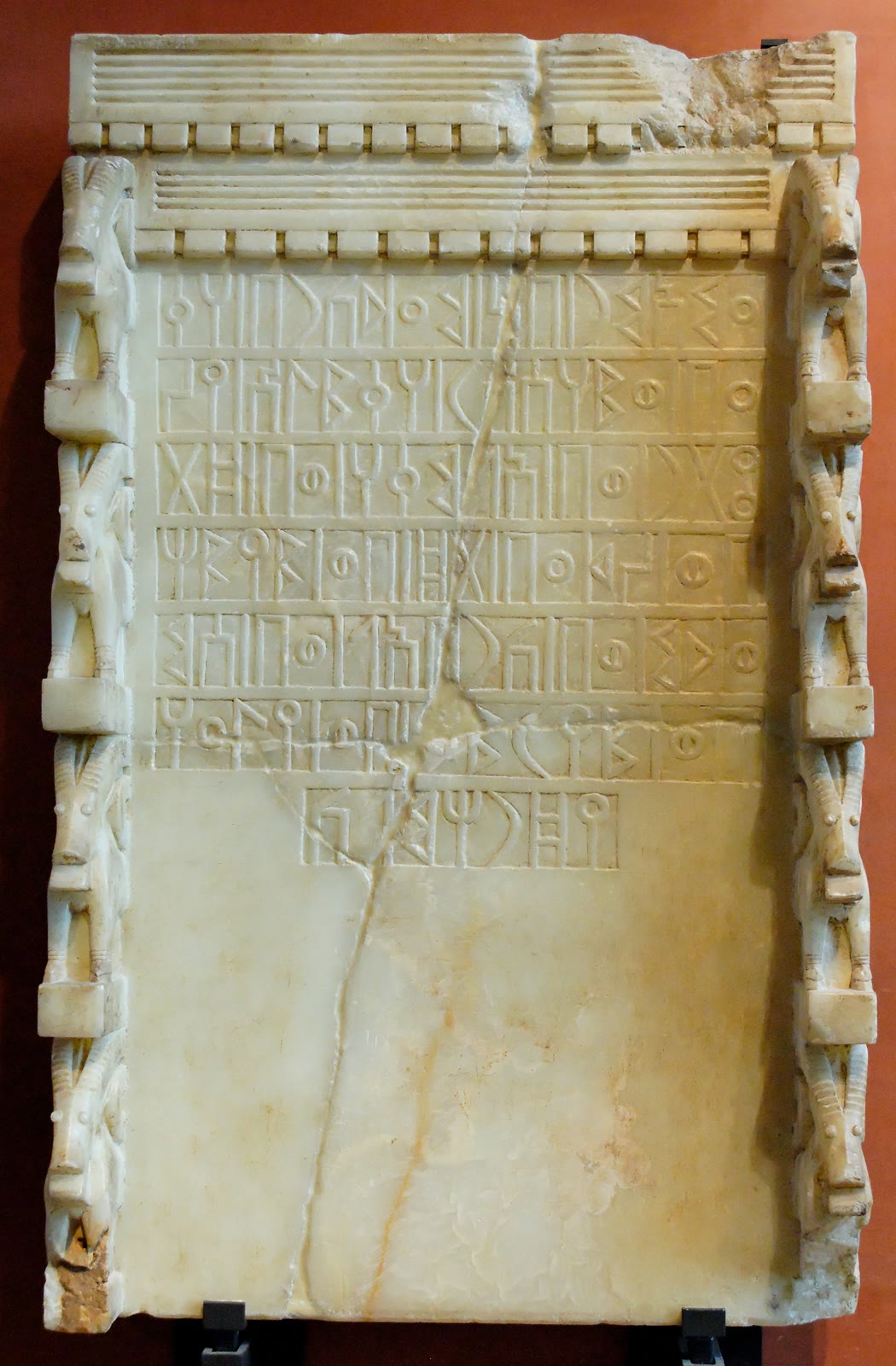
The Louvre’s inscribed fragment DAO 18, catalogued also as RES 4226, preserves the spelling Krbʾl in a Sabaean dedication to Almaqah. The object is described as a throne back, with ibexes framing the inscription. Its provenance near Maʾrib is reported by the purchaser and is marked uncertain by the museum. The lines alternate their direction, a layout called boustrophedon. The position of the names within those lines is part of the evidence. Krbʾl occurs beneath the opening dedication and among several names introduced together, so the inscription’s sequence helps distinguish the human name from the person making the offering and the god to whom it is made. In the inscription, the god who receives the dedication is named independently of the people listed later. The fragment shows the ending ʾl in a person’s name alongside a dedication with its own explicit divine recipient. [3]
Names in the oasis of Dadan
A Dadanitic inscription known as JSLiḥ 138 records the name kbrʾl and a royal title identifying its bearer as king of Dadan. María del Carmen Hidalgo-Chacón Díez cites it from the oasis of al-ʿUlā and discusses the name under the spelling KBR-ʾL. She translates it as an assertion of the greatness of ʾIl or God. The conventional reading Kabīrʾil is a way of supplying vowels for the written name. The letters and the title from the inscription identify the name and the bearer’s role, while the interpretation of the element is a matter for linguistic analysis. [4]
In the same Dadanitic corpus, Hidalgo-Chacón Díez catalogs both whbʾl and whblh. She relates their first element to a verb of giving and allows readings involving a gift, or a deity having given. The two names preserve different spellings in their final elements. It is possible to compare their structure and meaning while retaining that difference, which would disappear if they were both written with an identical modern rendering. Recording both the transliteration and the proposed interpretation keeps the evidence available to the reader. [4]
A family in Safaitic and Greek
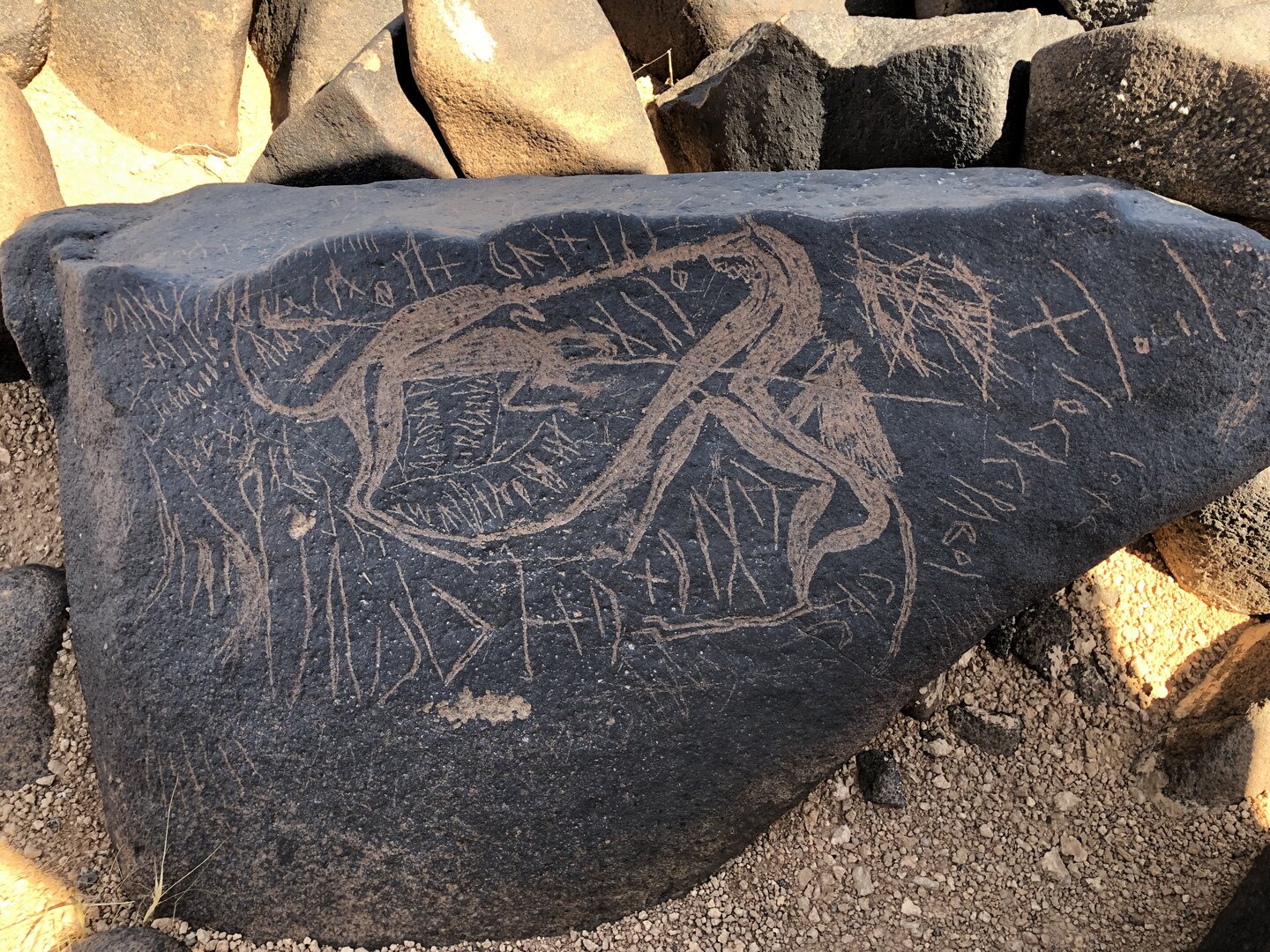
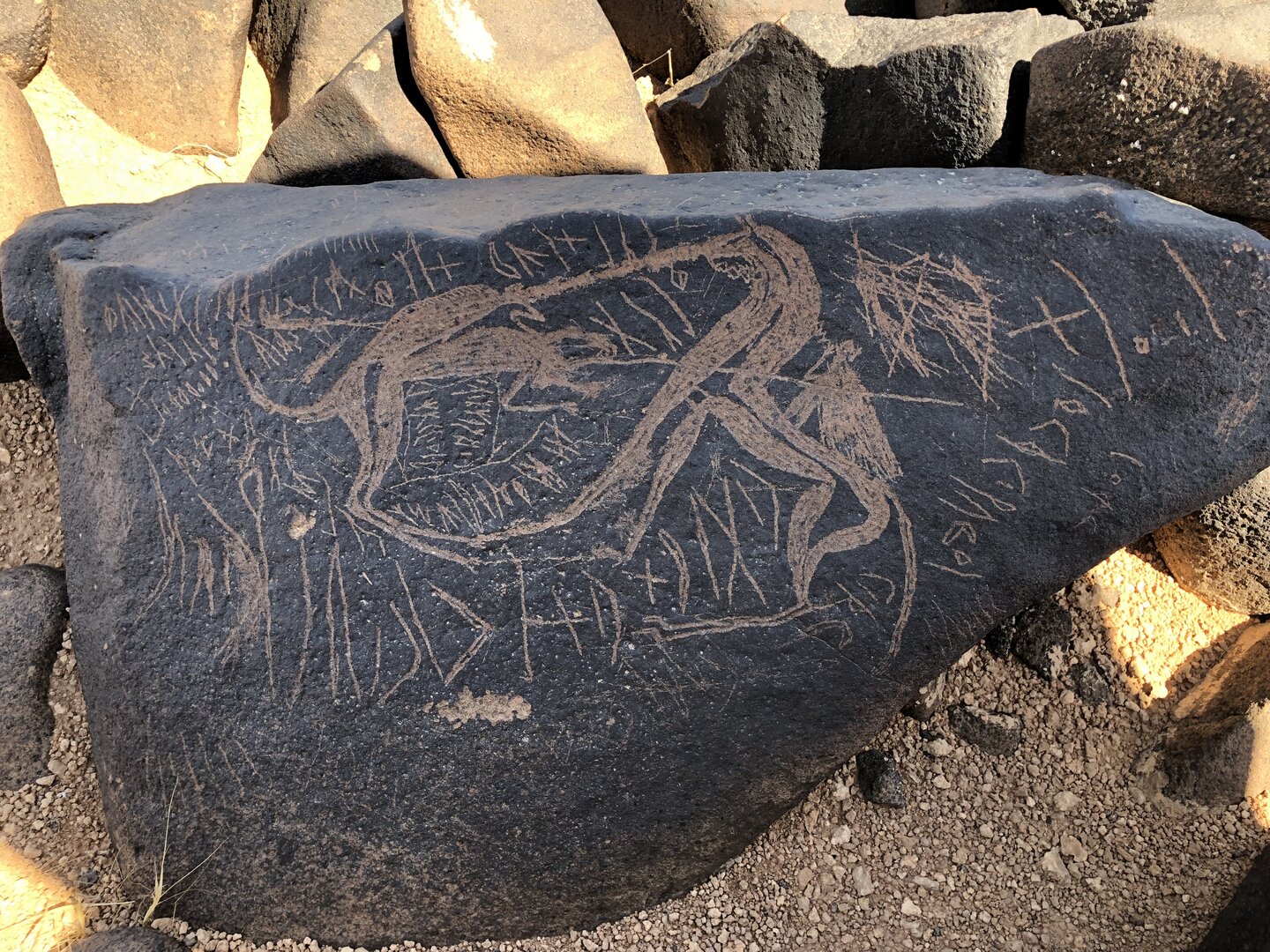
In the SafaiticSafaiticAn Ancient North Arabian consonantal script used for rock inscriptions recording names, kinship, pastoral movement and prayers in the pre-Islamic deserts of Syria, Jordan and northern Arabia.Glossary · Click to read the explanation inscription WH 1849, the writer gives a family line that starts with whblh, followed by ẓnʾl and whblh again. The inscription also describes building a shelter and asks LatAllatAn ancient Arabian goddess attested by Safaitic and Nabataean inscriptions, monuments in Palmyra, and the Quran; her roles and interpretations vary with period and context.Glossary · Click to read the explanation for security. A nearby Greek inscription, WH 1860, preserves three names that the OCIANAOCIANA: Ancient North Arabian InscriptionsOCIANA is an evolving academic database of ancient North Arabian inscriptions, with edited transliterations, translations, commentary, references, photographs and provenance; not a substitute for the stones.Glossary · Click to read the explanation editors read as Wahballāh son of Ẓannʾel son of Wahballāh. The editors consider it likely that both inscriptions were carved by the same person. The matching order and repeated name make this a better basis for comparison than a Greek name encountered on its own. [5][6]
The Greek rendering of whblh gives the editors evidence for the pronunciation Allāh in the name. It also shows why the Safaitic spelling can be difficult to interpret in isolation. In the same family, the name Ẓannʾel uses a different set of consonants. The request to Lat belongs to the act commemorated in the Safaitic text and uses yet another divine designation. The family’s names and the invocation tell us what the writer and his relatives were called and whom the writer addressed on that occasion. [5][6]
The letters in other positions
The same two letters can appear outside a personal name. In WH 1849, the edition reads ʾl Ḍf as the tribe of Ḍf. In KRS 1422, ʾl occurs in a phrase that the editors translate as longing for companions. A further text, SIJ 293, records a burnt offering and an oath by ʾlh, described as living. The positions of the forms within a sentence matter for deciding which use is present. A family name, a collective designation, a preposition and a deity invoked in an oath can be recognized through the words around them. [5][7][8]
Seen together, the Sabaean, Dadanitic, Safaitic and Greek witnesses show how writing preserves evidence at several levels. A local monument can give the consonants of a name. A foreign record can write part of it in another script, and a family sequence can make the match persuasive. A dedication or invocation tells us about an action in a way that the personal name alone leaves open. [1][2][3][4][5][6]
Further reading on IL Archive
References and notes (8)
- Norbert Nebes, Der große Tatenbericht des Karibʾil Watar aus Ṣirwāḥ Read pp. 66–69 on Glaser 1000 A, the Sabaean ruler and the chronology of his Assyrian contact. Return to the text ↑
- Dan T. Potts, The Mukarrib and His Beads: Karibʾil Watar’s Assyrian Diplomacy Read pp. 197–203 on Sennacherib’s foundation inscription, the gift, and the related inscribed beads. Return to the text ↑
- Musée du Louvre, throne fragment DAO 18, RES 4226 Read the catalogue description, uncertain provenance, and the lines naming Almaqah and Krbʾl. Return to the text ↑
- María del Carmen Hidalgo-Chacón Díez, Die theophoren Personennamen in den dadanischen Inschriften Read the lexicon entries for KBR-ʾL, WHB-ʾL and WHB-LH and the transcription for JSLiḥ 138. Return to the text ↑
- Ahmad Al-Jallad and Michael C. A. Macdonald, WH 1849, OCIANA Read the transliteration and translation of the family line, building of the shelter, tribe name and invocation to Lat. Return to the text ↑
- Ahmad Al-Jallad and Michael C. A. Macdonald, WH 1860, OCIANA Read the Greek transcription, translation and commentary on the parallel with WH 1849 and the pronunciation. Return to the text ↑
- Ahmad Al-Jallad and Michael C. A. Macdonald, KRS 1422, OCIANA Read the transliteration and translation of the expression about longing for companions. Return to the text ↑
- Ahmad Al-Jallad and Michael C. A. Macdonald, SIJ 293, OCIANA Read the inscription and commentary on the burnt offering and oath. Return to the text ↑
Suggest a correction · Suggest a source for this record
Cite this record
IL Archive, «ʾIl in Ancient Arabian Names, from Saba to the Basalt Desert», https://ilarchive.com/en/studies/il-in-ancient-arabian-names
Continue reading