Entity
Sacrificial substitution
A reference page linking a name, group, or concept to the materials that discuss it.
A source-based comparison of the ram offered in place of Isaac in Genesis, the unspecified ransom in Qur’an 37, and the deer substituted for Iphigenia in Euripides, distinguishing texts from later interpretations.
Estimated reading time: 4 min Published Last reviewed:
Share article

Text
Introduction
How can an offering take the place of a person facing sacrifice? Rescue by substitution appears in different narratives, but their details are not interchangeable. This entry compares Genesis, Sūrat al-Ṣāffāt and a Greek play about Iphigenia, separating what the texts actually state from details supplied by later interpreters.
The comparison illuminates a shared narrative motifLiterary motifA narrative or imagistic element recurring within or across stories; its role and context matter, and repetition alone cannot prove borrowing.Glossary · Click to read the explanation. By itself it cannot establish that one story was borrowed from another, or that a particular sacrificial rite took place in history.
What sacrificial substitution means
Here, “sacrificial substitution” describes an offering or ransom that takes a person's place within a narrative of threatened human sacrifice. The term does not mean that the accounts name the same animal or derive from a single historical practice. The first question is what each source explicitly says and leaves unspecified.
A ram in place of Isaac in Genesis
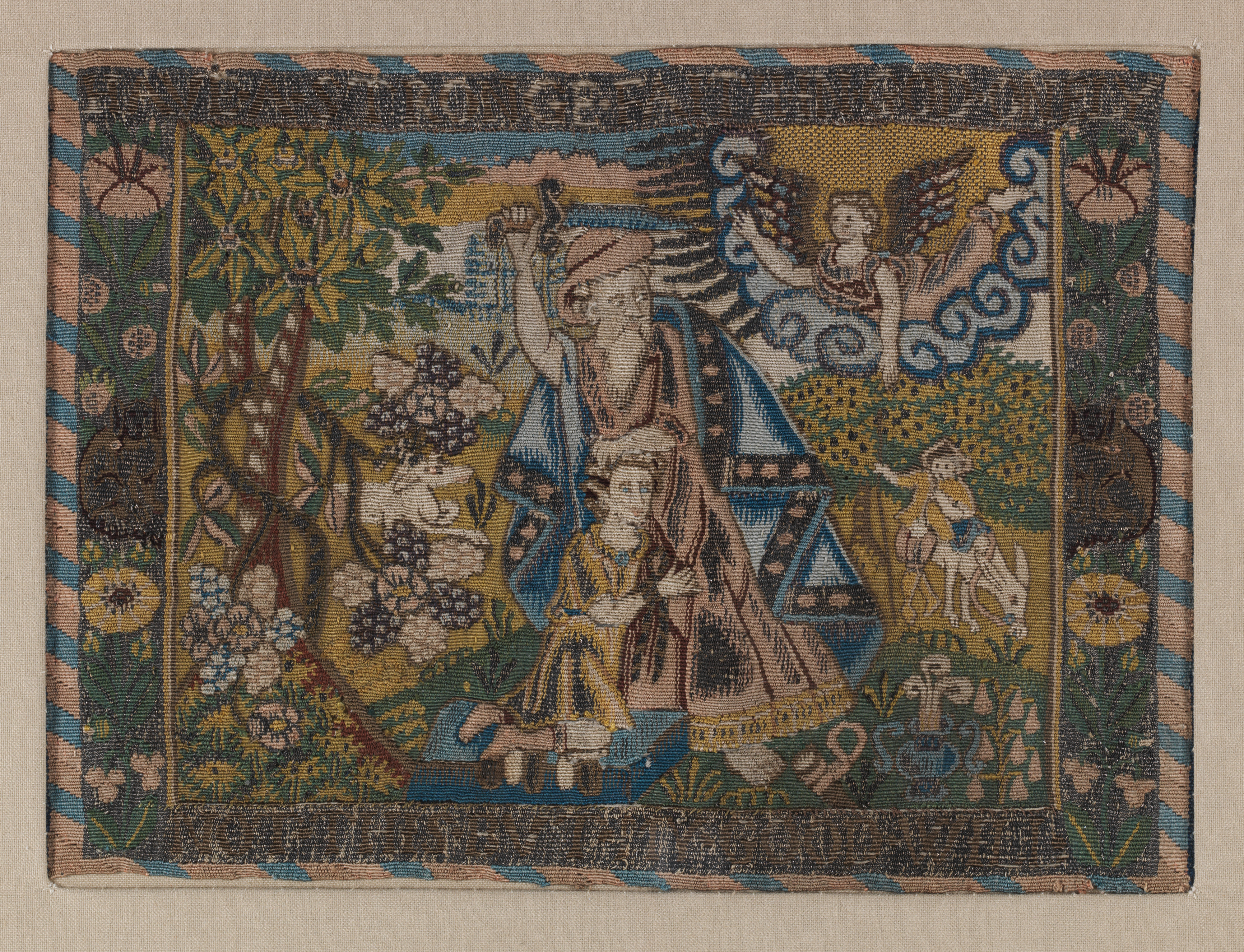
The Book of GenesisBook of GenesisHebrew book of the Torah containing Noah’s flood, survival offering and covenant with living creatures.Glossary · Click to read the explanation, part of the HebrewHebrewA Northwest Semitic language of the Canaanite group, encompassing Iron Age epigraphy, Biblical, Rabbinic, medieval and Modern Hebrew; its scripts and pronunciations changed over time.Glossary · Click to read the explanation TorahTorah / PentateuchThe first five books of the Jewish and Christian Bible: Genesis, Exodus, Leviticus, Numbers and Deuteronomy. They combine narrative and law from creation to Moses’ death; in Jewish usage, “Torah” can also encompass a wider body of authoritative teaching.Glossary · Click to read the explanation, describes the testing of AbrahamAbrahamCentral figure in Genesis, the Qur'an and Jewish, Christian and Islamic traditions; the sacrifice study compares what each text says about him.Glossary · Click to read the explanation when he is told to offer his son IsaacIsaacSon of Abraham and Sarah in Genesis; named explicitly in Genesis 22's sacrifice episode, while named after the unnamed-son scene in Qur'an 37.Glossary · Click to read the explanation as a burnt offering. Abraham builds an altar and binds his son, but an angel of the Lord stops him before the killing. Abraham then sees a ram caught by its horns in a thicket and offers it as a burnt offering “instead of his son” (Genesis 22:2, 9–13). [1][15]
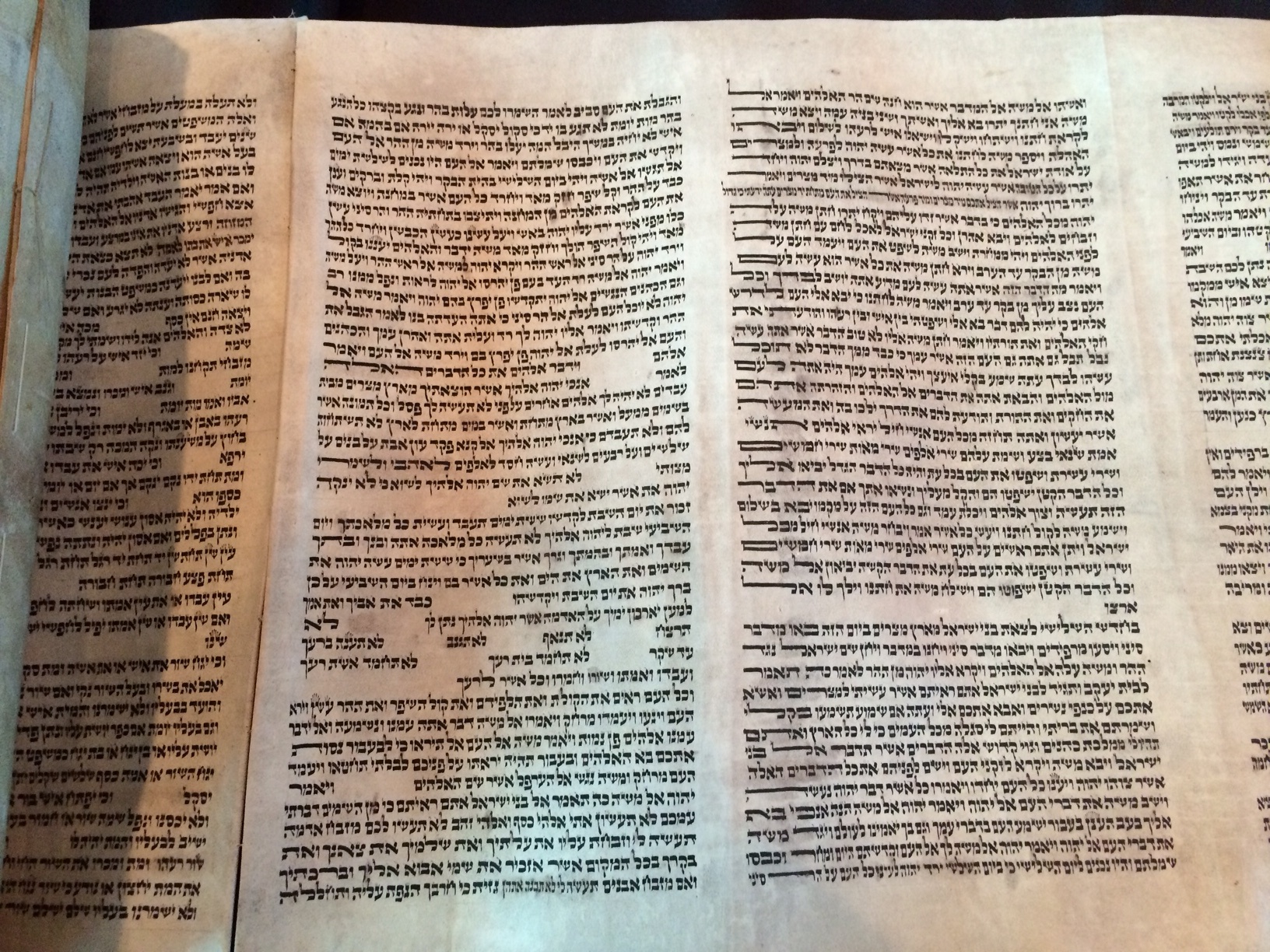
Of the three passages, this one most explicitly identifies both the threatened person and the replacement animal. The Hebrew phrase taḥat beno (תחת בנו) means “in place of his son.” The passage is a written religious narrative; its presence does not, by itself, independently establish a particular historical ritualRitualAn organised or distinguished practice meaningful to a community; it may leave traces, but its form alone does not reveal an associated doctrine.Glossary · Click to read the explanation practice. [15]
The ransom in Sūrat al-Ṣāffāt
In the Qur’anThe QuranThe central scripture of Islam, consisting of 114 Arabic surahs; its study distinguishes Quranic discourse from manuscript history, reading traditions, and historical inference.Glossary · Click to read the explanation, Sūrat al-Ṣāffāt (37:99–113) recounts Abraham's dream of sacrificing his son, the exchange between father and son, and the announcement that the test has been fulfilled. Verse 107 states that the son was ransomed with a “great sacrifice.” Yet the son is not named in the sacrifice scene, nor is the animal’s species, colour or horns specified. Isaac is named in verse 112, after the ransom account. [10]
Later interpretation is a different layer of evidence. The historian and commentator al-ṬabarīAl-TabariAbbasid-era historian and Qur'anic exegete (c. 839–923 CE). His commentary records competing views on Abraham's son, then favors Isaac.Glossary · Click to read the explanation (d. 923 CE) reports traditions identifying either Isaac or IshmaelIshmaelSon of Hagar and Abraham in Genesis; later Muslim interpretation identified him with the unnamed son in Qur'an 37's sacrifice scene.Glossary · Click to read the explanation, before preferring Isaac. The historian and commentator Ibn KathīrIbn KathirSyrian Qur'anic exegete and historian (c. 1301–1373 CE) who favors Ishmael in his reading of the sacrifice account.Glossary · Click to read the explanation (d. 1373 CE) favours Ishmael and transmits accounts that describe a ram, including details of its horns and colour. Such material matters for the history of exegesis, but it is not part of the wording of verse 107 itself. [16][17]
A deer in place of Iphigenia in Greek drama
At the beginning of Iphigenia in Tauris by the Greek playwright EuripidesEuripidesFifth-century BCE Greek tragedian, died 406 BCE. In his Iphigenia among the Taurians, the heroine recounts a deer substituted for her.Glossary · Click to read the explanation (fifth century BCE), IphigeniaIphigeniaMythic and dramatic daughter of Agamemnon. In Iphigenia among the Taurians, Artemis rescues her at the altar and substitutes a deer.Glossary · Click to read the explanation recalls being brought to an altar at AulisAulisAncient place on the Boeotian coast near the Euripus Strait in Greece; setting of Iphigenia's Greek story and site of a fifth-century BCE Artemis temple.Glossary · Click to read the explanation after her father, the legendary commander AgamemnonAgamemnonFigure of Greek narrative, commander of the expedition to Troy and Iphigenia's father in Euripides; the play does not independently establish his historicity.Glossary · Click to read the explanation, resolved to offer her to the goddess ArtemisArtemisGoddess of hunting in Greek traditions and Apollo’s sister, named among the divine company in the Iliad.Glossary · Click to read the explanation. The goddess instead saved Iphigenia, substituted a deer, and transported her to TaurisTaurisAncient Greek name for Taurian territory on the Black Sea, associated with today's Crimean peninsula; the setting of Euripides' Iphigenia play.Glossary · Click to read the explanation on the Black Sea, where she became a priestess. [14][18]
The Greek employs ἔλαφον, meaning a deer, not a gazelle in the zoological sense, and does not specify the animal’s sex here. These are words spoken by a character in a play set in a mythical world. They attest a Greek literary version of the story, not the historical occurrence of the legendary event. [18][19]
What resembles what—and what differs?
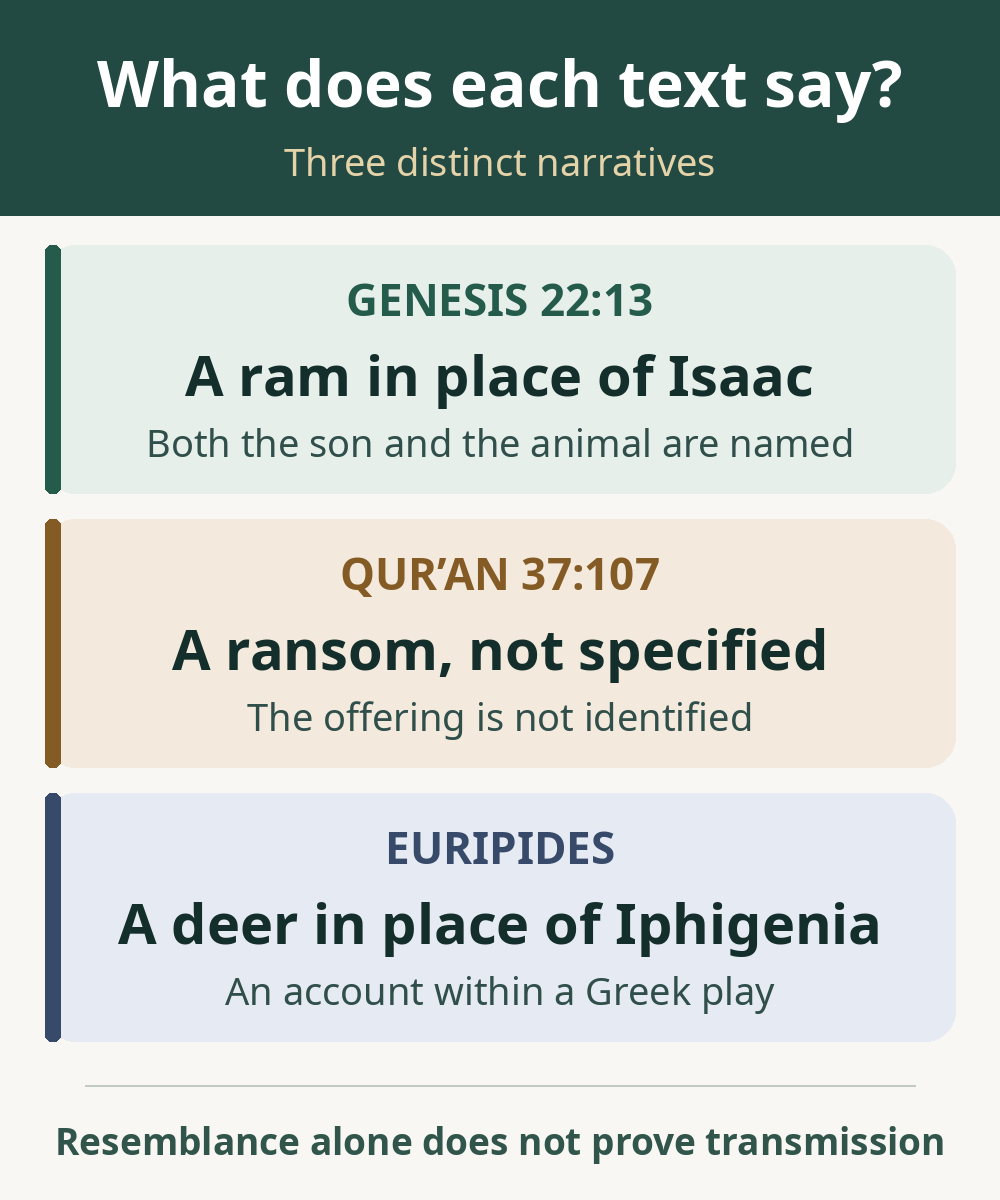
All three passages avert the threatened human sacrifice, but they identify the replacement differently. Genesis names Isaac and the ram and explicitly says the latter is offered in the son’s place. The Qur’anic passage speaks of a “great sacrifice” without naming the son or specifying the offering in the scene. Euripides describes a girl rescued by Artemis through the substitution of a deer. The settings, purposes and narrative functions also differ. [1][10][18]
The shared motif therefore cannot, on its own, establish borrowing. A historical argument for literary transmission would need attention to wording, chronology and evidence of circulation and contact. Such an argument can rest on converging clues even without a named intermediary, but the passages considered here do not establish a specific route. Likewise, a claim about real sacrificial practice needs evidence beyond the stories themselves. [1][10][18]
References and notes (8)
- Genesis 22 in the English King James Version (1611), especially verses 2 and 9–13; Hebrew text also checked in note [15]. Genesis 22:1–24 (KJV); focus 22:2, 9–13 Return to the text ↑
- Qur’an, Sūrat al-Ṣāffāt 37:99–113, especially 101–107 and 112; distinct from later exegetical explanations. Qur’an 37:99–113, esp. 101–107 and 112 Return to the text ↑
- Euripides, Iphigenia in Tauris, opening (lines 1–40) in Gilbert Murray’s English verse translation and preface; the translation is compared with Greek in [18]. Iphigenia in Tauris, opening 1–40; Murray translation and preface Return to the text ↑
- Genesis 22:2, 9–13, Hebrew text with facing English translation at Mechon-Mamre. Verse 13 names the ram and its horns and uses תחת בנו (“instead of his son”). Genesis 22:2, 9–13, especially 22:13 Return to the text ↑
- Al-Ṭabarī, Jāmiʿ al-bayān, commentary on Qur’an 37:107: competing identifications and his preference for Isaac; an exegetical position, not an explicit naming in the verse. Commentary on 37:107, especially “wa-awlā al-qawlayn” and following Return to the text ↑
- Ibn Kathīr, Tafsīr al-Qurʾān al-ʿaẓīm on Qur’an 37:101 and 107: favors Ishmael, cites traditions about the ram and horns, and records the contrary identification. Commentary on 37:101 and 107; reports and preferred interpretation Return to the text ↑
- Euripides, Iphigenia in Tauris, Greek opening (standard lines approximately 25–30), compared with the English translation by Edward P. Coleridge (1891), via Perseus. The Greek reads ἔλαφον ἀντιδοῦσά μου (“giving a deer instead of me”). Greek lines 25–30; opening lines of the English translation Return to the text ↑
- Liddell and Scott, Ancient Greek lexicon, s.v. ἔλαφος: a deer, male or female; it should not be rendered as gazelle. Lexicon entry ἔλαφος Return to the text ↑
Suggest a correction · Suggest a source for this record
Cite this record
IL Archive, «Sacrificial substitution», https://ilarchive.com/en/entities/sacrificial-substitution
Continue reading