Person · Figure
Enheduanna
- Names
- En-hedu-ana · Enheduana · Enheduanna
- Timeline
- 2300 BCE
- Region
- Mesopotamia
High priestess of the moon god at Ur around 2300 BCE and a daughter of Sargon of Akkad. A stone disk names her, and later copies attach her name to famous Sumerian hymns.
Estimated reading time: 6 min Published Last reviewed:
Share article
Text
Introduction
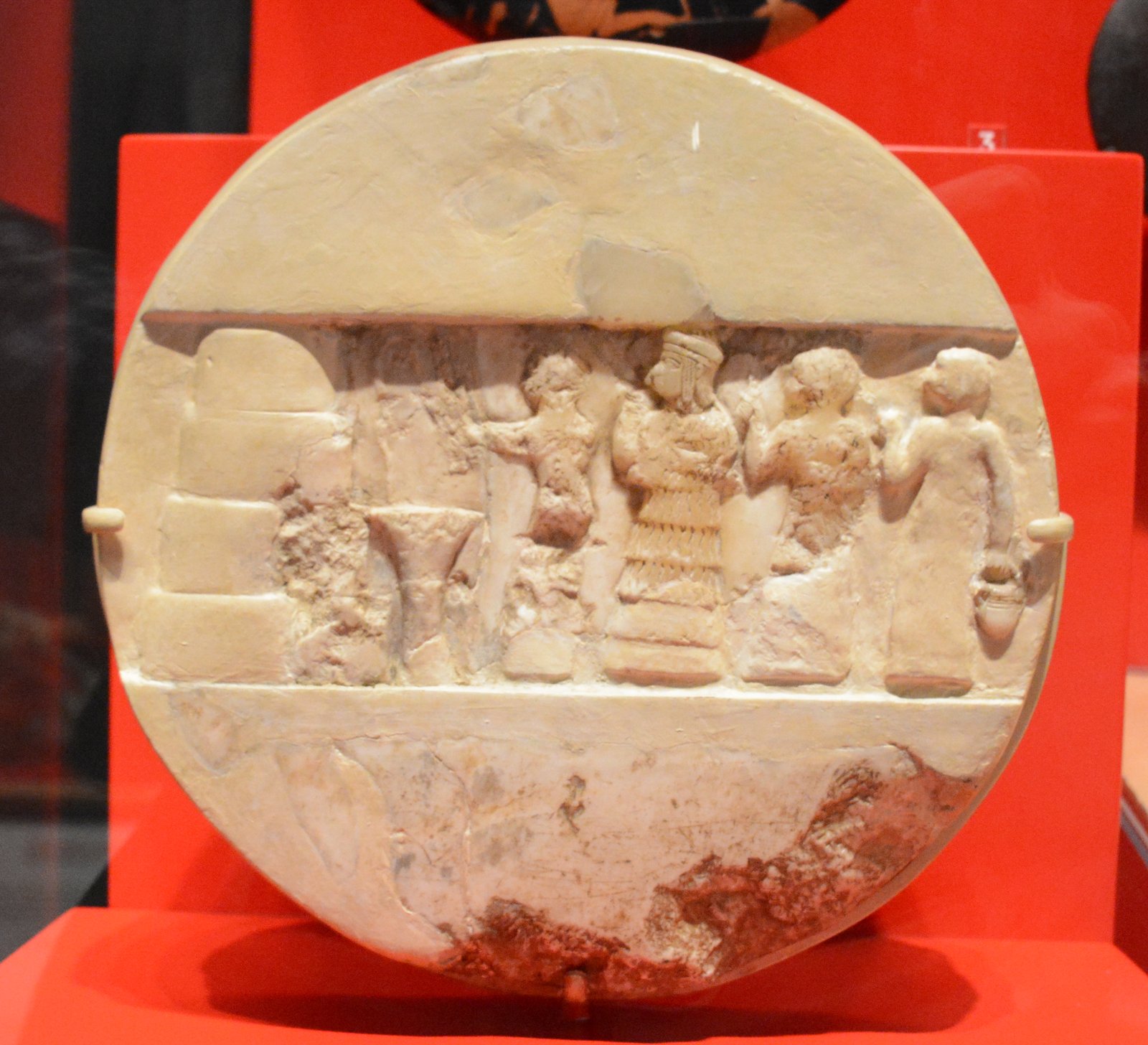
Enheduanna was a daughter of Sargon of AkkadSargon of AkkadSargon of Akkad was a historical third-millennium BCE ruler and founder of the Akkadian dynasty; royal accounts of his campaigns must be distinguished from later stories of his birth and rise.Glossary · Click to read the explanation, the king who brought the cities of southern MesopotamiaMesopotamiaHistorical region associated with the Tigris and Euphrates: Uruk, Ur, Eridu, cuneiform, Sumer, Akkad, Babylon and Assyria, their languages and cults, and the limits of archaeological evidence.Glossary · Click to read the explanation under one dynasty. Around 2300 BCE she served as high priestess of NannaNanna / Su’en / SinMesopotamian moon god known as Nanna, Su’en and Sîn/Sin. Worshipped especially at Ur and Harran, he is associated with the crescent and lunar cycle; names and myths have different histories.Glossary · Click to read the explanation, the moon god of UrUr of the ChaldeansCity named in Genesis’s account of Abraham’s family, commonly associated with archaeological Ur near Nasiriyah in southern Iraq.Glossary · Click to read the explanation. A carved stone disk found in that city names her and her father, and it shows her taking part in a temple ritualRitualAn organised or distinguished practice meaningful to a community; it may leave traces, but its form alone does not reveal an associated doctrine.Glossary · Click to read the explanation. [1][2]
She is often called the first author in history known by name. Several SumerianSumerian languageAncient language of southern Mesopotamia, clearly attested in third-millennium BCE texts and maintained in learning and ritual after its spoken use declined.Glossary · Click to read the explanation hymns carry her name, above all a poem to the goddess InannaInanna / IshtarA prominent Mesopotamian goddess whose Sumerian name Inanna became associated with Akkadian Ishtar across diverse traditions. She was associated with desire, war, royal authority and Venus, while local forms and genealogies varied among texts.Glossary · Click to read the explanation in which she speaks of being driven from her temple. But the copies of these poems were made centuries after her lifetime, and scholars still debate how much of them she wrote. This entry sets out what the disk and the poems show, and where the evidence stops. [3][5][8]
A king's daughter at Ur
Sargon, founder of the AkkadianAkkadianAn ancient East Semitic language written in cuneiform from the third millennium BCE; its varieties include Babylonian and Assyrian, and it served in international diplomacy.Glossary · Click to read the explanation Empire, needed the old southern cities to accept a new ruler. One of his steps was to make his daughter the en of Nanna at Ur. The Sumerian word en can mean "high priestess" but also "lord" or "ruler", so the office carried real authority and wealth. Rhonda McHale-Moore points out that Sargon seems to have followed an older Sumerian custom, while also binding the city's chief temple to the new royal family. Later kings did the same: for centuries, the king's daughter was often the high priestess at Ur. [2][3]
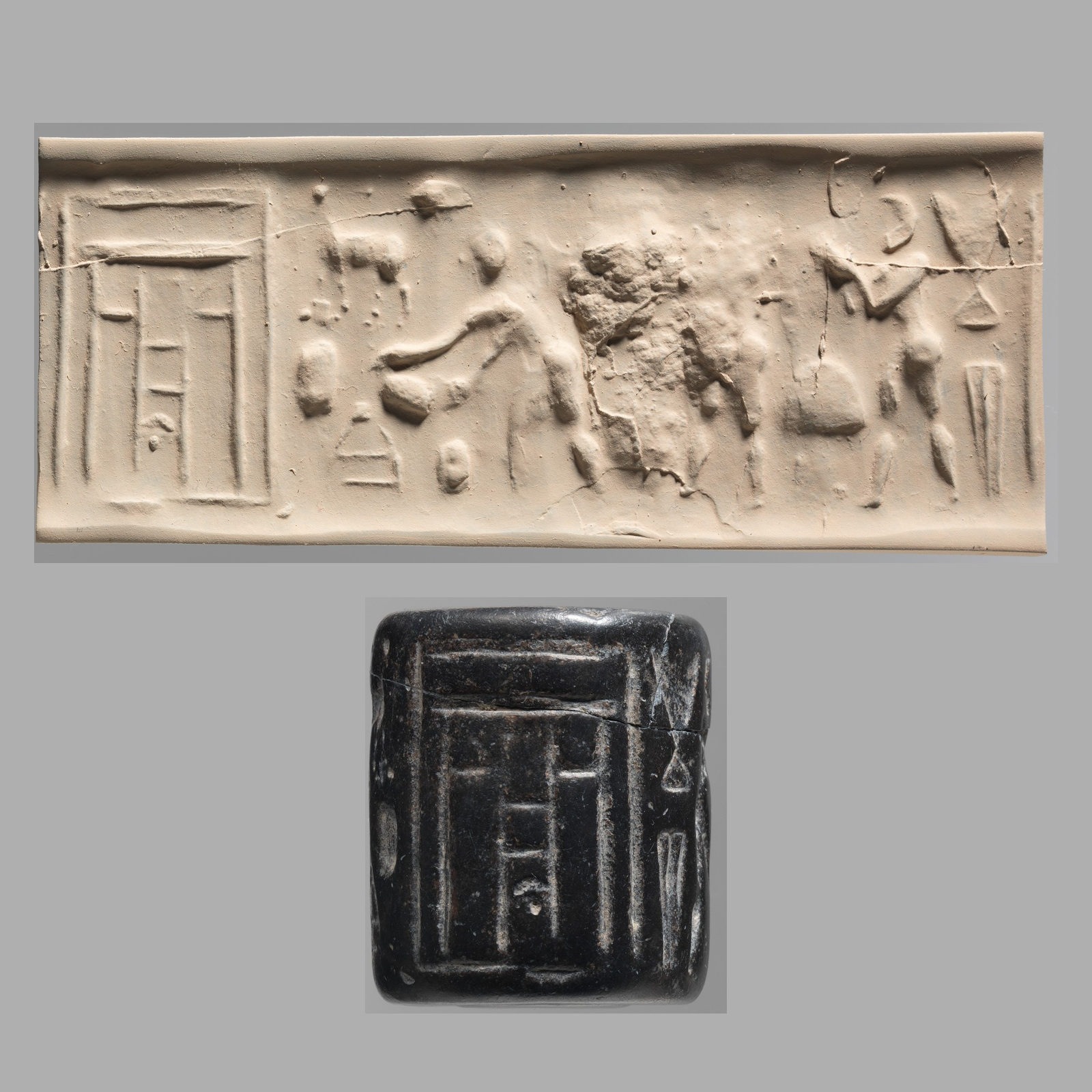
Enheduanna lived in the gipar, the residence of the high priestess inside Ur's sacred quarter. A few objects from her own time name the people who worked for her. Small stone cylinder sealsCylinder sealSmall engraved cylinder rolled over soft clay to leave an extended image. Used to secure, document and identify administrative actions; its pictures do not automatically constitute writing.Glossary · Click to read the explanation, rolled over clay to leave a name like a signature, name some of her servants: her hairdresser, Ilum-palil, the manager of her estate and her scribes. Little else is known: we do not know when she was born or when she died. [3]
The disk from Ur
The disk is a round slab of white calcite about 25 centimetres across and 7 centimetres thick. It is now in the Penn Museum in Philadelphia (B16665). The joint British Museum and Penn expedition led by Leonard Woolley found it in 1927, broken into pieces. It lay in a room of the temple of the goddess Ningal, in a building level from several centuries after Enheduanna's life. [1][2][4]
One side shows a ritual in relief. A priest pours a drink offering in front of an altar. Behind him stands the tallest human figure, a woman in a flounced robe and a tall cap, her hands held in a traditional gesture of greeting and respect. She is usually identified as Enheduanna. Two attendants follow her. The disk was heavily restored in modern times. The restorers added one of the figures behind her and the stepped tower on the far side of the altar. Sophus Helle notes that many scholars question these additions, especially the tower, which may once have been the statue of a deity. [1][4]
The other side carries an inscription. In Helle's translation it reads:
The words are damaged on the disk itself. They are best preserved in a copy on a clay tablet made by later scribes, which Edmond Sollberger published in 1969. [2][4]
How the disk ended up in a later level is unclear. Woolley thought it had been smashed on purpose. McHale-Moore doubts this, because her face and name were left untouched. She suggests that a later high priestess, Enanatuma, who rebuilt the gipar in the 19th century BCE, found the broken disk, had its text copied, and placed it in her new building to honour her famous predecessor. The disk was found next to a statue of Enanatuma, but the idea cannot be proved. [2][4]
The poems that carry her name
Three works are linked to Enheduanna. The best known is the Exaltation of Inanna, a poem of 154 lines in the Oxford edition. The poet calls herself "En-hedu-ana the en priestess". She tells how a man named Lugal-ane drove her out of the temple and sent her wandering through the mountains, and how Nanna did not answer her. So she turns to Inanna, goddess of war and desire, praises her power, and asks for help. In the last lines, Inanna's heart is calmed and the prayer is accepted. [5][6]
The second is a long hymn to Inanna. The third is the Temple Hymns, a collection of 42 short hymns, each praising a temple in a different city. At the end, a closing note says: "The compiler of the tablets was En-hedu-ana", followed by the words "something has been created that no one has created before". [3][7]
These poems were much copied. Annette Zgoll's 1997 edition of the Exaltation used 107 clay manuscripts, and more have been found since. Most come from the schools of the Old Babylonian period, where her poems were studied and copied on cuneiformCuneiformWriting with wedge-shaped signs, developed from Mesopotamian recording traditions and used for several languages from the third millennium BCE.Glossary · Click to read the explanation tablets. [3][8]
Did she write them?
The disk and the seals show that Enheduanna existed. Whether she wrote the poems is debated. [8]
- Against: most manuscripts date to the 18th century BCE, about five hundred years after her lifetime. Miguel Civil noted words and phrases that seem later. The Temple Hymns include a hymn to a temple of King Shulgi of the Third Dynasty of Ur, marked in the text as an addition, so the collection was not left as it was. The age of Sargon also became a favourite setting for later legends, so a poem set in it may be a later story. [7][8]
- For: ancient scribes named her as the author, and the poems fit what is known of her life and office. Benjamin Foster has argued that scribes updated the language of old poems as they copied them, so later wording does not prove later composition. Helle finds nothing in the Exaltation or the long hymn that makes a date in her time impossible. [8]
Helle concludes that we cannot say for sure whether the poems were written by Enheduanna or in her name. They may have grown over time: begun or gathered by her, added to by Shulgi, and adjusted by later scribes. Either way, the ancient schools remembered her as a high priestess with a voice of her own. [8]
Quick answers
Who was Enheduanna?
A daughter of Sargon of Akkad who served as high priestess of the moon god Nanna at Ur around 2300 BCE. [1][3]
Is she really the first known author?
She is the earliest person to whom ancient sources attribute literary works by name. Whether she wrote them herself is still debated. [8]
References and notes (8)
- Penn Museum (University of Pennsylvania Museum of Archaeology and Anthropology), “Disc of Enheduanna,” object B16665, collection record Whole record: Old Akkadian period, ca. 2300 BCE; limestone/calcite, diameter 25 cm, depth 7 cm; found in a chamber of the Larsa-period temple of Ningal (the gig-par-ku) at Ur; relief of a sacrifice scene and inscription naming Enheduanna as daughter of Sargon; British Museum/University Museum Expedition to Ur, 1926; field no. U.6612; on display in the Middle East Galleries; bibliography. Return to the text ↑
- Rhonda McHale-Moore, “The Mystery of Enheduanna’s Disk,” Journal of the Ancient Near Eastern Society 27 (2000): 69–74 Whole article, pp. 69–74: Sargon's appointment of his daughter as en-priestess, the find in 1927 in the giparu at Ur, Woolley's view of deliberate damage and the author's objections, the Old Babylonian copy of the inscription (Sollberger 1969), the find beside the statue of Enanatuma, and the proposal that Enanatuma recovered and copied the disk. Return to the text ↑
- Sophus Helle, “The Historical Enheduana,” enheduana.org (companion website to Helle, Enheduana: The Complete Poems of the World’s First Author, Yale University Press, 2023) Whole page: Sargon's daughter, the office of en and its meanings, the ĝipar at Ur, the seals of her hairdresser Ilum-palil, her estate manager and her scribes, the lack of birth and death dates, and the study of her poems in the Old Babylonian schools. Return to the text ↑
- Sophus Helle, “The Disk of Enheduana,” enheduana.org Whole page: the 1927 find, its fragmentary state and contested restoration (the added figure and the ziggurat), the relief, the translation of the inscription, the copy of the inscription, and McHale-Moore's proposal about Enanatuma. Return to the text ↑
- Sophus Helle, “The Exaltation of Inana,” annotated line-by-line translation, enheduana.org, 2022 Pp. 1–8: introduction (plot, Lugal-Ane, textual basis: Hallo and van Dijk 1968, Zgoll 1997 with 107 manuscripts, Delnero 2006, Attinger) and commentary on lines 1–19. Return to the text ↑
- J. A. Black, G. Cunningham, E. Robson and G. Zólyomi, “A hymn to Inana (Inana B),” c.4.07.2, The Electronic Text Corpus of Sumerian Literature, Oxford, 1998–2006 English translation, lines 66–108 (En-hedu-ana in the gipar, Lugal-ane, the expulsion, Nanna's silence), line 124, and lines 139–154 (the recitation and Inana's acceptance); the poem has 154 lines. Return to the text ↑
- J. A. Black, G. Cunningham, E. Robson and G. Zólyomi, “The temple hymns,” c.4.80.1, The Electronic Text Corpus of Sumerian Literature, Oxford, 1998–2006 English translation: the 42 temple hymns, the hymn to the E-hursaj of Shulgi at Ur marked as an addition (lines 129–134), and the closing lines 543–544 naming En-hedu-ana as compiler. Return to the text ↑
- Sophus Helle, “Authorship,” enheduana.org Whole page: the date of the manuscripts, Miguel Civil's linguistic objections, Benjamin Foster on scribal updating, the Shulgi addition to the Temple Hymns, later legends about the Akkadian age, Brigitte Lion on the ancient attribution, and Helle's conclusion. Return to the text ↑
Suggest a correction · Suggest a source for this record
Cite this record
IL Archive, «Enheduanna», https://ilarchive.com/en/people/enheduanna
Continue reading