Period
The Middle Bronze Age in the Levant (c. 2000–1550 BCE)
- Timeline
- From 2000 BCE to 1550 BCE
- Region
- The Levant
Fortified cities and royal palaces mark the Middle Bronze Age in the Levant. Pottery and radiocarbon dates chart the changes at individual sites, and Egyptian texts and objects document contacts across the region.
Estimated reading time: 6 min Published Last reviewed:
Share article
Text
Introduction
New fortifications, palaces and other buildings appeared at many sites in the LevantThe LevantThe Levant is a regional name for lands along the eastern MediterraneanGlossary · Click to read the explanation, at the eastern end of the Mediterranean, during the Middle Bronze Age. The dates in the title are approximate. Building phases at individual sites and records such as the letters from Mari and the Egyptian lists of place names each document part of this history. [15][17][25][28]
How the period is dated
Archaeologists distinguish phases by comparing pottery and the layers in which it was found. In one system used for the southern Levant, the Middle Bronze Age has three phases, I, II and III, corresponding to IIA, IIB and IIC in another system. Some older schemes used Middle Bronze I for the preceding Intermediate Bronze Age, also called Early Bronze IV. The two uses of the label refer to different phases. At Megiddo, radiocarbon results suggest that the first Middle Bronze phase began in the late 21st or early 20th century BCE. At Tel Kabri, a separate study dates the end of the palace’s last phase to around 1700 BCE, about 50–100 years earlier than two established models. The transition to the Late Bronze AgeLate Bronze AgeAn archaeological period around 1600–1200 BCE in much of the Near East, with international diplomacy, exchange and religious diversity; its endpoints vary by region.Glossary · Click to read the explanation (record 33) is dated from local evidence and correlations with other regions. [15][16][17][18][36]
Cities return
At HazorHazorAncient Canaanite city in present-day northern Israel, where Middle Bronze Age legal-tablet fragments were found in 2010.Glossary · Click to read the explanation, near the Hula Valley, the Middle Bronze Age town eventually occupied an upper and a lower city. The site guide puts their combined area at about 80 hectares, with about 10 hectares in the upper city. The lower city was enclosed by an earthen rampart. The archaeological dossier for Hazor places the foundation of the lower city in the mid-18th century BCE, in the phase it calls Middle Bronze IIB. Shlomit Bechar and Assaf Yasur-Landau place the palace in the upper city in the middle to late part of the first Middle Bronze phase, on the basis of pottery from its archaeological context. [19][35][37]
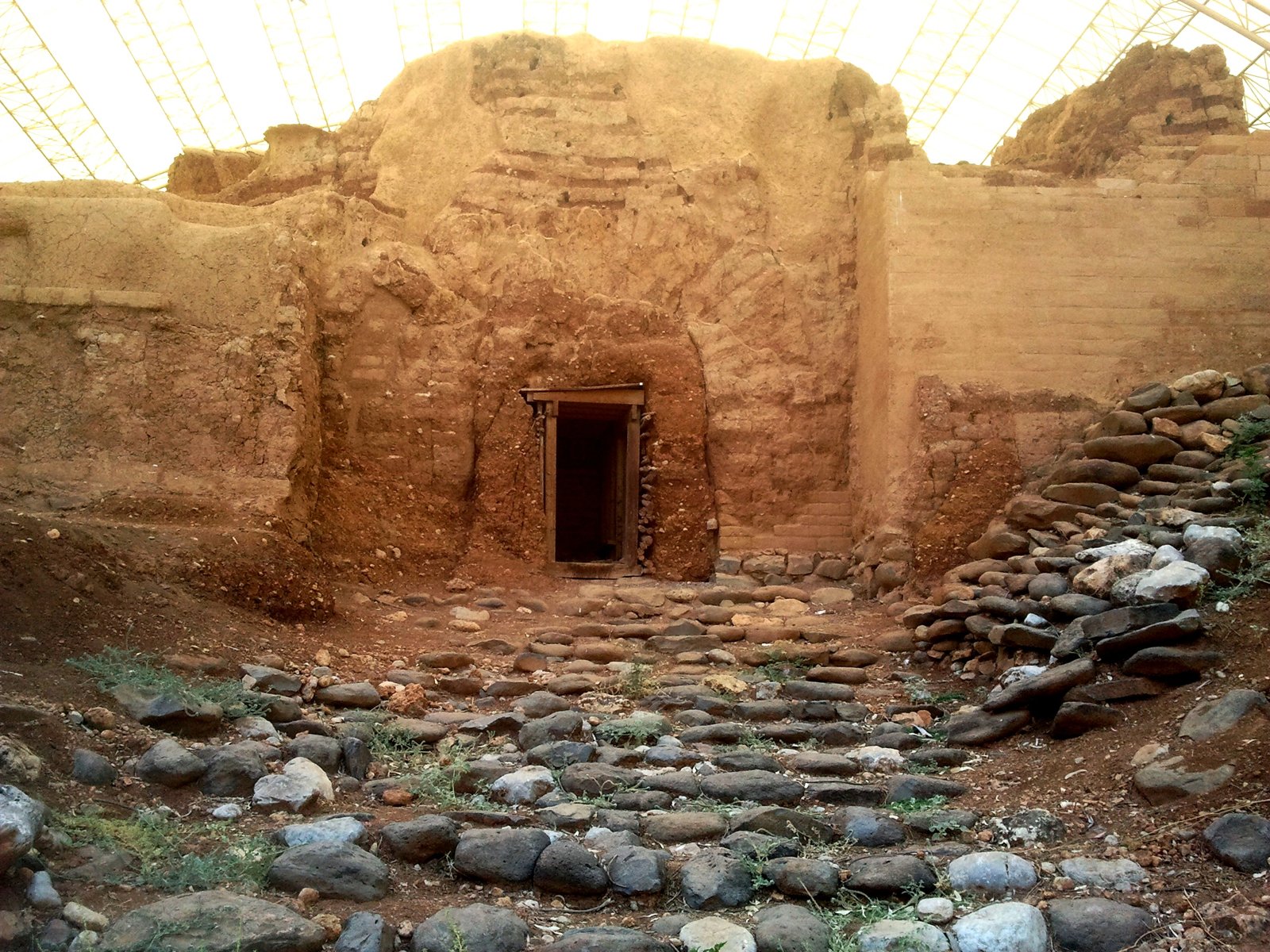
At Tel Dan in the northern Hula Valley, excavators found a mudbrick gatehouse with three surviving arches and an associated earthen rampart. The excavation team assigns the gatehouse to stratum XI, which it dates to the 18th century BCE. The national submission to the UNESCO Tentative List highlights the unusually complete preservation of the arches. Judges 18:29 gives Laish as the earlier name of Dan. [20][21][39]
The kingdoms of the north
Several rulers in northern Syria bore AmoriteAmoritesGroups associated with West Semitic speech in the Levant and Mesopotamia, whose dynasties were particularly prominent in the nineteenth and eighteenth centuries BCE (ca. 1900–1700 BCE).Glossary · Click to read the explanation names. AkkadianAkkadianAn ancient East Semitic language written in cuneiform from the third millennium BCE; its varieties include Babylonian and Assyrian, and it served in international diplomacy.Glossary · Click to read the explanation cuneiformCuneiformWriting with wedge-shaped signs, developed from Mesopotamian recording traditions and used for several languages from the third millennium BCE.Glossary · Click to read the explanation letters found at Mari document relations between the kingdoms of Yamhad, Qatna and Mari. [22][24][25]
- Yamhad had its capital at Halab (AleppoAleppo, historical cityNorthern Syrian city whose region appears in Mari reports, with architecture from multiple periods.Glossary · Click to read the explanation). Its king Yarim-Lim I supported Zimri-Lim of Mari, who married Yarim-Lim’s daughter Shibtu. The Mari correspondence documents this alliance. The Hittite Proclamation of Telipinu later recounts that Mursili I took Halab before marching on BabylonBabylonBabylon is an ancient city in central present-day Iraq, south of BaghdadGlossary · Click to read the explanation. [22][23]
- Qatna, near present-day Homs, was a rival of Yamhad. Its royal palace included a hall measuring about 36 by 36 metres. In 2002 the Syrian–German excavation team discovered a royal tomb of four chambers cut into the rock below the palace foundations. It contained sarcophagi, jewellery and other objects as well as human remains. [24][40]
- MariMariMari at Tell Hariri on the Syrian Euphrates was founded around 2900 BCE and rebuilt through three major urban phases. Its palace and cuneiform archives illuminate trade, royal government and religious practice, especially in the eighteenth century BCE.Glossary · Click to read the explanation, on the Euphrates, is known from about 20,000 tablets and fragments from the palace. Most are from the last two decades of the palace, including the reign of Zimri-LimZimri-Lim, king of MariEighteenth-century BCE king of Mari, recipient of letters reporting river ordeals.Glossary · Click to read the explanation. The archive documents diplomacy and administration. In the chronology used by its editors, HammurabiHammurabiKing of Babylon in Mesopotamia, reigning around 1792–1750 BCE. A celebrated legal text preserved on a stele and cuneiform copies bears his name.Glossary · Click to read the explanation captured Mari in 1761 BCE and the palace was destroyed in 1759 BCE (see record 1218). [25]
A tablet from Mari recording distributions of tin lists two allocations to Ibni-Addu, king of Hazor, at a place called Hazazar. The tablet connects a southern Levantine ruler to the network through which the court at Mari distributed tin. [26]
Canaan: city-states and the Egyptian texts
In the region later called CanaanCanaanRegional name in the Mediterranean Levant, associated with Canaanite cities and cultures in the second millennium BCE and with Abraham’s family’s destination in Genesis.Glossary · Click to read the explanation, MegiddoMegiddo, Tell el-MutesellimArchaeological mound in present-day northern Israel with Bronze and Iron Age cities, associated with a Gilgamesh fragment.Glossary · Click to read the explanation preserves several phases of Middle Bronze Age fortification. On the coast at ByblosByblos / JbeilByblos, or Jbeil, is a coastal city in Lebanon north of Beirut.Glossary · Click to read the explanation, a fragment of a relief with an Egyptian hieroglyphic inscription names both Neferhotep I and the local ruler Inten. It is one piece of evidence for ties between Byblos and Egypt. [17][27][35]
Egyptian Execration Texts name rulers, places and others targeted in ritualsRitualAn organised or distinguished practice meaningful to a community; it may leave traces, but its form alone does not reveal an associated doctrine.Glossary · Click to read the explanation. The Berlin group survives on fragments of clay bowls. The Brussels group includes more than 120 clay figurinesFigurineA small shaped object depicting a human, animal or abbreviated form, in clay, stone or another medium. Its form alone does not establish its use; manufacture, handling traces and find context matter.Glossary · Click to read the explanation of bound prisoners. People deliberately broke the objects as part of a ritual. Some place names can be linked to sites in the Levant, while others have competing identifications. The dates of the Egyptian texts and the phases at the sites matter when using the lists to reconstruct the region. [28]
The Egyptian Story of Sinuhe survives in several manuscripts, including a fragment dated to the Twelfth Dynasty. In the story, an Egyptian official takes refuge with a ruler of Retjenu. Sinuhe describes a land with figs, grapes and abundant wine, and becomes commander of the ruler’s army. The story gives a literary portrayal of the region from an Egyptian perspective. [29][30]
The Hyksos and Avaris
The Fifteenth Dynasty ruled from Avaris in the eastern Nile Delta. The Austrian Archaeological Institute dates Hyksos rule at this capital to about 1640–1530 BCE. The name Hyksos derives from an Egyptian title meaning “rulers of foreign lands”. A study of tooth enamel from 75 people buried at Avaris found evidence of people growing up outside the Nile Delta before the Fifteenth Dynasty came to power in EgyptEgyptEgypt lies mainly in northeastern Africa and includes the Sinai Peninsula in AsiaGlossary · Click to read the explanation. The isotope results do not establish a specific homeland for the rulers. [31][32][38]
Avaris is the excavated site of Tell el-Dabʿa in the eastern Nile Delta. In his tomb inscription at El-Kab, the soldier Ahmose son of Abana recounts the siege and sack of Avaris under King Ahmose I. The Aegean-style painted plaster, including scenes of people leaping over bulls, comes from later palatial contexts at nearby ʿEzbet Helmi. The Austrian excavators assign the decorated palaces to the reigns of Hatshepsut and Thutmose III, and of Amenhotep II, in the Eighteenth Dynasty. [31][33][34]
Reading the evidence with care
Different sites preserve different kinds of evidence. In JerusalemJerusalemJerusalem is a city of religious importance in Judaism, Christianity and IslamGlossary · Click to read the explanation, a radiocarbon study found signs of activity in the 20th century BCE. Its authors date the earliest public buildings in their excavated areas to a later phase. Mari’s archive records the business of a palace, and the Egyptian Execration Texts name the people and places selected for a ritual. Each source has its own geographical and chronological limits. [18][25][28]
Why it matters
Middle Bronze Age fortifications and palaces show how rulers and communities built and organised their towns. Tin allocations recorded at Mari and hieroglyphic inscriptions found at Byblos show particular connections between courts. These records give us points of contact across the Levant and with neighbouring regions. [17][24][26][27]
References and notes
- Wikipedia, 'Middle Bronze Age' (secondary summary) First 100,000 of 229,189 characters: Near East periodization, Levant section, high chronology, Old Syrian polities, Ugarit-Egypt contacts; the final part was not read Return to the text ↑
- Wikipedia, 'Hyksos' (secondary summary) First 100,000 of 213,691 characters: name, origins debate, Avaris, fall, open questions; the final part was not read Return to the text ↑
- Wikipedia, 'Canaan' (secondary summary) First 100,000 of 289,449 characters: Middle Bronze Age city-states, confederacies, Hazor, Megiddo, Sinuhe; the Canaanite culture section was not read Return to the text ↑
- Wikipedia, 'Execration texts' (secondary summary) Page read via fetch summary: nature, dates, Berlin and Brussels groups, places and rulers, limits Return to the text ↑
- Wikipedia, 'Tell el-Dab'a' (secondary summary) Page read via fetch summary: location, excavation history, Middle Bronze Age city, tombs, Minoan-style paintings, dating Return to the text ↑
- Wikipedia, 'Tel Hazor' (secondary summary) First 100,000 of 110,743 characters: size, MB I palace, MB IIB rampart, Mari mentions, excavators; the last part was not read Return to the text ↑
- Wikipedia, 'Mari, Syria' (secondary summary) First 100,000 of 237,226 characters: archives, Zimri-Lim, destruction by Hammurabi, key dates; the later part was not read Return to the text ↑
- Wikipedia, 'Yamhad' (secondary summary) First 100,000 of 148,274 characters: rulers, power, relations with Mari, Qatna and Babylon, fall to the Hittites; the last part was not read Return to the text ↑
- Wikipedia, 'Qatna' (secondary summary) First 100,000 of 235,353 characters: Middle Bronze Age city, kingdom, palace, royal tomb, excavations; the later part was not read Return to the text ↑
- Wikipedia, 'Tel Dan' (secondary summary) Page read via fetch summary: Middle Bronze Age mud-brick gate, Laish, key dates Return to the text ↑
- Wikipedia, 'Byblos' (secondary summary) First 100,000 of 156,396 characters: Middle Bronze Age objects naming Senusret II and Neferhotep I, temple of the Obelisks; the last part was not read Return to the text ↑
- Wikipedia, 'Story of Sinuhe' (secondary summary) Page read via fetch summary: date, plot, setting, literary caveat, manuscripts Return to the text ↑
- Wikipedia, 'Southern Levant' (secondary summary) Page read via fetch summary: only the short Bronze Age naming of phases (EB IV/MB I, MB IIa, IIb) was relevant Return to the text ↑
- Wikimedia Commons file page, 'Tel Dan Canaanite Gate 1.jpg' File page read: description, author Hanay, date 10 Aug 2013, licence CC BY-SA 3.0, size 2560 x 1920 Return to the text ↑
- Raphael Greenberg, “The Intermediate Bronze Age: Entering the Orbit of Syria,” in The Archaeology of the Bronze Age Levant (Cambridge University Press, 2019), 136–179. “Notes on Terminology and Chronology,” Intermediate Bronze, Early Bronze IV and earlier usage of Middle Bronze I. Return to the text ↑
- Felix Höflmayer, Assaf Yasur-Landau, Eric H. Cline, Michael W. Dee, Brita Lorentzen and Simone Riehl, “New Radiocarbon Dates from Tel Kabri Support a High Middle Bronze Age Chronology,” Radiocarbon 58.3 (2016), 599–613. Open abstract, the end of the final palace phase around 1700 BCE and the comparison with dates of about 1650 and 1600 BCE. Return to the text ↑
- Assaf Yasur-Landau, Eli Piasetzky, Matthew J. Adams, Helena Roth, Zachary Dunseth and Israel Finkelstein, “The Beginning of the Middle Bronze Age in the Levant: New Evidence from Megiddo,” Palestine Exploration Quarterly (2026). Institutional abstract, Area S, Stratum XIII, short-lived radiocarbon samples and the proposed start of MB I. Return to the text ↑
- Johanna Regev et al., “Middle Bronze Age Jerusalem: Recalculating Its Character and Chronology,” Radiocarbon 63.3 (2021), 853–883. Introduction on regional dating schemes and “Phase I: The Earliest Settlement” and “Phase II: The Earliest Public Architecture.” Return to the text ↑
- Israel Nature and Parks Authority, Tel Hazor National Park, English visitor guide. Opening site description and “Lookout over the Lower City,” combined area, acropolis area and earthen rampart. Return to the text ↑
- Nelson Glueck School of Biblical Archaeology, Hebrew Union College, “Tel Dan,” excavation project overview. Site description on Laish and biblical references, plus the stratigraphic table, stratum XI. Return to the text ↑
- “Triple-arch Gate at Dan & Sources of the Jordan,” national Tentative List submission 1469, UNESCO World Heritage Centre (2000). Description of the Middle Bronze Age mudbrick gate and the three preserved arches. Return to the text ↑
- João Batista Ribeiro Santos, “Aleppo, Mari and the aleppine-mariyanum dinastic project in the ancient Syria,” Varia Historia 41 (2025), e25049. Discussion of Yarim-Lim’s support, Zimri-Lim’s marriage to Shibtu and the diplomatic correspondence. Return to the text ↑
- “Edict of Telipinu” (CTH 19), English excerpt in University of Massachusetts Lowell, History 213 teaching slides (2012). §§8–9, Mursili’s accession and the expeditions against Halab and Babylon. Return to the text ↑
- University of Tübingen, “Grabungsprojekt Qatna,” Syrian–German excavation project. “Der Palast” and “Die Königsgruft,” hall C, the four chambers, tomb contents and the discovery in 2002. Return to the text ↑
- PROCLAC (CNRS and Collège de France), “Archives royales de Mari.” The reign of Zimri-Lim, the capture of Mari, the palace destruction and the tablet and fragment tally. Return to the text ↑
- Jack M. Sasson, translation of Mari tablet A. 1270 (ARM 23:556), figure 1 in Joan Aruz, Kim Benzel and Jean M. Evans (eds.), Beyond Babylon: Art, Trade, and Diplomacy in the Second Millennium B.C. (Metropolitan Museum of Art, 2008), p. 4. Lines 22 and 26, two allocations of tin to Ibni-Addu at Hazazar. Return to the text ↑
- Amel Bouhafs, “Entités divines et lieux de cultes à Byblos entre le IIe et le Ie millénaire d’après les inscriptions hiéroglyphiques giblites,” Égypte nilotique et méditerranéenne 16 (2023), 205–228. Discussion of the Baalat Gubal relief and its text, fig. 2a. Return to the text ↑
- Katharina Streit, “A Maximalist Interpretation of the Execration Texts—Archaeological and Historical Implications of a High Chronology,” Journal of Ancient Egyptian Interconnections 13 (2017), 59–69. Pp. 59–60 and table 1, the Berlin and Brussels groups and proposed Levantine place-name identifications. Return to the text ↑
- Mark-Jan Nederhof, Sinuhe, Egyptian text, transliteration and English translation (University of St Andrews). Version B, lines 78–87 and 99–101, the land’s produce and service as commander of the ruler’s army. Return to the text ↑
- Frank Feder et al., “Sinuhe,” Thesaurus Linguae Aegyptiae, text SIUBDGAOMVFR3GB5E3A5RH2UYU. Petrie Museum pUC 32773, the Harageh manuscript witness dated to the Twelfth Dynasty. Return to the text ↑
- Austrian Archaeological Institute, Austrian Academy of Sciences, “Tell el-Dabʿa / Avaris.” Site identification and the project’s chronology of Hyksos rule. Return to the text ↑
- Chris Stantis et al., “Who were the Hyksos? Challenging traditional narratives using strontium isotope (87Sr/86Sr) analysis of human remains from ancient Egypt,” PLOS ONE 15.7 (2020), e0235414. Abstract, section on Tell el-Dabʿa, sampling, results and discussion of geographic limitations. Return to the text ↑
- Miriam Lichtheim (trans.), “The Autobiography of Ahmose Son of Abana,” in Ancient Egyptian Literature, vol. II (University of California Press), 12–13. Tomb inscription at El-Kab, “Expulsion of the Hyksos,” the siege and sack of Avaris. Return to the text ↑
- Austrian Archaeological Institute, Austrian Academy of Sciences, “Tell el-Dabʿa: Late Minoan wall paintings.” Decorated palaces at ʿEzbet Helmi, Eighteenth Dynasty contexts and scenes of bull leaping. Return to the text ↑
- “The Biblical Tels and Ancient Water Systems: Megiddo, Hazor, Beer Sheba,” World Heritage nomination dossier 1108. Pp. 63–64 and the history of Hazor, successive Middle Bronze fortifications at Megiddo and the date proposed for Hazor’s lower city. Return to the text ↑
- Robert S. Homsher, Constructing Urbanism: Relating the Construction of Architecture to the Process of Urbanization in the Middle Bronze Age Southern Levant (PhD dissertation, University College London, 2013), vol. 1. Pp. 32–33, “Relative Chronology” and table 1, comparison of the phase labels. Return to the text ↑
- Shlomit Bechar and Assaf Yasur-Landau, “The Middle Bronze I Foundation of Hazor,” Palestine Exploration Quarterly (2026). Institutional abstract, reanalysis of pottery from the Standing Stones Complex and the proposed date of the upper-city palace. Return to the text ↑
- Danielle Candelora, “The Hyksos,” American Research Center in Egypt. Opening discussion of the Egyptian title and the designation of the Fifteenth Dynasty. Return to the text ↑
- Judges 18:29, New Revised Standard Version Updated Edition (2021). The verse gives Laish as Dan’s earlier name. Return to the text ↑
- Peter Pfälzner, “Qatna, Syria: Syria’s Royal Tombs Uncovered,” Current World Archaeology 15 (2006), 12–22. Opening description locates the site northeast of Homs. The report describes the tomb beneath the Bronze Age palace. Return to the text ↑
Suggest a correction · Suggest a source for this record
Cite this record
IL Archive, «The Middle Bronze Age in the Levant (c. 2000–1550 BCE)», https://ilarchive.com/en/periods/middle-bronze-age-levant