Site
Ehulhul, the Temple of Sin at Harran
- Names
- Ehulhul · Eḫulḫul · Temple of Sin at Harran
- Region
- Mesopotamia
Ehulhul was the sanctuary of the moon god Sîn at Harran. Assyrian and Babylonian kings recorded its rebuilding in detail. Reused steles and stamped bricks preserve its name, while the precise site remains uncertain.
Estimated reading time: 5 min Published Last reviewed:
Share article
Text
Introduction
The temple that Assyrian and Babylonian kings called Ehulhul was a home for the moon god SînNanna / Su’en / SinMesopotamian moon god known as Nanna, Su’en and Sîn/Sin. Worshipped especially at Ur and Harran, he is associated with the crescent and lunar cycle; names and myths have different histories.Glossary · Click to read the explanation at HarranHarranHistoric city in southeastern Türkiye, south of Şanlıurfa; Genesis places Abraham’s family there on its journey towards Canaan.Glossary · Click to read the explanation. Its ceremonial name means House Which Gives Joy. Royal inscriptions describe cedar roofing, surfaces of precious metal and ceremonies for bringing divine statues into the finished sanctuary. The place is securely identified with ancient Harran, though the surviving inscriptions and building materials have yet to fix its footprint within the city. [1] [2]
An Assyrian restoration
AshurbanipalAshurbanipalAshurbanipal was an Assyrian king of the seventh century BCE, reigning about 668–631 BCEGlossary · Click to read the explanation describes rebuilding Ehulhul in the seventh century BCE. His scribes credit Shalmaneser III, a ninth-century king, with the earlier construction. In one prism inscription, Sîn names Ashurbanipal as the future restorer even before his parents are born. The building declines in the intervening years, and the god’s old pronouncement finally becomes known when the work falls to Ashurbanipal. The inscription uses the building’s age to connect his reign with both a predecessor and an obligation that the god had set long before. [3]
From several versions of Ashurbanipal’s reports, Jamie Novotny reconstructs a sequence of works. The builders cleared the damaged walls, inspected old foundations, reused them and erected new courses of mud brick. They put cedar beams across the temple and hung wooden doors in the gates. The inner rooms were furnished with protective images, including bulls, long-haired figures and lion-headed eagles. These were guardians of thresholds and rooms, and some carried inscriptions. Sîn’s statue was brought in ceremonially and set on its raised seat. Ashurbanipal also built a sanctuary for Nusku called Emelamana within the complex. Its physical relationship to Ehulhul remains conjectural because neither building has been identified in excavation. [2] [4]
Harran after Assyria
The Fall of NinevehNineveh and KuyunjikNineveh is an ancient Assyrian city near Mosul in northern Iraq; Kuyunjik is one of its archaeological moundsGlossary · Click to read the explanation Chronicle records the capture of Harran in Nabopolassar’s sixteenth year, 610 BCE. It says that Babylonian and Median forces marched there and that the Babylonian king took booty from the city and its temples. The inscription in the name of Nabonidus’s mother Adad-guppi dates the city’s ruin to the same year and describes Sîn leaving for heaven after becoming angry with his city. Nabonidus’s own cylinder speaks specifically about Ehulhul and attributes its ruin to the Medes. The chronicle reports a military result. The two later temple accounts explain a rupture in worship and the possibility of bringing it to an end. [1] [5]
On his Harran stele, Nabonidus describes Sîn appearing to him at night and commanding him to rebuild the temple. On the Ehulhul Cylinder, he says both Sîn and MardukMardukBabylon’s leading god, worshipped at Esagil and elevated in the Akkadian Enūma eliš. His symbols include a spade and mušḫuššu dragon. His earliest origins remain obscure; Nibiru is no evidence of a planetary homeland.Glossary · Click to read the explanation appeared in a dream and that Marduk gave the order. In Adad-guppi’s inscription, Sîn tells her that her son will rebuild the sanctuary and lead the gods back. Each of the three texts preserves a named speaker and an intended builder. The changing speaker shows that the texts give different accounts of the commission even though all of them credit Nabonidus with the work. [1]
Building on earlier foundations
Nabonidus explains in the cylinder inscription that he laid foundations over Ashurbanipal’s, which in turn are associated with those of Shalmaneser III. He names silver, gold, choice stones and pieces of aromatic wood in the foundation account. He also describes cedar brought from Mount Amanus for the roof, gilded and silvered surfaces, and a metal bull standing in Sîn’s inner room. Two long-haired figures guard the sides of the Gate of the Rising Sun. These details give a reader a sense of the materials, interior and entryways the king wanted his inscription to commemorate. The record of the temple’s inauguration then shifts to the four divine residents. Nabonidus says that he took Sîn, Ningal, Nusku and Sadarnunna by the hand, led them out of BabylonBabylonBabylon is an ancient city in central present-day Iraq, south of BaghdadGlossary · Click to read the explanation, installed them at Harran and presented offerings. [1]
The stones that survived
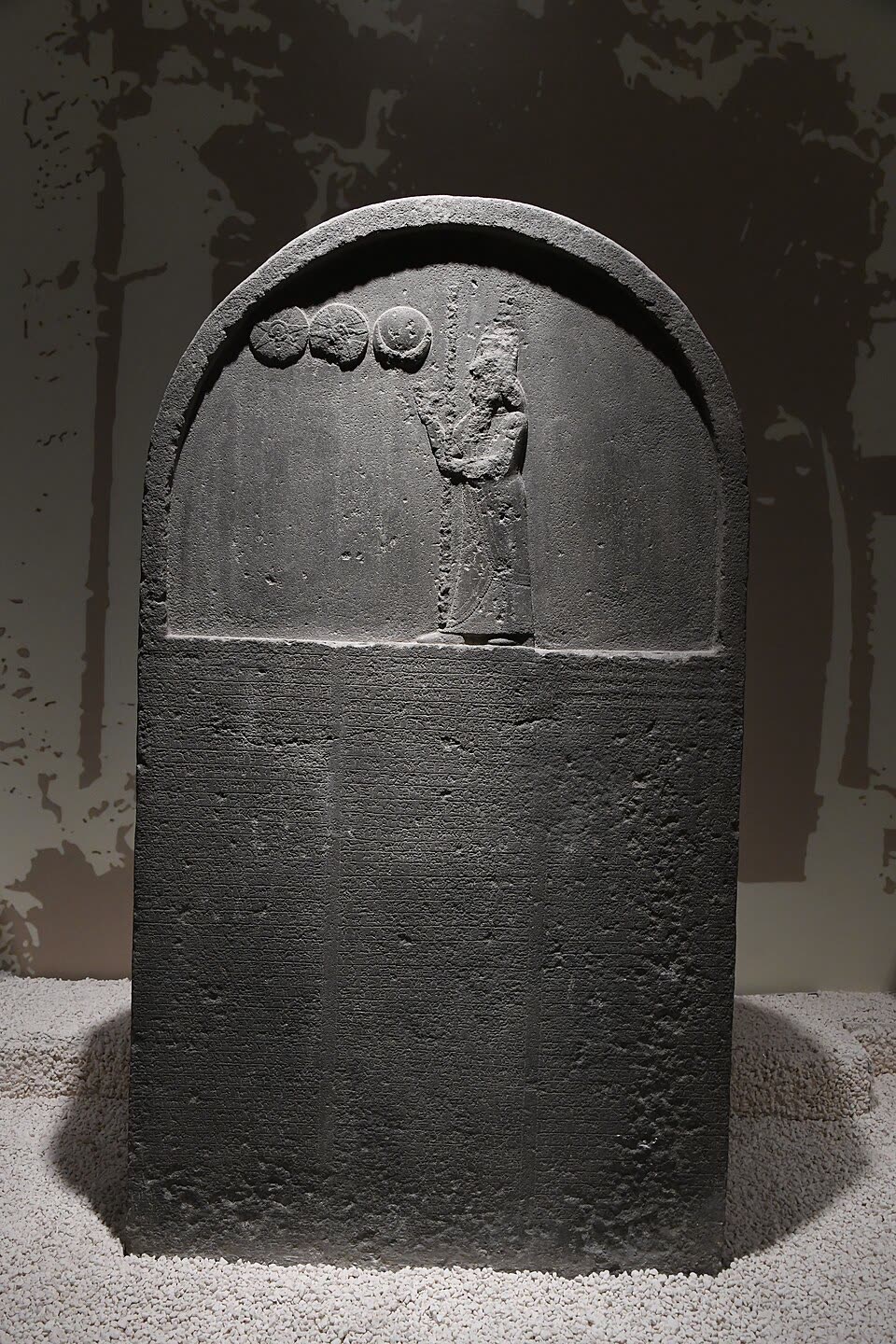
The stele shown here, H2 A, is one of two containing Nabonidus’s Harran inscription. Its companion was reused at the west entrance of the Great Mosque, while H2 A was found in the paving of the east entrance. The relief on each shows the king before symbols of Sîn, ŠamašShamashMesopotamian god of the sun and justice, shown before Hammurabi on an eighteenth-century BCE stele preserved in the Louvre.Glossary · Click to read the explanation and IštarInanna / IshtarA prominent Mesopotamian goddess whose Sumerian name Inanna became associated with Akkadian Ishtar across diverse traditions. She was associated with desire, war, royal authority and Venus, while local forms and genealogies varied among texts.Glossary · Click to read the explanation. Arranged above a royal account that names the rebuilding, the images place Sîn alongside other gods even when the inscription gives him the central role. The place where the steles were reused, centuries after they were carved, helps establish the ancient city’s identity and suggests a possible area for the temple. The association with the mosque remains a hypothesis because the steles had been moved. [1] [2] [6]
The stamped bricks add a second kind of evidence. Veysel Donbaz compared examples from later layers at Harran. His study found both square and rectangular bricks carrying the same short text naming the temple, its builder and the four deities. The surviving impressions were often faint, so the reading depends on comparing many copies. A fragmentary stone vessel also mentions the temple’s zigguratZigguratZiggurat: a monumental stepped or terraced cult structure of ancient Mesopotamia. Not every raised temple platform was a ziggurat, and the form and specific use of lost upper stages often remain uncertain.Glossary · Click to read the explanation, or stepped temple tower, in connection with vessels for carrying water for ritualRitualAn organised or distinguished practice meaningful to a community; it may leave traces, but its form alone does not reveal an associated doctrine.Glossary · Click to read the explanation use. Its inscription is evidence for a named feature of the sanctuary, while its uncertain findspot leaves open where that feature stood. The steles, bricks and vessel thus tell us about different parts of the same place even though the excavated ground has yet to tie their evidence to a confirmed plan. [1] [6] [7]
References and notes (7)
- Frauke Weiershäuser and Jamie Novotny, RINBE 2 Nabonidus 28 i 7–ii 29, 47 i 1–18 and catalogue, 51–52, 2001 i 1–ii 21 Return to the text ↑
- Joshua Jeffers and Jamie Novotny, RINAP 5/2 Introduction pp. 24–25, Harran building projects and location of Ehulhul Return to the text ↑
- Jamie Novotny and Joshua Jeffers, RINAP 5/1 Ashurbanipal 5 ii 2′–18′, commission and prior construction Return to the text ↑
- Jamie Novotny, Assurbanipal Inscriptions in the Oriental Institute, Part 2 pp. 13–15, reconstruction of building and decoration from the inscriptions Return to the text ↑
- Fall of Nineveh Chronicle, BM 21901, in RINAP 5/3 p. 45, lines 58–65, fall and plunder of Harran Return to the text ↑
- H. W. F. Saggs, Neo-Babylonian Fragments from Harran Iraq 31, opening discussion of the steles and the temple’s location Return to the text ↑
- Veysel Donbaz, A Brick Inscription of Nabonidus from Harran ARRIM 9, pp. 11–12, brick finds, stamp and translation Return to the text ↑
Suggest a correction · Suggest a source for this record
Cite this record
IL Archive, «Ehulhul, the Temple of Sin at Harran», https://ilarchive.com/en/sites/ehulhul
Continue reading