Study
Göbekli Tepe: Temple or Social Centre?
An extended study of a topic, with evidence and references.
How have domestic and food-processing evidence changed our understanding of Göbekli Tepe? Buildings, pillars, feasting and social networks reveal the possibilities and limits of interpreting ritual before writing.
Share article
Dates
Dates have distinct roles. The timeline uses creation, composition or historical coverage, rather than publication or discovery dates.
- Historical coverage
- Approximately From 9600 BCE to 8200 BCE
Text
Introduction
Was Göbekli TepeGöbekli TepeA Neolithic site in southeastern Turkey, known for communal buildings and T-shaped pillars; the excavation team describes a settlement with a pronounced ritual component.Glossary · Click to read the explanation a temple people visited and then left, or a settlement where dwelling and ritualRitualAn organised or distinguished practice meaningful to a community; it may leave traces, but its form alone does not reveal an associated doctrine.Glossary · Click to read the explanation stood together? The answer changed when smaller buildings and evidence of food and daily life appeared beside the great pillars. This study examines what has shifted in the reading of the site, and what remains open about feasting, pilgrimage and the word “temple” before writing.
UNESCO dates the monuments approximately to 9600–8200 BCE, thousands of years before cities and texts. That range belongs to those buildings, not to a single founding year for the whole mound. What survives in stone and the words that never reached us are different kinds of evidence. [1] [2]
Before divine names were written
Thousands of years before divine names reached us in writing, human communities were carving stone, building structures larger than a household needed, and bringing work, food and symbolism together. Their buildings survive; the words that gave them meaning do not.
Göbekli Tepe confronts us with this distance between what we can observe and what we try to interpret. The question is not simply whether it was a temple. It is also what we mean by “temple” when describing a society that lived more than eleven thousand years ago.
Before writing and cities
In the tenth millennium BCE, communities of the Pre-Pottery NeolithicPre-Pottery NeolithicA regional term for early Neolithic phases in Southwest Asia before the local spread of pottery; it does not imply an absence of settlement, architecture or cereal processing.Glossary · Click to read the explanation began constructing monumental stone buildings on a plateau overlooking the area around the Harran plain in southeastern AnatoliaAnatoliaAnatolia is the region occupying the Asian part of present-day TurkeyGlossary · Click to read the explanation. They quarried limestone, carved T-shaped pillars, and placed them inside circular and oval structures.
Göbekli Tepe lies about fifteen kilometres northeast of present-day ŞanlıurfaŞanlıurfaA modern city in southeastern Turkey, near Göbekli Tepe, whose museum displays Urfa Man.Glossary · Click to read the explanation. UNESCO dates its monumental structures approximately to 9600–8200 BCE. This is a range for the monuments highlighted in its description, not an exact founding date for the entire site. The excavation team's overview gives a broader approximate chronology and acknowledges uncertainty at both ends.[1][2][3]
Writing had not emerged, and pottery was not in use during this local phase. Cities, states and Sumerian temples lay far in the future. Yet people could organise collective work, move stones weighing tonnes, carve complex images, and modify and reuse buildings across generations.
The site's importance is that it makes the simple story “farming, then village, then temple” less adequate. Monumental communal architecture appeared here while settlement and food production were still changing, thousands of years before cities. The site alone does not establish an alternative sequence that every society must follow.[1]
A discovery that changed the picture
The mound had been known to archaeological survey since the 1960s. In 1994 Klaus SchmidtKlaus SchmidtGerman prehistorian who directed the Göbekli Tepe excavations from 1995 until his death on 20 July 2014.Glossary · Click to read the explanation and colleagues recognised its significance anew; excavations began in 1995. They revealed walls, benches and large buildings, several with two central pillars larger than those around them.[2][3]
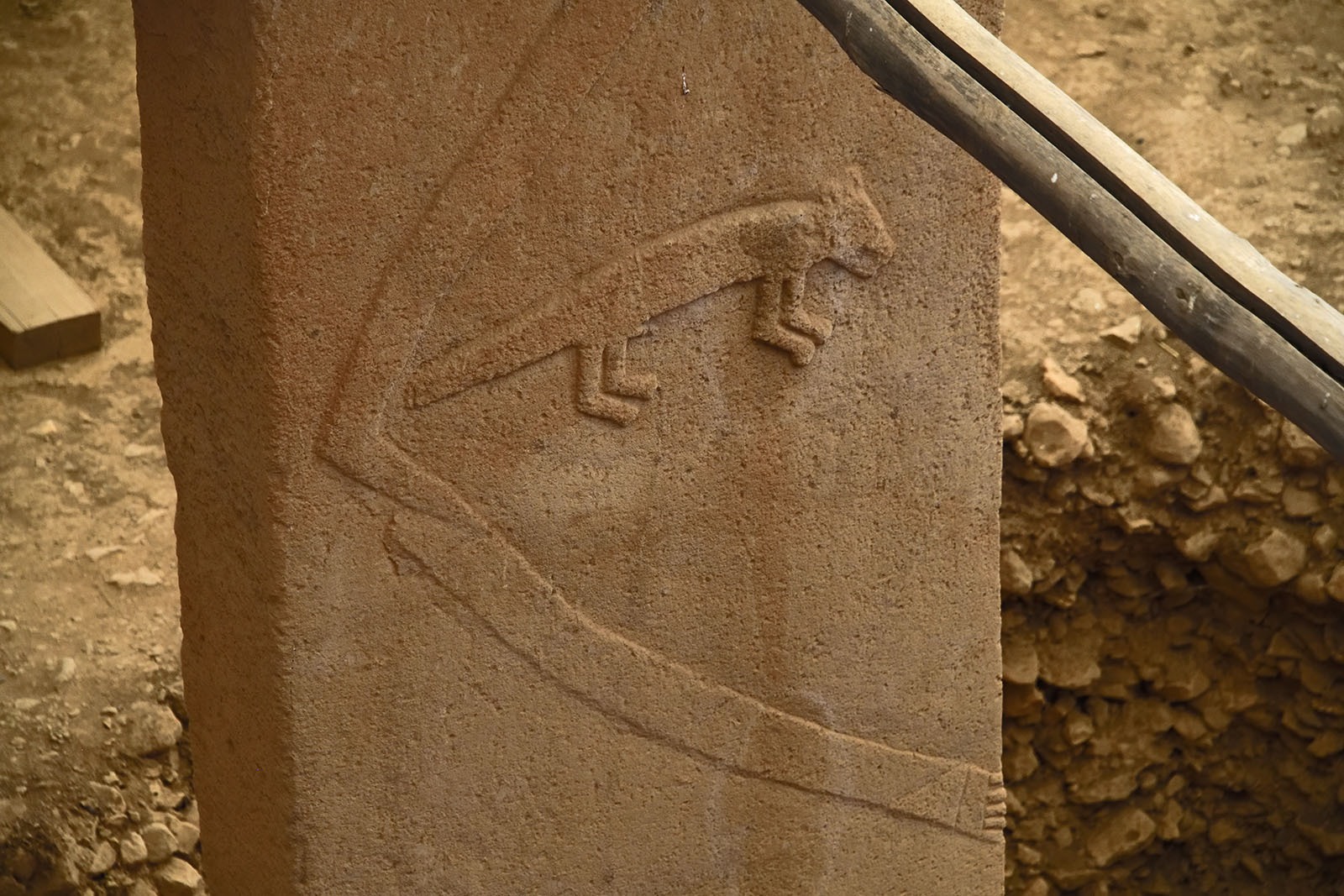
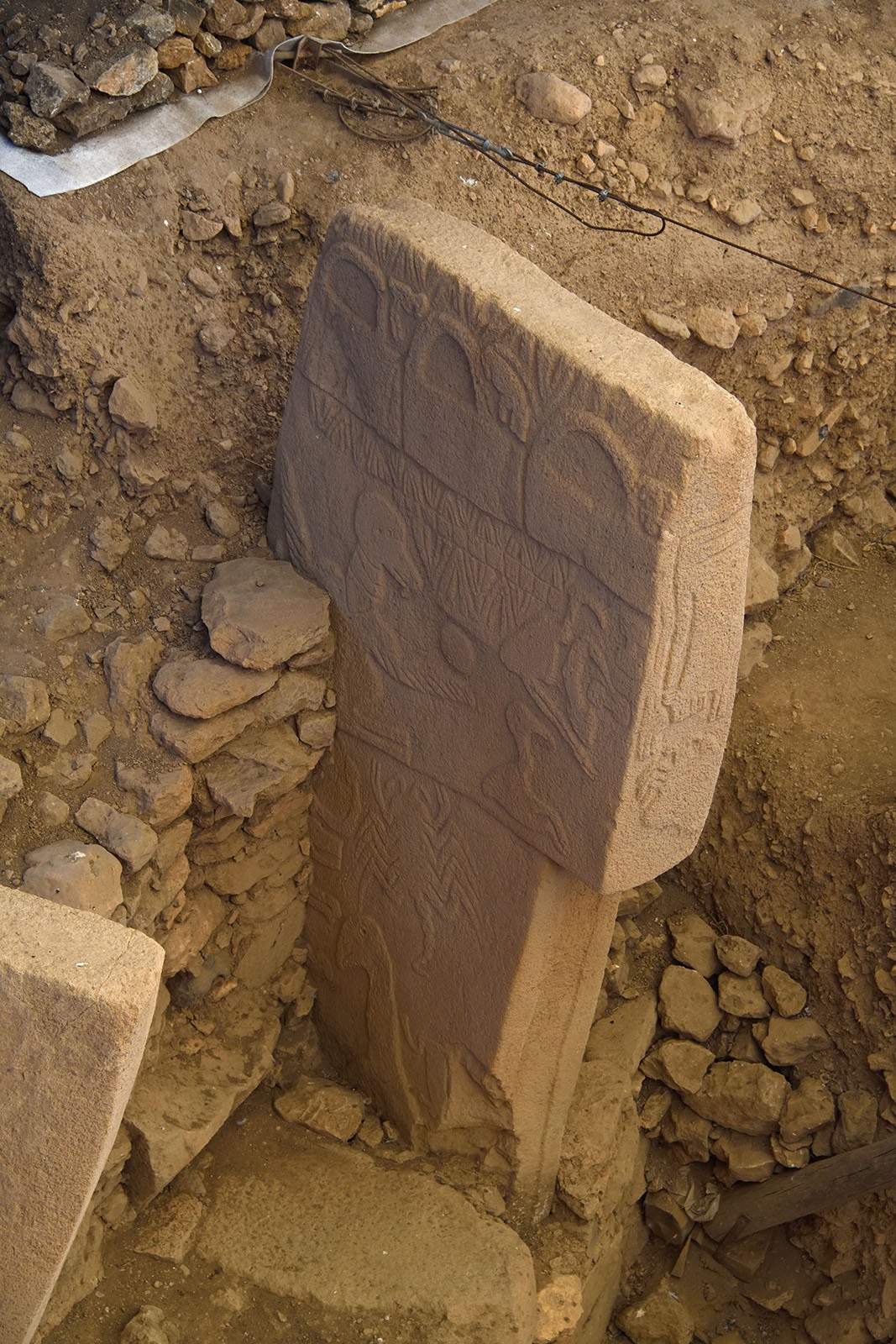
Some central pillars stand about 5.5 metres high. Certain pillars bear arms, hands, belts and clothing details. Interpreting them as human-shaped representations therefore rests on observable carvings, not the T-shape alone. Identifying these figures as gods, ancestors or other beings is a further interpretive step that their form cannot settle.[1][3][6]
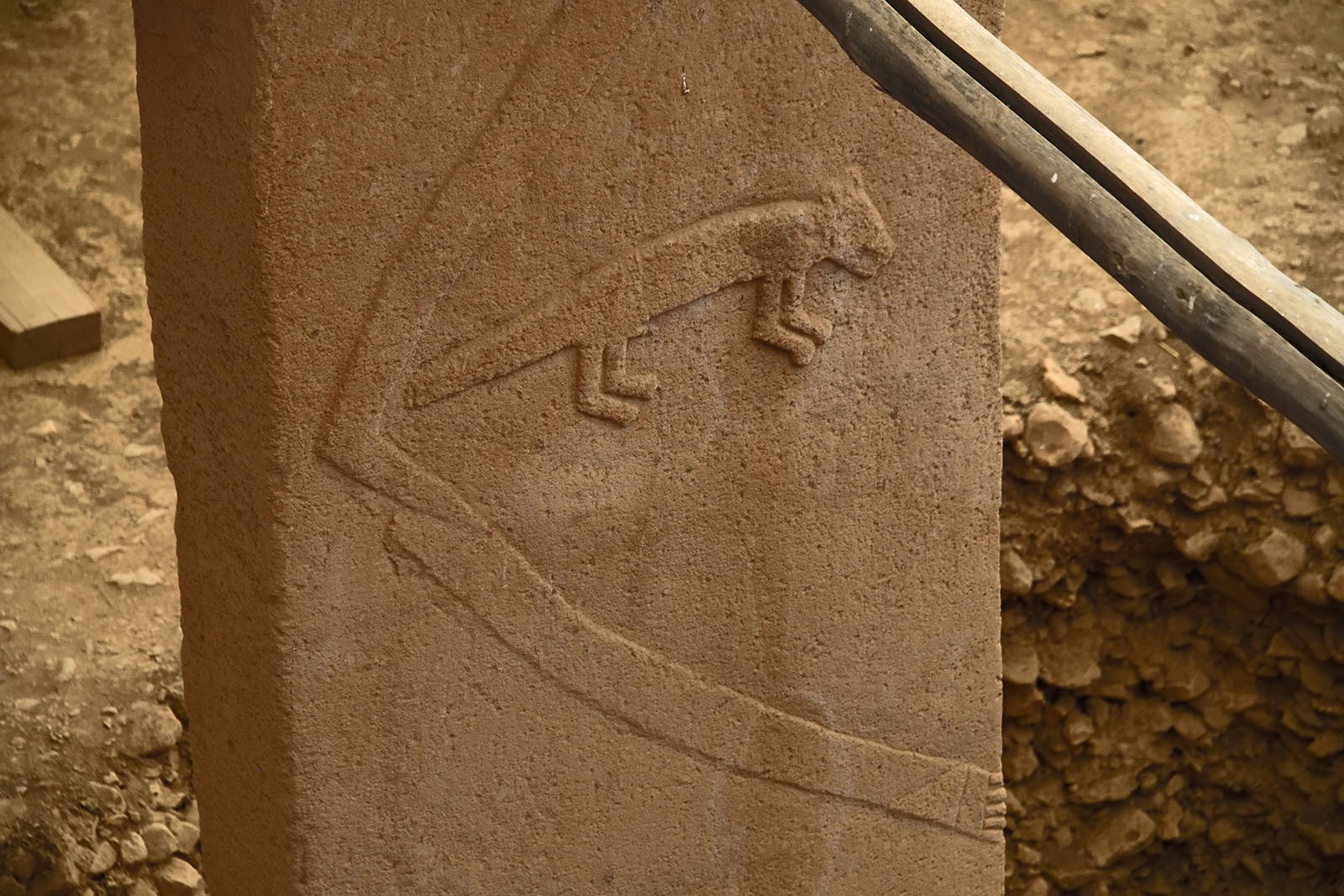
Other pillars depict snakes, foxes, wild boar, birds and further animals. This architecture differed from the simple dwellings researchers expected, and the domestic evidence known today was not clear in the early years. The site was consequently interpreted primarily as a ritual sanctuary visited by hunter-gatherers.[2]
From this picture came the media phrase “the world's oldest temple”. It condensed an influential interpretation, but also suggested that the place's function was understood and separate from habitation.
A temple without inhabitants?
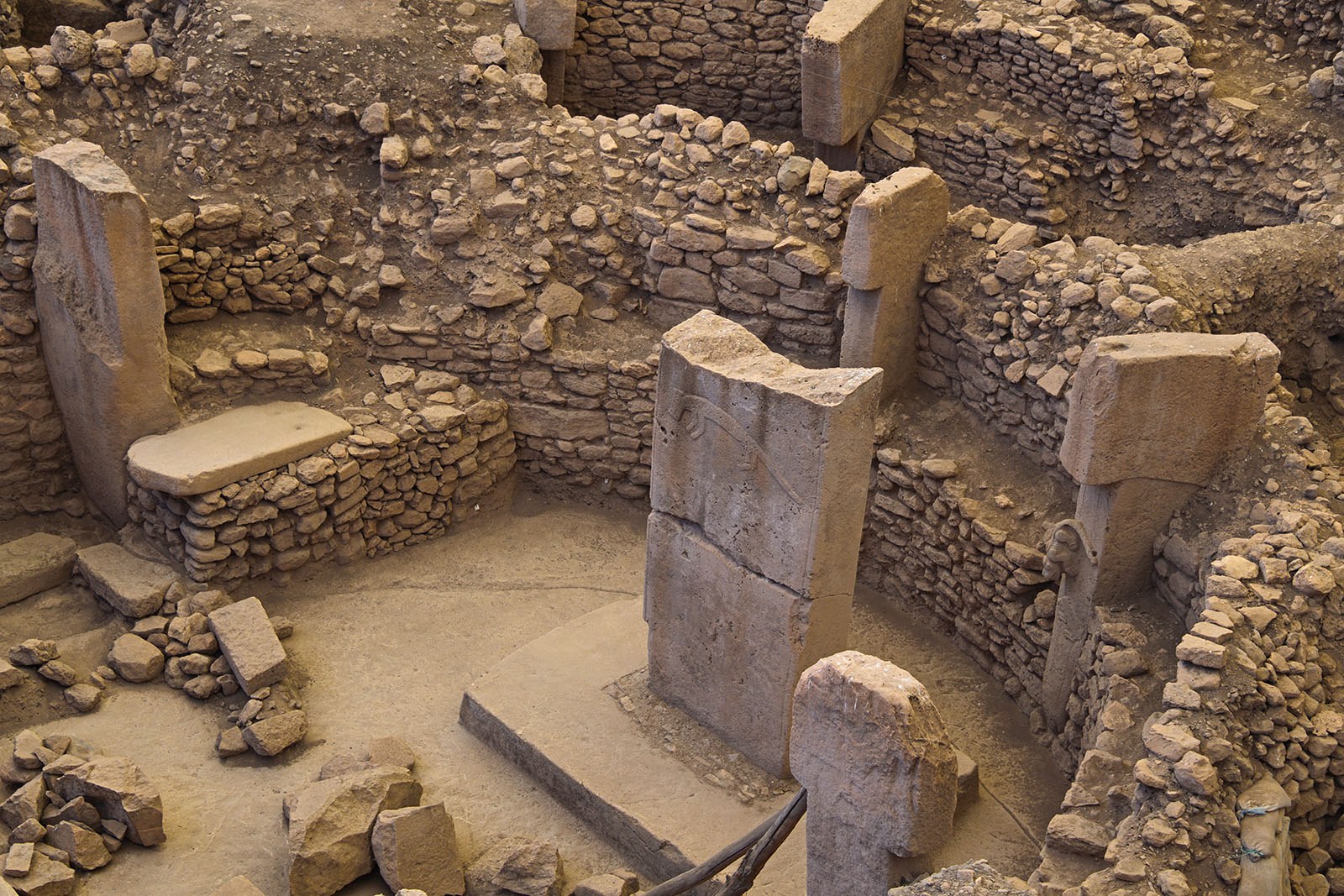
More recent excavations have broadened the picture. Smaller, more ordinary buildings appeared, alongside evidence of domestic activities and food processing and indications of permanent settlement. The German Archaeological Institute now describes Göbekli Tepe as a settlement with a pronounced ritual component.[2]
UNESCO also notes less monumental structures, some apparently domestic, alongside the large communal buildings.[1]
This does not remove the ritual component or turn every building into an ordinary house. It weakens a choice between two exclusive possibilities: either a temple people visited and left, or a village with no place for ritual. The team's current account brings residence, work, gathering and ritual practices together within the site, while the character of habitation and its changes over time remain under investigation.
Descriptions of an uninhabited sanctuary in older writing should therefore be read as a stage in the history of research, not a final statement of the team's present position.
Communities whose traces survive, but not their names
We have no transmitted name for the people who built Göbekli Tepe or for their language. They were early Neolithic communities in Upper MesopotamiaMesopotamiaA historical region associated with the Tigris and Euphrates, home to many societies and civilisations.Glossary · Click to read the explanation and southeastern Anatolia. Assigning them to Sumerians, HittitesHittitesAncient people and kingdom of Anatolia, dominating much of Anatolia and northern Syria around 1650–1200 BCE.Glossary · Click to read the explanation or Canaanites, whose names appear in much later evidence, would be unjustified.
Calling them “primitive hunters” also obscures the skill and organisation their remains reveal. Hunting and gathering plants need not exclude relative settlement, expertise in stone, or networks of communication and shared labour.[1][2]
Architectural and symbolic similarities connect the site with places including Jerf el Ahmar, Tell 'Abr and Körtik Tepe. In an account published in 2016, Oliver DietrichOliver DietrichAn archaeologist on the Göbekli Tepe project since 2005, writing on its imagery, feasting and Urfa Man.Glossary · Click to read the explanation compared snakes, birds, scorpions and communal building traditions across the region. Such similarities allow us to investigate contact between communities; they do not supply the name of a single people or a unified doctrine.[4]
Hunting was not the whole diet
A paper published in 2019 studied more than seven thousand grinding and crushing tools from Göbekli Tepe, drawing on classification, use-wear, experiments and comparison. Grinding equipment and plant silica remains support the importance of cereal processing at the site. This was not a community living on meat alone.[5]
Animal remains also indicate the importance of hunting, especially gazelle. These two lines of evidence belong to an economy that one label cannot adequately describe.
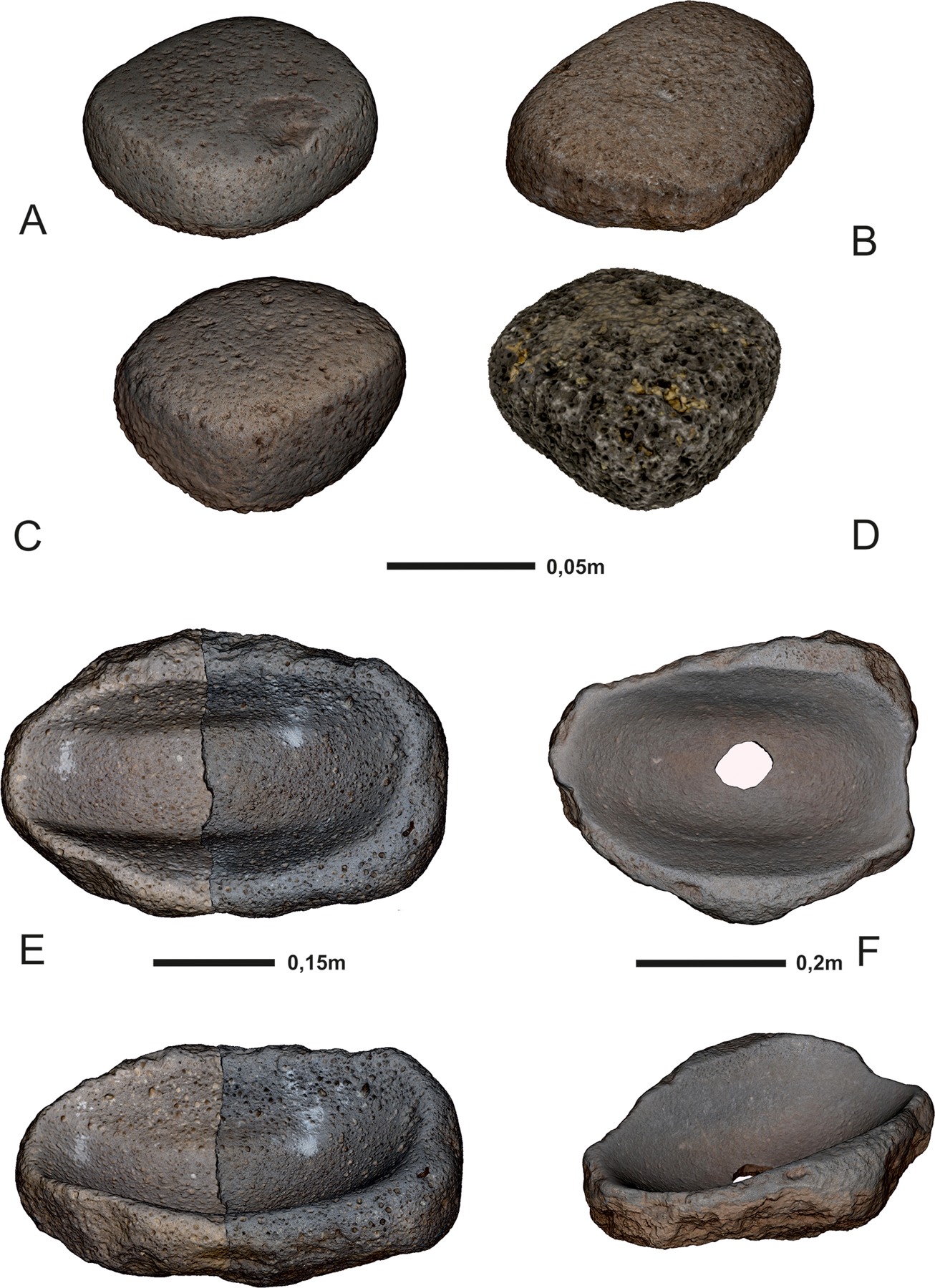
Grinding cereals does not, by itself, prove that domesticated cereals were cultivated at the site. Wild cereals can be gathered and processed intensively, and gathering and early cultivation can overlap during the transition towards food production. The presence, processing, cultivation and domestication of cereals must therefore be distinguished: each claim requires its own evidence.[5]
Göbekli Tepe matters because it lies within this transition, not because it lets us divide people into “hunters only” and fully established farmers.
What happened inside the large buildings?
Some early buildings reach around twenty metres in diameter. Benches run along their edges, several contain large central pillars, and carved images are abundant. These features strongly support a function beyond housing one small family. UNESCO describes their use for social and ritual events as probable.[1]
But no text describes a particular ceremony. Were these gatherings for feasts? Did some concern death and memory? Were stories told or performed? These are research questions, not a list of established events.
In a 2025 study, Marc VerhoevenMarc VerhoevenAn archaeologist at RAAP in the Netherlands who published a 2025 reading of human–animal relations at Göbekli Tepe.Glossary · Click to read the explanation discusses relationships and hierarchy among human-shaped figures, animals and other beings in the site's imagery, as part of an interpretation of its symbolic world. Such work offers a way of reading the images; it does not recover the figures' names or their makers' narratives.[6]
A carved fox does not establish fox worship. A larger pillar does not, on its own, establish a “high godHigh godA deity with a senior position among other gods; this does not itself mean monotheism.Glossary · Click to read the explanation”. We may recognise that an image mattered before knowing the meaning that made it important.
Feasting: food and the organisation of work
Animal remains, numerous grinding tools, stone vessels and communal architecture have made food an important interpretive key. One proposed model is work feastingWork feastingAn interpretive model connecting collective labour and hospitality: food accompanies participation in a project. Proposed for some Göbekli Tepe evidence, it does not establish the details of a particular feast.Glossary · Click to read the explanation: people gather for collective labour, with food and hospitality helping to organise participation and relationships.[5][7]
This model is familiar from anthropological comparison and can help us envisage labour mobilisation for large buildings without a state or an administrative apparatus known to us. The cereal study proposes that substantial food production may have accompanied gatherings and construction work. A 2012 study discussed the role of ritual and feasting in the emergence of Neolithic communities.[5][7]
Nevertheless, grinding tools alone cannot tell us who organised a feast, how many people attended, what participation rules applied, or whether it accompanied every building project. Work feasting is a possible interpretation supported by clues, not a scene documented in every detail.
Food in such an event could be labour, hospitality, symbolism and ritual at once. Separating these functions completely could conceal their connections.
What does the absence of large stores mean?
The 2019 study noted that the evidence then available did not reveal large storage facilities supporting a model of extensive cereal collection and redistribution. It suggested that much processing was directed towards consumption soon afterwards, perhaps during seasonal gatherings and collective work.[5]
The scope of this inference matters: it concerns excavated areas and data published in that study. It does not prove that the whole site lacked storage in every phase. Nor does the absence of a large store demonstrate an absence of inhabitants.
This illustrates the value and limits of negative evidenceNegative evidenceFailure to find an expected trace can test a hypothesis when preservation and investigation make discovery expectable; not every absence is evidence.Glossary · Click to read the explanation. What has not been found may weaken a particular model, depending on the extent of excavation, preservation and what the model predicted. It does not settle every alternative.
A meeting point in a wider network?
The site occupies a high point in the Germuş range, around 770 metres above sea level. Alongside monumental architecture and regional similarities in images and finds, this setting makes a role beyond one household community worth considering.[2][4]
A 2023 study compares imagery at Göbekli Tepe with WF16 in southern Jordan and examines the movement of ideas and gathering networks during the Neolithic transition. Similarity does not mean that everyone adopted identical meanings or beliefs: a symbol can travel while its significance changes.[8]
In the published summary of a 2019 chapter, members of the site team proposed a social hub for meetings, feasting and cohesion between communities.[9]
Göbekli Tepe can therefore be considered as a regional gathering point, or a place for relationships beyond house and family. Yet the number of communities, their travel distances and the regularity of attendance cannot simply be deduced from a similar carving.
Was it a place of pilgrimage?
Pilgrimage is easy to imagine: a prominent place, special architecture, symbols and people meeting there. But the term adds an interpretation of travel motives and the destination's sacred status that these features do not establish by themselves.
Groups may have come periodically to meet, work and celebrate. A shared ritual destination remains a possibility to investigate. Declaring a pilgrimage shrine to a particular god, or a defined doctrine motivating the journey, requires more specific evidence than we possess.
The absence of writing does not make investigating ancient pilgrimage impossible. It does make intention and doctrine harder to reconstruct. The distinction between a gathering place and a pilgrimage shrine should remain visible in our language.
Religious or social?
The question assumes a separation of religion from work, politics and economy that may not suit this society. We do not know its conceptual categories, but we can avoid assuming they matched modern institutions.
Shared building may create alliances. Hospitality may organise participation. A symbol may distinguish a community. Ritual may give a gathering meaning. These are plausible interpretive relationships, not thoughts we can hear directly from the site's inhabitants.
We need not make every practical activity devoid of ritual meaning, or every ritual activity separate from social life. Special buildings within a settlement allow a model connecting these aspects while leaving their details open.[2][6][9]
What remains of the “oldest temple”?
The answer partly depends on the definition of a temple. If we mean a communal building with a distinctive ritual function, some researchers may use the term for structures of this kind. If it brings an entire historical model with it—a named deity, an independent priesthood, an altar and specific rites—we lack sufficient evidence to establish that model at Göbekli Tepe.[3]
The absence of divine names should not become evidence that gods did not exist. The point is that their names and identities, if there were any, have not been documented for us; a religious function is not thereby excluded.
“Oldest” also depends on definition, dating and the sites discovered so far. Göbekli Tepe is among the earliest known examples of monumental communal architecture with a ritual component. The media phrase alone does not resolve the function of the entire site.
What research has changed is the adequacy of a sanctuary model isolated from habitation. Interpreting the large buildings as communal and ritual remains strong. Houses, special buildings and work areas can coexist, and one building may serve several purposes.[1][2][6]
What the site really changed
Göbekli Tepe did not give us the name of the first god, nor prove that religion invented agriculture. It revealed early communities' capacity to create large architecture and a rich world of imagery and to organise substantial labour while settlement, food and communication were changing.
The Neolithic transition is consequently difficult to reduce to one cause. Gathering, identity, hospitality and shared work may have helped some communities become more settled and organised. That is a hypothesis to test, not a law explaining every region.[5][8][9]
The site's value lies in revealing connections a simplified narrative keeps apart: architecture, economy, symbolism, ritual and social relationships. We need not name an unknown god to appreciate those connections.
What we see and what we interpret
Direct observations include buildings and carved pillars, human-shaped and animal images, tools and food remains, and evidence of domestic activities.
Several lines of evidence support communal and ritual functions for special buildings, within a settlement connected to a wider regional world.
Hypotheses include the details of feasting and labour organisation, the character of gatherings, the identity of represented figures and the precise meanings of symbols. We have no evidence naming particular gods or specifying doctrines.
The account closest to the team's current presentation is a settlement containing communal buildings with a marked ritual and symbolic component, perhaps also bringing together groups beyond its immediate inhabitants. This is broader than an uninhabited temple and more specific than a village with large buildings.[1][2]
Perhaps the most useful question is whether “temple” and “social centre” help us understand this world, or whether we load them with distinctions and meanings that have not been demonstrated for its people.
For more on how such evidence is interpreted, see Before We Knew the Names of Gods, an independent study of the difference between describing remains and interpreting belief.
References and notes
- UNESCO World Heritage Centre. Göbekli Tepe, property 1572. Description and Outstanding Universal Value; monuments approximately 9600–8200 BCE and probable communal and ritual functions. Return to the text ↑
- Deutsches Archäologisches Institut. Göbekli Tepe, project 5746. Current project overview; research history, domestic evidence and settlement with a ritual component. Its approximate site chronology is broader than UNESCO’s monument range. Return to the text ↑
- Göbekli Tepe Research Team. Frequently Asked Questions. The Tepe Telegrams, German Archaeological Institute. Especially questions 1–4 and 11–12: northeast of Şanlıurfa, discovery history, anthropomorphic pillars, dating and the definition of a temple. Relevant answers are used rather than older backfill descriptions in the page introduction. Return to the text ↑
- Oliver Dietrich (18 May 2016). Who built Göbekli Tepe? German Archaeological Institute / The Tepe Telegrams. Architectural and symbolic similarities and possible networks. A 2016 post; its older site description is not used to override newer domestic evidence. Return to the text ↑
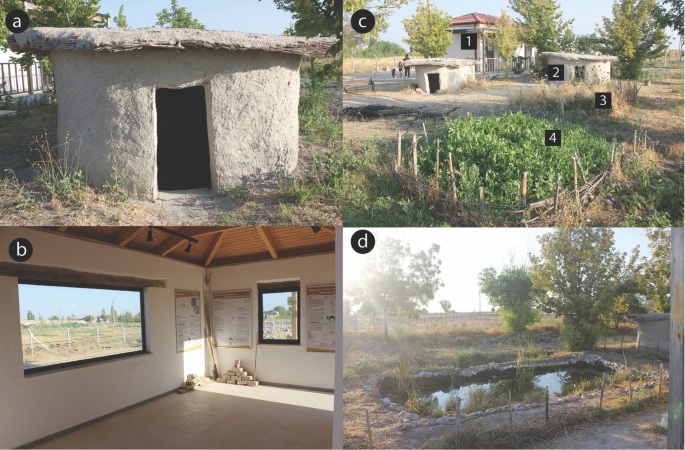
- Laura Dietrich et al. (2019). Cereal processing at Early Neolithic Göbekli Tepe, southeastern Turkey. PLOS ONE 14(5), e0215214. Abstract and selected methods, context and discussion sections; more than 7,000 tools, cereal processing and the feasting model. Storage absence concerns the study’s available evidence. Figure 7 includes a modern experimental replica in panel D. Return to the text ↑
- Marc Verhoeven (2025). Relationality, Immanence, Hierarchy: The Nature and Culture of Being(s) at Göbekli Tepe. Cambridge Archaeological Journal 35(3), 504–521. Abstract, introduction and Göbekli Tepe/iconography sections; an interpretive reading of relationships and hierarchy, not evidence for known names or a demonstrated doctrine. Return to the text ↑
- Oliver Dietrich, Manfred Heun, Jens Notroff, Klaus Schmidt & Martin Zarnkow (2012). The role of cult and feasting in the emergence of Neolithic communities. New evidence from Göbekli Tepe, south-eastern Turkey. Antiquity 86(333), 674–695. Publisher extract and metadata only; a reference for the history of the ritual and feasting model. The full text was not read; detailed food-evidence reasoning here comes from the open 2019 study. Return to the text ↑
- Steven Mithen, Amy Richardson & Bill Finlayson (2023). The flow of ideas: shared symbolism during the Neolithic emergence in Southwest Asia. WF16 and Göbekli Tepe. Antiquity 97(394), 829–849. Abstract, introduction and gathering-network sections; shared imagery and contact do not necessarily establish identical beliefs. Return to the text ↑
- Jens Notroff (2 October 2019). New publication: “Markers of Psychocultural Change”. German Archaeological Institute / The Tepe Telegrams. Chapter by Oliver Dietrich, Jens Notroff, Sebastian Walter & Laura Dietrich, in Handbook of Cognitive Archaeology (2019), 311–332. Publication announcement and the chapter abstract quoted there only, not the full chapter; proposed social hub and cohesion between groups. Return to the text ↑
Research history
Substantive changes are retained here. Minor copy edits remain in the internal operational log.
-
Substantive record update
Suggest a correction · Suggest a source for this record
Cite this record
IL Archive, «Göbekli Tepe: Temple or Social Centre?», Edition 2, https://ilarchive.com/en/studies/gobekli-tepe-temple-social-centre
Continue reading